
NEWS
Muse Tops the App Store, Then Hits Amazon’s Wall
Meta’s Muse hit No. 1 with 2.5 million downloads, then Amazon blocked the shopping agent while Shopify and PayPal opened checkout.

Amazon blocked Meta’s Muse shopping agent on Sunday night, 12 days after launch, even as the app sat at No. 1 on Apple’s free chart. Sensor Tower counted 2.5 million downloads in that short window, and the agent still cannot finish a cart on Amazon.com.
Shopify and PayPal spent the next two days wiring checkout to the same bot Amazon locked out. People will install an agent that shops. The store still decides whether it may.
Amazon Stopped Muse on Sunday Night
On Sept. 20, people who sent Muse to Amazon.com started hitting a popup: “Continued access by an unauthorized AI agent violates Amazon’s Conditions of Use, to which our customers have agreed.” Amazon said it had already asked Meta to pull Amazon out of the product, and Meta did not.
The two companies still share other business. Amazon goods have been for sale inside Facebook and Instagram since 2023, and Meta signed a multi-billion-dollar deal in April to run agent work on Amazon’s Graviton chips. The shopping door closed anyway.
WHY AMAZON CUT MUSE OFF
- No notice: Amazon said Meta never told it Muse would enter the store, scrape data, open accounts, or place orders.
- No name tag: Amazon said the agent does not identify itself in requests, which its Conditions of Use require of automated tools.
- Login details: Amazon said Muse appears to capture and store customer credentials and can open account pages and order history if a person asks it to.
Meta’s launch post says the opposite on the last point. Credentials go into secure storage, and Muse “has no visibility into people’s passwords or payment methods,” including passwords typed in the browser. Amazon is treating an unnamed third party walking through a logged-in account as the harm, whether or not the model can read the password string.
We think it’s fairly straightforward that third-party applications that offer to make purchases on behalf of customers from other businesses should operate openly and respect service provider decisions about whether or not to participate.
Amazon spokesperson, Sept. 20, 2026 statement
The same statement said agent apps “have the same obligations” as food-delivery and travel-booking tools, and that Amazon had “requested that Meta remove Amazon from the experience.” Asked about a lawsuit, Amazon declined to comment and said it was talking to Meta directly.
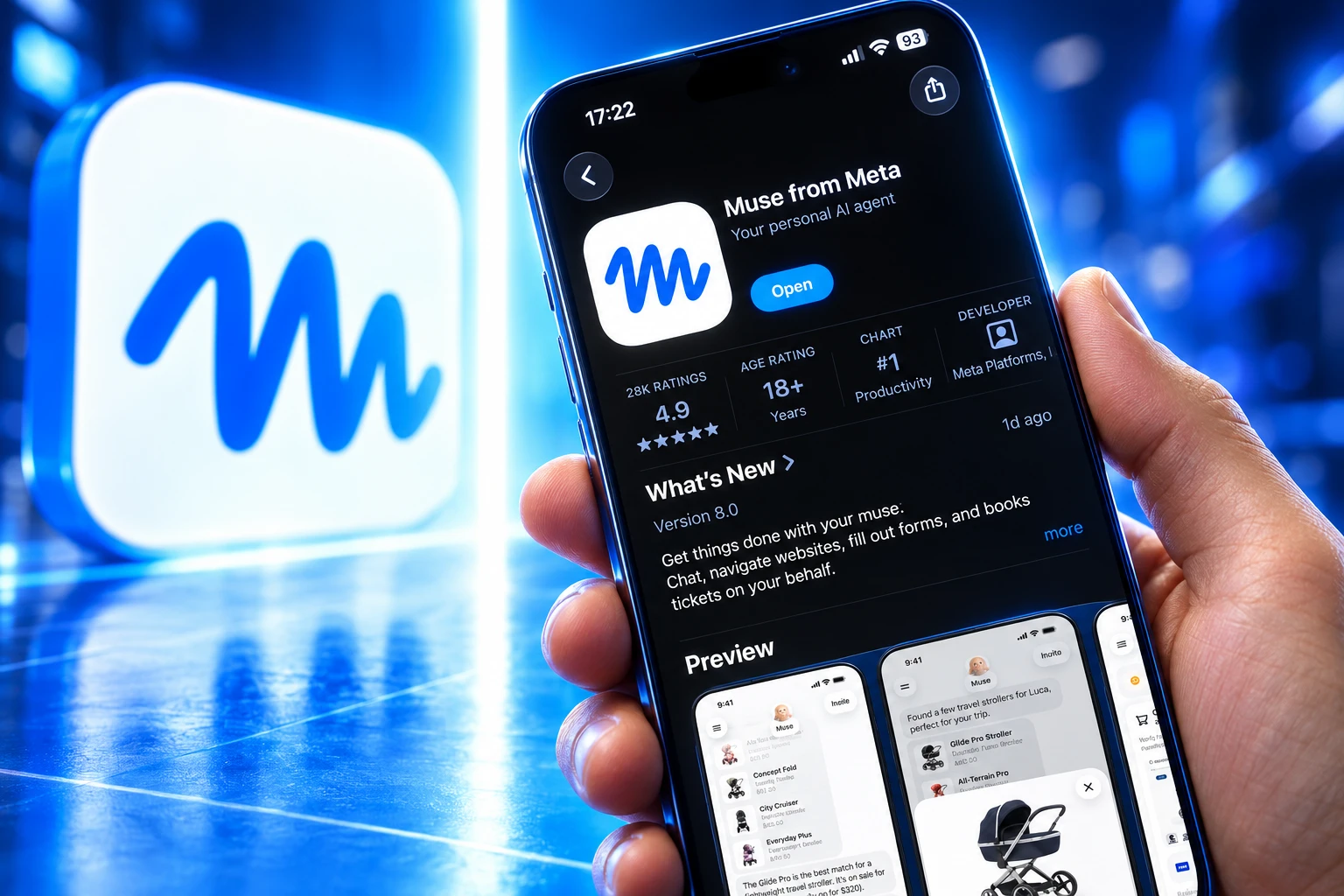
2.5 Million Downloads, and a Chart Peak
Meta unveiled Muse on Sept. 8 for adults in the United States, on iPhone, Android, the web, and WhatsApp. A Mac app followed on Sept. 17. By Sept. 18, ten days after launch, it was the top free iPhone app in the United States, ahead of ChatGPT, and it also led free downloads on Google Play.
Chart position is a daily sprint, not a lifetime total. In the same window Sensor Tower gave for Muse’s 2.5 million installs, ChatGPT still logged 3.1 million and Anthropic’s Claude logged 200,000. Muse passed ChatGPT on Apple’s free list with fewer cumulative downloads.
THE TWO-WEEK DOWNLOAD TALLY
| App | Downloads, same window | Free chart |
|---|---|---|
| Meta Muse | 2.5 million | No. 1 on Apple and Google Play |
| ChatGPT | 3.1 million | Behind Muse on Apple’s free list |
| Claude | 200,000 | Far behind both |
Neil Saunders, managing director at GlobalData Retail, called the rush “an important part of the journey for AI and consumers” and stopped short of a tipping point. John Mercer, head of global research at Coresight, said the useful part of a shopping agent is the deal hunt, not the chat.
An IBM Institute for Business Value survey with the National Retail Federation, covering more than 18,000 consumers in 23 countries, found that 41 percent use AI to research products and 31 percent use it to hunt for deals. Another 33 percent use it to read reviews, and 45 percent turn to AI somewhere in a buying trip, while 72 percent still shop in physical stores. Coresight, in a survey of more than 1,000 consumers, found 30 percent would use an AI tool to compare holiday prices and 30 percent would use one to find promo codes on gifts.
How Muse Checks Out
Meta is selling a personal AI agent that does the work, not a better search box. Each person gets a Muse Secure VM, a dedicated cloud computer with its own browser. A second process on that machine, Sentinel, has to approve anything Muse sends to the internet, and the person is asked before a purchase or an email goes out.
If a service has a public API, Muse can connect with logins the person provides. If it does not, Meta says the agent can use the site through a browser the way a person would. That browser path is what Amazon is now treating as unauthorized access.
Checkout at launch ran through Link by Stripe, which issues a one-time card so the real card never sits in the agent. Meta said Muse is the first AI agent covered by Link’s purchase protections for agents, including damaged or lost items, price drops, and no-fee returns on eligible buys. Shop Pay was listed as coming soon on day one.
The app is free for most use. Power is $20 a month and Maximum is $100 a month. Alexandr Wang, Meta’s chief AI officer, said the free tier should cover most people and that the paid plans exist to cover compute for heavy users. There is no advertising inside Muse. Wang said Meta is looking at commerce as a way to make money from it.
Later this year Meta says it will ship Muse Confidential VM, a version encrypted with a key only the person holds, so even Meta cannot read the workspace. AI glasses support is still listed as coming. Early users were already sending it after insurance policies, discount codes, and grocery carts before Amazon’s popup appeared.
The Brand Opt-Out Muse Never Got
Amazon is not anti-agent. It is anti-agent it does not control. Alexa for Shopping, the assistant that folded in the old Rufus chatbot, researches and recommends inside Amazon. A separate tool, Buy for Me shopping on brand sites, sends Amazon’s own agent onto other retailers’ pages when Amazon does not sell the item.
Amazon’s answer to the double standard is process. Buy for Me identifies itself, Amazon says, and brands can opt out. Muse, in Amazon’s telling, does neither. Independent shops have spent a year arguing the other way, that Buy for Me listed them first and made them email branddirect@amazon.com to get out. The rule Amazon is enforcing against Meta is the rule it wants other people to accept: the store picks who may act.
Amazon has also moved to keep shopping agents from Google and OpenAI off its catalog, the same posture it took with Muse. A bot that skips the results page also skips the sponsored slot. Amazon’s advertising business brought in more than $68 billion last year, a figure that depends on people browsing its pages, not on a silent agent grabbing the cheapest SKU and leaving.
Shopify and PayPal Said Yes
The day after the Amazon cutoff, Shopify chief executive Tobi Lütke wrote that the company was partnering deeply with Muse to enable agentic checkout with Shop Pay on all Shopify stores. Mark Zuckerberg posted the same deal from Meta’s side and said more partnerships were coming.
Teaming up with Shopify to make shopping and checkout easier in Muse. Shoppers find more. Shops sell more. More partnerships like this coming soon. https://t.co/ccak4J7IIb
— Mark Zuckerberg (@finkd) September 21, 2026
PayPal followed on Sept. 22. It said customers can shop and check out with Muse across PayPal merchants worldwide. Wang, in his own post on the Shopify deal, said Meta wants “Musers” to reach a wide range of stores and “the absolute perfect products.” The open-rail bet is that the agent becomes the storefront and Shop Pay or PayPal remains the till.
Other big merchants are taking that bet without waiting for Amazon. Walmart is working with Google and OpenAI so Walmart goods show up in those companies’ shopping agents, Walmart Connect senior vice president Ryan Mayward said on Sept. 9, even as Walmart builds its own agent, Sparky. Target chief executive Michael Fiddelke said in August that traffic from outside AI platforms was 3.5 times higher than a year earlier.
The Ninth Circuit Already Cut Amazon Back
Amazon has been here with a smaller company, and a court has already narrowed the hacking theory. The Muse popup cites contract, not computer fraud, which matches the hole the appeals court left open.
AMAZON’S YEAR OF AGENT FIGHTS
- November 2025: Sues Perplexity over the Comet browser, saying its agents shopped Amazon through customer accounts and hid as Chrome.
- March 2026: Wins a preliminary order blocking those agents, with a district judge finding strong evidence of access without Amazon’s permission.
- August 4, 2026: The Ninth Circuit lifts the order, holding that the user, not the AI company, is the one accessing Amazon’s computers under federal anti-hacking law.
- September 10, 2026: The appeals court denies Amazon’s request for a rehearing, two days after Muse launches.
- September 21, 2026: Amazon amends the Perplexity case with a contract claim built on the same Conditions of Use it used to stop Muse the night before.
If an agent rides a person’s own IP address and cookies, a store can still throw a popup when it recognizes the Muse browser. It has a harder time proving the click was not the customer. That is why Amazon is now arguing terms of use, the agreement the human shopper already clicked, rather than a clean hacking claim against Meta.
Who Keeps the Customer When Agents Buy?
Coveo’s 2026 Commerce Relevance Report found that only 16 percent of shoppers are comfortable letting an AI assistant find and purchase products on their behalf. Saunders said people remain “a little bit nervous about allowing AI agents to do the purchasing on their behalf.” Research is easy to hand over. The card is not.
HOW FAR SHOPPERS WILL GO
- Find and buy: 16 percent are comfortable letting an assistant find and purchase, per Coveo’s 2026 Commerce Relevance Report.
- Holiday help: 30 percent would use AI to compare holiday prices, and 30 percent would use it for gift promo codes, per Coresight.
- Still in stores: 72 percent of consumers in the IBM-NRF survey still shop in physical stores even as 45 percent use AI on the buying trip.
Chris Jones, managing director at PSE Consulting, put the fight in one question: who owns origination and the customer relationship, and who simply fulfills the order. An independent agent that compares across the market is what users say they want. The largest store would rather keep that relationship, and the ad impression that comes with it.
Meta shares jumped more than 11 percent on Monday, Sept. 21, as Muse sat at the top of the free charts and Amazon’s popup was already live. Investors priced the install spike faster than the missing Amazon cart. The next test is not another App Store screenshot. It is whether Muse can complete the buy on the rails that said yes, and whether Amazon’s talks with Meta end in a deal, a quieter block, or the same contract fight it just filed against Perplexity.

Final Fantasy Resonance Turns a Dead Gacha Into HD-2D

PHP2Shell Forced Sites Offline While Exploits Stalled

Kindle+ Folds AI Audiobooks Into the Page-Read Fund

Chip Stocks Fall as the Bond Rally Cheapens AI Spend

Comcast’s Record Odyssey Quarter Doubles as the Exit

Microsoft 365 Auth Fault Took Down Exchange and Teams

Xbox Caps Game Pass Cloud Gaming at 15 Hours

OpenClaw 2.0 Ships a Team Workplace With Host-Trust Defaults

OpenAI Unveils GPT-6 Astra With a Critical Cyber Label

Diesel Breaks Its Record as the White House Claims Credit
-
 NEWS2 months ago
Microsoft 365 Auth Fault Took Down Exchange and Teams
-
 GAMING2 months ago
Xbox Caps Game Pass Cloud Gaming at 15 Hours
-
 NEWS2 months ago
OpenAI Unveils GPT-6 Astra With a Critical Cyber Label
-
 NEWS2 months ago
OpenClaw 2.0 Ships a Team Workplace With Host-Trust Defaults
-
 BUSINESS2 months ago
Diesel Breaks Its Record as the White House Claims Credit
-

 LIFESTYLE2 months ago
Squishy Dumpling Toys Recalled After Hiding Illegal Water Beads
-

 BUSINESS2 months ago
ChargePoint Stock Rally Prices Wilmer’s Three-Year Cash Plan
-

 AUTO2 months ago
Tesla Puts Its Wheel-Free Cybercab on Austin Streets