
GAMING
Miami-Dade Took $975,000 to Put Vice City on the Heat
Miami-Dade collected $975,000 for a Vice City roof on the Heat after the sheriff objected, signing under the $1 million line that skips a board vote.

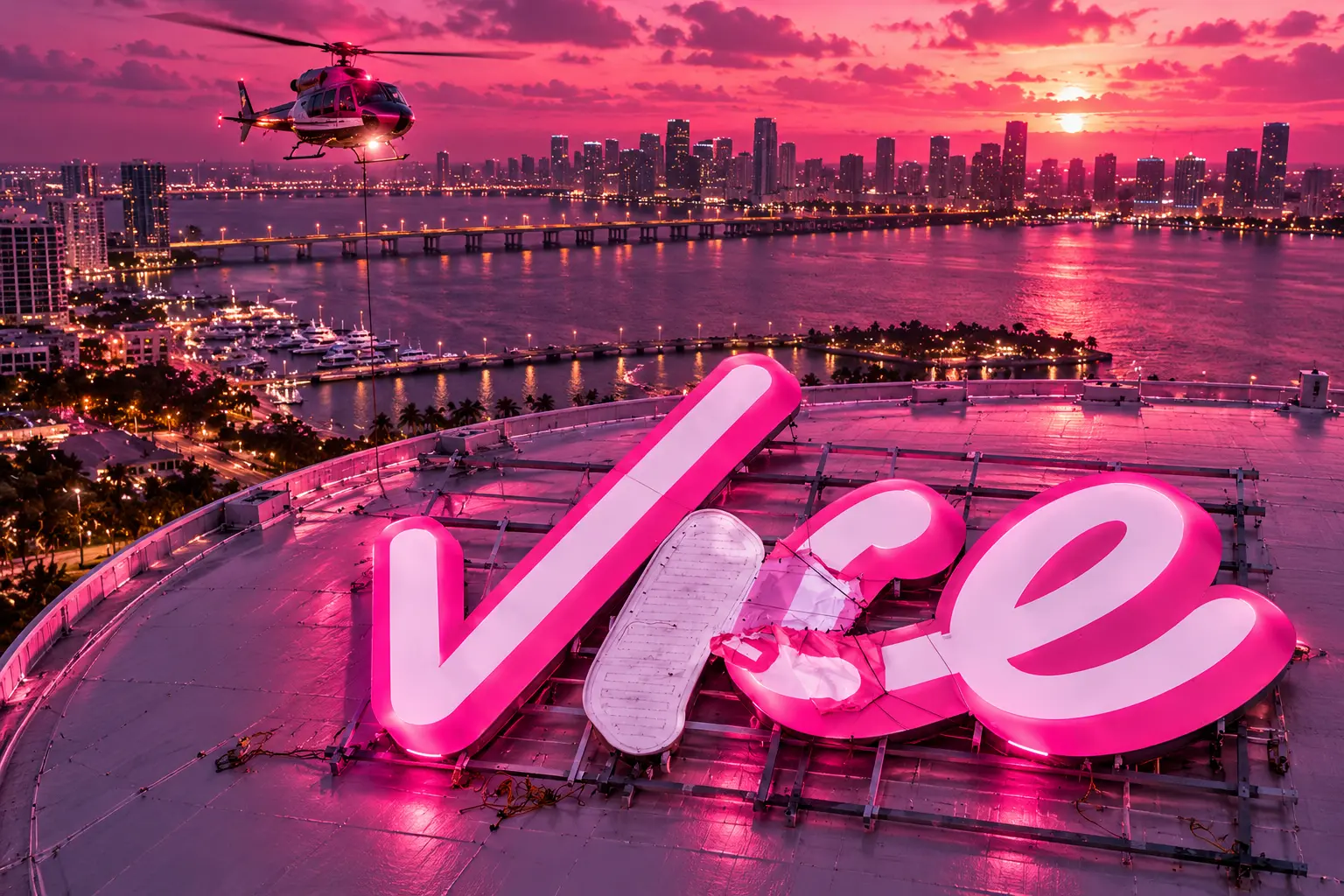
Miami-Dade County collected $975,000 from Rockstar Games to plant a Welcome to Vice City sign on the Miami Heat’s roof. A helicopter set the pink-and-white letters on Kaseya Center on Tuesday, September 22.
The county owns the arena. The sheriff had already told that same county not to rent the Vice City name. Mayor Daniella Levine Cava signed the deal on September 10, under the $1 million cap that lets her skip a board vote.
Miami-Dade Collected $975,000 for the Heat’s Roof
Those letters now sit on the most watched building the county holds downtown, aimed at planes inbound to Miami International Airport and at anyone with a window seat over Biscayne Bay. Rockstar is selling a return to Vice City, the pastel crime town it first hung on Miami in 2002. The county is selling the roof.
Christopher Hudtwalcker, Levine Cava’s chief of staff, ran the talks with Rockstar and the Heat. He told commissioners the office did not want to miss the cash. “It’s the biggest cultural phenomenon of the year,” he said, a little after 1:30 a.m. on September 18, during an overnight budget hearing.
The mayor’s office sat on the contract until the afternoon the letters went up, and only after a September 11 public-records request. Commissioners spent that Friday session learning they had already been cut out. The gaming posts that spread the helicopter video treated the $975,000 as a trailer budget. They barely mentioned that the county’s own sheriff had tried to kill the campaign.
Aerial photos from Wednesday, September 23, already show the letter i missing part of its wrap, with the loose skin folded onto the c. The first stills that moved the night before were mockups. The real job finished Tuesday afternoon.
The Mayor Signed Under the Board’s Radar
Levine Cava used her delegated power to sign contracts under $1 million without the Board of County Commissioners. The Kaseya deal was built to fit. Commissioner Oliver Gilbert III heard that and asked the obvious next question: how many more slices?
“I do not agree that you can do $900,000 for this, and $700,000 for this, and $400,000 for this, and because you did different agreements, then you don’t have to come before the board,” Gilbert said. Hudtwalcker had already told the room that other county properties were in talks for more signs.
Commissioner Natalie Milian Orbis said she wanted the file before the motion. “I would’ve appreciated more information,” she said, noting that the airport-as-Vice-City pitch, a wrapped Metromover train, and themed manhole covers had turned up in public reporting while the board was still in the dark.
THE PATH TO THE ROOF
- June 29, 2026: County officials submit a pitch deck to Rockstar offering airport, port, rail, and street stunts.
- September 3, 2026: Sheriff Rosie Cordero-Stutz and Commissioner Juan Carlos Bermudez release a joint statement opposing the campaign.
- September 10, 2026: The mayor signs the Kaseya agreement. The same day, Miami Beach’s commission votes 4-3 to negotiate its own deal.
- September 18, 2026: Hudtwalcker briefs commissioners at about 1:30 a.m. Bermudez tries to send the money to the Sheriff’s Office; the motion is pulled after the administration promises a fuller briefing.
- September 22, 2026: A helicopter sets the letters. The county releases the contract the same afternoon.
The papers give Rockstar an October 15 install deadline, with a right to walk if the date slips. The helicopter beat that clause by 23 days. October 15 is also the date Miami and Miami Beach marked for their own ads to start, so the roof is the piece that landed first.
Parcel B or the Sheriff’s Office
The fight after the signature was not only about taste. It was about who pockets the check.
Levine Cava’s office wants the $975,000 to go toward a long-stalled park on Parcel B, also called Dan Paul Plaza, the county waterfront lot behind the arena. Bermudez wants it in the Sheriff’s Office, which was looking at a budget hole in the same hearing.
“It’s a game where police officers are killed. Pedestrians are run over,” Bermudez said in that overnight session. “And we’re going to make money from a video game that glorifies it.” He added, “Maybe they’ll make us pedestrians,” and argued the county had spent years crawling out of a “Paradise Lost” image and should not rent it back.
Keon Hardemon, the District 3 commissioner whose map includes Kaseya Center, had been briefed and backed the deal. He plays Grand Theft Auto. “If you shoot at a police officer, you better believe it’s gonna be a ‘five-star crime,’ and all the police officers in Miami-Dade County are coming after you,” he said. “Look, the game is as realistic as you make it.”
Why the County’s Top Cop Said No
Cordero-Stutz did not wait for the letters. On September 3 she and Bermudez put a joint call to reject the Vice City campaign on the county’s own site, including the idea of dressing Miami International Airport as Vice City Airport.
Grand Theft Auto is a video game franchise built around criminal activity. Its fictional world includes murder, robbery, drug trafficking, carjacking, violence against law enforcement, and other conduct that the men and women of the Miami-Dade Sheriff’s Office work every single day to prevent.
Rosie Cordero-Stutz, Miami-Dade County Sheriff, Sept. 3 statement
She also said, “Miami-Dade County is not Vice City.” Bermudez, on the same release, said he still could not believe the county would even consider tagging MIA as Vice City Airport after decades of selling itself as a place for tourists and capital, not a crime map.
Carlos Suarez, a spokesperson for the mayor, had said in August that staff had held conversations with Rockstar, that nothing was approved yet, and that any idea would need a review, while calling the game a chance to raise money and put the county in front of a huge audience. The roof did not go through that board review. It went through the mayor’s under-$1 million pen.
Three Cities Sold Three Different Versions of Vice City
The county roof is the loud piece. It is not the only invoice. In the same two-week stretch, the City of Miami and the City of Miami Beach cut their own paths, each with a different product, a different price, and a different fight.
WHO SOLD WHAT
| Government | What Rockstar gets | Money | The fight |
|---|---|---|---|
| Miami-Dade County | Welcome to Vice City letters on the Kaseya Center roof | $975,000 to the county | Sheriff and Bermudez opposed; no board vote |
| City of Miami | Larger downtown banners, no guns, a 56-day cap | Permit fees aimed at an Overtown trail | Commissioner Christine King first worried, then backed it |
| City of Miami Beach | VI and Vice City on Boucher Brothers chairs and umbrellas | About $3 million expected | Passed 4-3 on September 10 |
Miami Beach’s yes votes came from Tanya Katzoff Bhatt, Laura Dominguez, Joseph Magazine, and Monica Matteo-Salinas. Mayor Steven Meiner and Commissioners Alex Fernandez and David Suarez voted no. Suarez played footage of a police car being rolled and an AR-15 getaway and said he did not want the city’s brand on that. Matteo-Salinas’s answer was blunt: “We’re not going to be doing live action GTA in the city. We’re not giving away pistols and cocaine to people.”
Bhatt told the room overall benefits could run closer to $4 million, a higher figure than the about $3 million commissioners used as the working take. The Beach campaign is set to start October 15. Dominguez said the VI and Vice City marks come off by the end of the year.
The City of Miami’s file is a zoning workaround, not a slogan on city hall. Ordinance 19783 lets Take-Two Interactive Software seek larger downtown banners for the GTA VI release for no more than 56 days in a row, starting no earlier than October 15 and ending no later than December 31. King said no city parks or city hall would carry the ads, and that permit money would help pay for the Reverend Edward T. Graham Heritage Trail in Overtown.
The Airport Pitch Still Sitting in a Drawer
A public-records pull turned up the June 29 deck county staff sent to Rockstar. Carlos Suarez confirmed the talks. The roof is what closed. The rest of the menu is still a menu.
WHAT THE COUNTY OFFERED ROCKSTAR
- Miami International Airport: An “immersive arrival experience,” with a display aircraft wrapped in Vice City marks, themed baggage claim, luggage carts, tags, and gate copy that would greet people as if they had landed in Vice City.
- Metromover and Metrorail: Cars wrapped in Vice City colors and station signs at the Stephen P. Clark Government Center, Brickell, and Bayfront Park.
- Streets: Artist-designed utility-box wraps and custom manhole covers in downtown and Brickell, dressed as a pretend municipal logo.
- PortMiami Terminal J: A large Port Gellhorn-style mural built from cargo boxes, cranes, and the working waterfront.
- Rickenbacker Beach and Tropical Park: A bay-view photo piece, plus a “family-appropriate” car-culture day with classic cars, lowriders, DJs, and branded photo spots.
That has not been approved. Hudtwalcker still talked about more county sites. Gilbert’s stacking warning sits over those talks: another round of sub-$1 million contracts would again miss the dais. Bermudez’s withdrawn motion means the board has not yet locked where even the first $975,000 lands.
October 21 Puts the Sign on ESPN
Rockstar Games set Grand Theft Auto VI for November 19, a Thursday, on PlayStation 5 and Xbox Series X|S, after moving the date in 2025 to buy finish time. Digital preload starts November 12.
The Heat’s own schedule now does some of the media buying. The club’s home opener against the Minnesota Timberwolves is Wednesday, October 21, at 7:30 p.m. at Kaseya Center, on ESPN. That is 28 days after the letters went on, and 29 days before the game ships. Any aerial shot of the building that night carries Welcome to Vice City into a national NBA window for free.
The contract ties the sign to a year after it went up and to the Heat’s last 2026-27 home game, listed for April 11, 2027. Read as the later of those two dates, the letters can outlast launch, outlast the Beach umbrellas, and still be on the roof when the Heat close the regular season. The papers do not require Rockstar to cut a trailer into that opener. They do leave the greeting in the shot if a camera tilts up.
The i is already shedding its wrap. The sheriff’s September 3 statement is still on the county site. The park behind the arena is still a lot. And on October 21, ESPN will be in the building the county just rented to Vice City.

Final Fantasy Resonance Turns a Dead Gacha Into HD-2D

PHP2Shell Forced Sites Offline While Exploits Stalled

Kindle+ Folds AI Audiobooks Into the Page-Read Fund

Chip Stocks Fall as the Bond Rally Cheapens AI Spend

Comcast’s Record Odyssey Quarter Doubles as the Exit

Microsoft 365 Auth Fault Took Down Exchange and Teams

Xbox Caps Game Pass Cloud Gaming at 15 Hours

OpenClaw 2.0 Ships a Team Workplace With Host-Trust Defaults

OpenAI Unveils GPT-6 Astra With a Critical Cyber Label

Diesel Breaks Its Record as the White House Claims Credit
-
 NEWS2 months ago
Microsoft 365 Auth Fault Took Down Exchange and Teams
-
 GAMING2 months ago
Xbox Caps Game Pass Cloud Gaming at 15 Hours
-
 NEWS2 months ago
OpenAI Unveils GPT-6 Astra With a Critical Cyber Label
-
 NEWS2 months ago
OpenClaw 2.0 Ships a Team Workplace With Host-Trust Defaults
-
 BUSINESS2 months ago
Diesel Breaks Its Record as the White House Claims Credit
-

 LIFESTYLE2 months ago
Squishy Dumpling Toys Recalled After Hiding Illegal Water Beads
-

 BUSINESS2 months ago
ChargePoint Stock Rally Prices Wilmer’s Three-Year Cash Plan
-

 AUTO2 months ago
Tesla Puts Its Wheel-Free Cybercab on Austin Streets