
NEWS
Meta Bets $1 Million on Hands-Only VR Glasses Apps
Meta is offering $1 million for seated, hands-only apps after cutting last year’s Start contest pool and shipping VR Glasses without controllers.

Meta opened a $1 million developer contest on September 24, 2026 for apps that work with bare hands on hardware that will not go on sale until spring 2027. The glasses will not include controllers in the box.
The brief is seated play, puzzle and lean-back software, and a full pass without pairing Touch Plus. Last year’s version of the same Start contest paid $1.5 million for a looser Quest assignment.
A $1 Million Bet on Controller-Free Software
The eight-week Meta VR Start contest runs through November 18, 2026, and winners are due on or around December 11. It is open only to members of the Meta VR Start Program, who may enter as a solo builder, a team, or a company, with a hard cap of one submission per person serving as representative.
Tracks are entertainment, gaming, and productivity. Builders can ship a new project conceived after September 24, or a significant update to something that already exists. Unity, Unreal, native engines, Android, and the web are all allowed, and the same build can target Meta VR Glasses, Meta Quest, or both, because the glasses run the Quest operating system and store.
Meta’s own pitch to small studios is visibility, not just the check. Winning projects get a developer-blog writeup, an end-of-contest livestream, and category posts on Meta’s social channels, which the company said helps a team without a marketing budget point to something concrete when it pitches the next project.
The Meta VR Start Developer Competition is open 🏆
You have 8 weeks to build for Meta VR Glasses, Meta Quest or both, and compete for a share of $1M in prizes across entertainment, gaming and productivity. Submission deadline closes Nov 18. Enter here 👉 https://t.co/esyOZfWGPI pic.twitter.com/k7if0RUiye— Meta VR Developers (@MetaVRDevs) September 24, 2026
Entrants must be 18 and the age of majority where they live. Residents of Brazil and Quebec are out, as are people in places under comprehensive U.S. sanctions. Government officials and Meta employees working the contest are barred. The representative for a winning team is the person who receives the money.
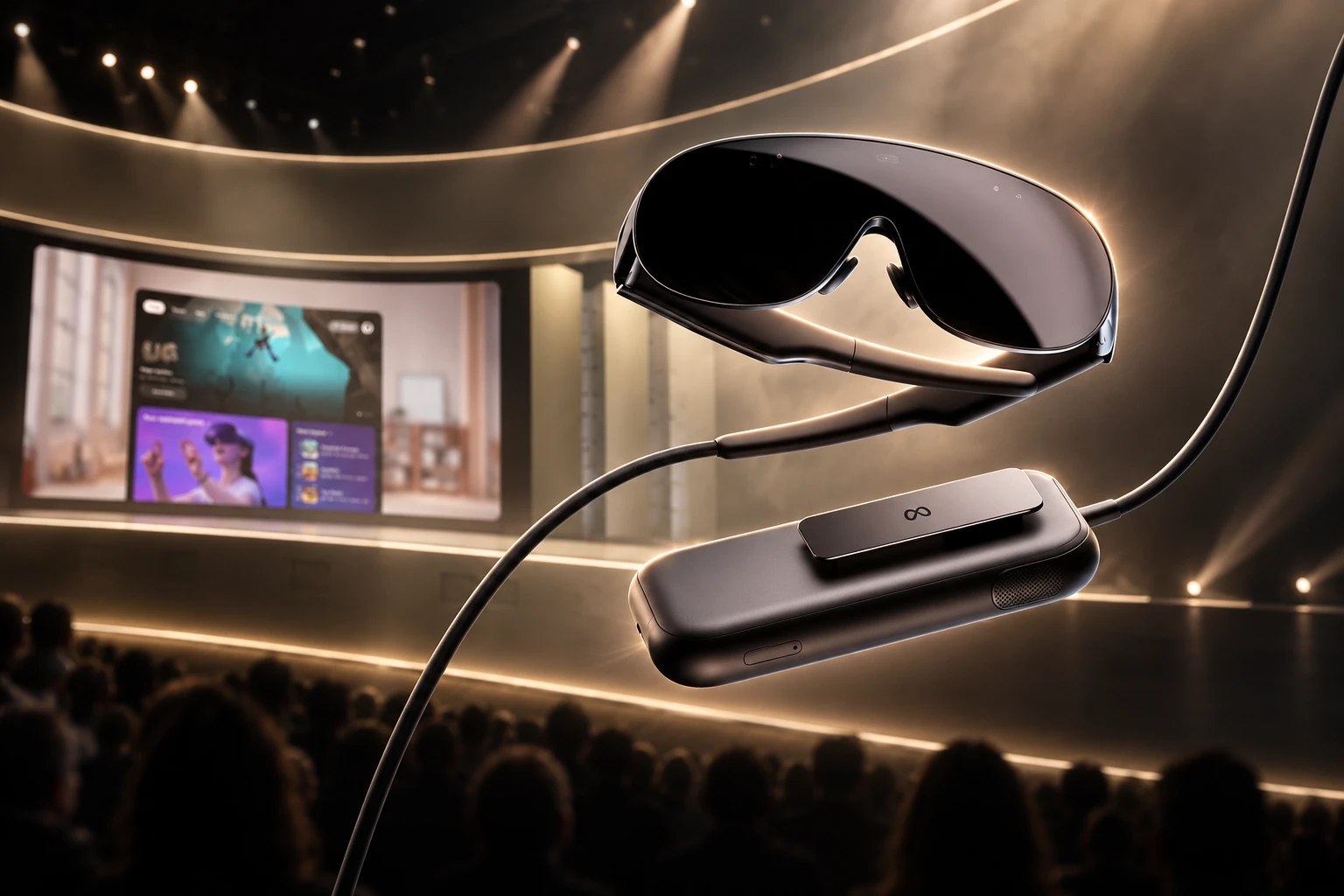
The Glasses Arrive Without Controllers
Meta VR Glasses were unveiled on September 23, 2026 as a two-part system: about 100 grams on the face, with sensors and displays in the frames, and a pocket puck on an optical tether holding compute, battery, and storage. Meta said they are five times lighter than Meta Quest 3, use micro-OLED panels at 37 pixels per degree, and go on sale in spring 2027 for $1,299.99.
Input is eyes, hands, and voice. “No controllers needed,” the product announcement said. Touch Plus still works, and a Quest 3 or Quest 3S pair can bind to the glasses, but nothing ships in the carton. Qualcomm’s Snapdragon Reality Elite chip sits in the puck. Battery life is listed at up to three hours of high-resolution media playback, with 45W fast charging.
The catalog Meta wants on day one is already being filtered for that setup. The company said it will have more than 75 games at launch that can be played solely with hand gestures, plus the rest of the Quest library for anyone who buys or already owns sticks. Xbox Cloud Gaming is a separate path that still wants a Bluetooth gamepad.
Field of view is the other constraint the contest is dancing around. Meta told developers the glasses see roughly 70 degrees by 66, against about 110 by 96 on Quest 3, so interface chrome parked at the far edge of a Quest layout can fall off the glasses. Seated puzzles and lean-back video lose less from that crop than a room-scale shooter does.
A Smaller Prize Pool Than 2025
This is the second Start developer contest. The 2025 Meta Horizon Start Developer Competition, which ran November 5 through December 9, put $1.5 million across 32 awards and drew more than 2,900 developers, who filed more than 650 new or heavily updated projects. Hands were a special, not a gate: three “Best Implementation of Hand Interactions” awards paid $50,000 each.
The casual-game winner last December was Tiny Golf by BRAINZ GAMIFY, mixed-reality mini golf played with a pinch. That is the exact interaction model this year’s rules now demand of every entry, while the cash on the table dropped by $500,000 and the award count fell from 32 to 20.
START CONTEST, YEAR OVER YEAR
| Term | 2025 Horizon Start | 2026 VR Start |
|---|---|---|
| Prize pool | $1.5 million | $1 million |
| Awards | 32 | 20 |
| Length | Five weeks | Eight weeks |
| Window | Nov 5-Dec 9, 2025 | Sep 24-Nov 18, 2026 |
| Hands | Special award, $50,000 x 3 | Required end to end |
| Target hardware | Quest, already shipping | Quest plus unreleased VR Glasses |
The extra three weeks this year are the concession. The harder brief is the point. Last year’s money already bought pinch-first toys; this year’s money is supposed to fill a store shelf for people who never take the controllers out of another box.
Why Hand Tracking Now Decides Store Reach
On VR Glasses, hand tracking is how most buyers will launch an app, because Meta does not expect them to own sticks. The company told developers that Touch Plus is supported, that locomotion and gun games still fit those controllers, and that titles which speak both languages will reach the widest set of players across glasses and Quest.
Eyes and hands are the primary inputs on VR Glasses, and though Touch Plus controllers are supported, we expect most customers not to use them.
Meta Horizon OS Developers, VR Glasses recap, September 24, 2026
That expectation is now a ranking rule. The Store ranks controller-free titles first for glasses owners who never pair Touch Plus, including apps that support both hands and controllers. People who do own sticks still see the full catalog. Supporting hands on an existing Quest title is, in Meta’s wording, a direct line to a new audience.
Meta Horizon Developers put the same instruction on X the afternoon the contest opened: eyes, hands, and voice are how you interact, and the glasses ship without controllers. A $1,299.99 headset that omits the sticks also omits the library those sticks unlocked, unless someone rebuilds the front door.
Games Must Work in an Airplane Seat
The mandatory test is blunt. Official rules ask whether someone can finish the entire experience without ever pairing a controller. Controller support is welcome. It is not enough.
THE HANDS-FIRST BRIEF
- Hands end to end: Every beat of the app has to be completable with hands, with controllers optional rather than assumed.
- Seated, 2-foot radius: Meta suggests the airplane-seat test, stationary use, limited room-scale, and no large physical movement.
- Ten-minute loop: Fast cold start, clean pause and resume, and something satisfying in 10 minutes or less.
- No wrappers: The core has to be built for the contest, not bolted onto an existing platform or service.
- Gaming genres named: Puzzle, strategy, casual, social, and narrative, the set that still works in a chair.
Entertainment is lean-back media: spatial cinema, interactive video, music visualization, immersive storytelling, spatial audio, companion apps. Productivity is multi-panel workspaces, task tools, creative apps, and habits tied to a morning, a commute, or a wind-down. Both tracks still require hands-first implementation.
A “significant update” can be new hand interactions, multiplayer, a mixed-reality mode, or a user-generated-content tool shipped during the window. Bug fixes, a new color scheme, and a performance pass with no user-facing feature do not count. Meta can reassign a project’s track or its new-versus-adapted division after you submit.
What the $1 Million Prize Pool Buys
The pool is 20 cash prizes, not a single jackpot. Entertainment and gaming still top out at $100,000. Productivity, the track closest to the “workspace in your bag” pitch for the glasses, tops out at $70,000. That split is in the 20 cash prizes in the official rules, not in the broader language on the kickoff blog that grouped every track at $100,000.
THE MAIN TRACK AWARDS
| Award | Winner | Runner-up |
|---|---|---|
| Best New Entertainment | $100,000 | $50,000 |
| Best Adapted Entertainment | $100,000 | $50,000 |
| Best New Gaming | $100,000 | $50,000 |
| Best Adapted Gaming | $100,000 | $50,000 |
| Best New Productivity | $70,000 | $35,000 |
| Best Adapted Productivity | $70,000 | $35,000 |
Six special awards pay $25,000 each: Best Social and Multiplayer Experience, Best Agentic Interaction, Best Reason to Come Back, Best First Five Minutes, Best Accessibility Forward Experience, and Boldest Original Concept. Two Judge’s Choice awards pay $20,000 apiece for entries that do not sit cleanly in one track. Those 12 track prizes plus eight specials are the 20 checks, and they add up to $1 million.
Best First Five Minutes maps onto the 10-minute guideline. Best Agentic Interaction maps onto the coding-agent stack Meta has been shipping since last year’s contest, including the Meta VR CLI that hooks an agent to docs, devices, and the asset library. The company told teams to scope to one mechanic and finish it, because judges play the build they are handed, not the roadmap in the readme.
Winners Land Months Before the Hardware
The glasses do not have to exist for this contest to run. The v207 SDKs are out. Meta XR Simulator for Unity and Unreal, Meta Spatial Simulator, and the Immersive Web Emulator all expose a glasses profile, and XR Simulator can track hands through a laptop camera. Quest 3 and Quest 3S remain the physical stand-ins, with gaze mocked from head direction if needed.
THE BUILD CALENDAR
- September 24, 2026: Entry period opens at 10:00 a.m. PT.
- November 18, 2026: Submissions close at 12:00 p.m. PT.
- November 18 to December 9, 2026: Judging window, on or around those dates.
- December 11, 2026: Winners announced, on or around this date.
- Spring 2027: Meta VR Glasses go on sale at $1,299.99, with no ship day set.
Whatever wins in December can go onto Quest immediately. The glasses inherit that store months later, if the team actually ships. Meta’s line at the close of the kickoff post was that the next eight weeks help define what people can do with the glasses when they arrive. The $1 million is the public wager that enough of those builds will be playable in a chair, with empty hands, to make a $1,299.99 headset that omits controllers feel stocked on day one.

Final Fantasy Resonance Turns a Dead Gacha Into HD-2D

PHP2Shell Forced Sites Offline While Exploits Stalled

Kindle+ Folds AI Audiobooks Into the Page-Read Fund

Chip Stocks Fall as the Bond Rally Cheapens AI Spend

Comcast’s Record Odyssey Quarter Doubles as the Exit

Microsoft 365 Auth Fault Took Down Exchange and Teams

Xbox Caps Game Pass Cloud Gaming at 15 Hours

OpenClaw 2.0 Ships a Team Workplace With Host-Trust Defaults

OpenAI Unveils GPT-6 Astra With a Critical Cyber Label

Diesel Breaks Its Record as the White House Claims Credit
-
 NEWS2 months ago
Microsoft 365 Auth Fault Took Down Exchange and Teams
-
 GAMING2 months ago
Xbox Caps Game Pass Cloud Gaming at 15 Hours
-
 NEWS2 months ago
OpenAI Unveils GPT-6 Astra With a Critical Cyber Label
-
 NEWS2 months ago
OpenClaw 2.0 Ships a Team Workplace With Host-Trust Defaults
-
 BUSINESS2 months ago
Diesel Breaks Its Record as the White House Claims Credit
-

 LIFESTYLE2 months ago
Squishy Dumpling Toys Recalled After Hiding Illegal Water Beads
-

 BUSINESS2 months ago
ChargePoint Stock Rally Prices Wilmer’s Three-Year Cash Plan
-

 AUTO2 months ago
Tesla Puts Its Wheel-Free Cybercab on Austin Streets