
BUSINESS
Japan’s Nikkei Tags 70,000 on a Thin Asia Tape
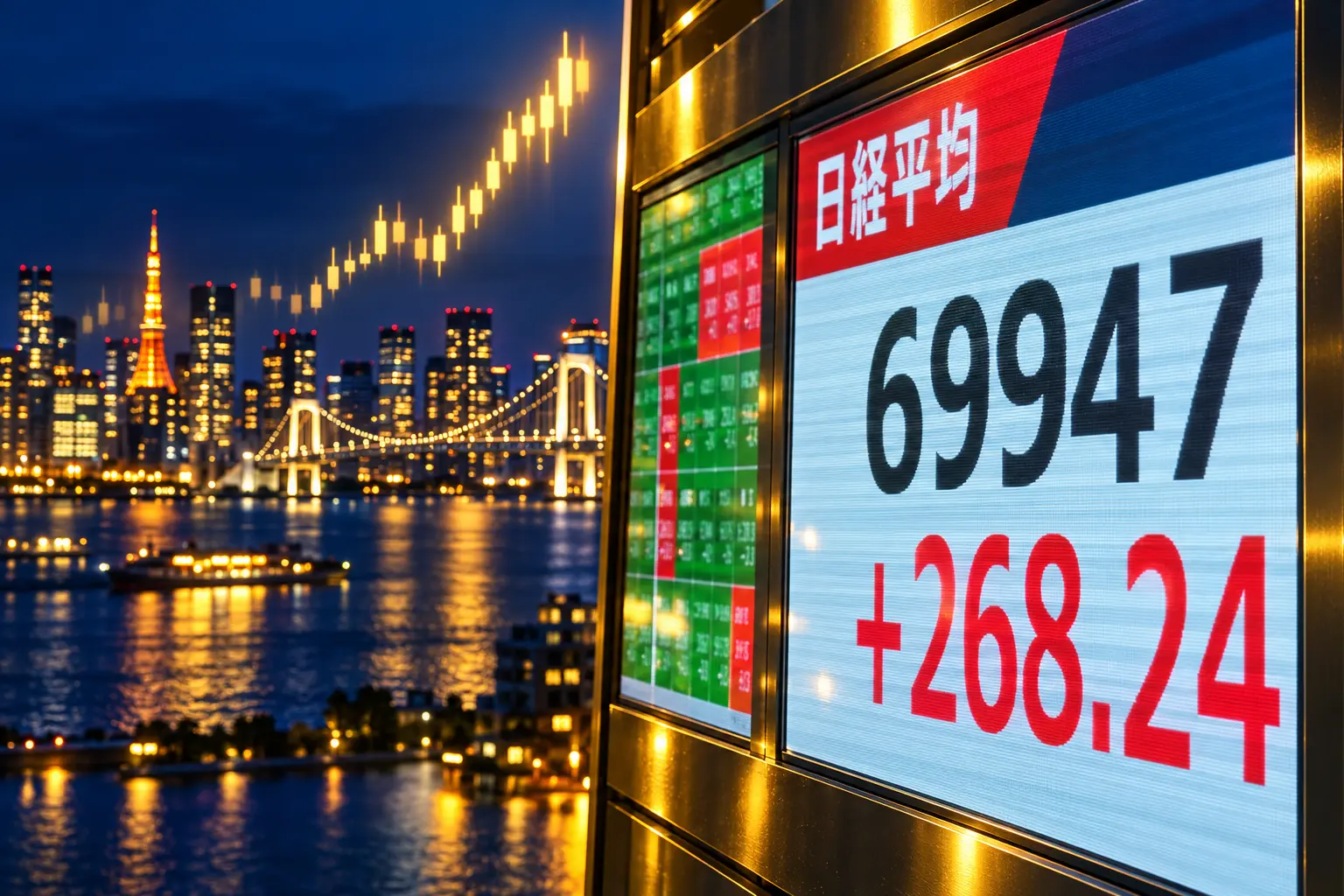
The Nikkei tagged 70,000 then closed at 69,947 as TSMC jumped 3% on unsigned Musk talks, while China sat out and the 10-year stayed near 5.25%.

Japan’s Nikkei 225 closed up 2.4% at 69,947 on Monday after tagging 70,000. It was the first print above that round number since July, on a day South Korea and mainland China were closed.
Chip stocks did the heavy lifting. TSMC rose 3% in Taipei, and U.S. futures slipped 0.1% in Asian hours after Friday’s Nasdaq 100 record. The bounce followed a 29,000-job U.S. print that cut the odds of an October Fed hike to about 20%. The 10-year Treasury still sat near 5.25% after giving Friday’s dip back.
A Holiday Tape and a 70,000 Touch
Tokyo opened at 69,113.74 and was through 70,000 by mid-morning. At 10:37 a.m. the Nikkei stood at 70,024.27. The morning session ended at 70,037.61, up 2.53%, with the high near 70,072. By the cash close it had slipped back under the round number, up 1,637 points at 69,947.
The broader Topix rose about 1%. Advantest was the largest positive contributor at lunch, up 4.66%. In morning trade Tokyo Electron gained 5.5% and SoftBank Group 3.3%. The yen was near 157.60 per dollar, and the 10-year JGB yield was around 3.095%.
That Japan print did not travel. Mainland China is shut through Golden Week until Thursday. South Korea was closed for National Foundation Day. Hong Kong’s Hang Seng was little changed at 23,981.50. Australia’s S&P/ASX 200 edged up 0.1% to 8,691.90. Singapore’s Straits Times gained 0.3%. India’s Nifty 50 rose to 22,430.70 and the Sensex added 0.1% to 71,961.20, while the Nifty Smallcap 250 fell 0.1%.
ASIA’S MONDAY SCOREBOARD
| Market | Level | Move | Session note |
|---|---|---|---|
| Nikkei 225 | 69,947 | +2.4% | Tagged 70,000, first time since July |
| TAIEX | 49,712.04 | +2.55% | Record close, high 49,770.66 |
| Hang Seng | 23,981.50 | Little changed | Mainland China closed |
| S&P/ASX 200 | 8,691.90 | +0.1% | Banks and miners, few chip names |
| Nifty 50 | 22,430.70 | Higher | Sensex +0.1% to 71,961.20 |
| KOSPI | Closed | Holiday | National Foundation Day |
| Shanghai Composite | Closed | Holiday | Golden Week through Thursday |
Taipei was the other open market that behaved like Tokyo. The TAIEX closed at a record 49,712.04, up 1,236.30 points, or 2.55%, on turnover of NT$1.15 trillion. MediaTek rose 4.34% and Delta Electronics 6.37%. United Microelectronics, a mature-node foundry, fell 5.57% to NT$152.5. The split inside Taiwan is the same split across Asia: advanced chips ran, everything else mostly sat.
September’s 29,000 Jobs Reset October
Friday’s U.S. report is the whole rate story Asia is trading. The Bureau of Labor Statistics said nonfarm payrolls rose by 29,000 in September, against forecasts near 90,000. The unemployment rate moved to 4.2% from 4.1%. Average hourly earnings rose 5 cents, or 0.1%, to $37.81, and are up 3.0% from a year earlier, the slowest annual pace since May 2021.
THE SEPTEMBER PAYROLLS PRINT
- Headline jobs: Payrolls rose 29,000 after a 12-month average gain of 45,000.
- Revisions: July was cut from +21,000 to -10,000 and August from +162,000 to +133,000, a combined 60,000 downgrade.
- Jobless rate: Unemployment is 4.2%, with 7.1 million people out of work, still inside a 4.1% to 4.3% band since March.
- Pay and hours: Average hourly earnings are $37.81, up 3.0% year on year, and the workweek stayed at 34.4 hours.
Private payrolls rose 46,000 and government jobs fell 17,000. Health care added 17,000. The labor force participation rate was 61.8%. Russ Mould, investment director at AJ Bell, said the figure was “a long way short of expectations,” and that in a market where weak data can mean relief on rates, “this has been taken positively by investors.”
The Federal Reserve raised its target range by 25 basis points on September 16, to 3.75% to 4.00%, the first increase since 2023, under Chair Kevin Warsh. New York Fed President John Williams said earlier in the week there was “no need for urgency.” Money markets then cut the chance of a follow-up at the October 27-28 meeting to about 20%, from around 70% early last week. A December move is still on the table. Nasdaq 100 futures were at 31,037.75, down 0.1%, and S&P 500 futures at 7,768.75, also down 0.1%. On Friday the S&P 500 closed at 7,722.72, up 0.73%, and the Nasdaq Composite at 27,190.86, up 1.19%.
TSMC Climbs 3% on Unsigned Texas Talks
TSMC closed at NT$2,575, up 75 Taiwan dollars, or 3%, after an intraday high of NT$2,580. The ADR had finished Friday at $472.78, up 2.96%, and was indicated about 1.8% higher before the U.S. open. The stock moved after Elon Musk confirmed that Terafab, the Tesla and SpaceX chip-plant plan in Grimes County, Texas, is talking to TSMC.
Musk’s wording on October 3 was short, and it is still the entire public record of the talks.
Just discussions, but something may come of it
— Elon Musk (@elonmusk) October 3, 2026
Taiwan-based journalist Tim Culpan had written that TSMC was looking at ways to help run the Texas plants. One structure under discussion would have TSMC own and operate a new fab, with SpaceX putting in equity, purchase commitments, or both. Another would leave SpaceX with a majority stake and TSMC supplying process know-how. TSMC has not commented. SpaceX has put the first phase at $16.8 billion, with at least 3,000 jobs. Chairman C.C. Wei has said a new wafer plant typically takes two to three years to build, then another one to two years to grow output.
Intel is already in the room. Musk has said Terafab would use Intel’s 14A process. Oppenheimer analyst Rick Schafer wrote on Monday that this is “a role TSMC’s own nodes could replace.” Intel shares fell more than 4% in U.S. premarket trade. TSMC is due to report earnings on October 15, when investors will listen for any Texas language that goes beyond talks.
The Bond Market’s Friday Reversal
Equities treated the jobs miss as a green light. The long end of the Treasury market did not. The 10-year yield fell to 5.168% right after the 8:30 a.m. release on Friday, then climbed back through Thursday’s close and finished at 5.28%, up 4 basis points on the day. In Monday’s Asian hours it was around 5.25%, down 2 basis points from that Friday close.
That path is the constraint on the chip rally. The same AI buildout lifting TSMC, Advantest and the Nasdaq is also the reason companies have been selling more bonds, on top of heavy government issuance and oil still above $100. A Fed that skips October does not, by itself, cheapen 10-year money. Japan’s own 10-year yield near 3.1% is a reminder the rate shock is not only American.
U.S. futures already knew Friday’s story, which is why they were slightly softer while Tokyo was catching up. The session Asia actually had was a semiconductor squeeze in the two markets that were open and heavy with AI supply-chain names. It was not a broad bid for Asian risk.
Nippon Paint Pays $1.35 Billion for Seven Countries
Away from chips, Japan still had a corporate print. Nippon Paint Holdings agreed to buy AkzoNobel’s decorative paints business in Southeast Asia and Oceania at an enterprise value of $1.35 billion (€1.20 billion). AkzoNobel put the multiple at 21 times 2025 EBITDA and said net cash proceeds, after tax and minority partners, should be about $1 billion. Nippon Paint priced the package at 216 billion yen and said the contracts were signed on October 3. Its shares rose 1%.
The deal covers Vietnam, Indonesia, Malaysia, Thailand, Singapore, Papua New Guinea and Australia. Closing is due in mid-2027, except Indonesia, which is slated for late 2026. Nippon Paint had tried to buy AkzoNobel’s entire decorative-paints unit for €7.5 billion ($8.4 billion) and, with Sherwin-Williams, had earlier bid for the whole Dutch company. This is the slice that sold.
The successful completion of our Asia portfolio review is part of an ongoing strategy to focus our portfolio on areas where we can achieve differentiating scale and strengthen our position.
Greg Poux-Guillaume, CEO, AkzoNobel
Wee Siew Kim, co-president of Nippon Paint, said the group was “excited to welcome these businesses and talented teams” and would keep delivering “the quality, experience and local expertise that customers have come to value.” AkzoNobel will keep its coatings business and said it is now concentrated on closing its merger with Axalta.
Why Brent Gave Back the Yemen Spike
Oil did the opposite of stocks. Brent crude for December delivery traded at $103.06 early on Monday, up 0.79%, after Yemen’s Houthis said they had fired missiles and drones at Saudi Aramco sites in Riyadh and the Khurais area. Later in the Asian session Brent was around $101.60, down 0.6%. West Texas Intermediate was near $90.15, down about 1%.
The fade had a supply story attached. The G7 agreed on Friday to release 100 million barrels of diesel and crude from emergency stocks over four months. Middle East loadings have been rising again, and Aramco cut November official selling prices to Asia. OPEC+ left November output targets unchanged.
WHAT WE KNOW
- The claim: Houthi spokesman Yahya Saree said the group launched long-range missiles and drones at Aramco sites and called the strikes a reply to Saudi-led attacks in Yemen.
- The campaign: Yemen’s Saudi-backed Presidential Leadership Council, led by Rashad Al-Alimi, said on Sunday it was sending the army to retake Houthi-held ground.
- The price: Brent ran above $103, then settled near $101.60 as the stockpile release and higher Gulf exports offset the headlines.
WHAT IS UNCONFIRMED
- Damage: Saudi Arabia has not confirmed hits on the Riyadh or Khurais facilities.
- Output loss: There is no verified figure for barrels taken offline by the claimed strikes.
Brent was still above $100 a barrel when Tokyo went home, with Riyadh yet to confirm the strikes the Houthis claimed. Mainland China is due back on Thursday. The Fed’s September minutes follow on October 7.
Disclaimer: This article is news reporting and market analysis for information only. It is not investment, trading or financial advice and does not recommend buying or selling any index, stock, bond, currency or commodity named above. Readers should consult a licensed financial adviser or other qualified investment professional about their own circumstances before acting on any price, yield or probability cited here. Closes, payrolls, yields and odds reflect the named sources on the dates given and can change with later trading, revisions and official updates.

Final Fantasy Resonance Turns a Dead Gacha Into HD-2D

PHP2Shell Forced Sites Offline While Exploits Stalled

Kindle+ Folds AI Audiobooks Into the Page-Read Fund

Chip Stocks Fall as the Bond Rally Cheapens AI Spend

Comcast’s Record Odyssey Quarter Doubles as the Exit

Microsoft 365 Auth Fault Took Down Exchange and Teams

Xbox Caps Game Pass Cloud Gaming at 15 Hours

OpenClaw 2.0 Ships a Team Workplace With Host-Trust Defaults

OpenAI Unveils GPT-6 Astra With a Critical Cyber Label

Diesel Breaks Its Record as the White House Claims Credit
-
 NEWS2 months ago
Microsoft 365 Auth Fault Took Down Exchange and Teams
-
 GAMING2 months ago
Xbox Caps Game Pass Cloud Gaming at 15 Hours
-
 NEWS2 months ago
OpenAI Unveils GPT-6 Astra With a Critical Cyber Label
-
 NEWS2 months ago
OpenClaw 2.0 Ships a Team Workplace With Host-Trust Defaults
-
 BUSINESS2 months ago
Diesel Breaks Its Record as the White House Claims Credit
-

 LIFESTYLE2 months ago
Squishy Dumpling Toys Recalled After Hiding Illegal Water Beads
-

 BUSINESS2 months ago
ChargePoint Stock Rally Prices Wilmer’s Three-Year Cash Plan
-

 AUTO2 months ago
Tesla Puts Its Wheel-Free Cybercab on Austin Streets