
NEWS
Indra’s Death Halves the First Litter in Four Years
Park vets put snow leopard cub Indra to sleep, leaving Tama as the only cub from a four-year wait.

The Royal Zoological Society of Scotland said on 28 September that it had put Indra to sleep after vets confirmed an incurable bone condition. Indra was the male in a twin litter at Highland Wildlife Park in Kincraig, the site’s first snow leopard cubs in four years. His sister Tama remains with their mother.
Keepers had watched the pair grow through summer. A limp in September ended that run for the male in a few days of tests.
A Limp, Then Specialist Tests, Then the Call
RZSS said Indra went under close watch last week, in the wording of the 28 September notice, after keepers saw he had started to limp. Vets at the park ran a first round of exams, then further tests and specialist assessments. The prognosis held. The charity said the bone condition would have had a significant impact on his quality of life.
Indra began to exhibit behaviours that suggested something was wrong and after initial tests we became increasingly concerned. Further tests confirmed the worst and we made the difficult decision to put him to sleep.
This is incredibly hard news to share. Indra was such a joy to watch growing and playing with his sister. He will be greatly missed.
Dr Stephanie Mota, Head of Veterinary Services, Royal Zoological Society of Scotland
The notice did not give a calendar date for the injection, only that the family had been doing well until the mobility problems showed. Born on 25 May, Indra was 126 days old when the park published the news, about four months. Tama is expected to stay with first-time mother Pari for up to two years before a move to another enclosure.
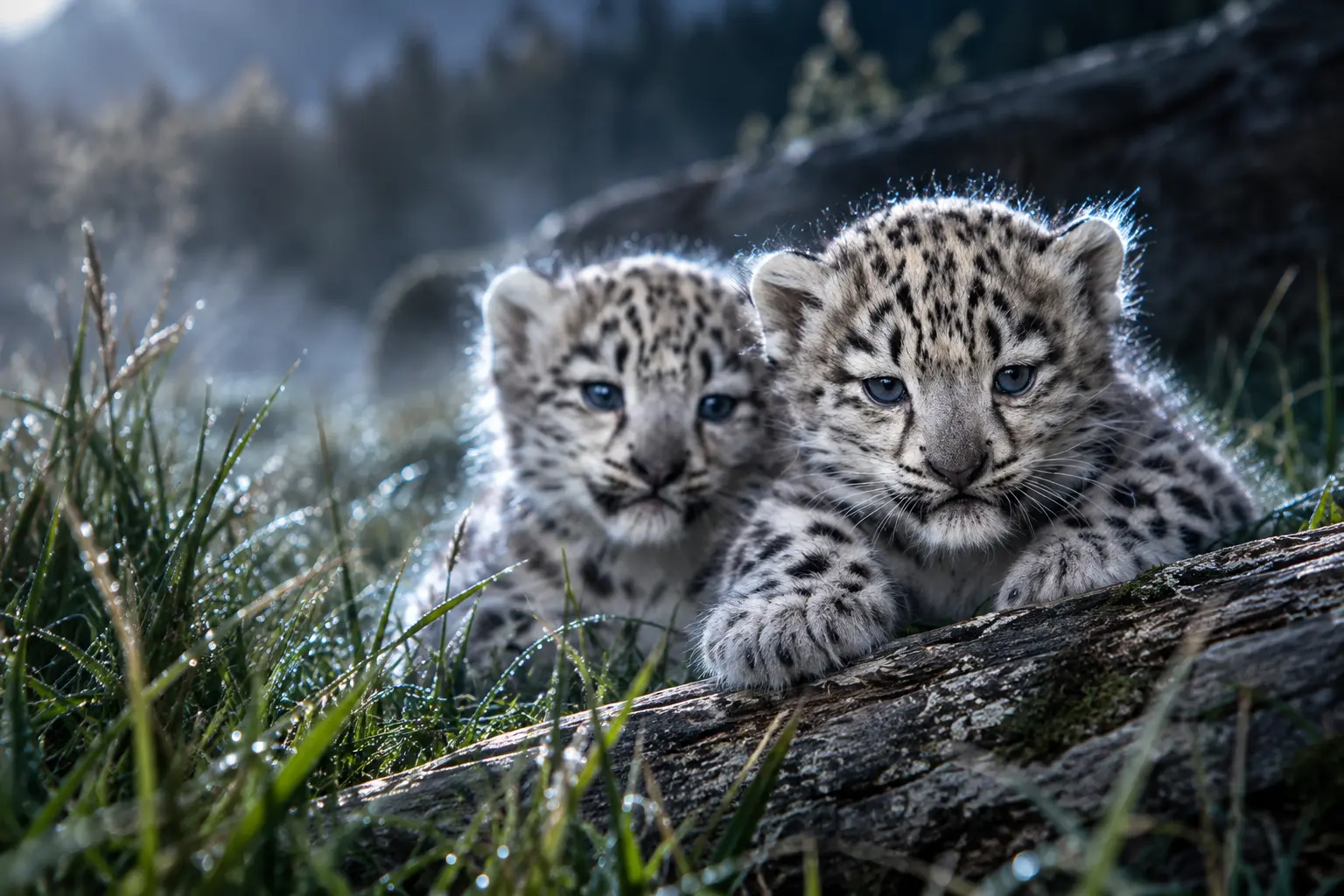
Pari Delivered Twins After a Four-Year Gap
Keepers said the twins were born on Monday 25 May to Pari and her mate Koshi. Lucy Petrie, then the park’s animal care manager, said staff had spent months introducing the pair and then stepped back. Because Pari was a first-time mother, they watched how she handled two cubs. Petrie said she was doing a wonderful job.
The cubs stayed in the den at first, as snow leopard young do. By early July they were stepping outside. Fathers are kept apart in this species while the mother raises the litter, and Koshi lived separately until the cubs were ready to meet him.
THE 2026 LITTER CLOCK
- 25 May 2026: Pari delivers two cubs at Kincraig, the park’s first snow leopard litter since 2022.
- 23 July 2026: At an eight-week health check the cubs are confirmed as a boy and a girl, both in good health and weighing around 3.5 kg. They are vaccinated, wormed and microchipped.
- 29 July 2026: RZSS opens a public vote on three name pairs drawn from the cats’ range in Central and South Asia.
- 4 August 2026: After thousands of votes on the charity’s social channels, the twins are named Indra and Tama.
- 28 September 2026: RZSS says Indra has been put to sleep after an incurable bone condition found once he began to limp.
Petrie, by then animal operations manager, said on 23 July it was exciting to have a boy and a girl and that both were in good health. Visitors had already started to glimpse them as they moved farther from the cubbing den. At eight weeks they still depended on Pari and spent much of the day inside.
Indra and Tama, Picked From Three Name Pairs
On 29 July the park asked the public to help name the cubs, with voting closing on the evening of 3 August and the result due the next day. RZSS named Indra and Tama on 4 August and said they had been the clear favourites.
THE THREE PAIRS ON THE BALLOT
- Indra and Tama: Indra is a male Nepalese name; Tama is a river in the Koshi system, which also gives the sire his name.
- Tamur and Nura: A second Himalayan pairing on the same shortlist.
- Annapurna and Tara: Names taken from the mountains and culture of the cats’ native range.
The naming post said the cubs had a clean bill of health at that first check and were beginning to eat solid food under Pari’s watch. The inquisitive pair were exploring more of the habitat. That was the last public health line before the limp.
Koshi’s 2022 Male Is Already a Father
Koshi is not a new sire at Kincraig. On 28 May 2022, keepers heard high-pitched sounds in the cubbing den and found cubs with mother Animesh, who had also produced young in 2019. Koshi was a first-time father then. The 2022 litter was three cubs, later named Padme, Maya and Yashin, a tribute to the Himalaya chosen by donors and a public vote.
KINCRAIG SNOW LEOPARD LITTERS
| Birth | Mother | Father | Cubs named | What followed |
|---|---|---|---|---|
| 28 May 2022 | Animesh | Koshi | Padme, Maya, Yashin | Maya moved to Zoo de Jurques; Yashin later sired cubs at Chester Zoo |
| 25 May 2026 | Pari | Koshi | Indra, Tama | Indra put to sleep in September; Tama remains with Pari |
Highland Wildlife Park said on 29 January 2025 that Maya, described as its last snow leopard cub, had arrived safely at Zoo de Jurques in France. Koshi stayed on the hilltop habitat. On 24 July 2025 the park congratulated Chester Zoo on new cubs and pointed to Yashin as the father, posting a 2023 picture of him as a youngster. The 2022 male had reached the breeding pool. The 2026 male will not.
Pari is a later arrival. On 1 May 2025 the park introduced her at one year and nine months, still shy, and said introductions to Koshi would start in the weeks after. The twins arrived a year later. She was a first-time mother at that birth. Koshi was the proven half of the pairing.
Why the Park Never Named the Bone Condition
RZSS called it an incurable bone condition and stopped there. No radiograph report, no disease name, and no note on whether one limb or several were involved. That gap matters because a limp in a growing snow leopard cub is not an unknown problem in zoos, and some of those cases have been treated rather than ended.
WHAT WE KNOW
- The trigger: Keepers saw a limp and then behaviours that worried the vet team.
- The work-up: Exams at the park, then further tests and specialist assessments.
- The finding: An incurable bone condition that, the charity said, would have had a significant impact on quality of life.
- The sister: Tama was not described as lame, and she remains with Pari.
WHAT IS UNCONFIRMED
- The diagnosis: The park has not said whether this was a cartilage flap, a metabolic problem, a congenital defect, or something else.
- The timing of onset: Both cubs passed an eight-week check in July; the limp is first described in the September notice.
- Whether Tama shares any risk: No public statement addresses that.
A 2012 paper in the Journal of Zoo and Wildlife Medicine described osteochondritis dissecans in snow leopards, a stifle-joint defect, in three cubs that went lame at 6, 8 and 10 months. Surgeons removed cartilage flaps. Two of those cats were sound later; one developed mild osteoarthritis. A 2018 follow-up treated two related females with osteochondral grafts. Those animals were older than Indra, and surgery was an option. The Kincraig notice never used those terms, and it would be a guess to pin his case on that lesion. The published record only shows that a limp in this species can be an orthopedic disease vets already know, not a mystery unique to one park.
One Surviving Cub in a Tight European Programme
Snow leopards sit on the IUCN Red List as Vulnerable, with an estimated 2,710 to 3,386 mature animals and a decreasing trend. Assessors in 2017 judged the global stock at more than 2,500 but fewer than 10,000 mature individuals, with at least a 10 percent decline over 22.62 years, or three generations. The IUCN Cat Specialist Group’s most recent range-wide estimate for all individuals, mature and young, is 7,446 to 7,996. The range covers 12 countries in the high mountains of Central and South Asia.
THE WILD AND ZOO NUMBERS
- Red List: Vulnerable, population decreasing, CITES Appendix I.
- Mature wild cats: 2,710 to 3,386 on the IUCN assessment.
- European zoos: A 2024 review of the EAZA programme counted 187 animals, 94.9 percent gene diversity, 53 founders.
- Who runs the EEP: Nordens Ark in Sweden, coordinator Emma Nygren, on EAZA’s April 2026 list.
A 2025 genome study found the snow leopard is the least genetically diverse big cat still living, a long-term small population rather than a recent inbreeding crash. Zoo cats in that work traced mostly to Kyrgyzstan-region ancestry. The EAZA chapter still called the European population healthy on diversity grounds, and it argued for a global management plan. In a herd of 187, one male cub is not a collapse. It is also not spare. Pari’s first litter has now produced a single living offspring for that studbook.
Wild threats listed by the Cat Specialist Group include herder conflict, prey loss, habitat damage and poaching. The group cites 221 to 450 snow leopards poached a year since 2008, with only 38 percent of cases detected. Those figures sit a long way from a Highland enclosure. They are why the park keeps the species at all.
Two Years Left With Pari
The park’s own snow leopard page now names two adults, Koshi and Pari, and one cub, Tama. That is the breeding result of the four-year gap: one young female still on her mother. Snow leopard cubs in the wild usually leave at 18 to 22 months. RZSS has said Tama should remain with Pari for up to two years, then move. Until then she is the public face of a pairing that took a new female, a proven male, and a summer of visitor traffic.
The death has not turned into a fight over the vet call. The sharper fact is quieter. Tama is now the only cub at Kincraig from that birth, and Koshi’s earlier son is already producing cubs at another zoo. The next decision in this line sits with Tama, and with whether Pari and Koshi are paired again.
Frequently Asked Questions
How Long Do Snow Leopard Cubs Stay With Their Mother in the Wild?
The IUCN Cat Specialist Group says cubs disperse at 18 to 22 months and may stay for a short time in sibling groups after that. Sexual maturity comes at 2 to 3 years, which is why a surviving zoo female like Tama is still years from any breeding recommendation even if she stays healthy.
When Were Snow Leopards Moved Off the Endangered List?
The 2008 IUCN assessment listed the species as Endangered. The 2017 assessment, published from a November 2016 review, moved it to Vulnerable under criterion C1 because mature numbers were judged higher than 2,500, with a projected decline of at least 10 percent over three generations rather than the steeper drop needed for Endangered.
How Many Cubs Can a Snow Leopard Have at Once?
Litter size is 1 to 5 cubs. Breeding in the wild runs from early January to mid-March, with most births in May and June after a gestation of 98 to 104 days, which matches the late-May births at Kincraig in both 2022 and 2026.
Can Snow Leopards Roar Like Lions or Tigers?
They cannot. The Cat Specialist Group notes that their vocal folds lack the fibro-elastic tissue other big cats use for a deep roar. They yowl, especially in the breeding season, and they mark with scent and scrapes along ridges instead.

Final Fantasy Resonance Turns a Dead Gacha Into HD-2D

PHP2Shell Forced Sites Offline While Exploits Stalled

Kindle+ Folds AI Audiobooks Into the Page-Read Fund

Chip Stocks Fall as the Bond Rally Cheapens AI Spend

Comcast’s Record Odyssey Quarter Doubles as the Exit

Microsoft 365 Auth Fault Took Down Exchange and Teams

Xbox Caps Game Pass Cloud Gaming at 15 Hours

OpenClaw 2.0 Ships a Team Workplace With Host-Trust Defaults

OpenAI Unveils GPT-6 Astra With a Critical Cyber Label

Diesel Breaks Its Record as the White House Claims Credit
-
 NEWS2 months ago
Microsoft 365 Auth Fault Took Down Exchange and Teams
-
 GAMING2 months ago
Xbox Caps Game Pass Cloud Gaming at 15 Hours
-
 NEWS2 months ago
OpenAI Unveils GPT-6 Astra With a Critical Cyber Label
-
 NEWS2 months ago
OpenClaw 2.0 Ships a Team Workplace With Host-Trust Defaults
-
 BUSINESS2 months ago
Diesel Breaks Its Record as the White House Claims Credit
-

 LIFESTYLE2 months ago
Squishy Dumpling Toys Recalled After Hiding Illegal Water Beads
-

 BUSINESS2 months ago
ChargePoint Stock Rally Prices Wilmer’s Three-Year Cash Plan
-

 AUTO2 months ago
Tesla Puts Its Wheel-Free Cybercab on Austin Streets