
NEWS
Two New Salish Sea Spiders Close a Long Naming Gap
A UBC master’s student named two new Salish Sea sea spiders, the first in almost a century, after scuba dives no deeper than 18 metres.

A University of British Columbia master’s student has named two new sea spider species from the Salish Sea, the first described there in almost a century. Cormac Toler-Scott collected them on dives no deeper than 18 metres, working Quadra Island, Vancouver, Bamfield, and Victoria between September 2023 and August 2024.
One species is known from a single animal with red eyes and a three-lipped mouth. The other is a parasite that carries parasites of its own. Both lived in water people already swim, which is the part the wire copy kept skipping.
Two New Names After Almost a Century
Toler-Scott did the dives for a master’s in zoology at UBC because he wanted climate and disturbance data on sea spiders and could not find any. “That’s largely because people don’t know much about what species exist here and what their lifestyle is,” he said. He needed names before anyone could track change.
UBC’s 23 September 2026 note called the pair the first described in almost a century for the Salish Sea. The paper behind that claim, published 26 August 2026 in Organisms Diversity & Evolution, still leans on Leon J. Cole’s 1904 west-coast monograph and W. A. Hilton’s 1942 name Phoxichilidium quadradentatum. Those are the dates the new work had to talk to.
Cole’s Harriman Alaska Expedition chapter was, in his own words, almost everything then in print on littoral sea spiders of the North American west coast. Hilton added a later name that this team had to redescribe. In between, the inland sea was sampled for salmon, orcas, and shoreline surveys. Sea spiders, millimetre-to-centimetre animals that hide on hydroids and look like one another, did not get a full pass with both a scanning electron microscope and DNA.
The university framed the find as late-night skittering on a swimmer’s calves. The useful fact is plainer. The animals were already in the Salish Sea. The names were not.
Researchers at UBC have identified two new sea spider species in the Salish Sea, the first in nearly a century, expanding understanding of marine biodiversity and creating new tools for future ecological research.
Read more: https://t.co/Kw6ZEtwdRo pic.twitter.com/NgEmVMgNu4
— UBC News and University Affairs (@UBCNews) September 23, 2026
A CENTURY OF SALISH SEA NAMES
- 1904: Cole publishes Pycnogonida of the West Coast of North America in the Harriman Alaska Expedition reports, the baseline still used for several Salish Sea species.
- 1942: Hilton names Phoxichilidium quadradentatum, the youngest of the five species this team redescribes.
- September 2023: Toler-Scott begins scuba collections around Quadra Island, Vancouver, Bamfield, and Victoria, down to 18 metres.
- August 2024: The field season ends after one run through those sites.
- November 2025: He completes the MSc in zoology at UBC; the thesis is posted on 16 September 2025.
- 26 August 2026: The journal paper appears, with two new species, five redescriptions, genetic sequences, and a regional identification key.
- 23 September 2026: UBC Science releases the public note that sent the red eyes around the internet.
That stretch is why a master’s project could still mint two species off cities. The gap was not depth. It was attention.
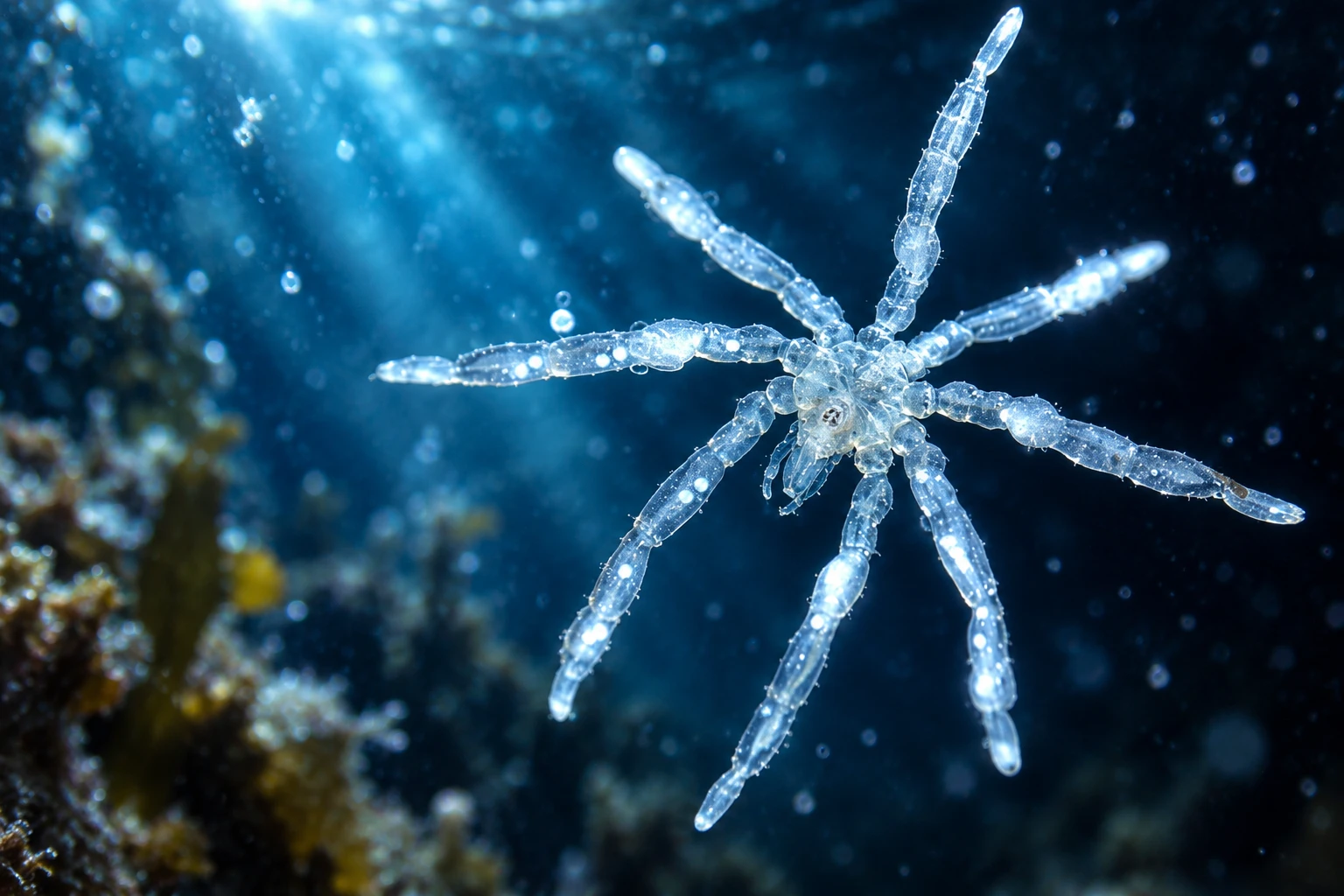
Hairy Feet, Red Eyes, One Animal
Callipallene pilosuspedes takes its second name from Latin for hairy feet, a nod to long, curved spines on the lower legs. It has red eyes and a short proboscis with claws that hold food before the bite. The mouth is a triangle with three lips, ringed in sensory tendrils. UBC compared it to a tiny marine Sarlacc pit. The photo of that mouth is scaled at 30 micrometres.
Under the microscope the team watched the sole specimen wrap its ovigers around its legs and comb debris with attached spines. Ovigers are the extra limbs males usually use to carry eggs. Here they doubled as a grooming kit. In 2025, a Natural Sciences and Engineering Research Council image contest had already shown Toler-Scott’s photograph of compound spines built for that job.
Researchers found one animal. Toler-Scott later said both new species are about a centimetre in legspan. A translucent white body and red eyes make it look finished in a way a single slide often does not. The name went out anyway, because the spines, the mouth, and the genetics did not match anything on the regional list.
Shallow-water sea spiders often live as parasites on larger invertebrates and drink through the proboscis. Toler-Scott put it without decoration: they “suck the juices out of their host.” This species has the hardware for that life. The host itself is still a blank, because one animal cannot answer an ecology question that needs a population.
The Parasite Carries Parasites of Its Own
Tanystylum kiixin is the species with a roster. The paper says it closely associates with the hydroid Plumularia setacea. Its ovigers are small and clumsy, so it cannot groom the way C. pilosuspedes can. Dirt and debris stay on the body. So do other lives.
An ecosystem within an ecosystem within an ecosystem.
Cormac Toler-Scott, lead author, UBC Science announcement
Among the debris the team kept finding protist parasites on the sea spider. The hydroid holds the spider. The spider holds the protists. None of that required a trench. It required a vial, a microscope, and a willingness to look at an animal other people treat as lint on a hydroid.
THREE LAYERS ON ONE ANIMAL
- The hydroid: Plumularia setacea is the cnidarian T. kiixin lives with, a classic shallow-water host for tiny pycnogonids.
- The sea spider: Tanystylum kiixin uses a proboscis on that host and cannot sweep its own cuticle clean.
- The protists: smaller parasites sit on the spider, which is why so many specimens looked dirty before anyone named them.
The nested pile is why this species, not the red-eyed one, is the better argument against the idea that coastal British Columbia is already catalogued. A parasite with passengers is easy to misread as a messy Tanystylum already on the books. Genetics and scanning electron microscopy are what split it.
Kiixin Is a Village on Barkley Sound
The epithet kiixin is pronounced kee-hin. UBC says the word is the sound of waves at the base of the ancient village near the first collections, which puts the type locality in the Bamfield country on the west coast of Vancouver Island, at the open edge of the Salish Sea ecoregion the paper treats.
Kiixin was the traditional capital of the Huu-ay-aht, a Nuu-chah-nulth nation. Parks Canada’s file on the Kiixin Village and Fortress historic site describes a 19th-century village and fortress with older occupation, still sacred to the Huu-ay-aht, and rare on that coast for the architecture that is still standing.
Huu-ay-aht materials call it the only known traditional First Nations village with standing house remains on the west coast of southern British Columbia. The name on the sea spider is not decoration. It pins a millimetre-scale animal to a place that already had a name, a sound, and a nation attached, long before a Latin binomen arrived.
Bamfield is also a marine station town. Students have pulled invertebrates off those rocks for decades. That a new Tanystylum could still sit on a common hydroid there is the sleeper inside the sleeper. The village was mapped. The fortress was designated. The sea spider on the hydroid was not.
Sea Spiders Keep Their Organs in Their Legs
Sea spiders, or pycnogonids, are marine chelicerates, the broad group that also holds spiders, scorpions, and horseshoe crabs. They are not arachnids. They never left the water. UBC dates the lineage to around 500 million years ago, earlier than true spiders. The body is a reduced trunk. The legs do the rest of the work.
“If you took a cross-section of a sea spider leg, for example, you would see leg muscles and also organs and ovaries or gonads,” Toler-Scott said. Females hold ovaries through the limbs and eggs exit from a dedicated pore. Males scoop those eggs with ovigers at the base of the head, dab them in glue secreted from the legs, and carry the clusters until they hatch. Gas exchange is through the skin. There are no lungs and no gills in the usual sense.
Leg count can reach 12. Size in this fauna is a centimetre of span; elsewhere the same body plan runs from less than a centimetre to more than 70 cm in Antarctica. Four eyes usually sit on a dorsal tubercle. A three-part proboscis sits at the front. Some species lose eyes, palps, or chelifores. The shallow ones tend toward parasitism on hydroids, bryozoans, and other attached prey.
The new paper is not only two names. It is a comparative study of seven coastal species from the Salish Sea, using scanning electron microscopy and molecular sequences, with GenBank numbers reported in the paper. Co-authors listed with Toler-Scott include E. Park and H. Gordon. Five older names get modern descriptions. Two names are new.
SPECIES TREATED IN THE 2026 PAPER
| Species | Original name | What the paper does |
|---|---|---|
| Callipallene pilosuspedes | 2026, this study | New species; one specimen; red eyes, hairy lower legs, three-lipped mouth |
| Tanystylum kiixin | 2026, this study | New species; lives with Plumularia setacea; poor groomer; hosts protists |
| Achelia alaskensis | Cole, 1904 | Redescribed with new images and sequences |
| Achelia gracilipes | Cole, 1904 | Redescribed with new images and sequences |
| Anoplodactylus erectus | Cole, 1904 | Redescribed with new images and sequences |
| Anoplodactylus viridintestinalis | Cole, 1904 | Redescribed with new images and sequences |
| Phoxichilidium quadradentatum | Hilton, 1942 | Redescribed; youngest of the historical names in the set |
Those five old names were not lost. They were thin. Without sequences and without a key that a diver can actually use, a “known” species is a label that cannot be checked in the field.
A Key for the Next Diver
The last product in the paper is a dichotomous key to pycnogonids of the Salish Sea and the west coast of Vancouver Island. UBC called the project the first comprehensive Salish Sea sea spider study to pair detailed imaging with DNA. Along the way the team sequenced species that had never been sequenced. The two new names are in a global database.
In order to understand how marine invertebrates are being impacted by things like climate change and how we can better protect these key elements of the ecosystem, we have to be able to identify them.
Cormac Toler-Scott, lead author, UBC Science announcement
That is the unglamorous half of a species paper, and it is the half that changes what happens on the next boat. A red-eyed holotype in a drawer does not help a survey tech. A couplet that splits hairy feet from a short-oviger Tanystylum does. So does a COI sequence that stops someone from filing T. kiixin under an older name because the animal looked dusty.
Toler-Scott also argued that scuba, used on purpose, still finds animals nets miss. He said a master’s student finding two new sea spiders in one British Columbia field season is a measure of how many marine invertebrates remain undescribed while disturbance and climate change rearrange the communities those animals live in. The sentence is a warning. It is also a methods note. You have to get in the water.
Twenty Species on a Watched Coast
Including the two new names, Toler-Scott said 20 sea spider species are now documented from the Salish Sea and the west coast of Vancouver Island. The paper handled seven of them in detail. The other thirteen sit on the regional list without this treatment. That is a small fauna, and it still had holes in 18 metres of water.
Pycnobase, the World Pycnogonida Database, listed 1,419 living sea spider species in its March 2026 Catalogue of Life snapshot, months before these names were published. The editors there already warn that shallow surveys and the deep sea both keep turning up unnamed species, and that DNA keeps splitting what used to look like one widespread animal. UBC says the two Salish Sea names have since been registered in that global system.
THE SALISH SEA TALLY
- Field season: One run, September 2023 through August 2024, never below 18 metres.
- New names: Two, one of them from a single animal about a centimetre across the legs.
- Regional list: Twenty species now recorded from the Salish Sea and west Vancouver Island, seven of them treated in this paper.
- Worldwide baseline: 1,419 living species listed in March 2026, before the Salish Sea names appeared.
“I only had one field season but there’s definitely more diversity out there that we haven’t documented,” Toler-Scott said. The two names are in. The key is in the paper. The water off Vancouver and Victoria is the same water it was in 1942. The list is not.
Frequently Asked Questions
Are the new Salish Sea sea spiders dangerous to people?
No. Toler-Scott said they are completely harmless, and the new animals span about a centimetre across the legs, feeding on other marine invertebrates with a sucking proboscis rather than biting people. They are not true spiders, they do not come ashore, and nothing in the UBC work treats them as a swimming hazard.
How many living sea spider species are known worldwide?
The March 2026 Catalogue of Life edition of Pycnobase listed 1,419 living species, together with 13 extinct species, 92 genera, and 15 families. That living total predates the two Salish Sea names, which UBC says have now been registered in the global database.
When was Kiixin Village named a national historic site?
The Government of Canada designated Kiixin Village and Fortress in 1999. Occupation at the site dates to 1000 B.C.E., and the main village holds evidence of ten houses, eight of them with traditional timber frames still standing or fallen in place.
Can sea spiders have more than eight legs?
Yes. Pycnobase records six polymerous species, four of them with five pairs of walking legs and two with six pairs, so some sea spiders walk on 10 or 12 legs instead of eight. UBC notes the count in this group can reach 12.
Who funded the UBC sea spider research?
The Natural Sciences and Engineering Research Council of Canada funded the work, according to the university’s 23 September 2026 announcement. The dives and lab study were a master’s project in the UBC Department of Zoology, not a dedicated survey agency program.

Final Fantasy Resonance Turns a Dead Gacha Into HD-2D

PHP2Shell Forced Sites Offline While Exploits Stalled

Kindle+ Folds AI Audiobooks Into the Page-Read Fund

Chip Stocks Fall as the Bond Rally Cheapens AI Spend

Comcast’s Record Odyssey Quarter Doubles as the Exit

Microsoft 365 Auth Fault Took Down Exchange and Teams

Xbox Caps Game Pass Cloud Gaming at 15 Hours

OpenClaw 2.0 Ships a Team Workplace With Host-Trust Defaults

OpenAI Unveils GPT-6 Astra With a Critical Cyber Label

Diesel Breaks Its Record as the White House Claims Credit
-
 NEWS2 months ago
Microsoft 365 Auth Fault Took Down Exchange and Teams
-
 GAMING2 months ago
Xbox Caps Game Pass Cloud Gaming at 15 Hours
-
 NEWS2 months ago
OpenAI Unveils GPT-6 Astra With a Critical Cyber Label
-
 NEWS2 months ago
OpenClaw 2.0 Ships a Team Workplace With Host-Trust Defaults
-
 BUSINESS2 months ago
Diesel Breaks Its Record as the White House Claims Credit
-

 LIFESTYLE2 months ago
Squishy Dumpling Toys Recalled After Hiding Illegal Water Beads
-

 BUSINESS2 months ago
ChargePoint Stock Rally Prices Wilmer’s Three-Year Cash Plan
-

 AUTO2 months ago
Tesla Puts Its Wheel-Free Cybercab on Austin Streets