
NEWS
Physicists Measure the W State That Survives Photon Loss
A Kyoto-Hiroshima circuit identifies three-photon W-state entanglement in one shot, the loss-tolerant type quantum networks actually need.

A Kyoto and Hiroshima team has shown a one-shot optical circuit that identifies three-photon W-state entanglement with a discrimination fidelity of 0.871 ± 0.039.
The result, published September 12, 2025, closes a gap that has stood since a 1998 proposal for a similar reading of GHZ states. W states are the other genuine three-particle entanglement, and they still hold useful correlations if one photon never arrives.
Kyoto Built a Circuit That Reads Three Photons at Once
Entangled measurements are the many-particle cousin of a Bell-state measurement. Instead of reconstructing a state from many separate slices, the device projects incoming photons onto an entangled basis in a single shot, then names which entangled state it saw.
Geobae Park, then a doctoral student at Kyoto University’s Graduate School of Engineering, ran the optics. Holger F. Hofmann, a professor at Hiroshima University, built the theory with Park. Ryo Okamoto, an associate professor at Kyoto, and Shigeki Takeuchi, a Kyoto professor of quantum information and the corresponding author, completed the four-author team.
More than 25 years after the initial proposal concerning the entangled measurement for GHZ states, we have finally obtained the entangled measurement for the W state as well, with genuine experimental demonstration for 3-photon W states.
Shigeki Takeuchi, corresponding author, Kyoto University
Kyoto’s account is blunt about the hole they were filling. A one-shot reading of GHZ states already existed. For the W state, the other representative multi-photon entangled state, no such measurement had been proposed, and none had been shown in the lab.
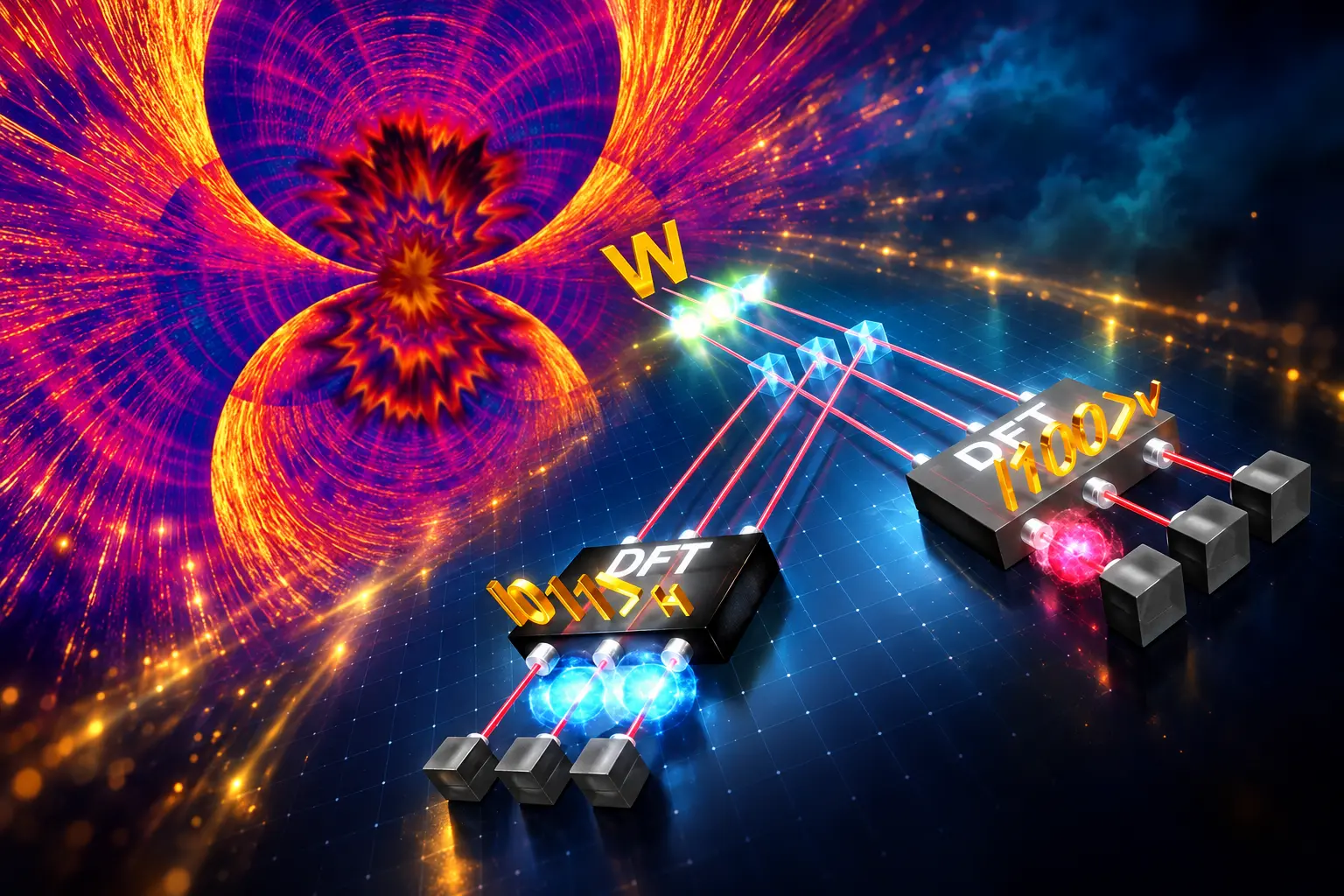
They demonstrated the idea with three photons in high-stability optical quantum circuits that ran for long stretches without active control. Three single photons of chosen polarization went in. Detector patterns then told the team which type of three-photon W state, and which non-classical correlation, the trio had carried.
Ordinary quantum tomography cannot do that cheaply. Each look collapses the state, so the lab must prepare many copies, and the number of settings grows exponentially with the photon count. A working entangled measurement sidesteps both bottlenecks, which is why Bell measurements sit at the center of teleportation and entanglement swapping, and why a W-state version has been missing.
The Entanglement That Survives a Missing Photon
Three qubits can be genuinely entangled in two inequivalent ways. A GHZ state is an all-zero, all-one superposition. Measure one particle and the other two fall into a product state, with no entanglement left to spend. A W state is different. Exactly one of the three carries the excitation, the three options sit in superposition, and if one particle is lost the remaining pair can still be entangled.
GHZ VERSUS W STATES
| Property | GHZ state | W state |
|---|---|---|
| If one particle is lost | All entanglement is gone | The remaining particles can stay entangled |
| Conversion to a Bell pair | Deterministic | Probabilistic |
| Lossy networks as they grow | The resource goes dark after a single loss | Advantage over GHZ grows with network size |
| Entangled measurement | Analyzer proposed in 1998 | Photonic experiment, September 12, 2025 |
That trade is the whole point for anyone trying to share entanglement through real fiber, where photons go missing. GHZ states convert cleanly into Bell pairs, then die if a single qubit never shows up. W states convert only with some probability, yet they still leave bipartite entanglement behind after a loss. An August 14, 2025 study of centralized N-party networks, published as Scientific Reports volume 15, article 29778, put numbers on that split and found the W side pulling further ahead as the network got larger.
Filing the Kyoto result as another teleportation stunt misses that split. Teleportation already has Bell measurements. What a multi-node photonic network lacks is a way to recognize the entangled resource that does not vanish when a channel drops a photon.
A GHZ Analyzer Was Proposed in 1998
Jian-Wei Pan and Anton Zeilinger set the clock Takeuchi is counting from. In Physical Review A volume 57, page 2208, dated March 1, 1998, they laid out a linear-optics scheme that could identify two of the three-particle GHZ states with polarizing beam splitters and half-wave plates, and they noted the design extends to N particles. They called that analyzer essential for multiparticle dense coding, teleportation, and entanglement swapping.
FROM THE GHZ ANALYZER TO A W-STATE READING
- March 1, 1998: Pan and Zeilinger publish a practical GHZ-state analyzer in linear optics.
- February 15, 1999: Dik Bouwmeester, Jian-Wei Pan, Matthew Daniell, Harald Weinfurter, and Anton Zeilinger report three-photon GHZ entanglement in Physical Review Letters.
- August 14, 2025: A lossy-network analysis finds W states beating GHZ-like states at extracting Bell pairs as node counts rise.
- September 12, 2025: Park, Hofmann, Okamoto, and Takeuchi publish the W-state entangled measurement in Science Advances volume 11, issue 37, article eadx4180.
GHZ states had a proposed analyzer, then a lab life, then years of protocols built on top. W states had the nicer loss behavior on paper and no comparable one-shot reading. Kyoto’s English release says the team took that challenge because the W measurement had been neither proposed nor found experimentally. The paper itself says entangled measurements had, until then, focused on two-party systems or GHZ states.
How the Circuit Spots a Cyclic Shift
The device is a three-mode discrete Fourier transform in glass and beam splitters. Three photons of set polarization go in, split, and recombine. Detector clicks then reveal which W-type correlation the trio carried, because a W state is unchanged when the photons trade places in a loop.
Park and Hofmann treated that loop, the cyclic shift symmetry of W states, as a fingerprint. In a discrete Fourier transform of bosonic modes, the same symmetry maps onto particular output patterns, so the clicks can project a multi-qubit state onto W states in a deterministic way. The theory is not limited to three photons. Kyoto says the photonic circuit that performs the quantum Fourier transform is written for a W state of any photon number.
The three-mode circuit they actually built decomposes into two balanced beam splitters, a beam splitter with one-third reflectance, and a π/2 phase shifter. That layout sits in a displaced Sagnac interferometer made with hybrid beam splitters. The engineering write-up from Kyoto’s faculty says the loop holds nanometer-order alignment without external control, which is the difference between a one-afternoon alignment and a measurement you can run long enough to collect statistics.
The measurement still destroys the photons. It does not reconstruct a wavefunction in the tomography sense. It answers a narrower question: which W-type entangled component arrived. For three-qubit W state discrimination, that is the question the network protocols need answered on the fly.
The Score Lands Above Two-Thirds
A bi-separable measurement, one that splits the three photons into two groups, cannot beat a discrimination fidelity of two-thirds. Crossing that ceiling is how the team claims a genuine three-qubit entangled measurement, not a dressed-up pairwise test.
MEASUREMENT DISCRIMINATION SCORES
- Averaged MDF: 0.871 ± 0.039, the headline figure for the three-qubit W reading.
- W3(0) component: 0.882 ± 0.038 for the input labelled ψ0, the strongest single entry they quote.
- W-bar components: 0.870 ± 0.038, averaged over the corresponding K values.
- Bi-separable ceiling: two-thirds, the score a split measurement cannot exceed.
The method is, in principle, able to identify the input W state with 100 percent efficiency in one shot. The lab did not get there. The shortfall is blamed on imperfect photon preparation and on the measurement setup itself, which is a hardware problem, not a hole in the cyclic-shift argument.
0.871 ± 0.039 is a proof that the Fourier circuit is doing three-particle work. It is not an error rate a cryptographic protocol would accept. Anyone stacking this result with room-temperature entanglement gadgets and space-station Bell tests as a finished teleportation tool is jumping a step the authors have not taken. They showed a three-photon analyzer that clears the two-thirds bar. They did not show a network node.
Why Lossy Networks Prefer W States
In a network that loses particles in transit, W states still leave bipartite entanglement behind. GHZ-like states do not. The August 14, 2025 study of centralized lossy networks found that this gap widens as more nodes are added, and it proved that W states remain more effective in large-scale networks when the node count is taken to infinity.
As the model grew from 4 to 8 parties, the loss threshold at which W stopped beating GHZ fell from about 0.2 to about 0.1, meaning the W advantage set in at milder loss once more links were in play. Losing any number of particles from a GHZ state left a maximally mixed remainder. Losing up to N-2 particles from a W state left a noisy pair that still carried entanglement. That is the arithmetic behind the table, not a slogan about quantum futures.
Park and colleagues wrote that the demonstration opens the door for new quantum network protocols between multipartite systems. Takeuchi’s group, in the Japanese engineering summary, named the jobs they think a W-state analyzer can take.
USES THE KYOTO TEAM FLAGS
- Many-user key distribution: quantum key distribution that does not trust each user’s detector, extended across many parties.
- Multi-photon teleportation: transfer of entangled states that involve more than a Bell pair.
- Measurement-based computing: new cluster-style recipes that call an entangled measurement as a gate.
- Sensing and communication: the paper’s own list, photonic quantum computation, communication, and sensing, with networks as the lead example in the abstract.
Photons are the carrier they chose because they travel far and hold quantum states at room temperature, which superconducting chips do not. A W-state analyzer in glass is, in that sense, a network tool first. Computing slogans come later, if the same circuit can be scaled past three photons.
On-Chip Photonic Circuits Are the Next Build
The team says it will push the method to larger, more general multi-photon entangled states and will try to put the entangled measurement on a photonic chip. Kyoto’s English release frames that as the way to move from a tabletop Sagnac loop to something a communications lab might actually plug in.
Takeuchi’s second remark is drier than the applications list. He said research speeds up when people go back to basic concepts until a new idea appears. The basic concept here is small: W states look the same after a cyclic shuffle, a Fourier circuit can see that shuffle, and three photons were enough to beat two-thirds.
The present device still lives on an optical table, held by a Sagnac loop and hybrid beam splitters. Three photons still have to become many before the loss advantage in those N-party models is a machine instead of a paper. Until then the score is 0.871 ± 0.039 on a three-photon W state, read in one shot.
Frequently Asked Questions
What Is a Three-Qubit W State?
It is the equal superposition of the three basis states in which exactly one qubit is 1 and the other two are 0, written (|001⟩ + |010⟩ + |100⟩) divided by the square root of 3. That is a different entanglement class from GHZ, which is the superposition of all zeros with all ones, and the two classes cannot be converted into each other by local operations and classical communication.
What Does Measurement Discrimination Fidelity Count?
Kyoto defines it as the probability of obtaining the correct result when a pure W state is sent in. The averaged figure 0.871 ± 0.039 is that probability across the W components they tested, not a tomographic fidelity of a reconstructed density matrix.
Why Is Two-Thirds the Cutoff for Three Photons?
Any measurement that can be split into two separate parts, a bi-separable measurement on three qubits, has a maximum discrimination fidelity of two-thirds. Clearing that number is the test the authors use to say the circuit performed a genuine three-qubit entangled measurement rather than a pairwise substitute.
Why Use Photons for a W-State Analyzer?
The Kyoto engineering write-up stresses that photons can be sent over long links and keep their quantum states at room temperature, which makes them the natural carrier for communication and sensing. A tabletop interferometer that reads W states is therefore aimed at networks first, even though the same authors also list computing among later uses.
What Funded the Kyoto W-State Experiment?
The work drew on the Japan Science and Technology Agency’s ERATO Takeuchi Super Quantum Entanglement Project (JPMJER2402), CREST grant JPMJCR1674, the Q-LEAP photon-quantum flagship (JPMXS0118067634), and JSPS KAKENHI grants 24H00195 and 21H04444.
Park’s three photons already clear the two-thirds test on a tabletop Sagnac loop. The chip, and a photon number large enough to match those N-party models, are still a build the group has only described as a plan.

The Salary Cap Fight That Can Freeze Baseball’s TV Payday

The 2027 Mercedes GLE and GLS Keep Alabama Busy

Margaret Hamilton Dies at 90 With a Harder Fight Unfinished

Unity Parks Its Engine Inside Google’s Prompt Games

The Hidden Vendor Cut in 403(b) vs 401(k) Plans

Microsoft 365 Auth Fault Took Down Exchange and Teams

IFA 2026’s Weird Gadgets Are Building a Sensor Home

Xbox Caps Game Pass Cloud Gaming at 15 Hours

Squishy Dumpling Toys Recalled After Hiding Illegal Water Beads

Tesla Puts Its Wheel-Free Cybercab on Austin Streets
-
 NEWS1 month ago
Microsoft 365 Auth Fault Took Down Exchange and Teams
-
 GAMING1 month ago
Xbox Caps Game Pass Cloud Gaming at 15 Hours
-
 NEWS1 month ago
IFA 2026’s Weird Gadgets Are Building a Sensor Home
-
 NEWS1 month ago
OpenAI Unveils GPT-6 Astra With a Critical Cyber Label
-
 AUTO1 month ago
Tesla Puts Its Wheel-Free Cybercab on Austin Streets
-
 NEWS1 month ago
OpenClaw 2.0 Ships a Team Workplace With Host-Trust Defaults
-

 NEWS1 month ago
Sony and Warner Sue Anthropic Over Torrented Song Lyrics
-
 LIFESTYLE1 month ago
Squishy Dumpling Toys Recalled After Hiding Illegal Water Beads