
NEWS
A Remote Fiber Swap Set Off the FAA Ground Stop
A copper-to-fiber router swap on L3Harris’s FAA network halted U.S. flights for more than four hours, echoing a 2009 failure.

A copper-to-fiber swap at a remote FAA site on Friday, November 13, flooded the air traffic network and halted U.S. departures for more than four hours. Transportation Secretary Sean Duffy said a router involved in that work started hammering other routers, so the agency issued a nationwide FAA ground stop until crews could isolate the site.
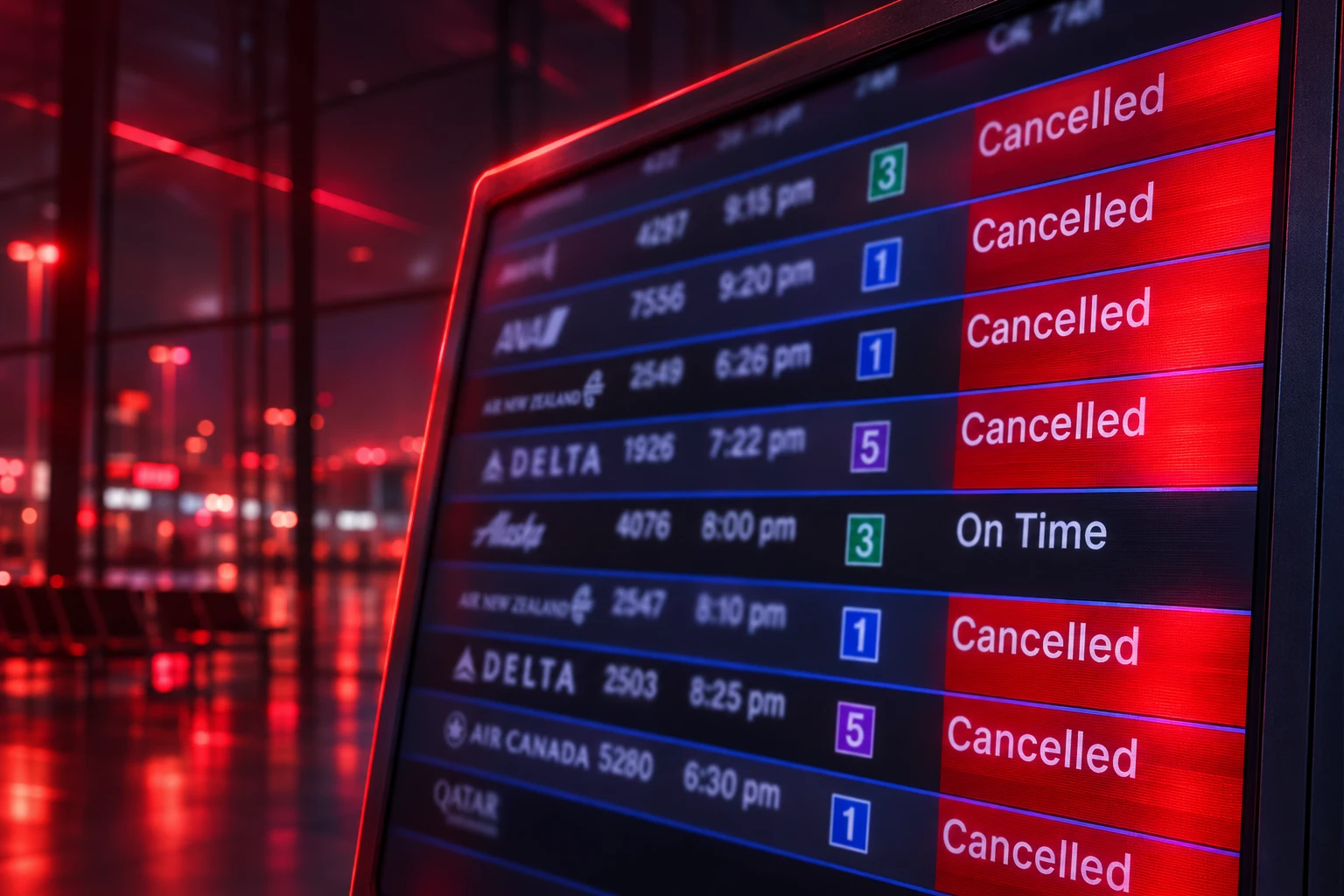
FlightAware counted about 9,200 canceled U.S. flights and 7,500 delays on Friday, then more than 6,400 cancellations by 9:35 p.m. ET Saturday. Duffy said the contractor on the job was L3Harris Technologies, which has run the FAA’s private communications net for more than 20 years and still owns it.
A Remote Router Took Down Every U.S. Departure
Duffy told reporters the crew was moving an old copper line onto fiber at a remote FAA location because the copper itself was being discontinued. The cutover, from analog TDM circuits to IP, is the same class of work phone companies finished years ago. On Friday it did not stay local.
The new or replacement router, he said, began flooding peers across the air traffic control system with more than 1,000 connection attempts every four to five seconds. Radio links to aircraft got choppy. Radar feeds hiccuped. FAA Administrator Bryan Bedford said as many as 17 of 22 en route centers felt it, though none of those rooms went fully dark, and controllers kept switching between primary and backup frequencies.
About 3,500 flights were already airborne. Duffy said those aircraft landed. The ground stop then held the rest of the country on the pavement until the remote work was pulled off the network and the paths came back.
FRIDAY ON THE NETWORK
- Friday afternoon, November 13, 2026: L3Harris crews switch a remote copper circuit to fiber and a router on that job begins flooding other routers.
- Friday afternoon: Communications with aircraft and radar feeds turn intermittent, and the FAA issues a nationwide ground stop for departing flights.
- Friday evening: Crews isolate the remote work, the flood stops, and the agency lifts the halt after more than four hours.
- Friday night: More than 8,000 flight operations resume, while crews and aircraft remain out of place for Saturday.
Homeland Security Secretary Markwayne Mullin said there was no sign of a cyberattack. Bedford added there was “zero evidence of anything nefarious, and zero evidence of anything AI-related.” Once the remote site was cut away, Duffy said, the systems came back, which is why officials do not treat Friday as an intrusion.
L3Harris Owns the Wires Controllers Still Use
The network under that router is the FAA Telecommunications Infrastructure, or FTI, the private backbone that carries controller voice, radar, weather, and flight data among more than 4,400 FAA sites. Harris Corporation won the FTI contract in 2002. L3Harris still operates it. Duffy’s problem, which he said out loud, is that he cannot shop the work to someone else while that net is still the one in service.
They’ve been working for the FAA for over 20 years, and the network that we use at the FAA to control the airspace, L3Harris actually owns that network.
Sean Duffy, U.S. transportation secretary, November 14, 2026 briefing
He asked whether Friday was “user error or install error from L3Harris” or a faulty router, and said that question is still open. “Until I can build” a replacement, he said, “I’m stuck with L3Harris.” He named AT&T, Verizon, and Lumen as the firms now working on that next network. It is not in service yet.
L3Harris, in its own statement, put the copper-to-fiber project on the company’s progress sheet, not in the accident file. The firm said that with its telco partners and the FAA it has finished more than 70 percent of the conversion from legacy copper to fiber, and that it is supporting the FAA investigation.
L3Harris has been modernizing the communications infrastructure supporting the National Airspace System in close coordination with the FAA. With safety and reliability as our highest priorities, L3Harris, together with its telco partners and the FAA, has completed more than 70%…
— L3Harris (@L3HarrisTech) November 14, 2026
A single remote site should not be able to spray a thousand bogus handshakes across the national backbone. Shared paths on FTI still let a bad router at a small cutover talk to peers it was never supposed to drown, which is why a job Duffy called “pretty straightforward” became a coast-to-coast stop.
WHAT WE KNOW
- The work: L3Harris was converting a remote copper line to fiber when a router on that job flooded other routers.
- The load: Duffy said the flood ran at more than 1,000 connection attempts every four to five seconds and hit both voice and radar.
- The airborne count: Controllers and pilots landed 3,500 aircraft after the stop was ordered.
- Cyber: Duffy and Mullin said isolating the remote work restored the system, and they do not believe the event was a cyberattack.
WHAT IS UNCONFIRMED
- The fault: Officials have not said whether the router was defective or whether it was installed or configured wrong.
- The footprint: Duffy described at least one remote site; the technicians’ union said two contractor-owned routers were being updated midday.
Bedford said a root-cause review will be released when it is finished. Until then the public record is a named contractor, an unfinished fiber cutover, and a network the FAA does not own.
What the $12.5 Billion Rebuild Did Not Cover
Congress appropriated $12.5 billion in July 2025 for the Brand New Air Traffic Control System, the accelerated rebuild Duffy has used as his main talking point. On Saturday he treated Friday’s copper work as proof that money is moving: 69 percent of copper communications replaced, plus a stack of radios, screens, and switches installed over the past year.
DUFFY’S SATURDAY SCORECARD
| Item | Figure he cited November 14 |
|---|---|
| Copper communications moved to fiber | 69 percent |
| Surface Awareness Initiative at control towers | 143 towers |
| Radio sites converted | 469 |
| Electronic flight strips | 25 towers |
| IP voice switches at towers | 224 |
| Tower simulator systems | 18 |
| SMR4 surface-movement radars | 9 |
Bedford drew a hard line under that list. He said Friday’s router job should not be folded into the $12.5 billion integrator contract awarded to Peraton. The FAA, he said, still spends a billion dollars a year keeping the 1980s TDM network alive, “call it 1G,” and is “constantly replacing 2,000 Cisco 600 routers with Juniper routers.” In his telling, that is ordinary upkeep of the old net, not the rebuild on the press releases.
The Government Accountability Office does not treat the copper swap as a side chore. In a September 14, 2026, review of the new rebuild, GAO said that as of May 2026 the FAA had replaced 2,560 of 5,170 old copper wires with fiber, a snapshot of just under half the planned lines a few months before Duffy’s 69 percent figure. The same audit found no integrated master schedule for phase 1, only 11,389 separate project schedules, so crews can be booked into the same facilities without anyone lining up the outages. Phase 1 is supposed to finish by December 2028. Phase 2, new automation to track aircraft, is pegged at about $10.2 billion with no start or end date.
GAO also restated its 2024 finding that over 75 percent of the FAA’s 138 air traffic control systems were unsustainable or potentially unsustainable. The watchdog’s warning in 2026 was that a rebuild run without a real cost estimate or a single schedule raises the odds of more delays and more time on gear that already fails. Transportation partially agreed with both recommendations. Both remain open.
The 2009 Fiber Move Hit 129 Facilities
Harris, the company later folded into L3Harris, has already broken FTI on a fiber cutover. On November 19, 2009, flight-plan traffic seized up after a router change during a move off the old network. The Transportation Department inspector general later found that a Harris technician had incorrectly configured an FTI router at Los Angeles Center while Salt Lake City was shifting onto fiber.
The bad configuration was first loaded on October 21, 2009, on a temporary “bridge” router between the old and new nets. When a replacement router inherited that map, the network started sending air traffic data down the wrong routes. Harris officials told the inspector general that a missing “no” statement in the config made the failure spread to 129 facilities instead of the 21 that should have seen it. The FAA, the report said, had not known Harris had configured the network in error, and the agency did not own the network then either.
Friday was not a carbon copy. Officials have not called this one a confirmed config mistake, and Bedford has described an equipment problem still under review. The seam is the same: a contractor-owned backbone, a live fiber migration, a router that did not stay contained, and an FAA that finds out after traffic is already sick. January 11, 2023, was a different machine, the NOTAM database, but it was also contractor maintenance, a nationwide halt of departures for about 90 minutes, more than 1,300 cancellations, and more than 10,000 delays. Friday lasted longer than that 2023 stop and is the longest nationwide ground stop since September 11, 2001.
FAA Technicians Were Kept Off the Upgrade
The Professional Aviation Safety Specialists union, which represents FAA technicians, said the failure sat on two contractor owned and maintained routers that were being updated in the middle of the day. PASS said its members were not on those upgrades. Historically, the union said, contractors have followed a protocol in which FAA employees run a risk assessment and coordinate the work. An FAA official said the agency did do a safety assessment before Friday’s job. PASS still wants the in-house techs in the room.
WHAT PASS PUT ON THE RECORD
- Who touched the routers: PASS said the midday updates were contractor-owned gear and that PASS-represented technicians were not involved.
- The old protocol: The union said FAA employees have historically assessed risk and coordinated this kind of maintenance before a contractor cuts live.
- Staffing: A May 2026 FAA workforce plan calls for at least 750 more certified professional technicians by 2030, and PASS said hiring on that plan has barely moved.
- The ask: The union backs the rebuild but says it will go faster, with fewer shocks, if those technicians are trained on the new gear and staffed to install it.
Duffy said remote cutovers are done during the day because they “shouldn’t” hit the national system the way a Newark-sized facility would, and that the big rooms get their swaps at night. After Friday he said that timing will be reviewed. The thread that followed the official account of the outage kept returning to that point: a live backbone is a live backbone, even at a site nobody can find on a passenger map.
Saturday Added 6,400 More Canceled Flights
The network came back Friday night. The airline operation did not. Crews and aircraft were in the wrong cities, rest clocks were a mess, and Saturday’s book was already full. Bedford told reporters as many as 5,000 of the 41,000 flights scheduled for Saturday could come out; FlightAware’s evening tally ran higher.
FLIGHTAWARE TALLIES AFTER THE STOP
| Day | Canceled | Delayed |
|---|---|---|
| Friday, November 13 | about 9,200 | 7,500 |
| Saturday, November 14, as of 9:35 p.m. ET | more than 6,400 | more than 8,000 |
Delta, United, and American each canceled about 25 percent of Saturday’s flying. JetBlue canceled nearly 45 percent. FlightAware already showed 875 Sunday flights pulled as of Saturday night. Bedford said Saturday would still be ugly and that airline partners expected “full schedule integrity by the close of business on Sunday,” November 15. Delta told customers who could wait to move to Monday, November 16, or later.
Chicago O’Hare, Atlanta, Dallas-Fort Worth, Denver, and Charlotte were among the Saturday choke points. Freight and mail flying was hit too. Duffy thanked controllers, pilots, flight attendants, and passengers, then went back to the funding pitch: Congress gave him a partial payment, he has spent it, and he wants the rest so the country is not living on the leftover copper.
The Remaining Copper Still Has to Be Cut Over
L3Harris’s own page, updated November 2, listed 70 percent of sites upgraded, 4,400 sites, and 5,170 fiber connections. Duffy’s 69 percent and the company’s “more than 70 percent” sit on that same unfinished job. The May GAO count shows how much of this year was spent getting off the bottom half of the list. The rest of the copper still has to be cut, on a network the FAA does not own, with daytime remote work now under review because one of those “small” jobs took down the country.
Bedford put the blunt version on the record: the old comms system “will continue to break until we fix it.” Thanksgiving falls on November 26, and officials said the operation should be back in time for that rush if Sunday’s rebuild of the schedule holds. The next copper line will still be someone else’s router, on someone else’s backbone, until the replacement net is actually running.

Xiaomi 18 Pro Goes Global as Its Privacy Filter Falters

iFixit Finds HomeView Glued Shut After Repair Gains

Polymetallic Nodules Shelter 4,139 Animals Miners Want

One UI 9.5 Puts Now Brief Behind a System Agent

Framework’s $99 Keyboard Brings Laptop Repair to the Couch

Microsoft 365 Auth Fault Took Down Exchange and Teams

OpenClaw 2.0 Ships a Team Workplace With Host-Trust Defaults

Xbox Caps Game Pass Cloud Gaming at 15 Hours

OpenAI Unveils GPT-6 Astra With a Critical Cyber Label

Squishy Dumpling Toys Recalled After Hiding Illegal Water Beads
-
 NEWS3 months ago
Microsoft 365 Auth Fault Took Down Exchange and Teams
-
 GAMING3 months ago
Xbox Caps Game Pass Cloud Gaming at 15 Hours
-
 NEWS3 months ago
OpenClaw 2.0 Ships a Team Workplace With Host-Trust Defaults
-
 NEWS3 months ago
OpenAI Unveils GPT-6 Astra With a Critical Cyber Label
-
 LIFESTYLE3 months ago
Squishy Dumpling Toys Recalled After Hiding Illegal Water Beads
-

 BUSINESS3 months ago
Diesel Breaks Its Record as the White House Claims Credit
-

 NEWS3 months ago
IFA 2026’s Weird Gadgets Are Building a Sensor Home
-

 BUSINESS3 months ago
ChargePoint Stock Rally Prices Wilmer’s Three-Year Cash Plan