
AUTO
Rivian Sells Autonomy While Volkswagen Pays the Software Bill
Most of Rivian’s autonomy-era software profit is Volkswagen contract work that fades near the 2028 Uber robotaxi launch.

Rivian posted a 42% margin on $605 million of software revenue in the third quarter, and most of that check was not for self-driving. On the October 29 earnings call, founder and CEO RJ Scaringe still spent the hour selling Rivian autonomy as the thing that will move market share, with Point to Point hands-free driving going to employees later in 2026 and to customers in 2027.
The R2 is already the company’s volume car. The car business still lost money at the gross level, and the invoices that made the quarter look like a software company came from Volkswagen Group, on a clock that runs to about mid-2028.
R2 Is Already the Volume Car, and It Still Loses Money
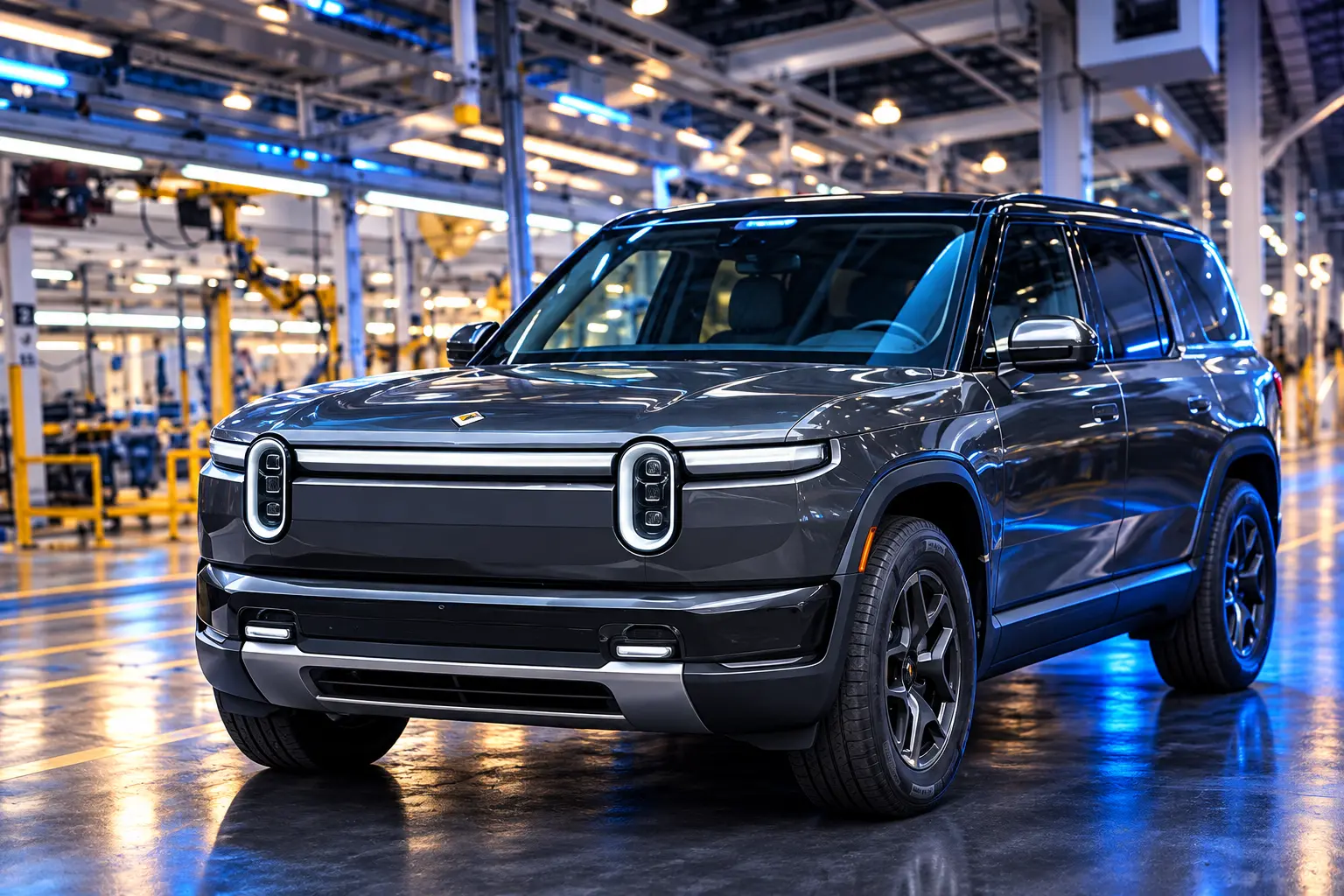
Rivian delivered a record 19,248 vehicles and built 19,751 at Normal, Illinois, both up sharply from a year earlier. The R2, in its first full quarter, outsold the R1 and the Amazon electric van. Consolidated revenue was $2.155 billion, up 38%. The company raised 2026 delivery guidance to 67,000 to 70,000 vehicles from 65,000 to 70,000, improved its adjusted EBITDA outlook by $100 million at the midpoint to a loss of $1.75 billion to $1.85 billion, and cut planned capital spending by $300 million at the midpoint to $1.40 billion to $1.50 billion.
The plant is moving. The automotive P&L is not. Automotive revenue was $1.550 billion, up 36%, and the segment still posted an $80 million gross loss, better than the $130 million loss a year earlier and still a loss. Rivian booked about $120 million of extra cost of revenue on the R2 ramp and $81 million of regulatory credits that will not show up every quarter. Cost of goods sold per vehicle fell by more than $12,000 from the prior quarter, which is the number the factory has to keep beating if cheaper R2 trims, priced from $45,000 to $57,000, are going to make money.
Q3 2026 GROSS PROFIT BY SEGMENT
| Segment | Revenue | Gross profit (loss) | Margin |
|---|---|---|---|
| Automotive | $1.550 billion | $80 million loss | About -5% |
| Software and services | $605 million | $256 million | 42% |
| Consolidated | $2.155 billion | $176 million | 8% |
Adjusted EBITDA was a $435 million loss, versus $602 million a year earlier. The net loss attributable to common stockholders was $913 million. Free cash flow was a $1.124 billion outflow, versus $421 million a year earlier. Cash, cash equivalents, and short-term investments were $5.502 billion on September 30. Pro forma available liquidity was $7.095 billion after a $1 billion, 10-year Volkswagen term loan funded on October 7 at 6%. Demo drives hit 103,000, up from 57,000 in the second quarter, so people are getting in the R2. They are not yet paying for a car that prints automotive gross profit.
Volkswagen Writes Most of the Software Check
Software and services is the only reason Rivian posted a consolidated gross profit. The segment brought in $605 million, up 45%, and $256 million of gross profit at a 42% margin. Derek Mulvey, then vice president of finance and interim chief financial officer as of October 30, told analysts the autonomy bet is supposed to be the long-run version of that line.
We believe autonomy is a primary product differentiator, market share driver, and long-term value creator.
Derek Mulvey, vice president of finance, Q3 2026 earnings call
The mix underneath that sentence is less romantic. Of the $605 million, $354 million, or 59%, came from the joint venture with Volkswagen Group, which pays Rivian for electrical architecture and software development. Rivian expects to keep recognizing that revenue through about mid-2028. It has received $5.3 billion of $5.8 billion in expected Volkswagen joint-venture capital commitments. Autonomy+, the paid driver-assist package, sits in the same segment, and take rates are “trending ahead of our expectations,” Scaringe said, without giving the rate.
WHAT FILLED THE SOFTWARE LINE
- VW invoices: $354 million, 59% of software and services revenue, booked as development work rather than as a self-driving subscription.
- The end date: Rivian expects to recognize that joint-venture revenue through about mid-2028, the same window as the first Uber robotaxis.
- Autonomy+ itself: Sold as a $49.99 monthly plan or a $2,500 purchase, with a 60-day trial, and bundled on R2 Launch Edition so the R2 take rate is still opaque.
- R&D load: Research and development was $485 million, up from $453 million, with the increase tied to AI and autonomy software.
Scaringe called Volkswagen’s first joint-venture vehicle, due next year as the ID.1, “a billboard for the capability” of Rivian’s electrical architecture. That is a real product. It is also a reminder that the high-margin work already shipping is contract engineering for another carmaker, not Point to Point in customer driveways. Analysts spent the hour on autonomy because that is where they price the stock. The quarter’s software profit was still a Volkswagen invoice.
What Point to Point Will Do on a Real Street
Autonomy+ is already on every R2 and on R1s from the 2025 model year. The feature customers can buy today is Universal Hands-Free, which Rivian says can run hands-free on 3.5 million miles of roads in the US and Canada, plus lane change on command. The car still wants a painted or dotted line. Point to Point is the next step: enter an address, and the vehicle follows the route through city streets, lights, and highway interchanges with the driver still in charge.
Scaringe said he has been using the system on his commute and called it “a wonderful” experience. He also said it is unclear how fast the US car market will treat that capability as a purchase criterion, even as he argued Rivian is “at the front end of an inflection point.” A limited rollout is due later in 2026 through an invitation-only Autonomy Early Access Program, with a general release to Autonomy+ subscribers in 2027. Last week Rivian also bought Third Dimension AI to tighten the simulation loop around its Large Driving Model, the foundation model Scaringe said will run across R2 and newer R1s.
THE AUTONOMY CALENDAR RIVIAN IS ON
- December 11, 2025: Unveils the RAP1 chip and a third-generation stack that adds lidar at Autonomy and AI Day.
- March 19, 2026: Signs the Uber partnership for robotaxis, with investment tied to autonomy milestones through 2031.
- April 2026: Launches Autonomy+ as a paid package, $49.99 a month or $2,500 up front, with a 60-day trial on new deliveries.
- Later in 2026: Starts invitation-only Point to Point, puts lidar and dual RAP1 hardware into an employee validation program, and aims to unlock a $250 million Uber tranche.
- December 9, 2026: Hosts the next Autonomy and AI Day to show the driving, not just the roadmap.
- 2027: Releases Point to Point to Autonomy+ subscribers and aims to put the next hardware generation on customer vehicles.
- 2028: Targets unsupervised R2 robotaxis in San Francisco and Miami, as Volkswagen software revenue is slated to run through about mid-year.
Until Point to Point is in customer cars, the comparison a shopper can actually take is Tesla’s supervised city driving against Rivian’s line-following hands-free. That is a lopsided demo. It is also the demo that exists.
Two Processors and a Lidar Hit the R2 Bill
Current Autonomy+ cars run 10 high-dynamic-range cameras and five radars on a computer Rivian rates at 200 trillion operations per second. The next hardware generation puts two in-house RAP1 processors in the vehicle, 800 TOPS each, for 1,600 TOPS, married to camera, radar, and a lidar sensor. Scaringe said that stack is going through an employee program late this year, with customer availability in 2027. The consumer robotaxi-era suite is specified as 11 cameras totaling 65 megapixels, five radars, and one lidar.
IR chief Chip Newcom has put the lidar at “a few hundred dollars,” down from the thousands to tens of thousands the parts used to cost, and said that bill sits in automotive cost of goods, not in Autonomy+ pricing. Cheap lidar does not make the rest of the stack free. Claire McDonough, still on the call as chief financial officer, said the team is managing “increasing commodity and memory costs.” Mulvey said rising memory and electronics costs “anticipate will continue to impact our profitability.” The R2 is the mass-market car that is supposed to absorb those chips. It is also the car that already carried $120 million of ramp cost in the quarter.
COO Javier Varela said bringing up hundreds of suppliers is “an immense task,” and that the ramp runs at the speed of the slowest one. Adding two processors and a lidar to some R2s does not have to wreck the model. It does land on a vehicle that is not yet gross-margin positive, in a quarter when the company already warned that electronics are getting pricier.
Tesla’s 1.74 Million Paid Drivers
Tesla’s third-quarter update put Full Self-Driving (Supervised) on over 75% of new deliveries in North America, a jump of nearly 20 points from 55% in the second quarter. Active FSD subscriptions, including older lifetime purchases, reached 1.74 million, up 67% from 1.04 million a year earlier. Tesla still tells buyers the system needs an attentive driver and does not make the car autonomous. It also already sells city-street trips that Rivian is validating on a commute and an employee list.
WHAT BUYERS CAN PAY FOR NOW
| Item | Tesla FSD (Supervised) | Rivian Autonomy+ |
|---|---|---|
| Price | monthly subscription of $99 | $49.99 a month or $2,500 |
| Attach rate | Over 75% of new North America deliveries | Not disclosed; “ahead of expectations” |
| Paid users | 1.74 million active | Not disclosed |
| City-to-city supervised driving | Shipping in customer cars | Employee and early access later in 2026; customers in 2027 |
| Sensor bet | Cameras | Cameras and radar now; lidar on the next hardware generation |
Rivian is cheaper, and that is a real wedge if Point to Point works. Scaringe declined to give Autonomy+ take rate and said only that it “has exceeded our expectations.” Launch Edition R2s include the package, which makes the R2 rate even harder to read. Tesla delivered 486,532 vehicles in the same quarter. Rivian delivered 19,248. The data flywheel argument is not subtle, and Scaringe’s answer is lidar, custom silicon, and a driving model he says will transfer across R1, R2, and commercial vans. The unpaid test is whether that stack, in a much smaller fleet, can catch a system that is already on 1.74 million cars.
Uber’s Checks Arrive Only After the Tests
The March 19 deal with Uber is the other clock. Uber is to invest up to $1.25 billion in Rivian through 2031, subject to autonomy milestones, after an initial $300 million. Scaringe said on the call he is “very confident” Rivian will hit the milestone that unlocks another $250 million by year-end. Uber, or its fleet partners, are expected to buy 10,000 fully autonomous R2 robotaxis, with an option on up to 40,000 more beginning in 2030. First commercial deployments are planned for San Francisco and Miami in 2028, then about 25 cities in the US, Canada, and Europe by 2031, exclusive to Uber’s app.
THE UBER MONEY AND THE FLEET
- The investment: Up to $1.25 billion through 2031, milestone-based, with $250 million targeted by the end of 2026.
- The order: 10,000 unsupervised R2 robotaxis, plus an option for 40,000 more from 2030, sold to Uber or its fleet partners with a software fee tied to miles.
- The cities: San Francisco and Miami first in 2028, scaling toward 25 cities by 2031.
- The hardware: The same RAP1, camera, radar, and lidar platform Rivian is still putting through employee builds.
Chip Newcom has already said the 10,000-vehicle order is not a sure thing without a Level 4 capable service. That is the honest version of the 2028 date. Balaji Krishnamurthy, Uber’s chief financial officer, wrote in August that Scaringe had given him a preview of Autonomy+ that “flawlessly drove from Sunnyvale to Cupertino and back,” after which he traded into a Launch Edition R2. A supervised preview on a peninsula commute is not a driverless fleet in Miami. It is, for now, the most specific third-party drive on the record.
Rivian put the next Autonomy and AI Day on December 9, and Scaringe said he looks forward to showing the platform there. Before that date the company still has to run Point to Point with employees and still has to clear the Uber milestone that pays $250 million. Volkswagen’s invoices keep the software line green until about mid-2028. The robotaxis are scheduled for the same window.
Disclaimer: This article is news reporting and analysis of Rivian’s public earnings materials, product pages, and partnership terms, and it is for information only. It is not investment advice, a recommendation to buy or sell Rivian, Tesla, Uber, or Volkswagen securities, or a forecast of deliveries, take rates, or robotaxi timing. Readers who are considering a financial decision should consult a licensed investment adviser or other qualified financial professional who can review their own situation. Figures, guidance, and program dates reflect the companies’ disclosures as of the dates named in this article and can change with later filings, hardware delays, or missed milestones.

Xiaomi 18 Pro Goes Global as Its Privacy Filter Falters

iFixit Finds HomeView Glued Shut After Repair Gains

Polymetallic Nodules Shelter 4,139 Animals Miners Want

One UI 9.5 Puts Now Brief Behind a System Agent

Framework’s $99 Keyboard Brings Laptop Repair to the Couch

Microsoft 365 Auth Fault Took Down Exchange and Teams

OpenClaw 2.0 Ships a Team Workplace With Host-Trust Defaults

Xbox Caps Game Pass Cloud Gaming at 15 Hours

OpenAI Unveils GPT-6 Astra With a Critical Cyber Label

Squishy Dumpling Toys Recalled After Hiding Illegal Water Beads
-
 NEWS3 months ago
Microsoft 365 Auth Fault Took Down Exchange and Teams
-
 GAMING3 months ago
Xbox Caps Game Pass Cloud Gaming at 15 Hours
-
 NEWS3 months ago
OpenClaw 2.0 Ships a Team Workplace With Host-Trust Defaults
-
 NEWS3 months ago
OpenAI Unveils GPT-6 Astra With a Critical Cyber Label
-
 LIFESTYLE3 months ago
Squishy Dumpling Toys Recalled After Hiding Illegal Water Beads
-

 BUSINESS3 months ago
Diesel Breaks Its Record as the White House Claims Credit
-

 NEWS3 months ago
IFA 2026’s Weird Gadgets Are Building a Sensor Home
-

 BUSINESS3 months ago
ChargePoint Stock Rally Prices Wilmer’s Three-Year Cash Plan