
BUSINESS
Anthropic’s First Close Hands Index Funds a $1.28 Trillion Name
Anthropic stock closed at $97.17, 17% above its $83 IPO, and now faces Nasdaq-100 funds, a 23-date lock-up, and a Senate AI bill.

Anthropic stock closed at $97.17 on Nov. 19, up 17% from its $83 IPO price after opening at $111.50. The Claude maker listed on Nasdaq as ANT after selling 980 million Class A shares the night before. Most of the opening pop was gone by the close, and the public company now faces index funds, a staged lock-up, and a Senate bill filed the same day.
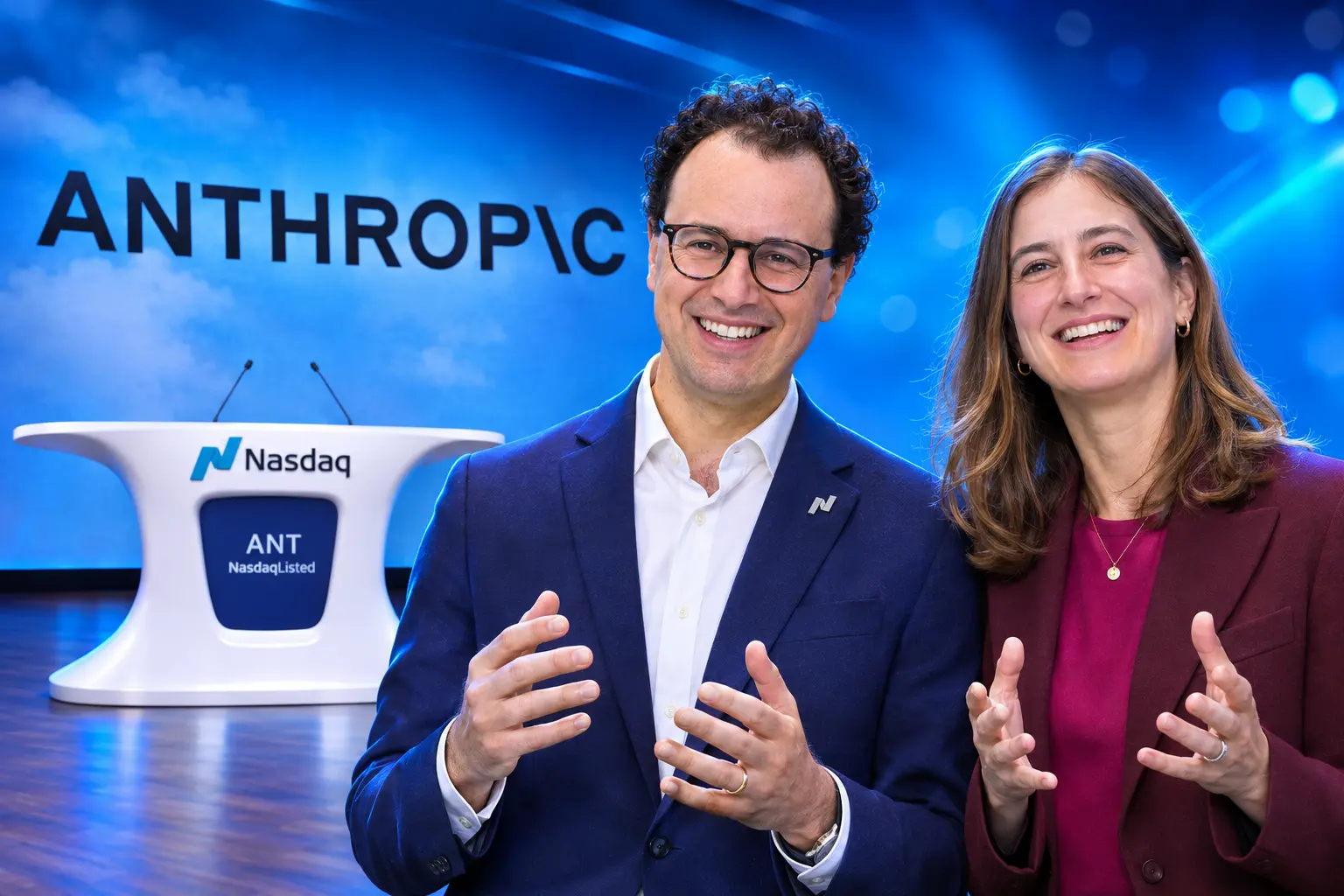
Chief executive Dario Amodei and president Daniela Amodei rang the opening bell at Nasdaq’s Times Square studio. The offering was set to settle on Nov. 20. Founded in 2021, Anthropic is a public benefit corporation, and the first session already showed how thin the tradable stock is next to the claims now attached to it.
Shares Opened at $111.50 and Closed at $97.17
The first one-minute bar printed at 11:48 a.m. Eastern at $111.50, 34% above the $83 offering price. The high was $115.10 in that first minute. The stock then slid, traded as low as $95.05 around 12:19 p.m., and finished at $97.17, still 17% above the IPO price and about 13% below the open.
THE FIRST PRINT AND THE CLOSE
- Offering price: $83.00, set on Nov. 18 above a $70 to $78 range.
- First trade: $111.50, then a $115.10 high in the opening minute.
- Close: $97.17, up 17% from $83 and well below the first print.
- Value on 13.22 billion shares: about $1.10 trillion at $83, $1.47 trillion at the open, and $1.28 trillion at the close.
On the 13.22 billion shares the final prospectus lists as outstanding, that close is a $1.28 trillion company. The same share count was worth about $1.47 trillion at $111.50. The rest of the tape was weak, with the Nasdaq Composite, the Dow, and the S&P 500 all lower on the session, so ANT still stood out even after the fade.
Retail flow was loud and two-sided. Vanda Research recorded $18.6 million of net retail buying in the first 30 minutes, behind SpaceX’s $25.6 million in June, on $255 million of retail turnover, more than double SpaceX’s early window. Analyst Viraj Patel wrote that retail traded the stock hard but took both sides rather than a one-way bid, with the retail buy share slipping from 57.2% to 52.5%. Buyers funded some of those purchases by selling other single names, led by AMD, as Nvidia buying stalled.
ARK Invest’s Nov. 19 trade notice showed 934,968 ANT shares bought across six of its active ETFs, about $90.9 million at the close. That ticket is small next to 980 million new shares. It still shows the kind of dedicated AI buyer who showed up after the open had already given back most of the pop.
The Sale Came With a $26 Billion Side Deal
Anthropic priced 980 million Class A shares at $83.00 on Nov. 18, above the $70 to $78 range filed earlier in the month. The company sold 956.4 million of those shares. Selling stockholders, the seven cofounders among them, sold 23.6 million and keep those proceeds. The base offering is $81.34 billion before expenses, larger than SpaceX’s $75 billion June IPO. Underwriters led by Goldman Sachs and Morgan Stanley have a 30-day option on 147 million more shares.
A separate $26.0 billion sale of nonvoting Class N stock closed alongside the IPO at the same $83 price, 313 million shares in all. Anthropic estimates net proceeds of about $104.8 billion from the two deals after fees, and pro forma cash and short-term investments of $232.4 billion. The banks’ discount on the public book was $550 million. Some $4.3 billion of the cash is earmarked for tax withholding on restricted stock that settled at the listing.
THE $26 BILLION SIDE BUYERS
- Google: $10.0 billion of Class N stock at $83.
- NVIDIA: $10.0 billion at the same price.
- AMD: $2.5 billion.
- Broadcom, Micron, and Microsoft: $1.0 billion each.
- TSMC: $0.5 billion.
Those seven checks do not count as IPO proceeds, and the Class N paper is not under the employee lock-up. Combined with the $81.34 billion public book, the two sales total $107.3 billion. Retail received under 20% of the Class A shares, through a selling group that included Charles Schwab, Fidelity, Robinhood, SoFi, and E*TRADE. Nasdaq president Nelson Griggs later put the retail slice closer to 13%, versus about 25% in the SpaceX deal.
How Anthropic Makes Its Money
Claude is sold two ways. Developers and companies pay for tokens through the API, the Claude Platform, and cloud marketplaces. Individuals and offices pay monthly for Pro, Max, Ultra, Team, and Enterprise seats. In the nine months through Sept. 30, usage fees were $26.3 billion, 79% of revenue, and subscriptions were $6.9 billion, 21%. Cloud marketplaces took 44% of that nine-month total. The United States was 71% of billings.
Third-quarter revenue was $17.0 billion, twelve times the $1.38 billion in the same quarter of 2025. Nine-month revenue was $33.2 billion. Trailing twelve-month revenue was $35.3 billion. Anthropic also publishes a run-rate figure it does not treat as GAAP: about $81 billion as of Oct. 31, up $10 billion from Sept. 30, built from 28 days of usage fees times 13 plus annualized subscriptions.
The customer list is concentrated at the top and still expanding. More than 11,900 accounts with at least $100,000 of trailing revenue produced $26.1 billion, 74% of that twelve-month total. More than 1,900 accounts were above $1 million. Net revenue retention was about 900%. The top five customers were about 25% of nine-month revenue, and no customer reached 10%.
The bill for that growth is compute. Compute and infrastructure were 58% of third-quarter revenue. The prospectus lists about $900.9 billion of committed spend, including $121.3 billion with Google, up to $120.5 billion with SpaceXAI, $110.0 billion with Amazon, and at least $47.2 billion with Microsoft. Anthropic posted a $1.26 billion operating loss for the nine months, including a $567 million operating loss in the third quarter after a $974 million operating profit in the second. Cash from operations for the nine months was positive even so, at $6.57 billion, which is why the listing is a refinancing of a business that already throws off cash and still does not show an operating profit.
Nasdaq Rewrote Its Rules for Listings This Large
ANT is already large enough to sit among the biggest non-financial names on Nasdaq, which is the point of a rule Nasdaq put in place on May 1 for companies that list at this scale. Under the older playbook a new stock waited at least three full calendar months, then took its chances at the December reconstitution. The new Fast Entry pathway for large listings lets a stock that ranks in the top 40 of the Nasdaq-100 by full market capitalization skip that wait. Emily Spurling, global head of index at Nasdaq Global Indexes, said the path is there so the benchmark can move when a company of this size comes to market, while weights still rest on listed shares and a cap of three times free float.
Griggs told an interviewer that Nasdaq will look at Anthropic after the seventh business day and that, if it is in that top 40, “which clearly it looks like they will be, they will go into the index.” He pointed to the yearly reconstitution in December as the likely vehicle. Full market capitalization for ranking includes unlisted classes, so the 13.22 billion share count is the size test, not the 980 million shares that actually trade. Weighting is tighter. For a name with a small float, index weight is the lesser of full listed value or three times the free-float value, which is how Nasdaq tried to keep passive buying from overwhelming a thin book.
HOW FAST ENTRY WORKS
- Day 1: The stock begins trading on an eligible exchange. For ANT that was Nov. 19.
- End of day 7: Nasdaq runs the seventh trading day evaluation against the top 40 by full market cap, with the usual seasoning rule waived.
- After day 10: If the name qualifies, inclusion is announced after the close.
- After day 15: The stock is added after the close, effective at the next open, and no existing member has to be removed until the next reconstitution.
Funds that track the Nasdaq-100 then have to own it at whatever price the tape is printing. They pay for the shares by trimming other holdings. SpaceX used the same door after its June listing and later saw its weight rise again at a quarterly rebalance as more stock came free. Anthropic’s seventh session falls at the end of November, which is also the ranking window for the December reconstitution, so the fast path and the annual review may collapse into one event. Nothing is added until Nasdaq says so. The rule, and Griggs’s reading of the top 40, is why retirement accounts that never asked for Claude already have a date on the calendar.
Twenty-Three Lock-Up Dates Sit on the Calendar
The float that those funds would buy is still small. About 15.5 billion Class A-equivalent shares sit under lock-up or market standoff agreements, for up to 180 days for most holders and up to 365 days for the cofounders and certain holders above 0.5% of fully diluted shares. The prospectus does not use one 180-day cliff. It lists 23 release dates, counted from a Nov. 18 prospectus date, and several of those dates move with earnings.
Up to 315 million Class A shares held by non-founder directors, officers, employees, and consultants were eligible on the first trading day, up to 10% of their locked stock. Being allowed to sell is not the same as selling. The next fixed dates are Dec. 15, Jan. 5, Jan. 19, and Feb. 2. The largest later blocks are tied to full-year 2026 results, then to first-quarter 2027 results or day 180, which is May 17, 2027 at the latest. The cofounders’ outer date is the earlier of third-quarter 2027 results or Nov. 18, 2027.
SHARES THAT CAN REACH THE MARKET
| Earliest window | Up to, Class A | Up to, Class N |
|---|---|---|
| Nov. 19, 2026, first trading day | 315 million | – |
| Dec. 15, 2026 to Feb. 2, 2027 | 754 million | 560 million |
| After FY2026 results, then five steps | 2.88 billion | 1.29 billion |
| Q1 2027 results or day 180, then four steps | 3.25 billion | 1.57 billion |
| After Q2 2027 results, then five steps | 941 million | 2.13 billion |
| Q3 2027 results or day 365 | 1.40 billion | 503 million |
Jim Prosser, founder of Tamalpais Strategies, has long argued that a failed IPO is the worst outcome and that a wildly successful one is the second worst, because it “changes the scorecard underneath you” and pulls every later quarter up with it. ANT did not fail. It also did not hold $111.50. The open-to-close fade already priced in some of the supply the calendar will keep adding, which is why Dec. 15 is the first date that will test whether that fade was a one-day flush or a preview.
Four Senators Filed an AI Bill on Listing Day
The same Thursday, Sens. Mark Warner of Virginia, John Kennedy of Louisiana, Angela Alsobrooks of Maryland, and Mike Rounds of South Dakota introduced the AUDIT AI Act, a bipartisan AI investment disclosure bill aimed at public companies. It would make firms say whether they have an AI governance policy and a board committee for AI, identify joint ventures and special-purpose vehicles used to finance infrastructure, and standardize risk language on third-party models, compute concentration, costs, and data. The SEC would study how companies account for AI research, revenue, and capital spending, and report each year on automated trading and herding.
AI has enormous potential to transform our economy, but the trillions of dollars pouring into this technology come with real financial risks. Investors and policymakers deserve to know where that money is going, how these deals are being financed, and what risks are involved.
Sen. Mark Warner, D-Va., AUDIT AI Act announcement, Nov. 19, 2026
The release cites a Brookings paper that puts $10.3 trillion of AI infrastructure spending from 2025 to 2032, about 3.6% of U.S. GDP a year. Rep. Pramila Jayapal of Washington said Wall Street should not be “cashing in on a company that could turn out to be a ticking time bomb.” Sen. Elizabeth Warren of Massachusetts, the Banking Committee’s top Democrat, had already written Amodei to argue that listing could tie retirement savings to a technology the company itself has described in existential terms, and she used the pricing day to say regulators were behind.
That is not a law yet. It is the file that opened the hour ANT started trading, and it is the file public-company Anthropic now answers on, along with the $900.9 billion of compute commitments already in the prospectus.
A Trust and One Share Still Run the Board
Buyers of ANT bought economics, not control. A Founder LLC holds one Class F share with 50.1% of the votes. A Long Term Benefit Trust elects a majority of the board through one Class T share. Amazon holds 34.4% of the nonvoting Class N stock and Google holds 31.5%. The public Class A line is the slice that priced at $83 and closed at $97.17. The people who can still set safety policy, board makeup, and the pace of training are the people who set them last week.
Amodei used the bell to repeat that point. He said Anthropic would “pace the training and deployment of AI systems, taking as long as is necessary to have confidence that they are safe and will remain under human control,” and that the firm would “not bend to either business nor political pressure.” Daniela Amodei told viewers uneasy about the technology, “This technology needs you. Not your trust, not your use, but your voice.” Those lines are now part of a listed company’s first-day record, next to a 17% gain, a $1.28 trillion close, and a lock-up that starts in earnest on Dec. 15.
Index funds may have to own that package before the first full public quarter is even printed. The float they would buy is still a fraction of the 13.22 billion shares, and the next supply is already dated. That is the aftertaste of a debut that closed green.
Disclaimer: This article is news reporting and analysis of Anthropic’s IPO and first trading session, and it is for information only. It is not investment advice, a recommendation to buy or sell ANT or any other security, or a forecast of index inclusion, lock-up selling, or legislative outcomes. Readers should consult a licensed financial adviser, broker, or other qualified professional who can review their own holdings, tax position, and risk tolerance before acting on any figure in this piece. Share prices, share counts, lock-up dates, index rules, and bill language are taken from the cited filings and statements as of Nov. 20, 2026, and all of them can change.

The Strip Bojangles That Charged $100 for 10 Minutes

The Security Fixes Took Microsoft and the NSA Offline

iOS 27 Finally Shrinks the Giant iPhone Lock Screen Clock

AirPods Pro 3 Are $179 Again, Below Last Year’s Cut

Dragon Returns ISS Samples Only It Can Bring Home

Microsoft 365 Auth Fault Took Down Exchange and Teams

OpenClaw 2.0 Ships a Team Workplace With Host-Trust Defaults

Xbox Caps Game Pass Cloud Gaming at 15 Hours

OpenAI Unveils GPT-6 Astra With a Critical Cyber Label

Squishy Dumpling Toys Recalled After Hiding Illegal Water Beads
-
 NEWS3 months ago
Microsoft 365 Auth Fault Took Down Exchange and Teams
-
 NEWS3 months ago
OpenClaw 2.0 Ships a Team Workplace With Host-Trust Defaults
-
 GAMING3 months ago
Xbox Caps Game Pass Cloud Gaming at 15 Hours
-
 NEWS3 months ago
OpenAI Unveils GPT-6 Astra With a Critical Cyber Label
-
 LIFESTYLE3 months ago
Squishy Dumpling Toys Recalled After Hiding Illegal Water Beads
-

 BUSINESS3 months ago
Diesel Breaks Its Record as the White House Claims Credit
-

 NEWS3 months ago
IFA 2026’s Weird Gadgets Are Building a Sensor Home
-
 BUSINESS3 months ago
ChargePoint Stock Rally Prices Wilmer’s Three-Year Cash Plan