
NEWS
The Hormuz Shock Turns Electricity Into the Security Fuel
The IEA says the Hormuz shock makes electricity the security fuel, lifting solar and nuclear while letting Asian coal run longer as backup.

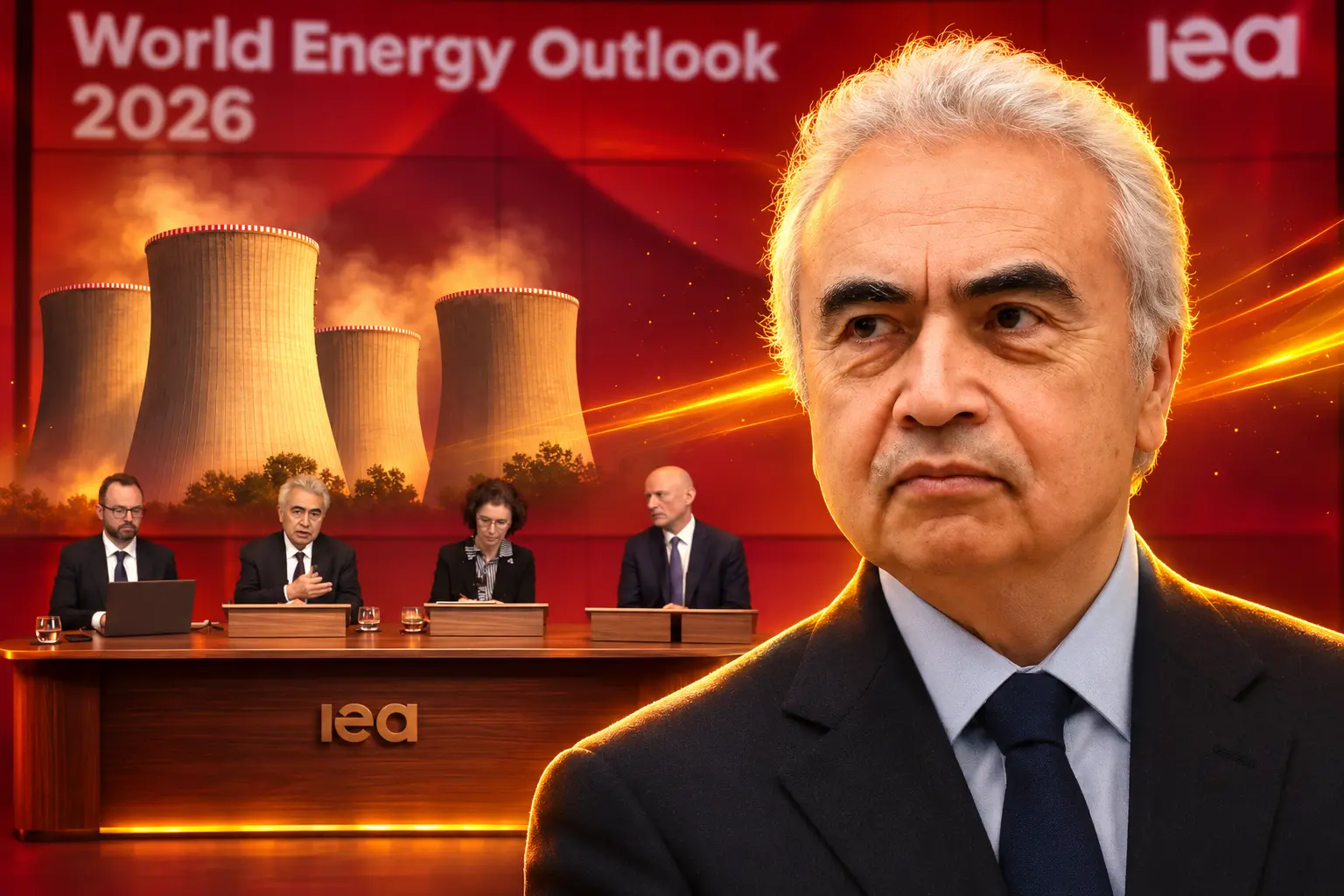
The IEA said on 19 November that the Hormuz crisis is the largest energy supply shock on record. Fatih Birol, the agency’s executive director, said he sees no credible path back. The shift underneath the missing oil is that governments now treat electric power as the security fuel.
Solar and nuclear stand to gain most, and coal in parts of Asia gets a longer job as backup. Climate talks in Antalya want electricity at 35 percent of energy use by 2035, without requiring that power to be clean.
Electricity Is the Security Fuel Now
The Paris agency’s World Energy Outlook 2026 is not a single forecast. It runs several cases because the Middle East conflict, which began on 28 February 2026, is still in flux, and because climate risk, trade fights and cyberattacks have widened the range of energy futures.
In a note on the largest energy supply shock in history, the IEA said the 2026 crisis is likely to leave lasting marks and to put security and cheaper bills at the front of energy decisions. Birol said the longer the crisis lasts, the deeper the effects will be.
The Hormuz crisis has delivered a huge shock to the system. While the energy sector and the global economy have shown considerable resilience, the longer the crisis lasts, the deeper the effects will be. And I don’t see any credible pathway for the energy world to return to the way it was before.
Fatih Birol, Executive Director, International Energy Agency
Since 2019, electricity demand has grown 3.3 percent a year, faster than the world economy at 2.9 percent and twice as fast as total energy demand at 1.5 percent. The outlook says that share of final energy use, 23 percent in 2025, is closing in on 30 percent by 2035 in its current-policy and stated-policy cases. Twenty-five countries have announced new electric-power rules since February, and the agency said sales of electric kit, solar panels and batteries have jumped in countries hit by the fuel shock.
Laura Cozzi, the IEA’s director of sustainability, said security policy and transition policy are lining up in a way the agency has not seen, with electric power at the centre of the crisis response. Birol posted the same turn in shorter form as the report went out.
The Hormuz crisis has delivered a huge shock to the energy system, dwarfing the scale of past crises
The longer it lasts, the deeper the effects. Diversification, domestically available resources & electrification = the big winners
Read @IEA's WEO 2026: https://t.co/Hf2jiaskjm pic.twitter.com/qvouKNbgyM
— Fatih Birol (@fbirol) November 19, 2026
He also warned countries not to swap one dependency for another. Grids, critical minerals, weather and cyberattacks now sit beside oil tankers on the risk list. Peak electricity demand rises 40 to 50 percent by 2035 across the agency’s cases, and data-centre power doubles to 1,000 terawatt-hours by 2030 in the stated-policies case.
Oil Through Hormuz Could Fall Below 2 Million Barrels
Before the war, about 20 million barrels a day of crude and products moved through the Strait of Hormuz, around 25 percent of seaborne oil trade in 2025. The IEA said that if shipping risk lasts, new bypass pipes, other suppliers and efforts to cut oil use could drop that flow to 8.5 million barrels a day in 2030 and to under 2 million barrels a day by 2035.
Even in that extreme case, the Middle East would still be the world’s largest oil exporter. The chokepoint shrinks. The region does not vanish from the market. Three-quarters of the world’s people live in oil- and gas-importing countries, and more than 4 billion live in countries that lean on the strait for more than 30 percent of their oil.
WHO STILL DREW CRUDE THROUGH HORMUZ IN 2025
| Importer | Share of crude imports via Hormuz |
|---|---|
| Southeast Asia | 66% |
| Japan and Korea | 63% |
| China | 44% |
| India | 41% |
| European Union | 6% |
That map is why the second shock is an Asian electricity shock more than a European one. Japan, Korea, India, China and Southeast Asia drank the strait. Europe did not. By the end of October 2026, lost Gulf oil supply had reached 2.8 billion barrels, which is seven times the 400 million barrels IEA members put on the market in March.
Bruce Douglas, chief executive of the Global Renewables Alliance, said each day of the fuel crisis costs importers an extra $1.8 billion. Mohamed Adow, director of Power Shift Africa, put the household version in one line: a fight thousands of miles away can send energy bills soaring at home.
Solar, Nuclear and a Longer Life for Asian Coal
The outlook sees three common moves, even though national plans differ. Spreading suppliers and routes is the first. Preferring fuel and power you can produce at home is the second. Faster electric use in cars, buildings and factories is the third. Birol’s own summary was that diversification, domestic resources and electrification are the big winners.
THREE MOVES AFTER HORMUZ
- More suppliers: Governments want extra routes, extra fuels and extra kit supply chains, not a single strait.
- Home resources: Solar, wind, nuclear, efficiency, biofuels and, in some countries, local fossil fuels all get a security premium.
- Electric end uses: Motors, air-conditioners, electric vehicles, heat pumps and data centres pull demand onto the grid.
Renewables led by solar PV, and nuclear plants, grow strongly in every case the report tests. Near 90 gigawatts of new nuclear was under construction by mid-2026, the most in more than 35 years, and more than 50 countries now have nuclear plans or targets, including small modular reactors. Nuclear’s share of electricity is 9 percent today; the IEA raised its outlook, with most of the extra in China and the United States, and said nuclear could grow faster than power demand.
Coal is the rider on that verdict. The Additional Response Case, which tests stronger crisis replies that are not yet formal policy, also supports coal where domestic reserves are large. The IEA’s own policy tracker notes that some governments have already switched power from gas to coal. Michelle Manook of FutureCoal, the industry group once called the World Coal Association, said that for coal-rich economies, domestic coal remains an important energy security asset.
That is not a new coal boom in the global totals. Coal demand got a short-term lift from the crisis, but it is in decline by 2030 in all of the IEA’s cases. In the stated-policies case, coal-fired generation falls about 15 percent to 2035 and industrial coal use falls 5 percent. China accounts for more than half of world coal demand, and the agency said its coal plants are shifting from bulk power toward peaks and flexibility as renewables and nuclear grow. Birol said coal has momentum and that it is not yet clear how long that lasts.
Cooling Demand Has Overtaken Heating for the First Time
The same outlook that tracks tankers also records a quieter turn in buildings. Energy needed to keep buildings cool is now overtaking energy needed to heat them, a first in the agency’s energy history. Cozzi called it the start of a trend that will run through the next decade and beyond.
India, with Southeast Asia, leads the next decade of energy-demand growth as the global population rises by 650 million and the world economy is one-third larger by 2035. China, already among the most electrified large economies, may see electricity’s share of energy use rise from 32 percent in 2025 to 43 percent by 2035, the highest among major economies.
THE COOLING TURN
- The crossover: Cooling buildings now uses more energy than heating them, the IEA said.
- Extra power: Electricity for cooling rises by 1,700 terawatt-hours by 2035 in the stated-policies case, inside more than 10,000 terawatt-hours of new electricity demand over the decade.
- Heatwave case: Stronger, longer heat adds 700 terawatt-hours, about 40 percent more, with the stress landing on peak demand.
- The access gap: About 85 percent of households in emerging economies outside China face high heat, and fewer than 20 percent have air conditioning.
Hot summers in places that used to be milder, including Europe, are part of that load. So is rising income. Cooling is an electric load by design, unlike a gas boiler, so the climate signal and the security signal point at the same grid. That is the overlap Cozzi described. It is also a new reliability problem, because the hours that need the most power are the hottest hours.
Why COP31’s 35% Target Outruns Today’s Policies
COP31, the UN climate talks in Antalya from 9 to 20 November 2026, made electric power its flagship. The presidency’s 35-by-35 pledge aims to lift electricity’s share to 35 percent of final energy use by 2035, from around 23 percent now. Murat Kurum, COP31 president and Turkey’s environment minister, said the fuel crisis shocked governments out of complacency and showed the risk of depending on energy imports.
The IEA is secretariat to the presidency’s electrification board and will track the pledge. Birol said the 35-by-35 goal can accelerate progress beyond the path already in the outlook. That gap is the point. In the IEA’s current-policy and stated-policy cases, the world only closes in on 30 percent by 2035. The 35 percent figure is the pace the presidency ties to a 1.5 degrees Celsius path, not the path governments are on.
ELECTRICITY’S SHARE OF FINAL ENERGY USE
| Case | Share |
|---|---|
| 2025, IEA | 23% |
| 2035, IEA current- and stated-policy cases | Closing in on 30% |
| 2035, COP31 35-by-35 goal | 35% |
Chris Bowen, president of negotiations, said electrification cuts bills and emissions when it is backed by clean power, stronger grids and storage. The pledge text does not lock that in. UN papers on the table do not spell out that the extra power must come from renewables, which means coal and gas plants can feed the target, at least at first. Dave Jones, co-founder of the think tank Ember, said governments are only beginning to grasp how much energy crises change the world over the long term.
Rachel Cleetus, climate program director at the Union of Concerned Scientists, said the fossil energy crisis had already changed the system and added to the case for a rapid shift to clean power. The talks can raise electricity’s share and still burn more coal to keep the lights on during a tanker war. That is the cheap version of security, and it is on the table in Antalya because the text never closed it off.
The Agency Built in 1974 Faces a Larger Shock
The IEA exists because of the last great oil break. It was created in 1974 after the 1973-74 embargo, and the Hormuz year is the test that now dwarfs those shocks, Birol wrote in the outlook’s foreword. The agency’s first answer was still oil in tanks.
THE HORMUZ YEAR
- 28 February 2026: The Middle East conflict begins, and oil flows through the Strait of Hormuz start to break down.
- 11 March 2026: All 32 IEA member countries agree to make 400 million barrels available from emergency stocks, the sixth collective action after 1991, 2005, 2011 and two rounds in 2022.
- End of October 2026: Cumulative lost oil supply from the Gulf reaches 2.8 billion barrels, larger than any previous shock.
- 9 November 2026: COP31 opens in Antalya with the 35-by-35 electricity pledge as the host’s main energy offer.
- 19 November 2026: The World Energy Outlook 2026 is published, with Birol saying there is no credible path back to the old energy order.
Well-filled tanks, the stock release, bypass routes, more Atlantic exports and a sharp cut in Chinese crude imports blunted the first hit. The IEA said the burden is now falling on consumers through destroyed demand and high prices. This is the second major energy crisis in five years, and it has already begun to dent a 2025 gain in energy access. Around 720 million people still lack electricity, and nearly 2 billion still cook with dirty fuels.
Nuclear readers treated the outlook as a 1970s-style revival, because home-grown firm power is what a blocked strait cannot touch. The live argument on 20 November was still the waterway itself, with tanker risk moving oil prices. The report’s new phrasing around peak supply loss sits beside that fact: the missing barrels are already historic in scale, and the crisis is not over.
The Shock Does Not Close the 1.5 Degree Gap
Birol said energy security and energy transitions have never been so closely aligned. He also wrote that security concerns alone are not enough to close the gap with a 1.5C-aligned pathway. On current and stated policies, the IEA put temperature outcomes in a range from 2.5 degrees to 2.9 degrees Celsius. New national climate plans, it said, do not show a big extra cut in energy-sector greenhouse gases compared with the last round.
A clear end to the conflict could even refill a buyer’s market for oil and gas, as delayed liquefied natural gas hits the system and inventories are rebuilt. Structural demand changes, especially faster electric use, would still sit on the other side of that scale. Cozzi said the world will not look the same after this crisis, and that the exact shape still depends on the next few months.
On 20 November, tanker risk in the strait still moved oil markets, the condition Birol said would deepen the shift.

The Strip Bojangles That Charged $100 for 10 Minutes

The Security Fixes Took Microsoft and the NSA Offline

iOS 27 Finally Shrinks the Giant iPhone Lock Screen Clock

AirPods Pro 3 Are $179 Again, Below Last Year’s Cut

Dragon Returns ISS Samples Only It Can Bring Home

Microsoft 365 Auth Fault Took Down Exchange and Teams

OpenClaw 2.0 Ships a Team Workplace With Host-Trust Defaults

Xbox Caps Game Pass Cloud Gaming at 15 Hours

OpenAI Unveils GPT-6 Astra With a Critical Cyber Label

Squishy Dumpling Toys Recalled After Hiding Illegal Water Beads
-
 NEWS3 months ago
Microsoft 365 Auth Fault Took Down Exchange and Teams
-
 NEWS3 months ago
OpenClaw 2.0 Ships a Team Workplace With Host-Trust Defaults
-
 GAMING3 months ago
Xbox Caps Game Pass Cloud Gaming at 15 Hours
-
 NEWS3 months ago
OpenAI Unveils GPT-6 Astra With a Critical Cyber Label
-
 LIFESTYLE3 months ago
Squishy Dumpling Toys Recalled After Hiding Illegal Water Beads
-
 BUSINESS3 months ago
Diesel Breaks Its Record as the White House Claims Credit
-

 NEWS3 months ago
IFA 2026’s Weird Gadgets Are Building a Sensor Home
-
 BUSINESS3 months ago
ChargePoint Stock Rally Prices Wilmer’s Three-Year Cash Plan