
NEWS
Dragon Returns ISS Samples Only It Can Bring Home
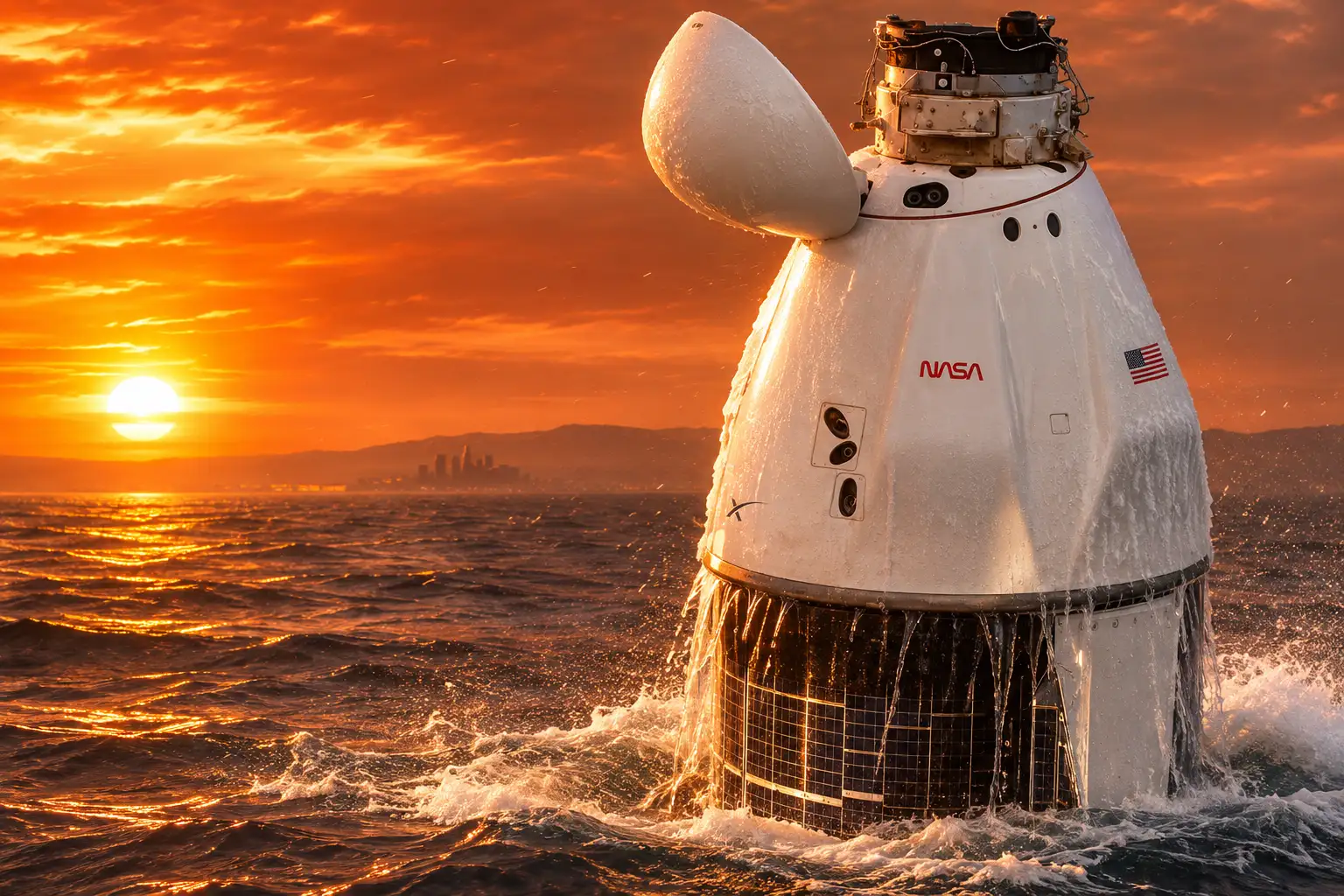
SpaceX’s CRS-35 Dragon splashed down off California on Nov. 21 with bioprinted vessels and frozen samples no other ISS cargo ship can return.

A SpaceX Dragon cargo capsule splashed down near Los Angeles at 2:03 p.m. PST on Nov. 21, ending NASA’s CRS-35 flight. It had left the International Space Station 29 hours earlier with frozen samples no other cargo ship flying today can land intact.
The drop into the Pacific closed a 39-day run that began at Cape Canaveral. What NASA wants next sits in freezers and bags, not in the parachutes.
Dragon Splashed Down off Los Angeles With Frozen Samples
SpaceX flight controllers sent Dragon away from the Harmony module’s space-facing port at 12:05 p.m. EST on Nov. 20, while the station was 260 miles (418 kilometers) over western China. NASA logged the undock at 11:05 a.m. CST. Four departure burns pushed the capsule clear, and the company later said the trunk had been jettisoned and the nosecone closed with splashdown about 32 minutes out.
Four main parachutes opened before the water. SpaceX also warned that the capsule would announce itself with a brief sonic boom. NASA did not stream the reentry or the landing and said updates would go on its space station blog instead.
CRS-35 FROM LAUNCH TO THE WATER
- October 13, 2026: A Falcon 9 lifts Dragon from Space Launch Complex 40 at Cape Canaveral Space Force Station at 6:33 a.m. EDT with more than 6,300 pounds of cargo.
- October 15, 2026: The capsule arrives at the station and begins unloading for the Expedition 75 crew.
- November 18, 2026: An earlier undocking target slips after rough seas in the California recovery zone.
- November 20, 2026: Dragon undocks at 12:05 p.m. EST and starts a 29-hour trip home.
- November 21, 2026: The uncrewed capsule splashes down at 2:03 p.m. PST in the Pacific near Los Angeles.
SpaceX confirmed the landing in a single line that closed the flight for the public record.
Splashdown of Dragon confirmed, completing SpaceX’s 35th Commercial Resupply Services mission to the @Space_Station!
— SpaceX (@SpaceX) November 21, 2026
Recovery teams now have the capsule. The science clock starts on the ground, where frozen constructs and microbes have to stay cold enough to be worth the ride.
Bioprinted Vessels, Frozen Tumors, and Station Lights
NASA said thousands of pounds of cargo came back from the station, including research samples meant to help future crews and patients on Earth. The agency named four investigations in its splashdown update and left the rest of the bags in that bulk figure.
SCIENCE NASA NAMED ON THE WAY DOWN
- Blood vessel construct: A 3D-bioprinted sample used to study vascular aging and cardiovascular disease in space and on Earth.
- Tumor organoids: Frozen mini-tumors treated aboard the station, which researchers will use to hunt better cancer treatments and more personal drug tests.
- Microbial samples: Frozen cultures for work on how antibiotic-resistant bacteria survive, adapt, and evolve in orbit.
- Station lighting: A lighting system that spent more than three years on the outpost while researchers tested sleep and well-being on long flights.
Those items only matter if they arrive whole. A bioprinted vessel that burns on the way in is a photo in a mission log. A frozen organoid that thaws in the wrong place is waste. Dragon’s heat shield and parachutes are the reason those bags were packed at all.
NASA’s launch papers for the same flight had already advertised other biology headed the other way, including hardware to build artificial retinas layer by layer and brain organoids tied to Alzheimer’s, Parkinson’s, and multiple sclerosis research. The splashdown list is narrower. It is also the list Earth labs can now touch.
How the Crew Printed Blood Vessels in Columbus
The vessel construct did not arrive as a finished souvenir. In an Oct. 22 station update, NASA said the Expedition 75 crew put the BioFabrication Facility to work in the Columbus laboratory module, printing blood vessels using vascular cells.
NASA flight engineer Luke Delaney took the cells out of a science freezer, thawed them, and mixed them with a biological printing material. He loaded that mix into the printer and powered the device on. Flight engineer Anil Menon then preserved and nourished the newly printed tissues inside the machine so they could keep growing.
The returning research includes a 3D-bioprinted blood vessel construct used to study vascular aging and cardiovascular disease in space and on Earth.
NASA, International Space Station blog, Nov. 21, 2026
Jessica Watkins and Canadian Space Agency astronaut Joshua Kutryk spent part of that same busy stretch on a spacesuit fit check in the Quest airlock, work that accounts for how bodies change in weightlessness, including a longer spine. The printer session is the piece that now sits in a return bag. Gravity on Earth pulls soft gels out of shape as they set, which is why crews bother to print in orbit at all. The test of that work still happens in a lab with benches and microscopes, not in Columbus.
Cygnus, Progress, and HTV-X Still Burn Up
Dragon is the only cargo craft flying to the station that can make this kind of downward delivery. Northrop Grumman’s Cygnus, Russia’s Progress, and Japan’s HTV-X are built as one-way trucks. After they leave, they are steered into the atmosphere and destroyed.
ISS CARGO SHIPS AND WHAT COMES BACK
| Vehicle | Operator | End of mission |
|---|---|---|
| Cargo Dragon | SpaceX | Parachute splashdown with pressurized cargo |
| Cygnus | Northrop Grumman | Destructive reentry |
| Progress | Roscosmos | Destructive reentry |
| HTV-X | JAXA | Destructive reentry |
Crew ships are a different file. Soyuz and Crew Dragon can carry people and a small amount of cargo home, but they are not the station’s freight service. The lab’s large, cold, and awkward return load still needs a cargo capsule with a heat shield.
That split is why a splashdown off California is the quiet half of station logistics. Food and tanks can ride a vehicle that is going to burn. A printed vessel, a frozen tumor model, and a bag of resistant bacteria cannot. After 35 SpaceX resupply flights, the landing is easy to treat as weather and parachutes. The station is a workplace because those parachutes exist.
Canadarm2’s Failed Wrist Joint Had One Way Home
The same rule applies to broken metal. On May 27, during normal Canadarm2 work, the Canadian-built arm drew elevated motor current and did not move as expected. NASA and the Canadian Space Agency chose to replace a failed joint on Canadarm2 rather than try to fix it from the ground.
On June 30, NASA astronauts Chris Williams and Jessica Meir finished that swap in a 7-hour, 20-minute spacewalk that ended at 3:40 p.m. EDT. Mission Control in Houston then powered the arm and checked power and data. NASA called the outing U.S. Spacewalk 95 and the 280th spacewalk in support of station assembly, maintenance, and upgrades. CSA astronaut Jenni Gibbons handled communications with the spacewalkers.
NASA said repairs like this are expected after more than 25 years of continuous use, because the arm was designed with replaceable parts. The agency also said the faulty joint would be returned to Earth to be inspected and refurbished for future use if needed. CSA has said Canadarm2 is still doing essential work 10 years past its original design life. None of that inspection happens if the old wrist rides a Cygnus into the atmosphere.
NASA’s splashdown note for CRS-35 did not list the joint beside the vessels and organoids. The June statement still names Dragon’s job in plain language: station hardware that has to be studied is packed for a capsule that can land.
Two Extra Days on Harmony
Dragon spent 36 days at the station, from arrival on Oct. 15 to undocking on Nov. 20. SpaceX had first aimed to leave as soon as Nov. 18, after 34 days docked. Rough water off California pushed the departure. NASA’s mid-November advisory already pointed to Nov. 20 as the no-earlier-than date and to a Saturday splashdown off the coast.
The extra days did not change the return list. They did keep a loaded capsule on Harmony while recovery ships waited for a calmer box of ocean. Hatch closed, cargo aboard, the vehicle sat until the water was fit for a crane.
SpaceX said CRS-35 was the fourth flight for this Dragon, after CRS-26, CRS-29, and CRS-33. Reuse is how the same heat shield keeps showing up for the downmass that Cygnus will never attempt. On the way up, the unpressurized trunk had carried the final pair of station roll-out solar arrays, hardware that stayed in orbit when the trunk was dropped before reentry. Menon and Kutryk had already been assigned an Oct. 29 spacewalk to install a roll-out array on the port truss.
What left the water on Nov. 21 is the part of the flight other cargo ships cannot copy. NASA now has a 3D-bioprinted blood vessel, frozen tumor organoids, microbial samples, and a lighting rig that lived on station for more than three years. Recovery crews off California hold the capsule. The labs that asked for those bags get the last move.
Frequently Asked Questions
What Was NASA’s CRS-35 Mission?
CRS-35 was SpaceX’s 35th cargo flight for NASA’s Commercial Resupply Services program, also tagged as the agency’s SpaceX 35th commercial resupply mission to the International Space Station. The Falcon 9 and Dragon pair lifted more than 6,300 pounds of crew supplies, science, and equipment, including the final pair of International Space Station Roll-Out Solar Arrays in the trunk and investigations such as LambdaVision-1, which tests making artificial retinas in microgravity one thin layer at a time.
Why Can Dragon Return Cargo From the ISS?
Cargo Dragon flies with a heat shield and parachutes and is recovered after splashdown, so pressurized bags can ride back through reentry. Cygnus, Progress, and HTV-X have no landing system for cargo and are destroyed in the atmosphere on purpose, which is why frozen biological samples and failed station parts are booked on Dragon rather than on those one-way freighters.
What Is the BioFabrication Facility on the Space Station?
The BioFabrication Facility is a bioprinter kept in the European Columbus laboratory module and used to print living tissue in orbit. On this increment NASA said Luke Delaney mixed thawed vascular cells with a biological printing material and ran the device, and Anil Menon then kept the printed vessel tissues fed inside the printer so they could be cultivated before packing.
When Did CRS-35 Launch and Dock at the ISS?
Falcon 9 launched Dragon at 6:33 a.m. EDT on Oct. 13, 2026, from Space Launch Complex 40 at Cape Canaveral Space Force Station in Florida. The spacecraft then docked on its own to Harmony’s space-facing port on Oct. 15 and stayed there 36 days before the Nov. 20 undocking.
What Happened to Canadarm2’s Wrist Joint in 2026?
Canadarm2’s wrist joint drew elevated motor current and failed to move during routine operations on May 27, 2026, and NASA and the Canadian Space Agency chose a spacewalk replacement instead of a remote repair. Chris Williams and Jessica Meir installed a new joint on June 30 during U.S. Spacewalk 95, after which Houston powered the arm and confirmed power and data, and NASA said the old joint would come home for inspection and possible refurbishment.

The Strip Bojangles That Charged $100 for 10 Minutes

The Security Fixes Took Microsoft and the NSA Offline

iOS 27 Finally Shrinks the Giant iPhone Lock Screen Clock

AirPods Pro 3 Are $179 Again, Below Last Year’s Cut

Dragon Returns ISS Samples Only It Can Bring Home

Microsoft 365 Auth Fault Took Down Exchange and Teams

OpenClaw 2.0 Ships a Team Workplace With Host-Trust Defaults

Xbox Caps Game Pass Cloud Gaming at 15 Hours

OpenAI Unveils GPT-6 Astra With a Critical Cyber Label

Squishy Dumpling Toys Recalled After Hiding Illegal Water Beads
-
 NEWS3 months ago
Microsoft 365 Auth Fault Took Down Exchange and Teams
-
 NEWS3 months ago
OpenClaw 2.0 Ships a Team Workplace With Host-Trust Defaults
-
 GAMING3 months ago
Xbox Caps Game Pass Cloud Gaming at 15 Hours
-
 NEWS3 months ago
OpenAI Unveils GPT-6 Astra With a Critical Cyber Label
-
 LIFESTYLE3 months ago
Squishy Dumpling Toys Recalled After Hiding Illegal Water Beads
-

 BUSINESS3 months ago
Diesel Breaks Its Record as the White House Claims Credit
-

 NEWS3 months ago
IFA 2026’s Weird Gadgets Are Building a Sensor Home
-

 BUSINESS3 months ago
ChargePoint Stock Rally Prices Wilmer’s Three-Year Cash Plan