
BUSINESS
Anthropic’s IPO Sells a Gold Rush Most Firms Have Not Joined
Novo founder Michael Rangel calls Anthropic’s IPO a solopreneur gold rush, yet one in eight clients use AI and trucking leads adoption.

Anthropic listed on Nasdaq on November 19 at $83 a share, a debut Novo founder Michael Rangel called the start of a small-business gold rush. His platform still counts only one in eight of more than 250,000 small-business clients as AI users, and he says analog shops will need a long time to change how they work.
Rangel’s Gold Rush Is Still One in Eight
Novo is a banking platform for small and independent businesses. Rangel founded it in 2016, ran it as chief executive for more than nine years, and stepped down from that job in April 2025. He remains founder and a board member, and he is the one selling the solopreneur story against Anthropic’s listing.
Of Novo’s more than 250,000 small-business clients, he said, only one in 34 used AI in 2023. That share is now one in eight. He called the jump a herd forming around productivity and time, then pointed at the rest of the book as the opening.
The solopreneur, so no employees: I think that is going to be a rocket ship. And I think that is actually one of the biggest things this country has been sleeping on is I truly believe we’re going to be at the beginning of a gold rush here for the solopreneur.
Michael Rangel, founder of Novo
He did not hide the leftover math. Seven in eight of those clients still sit out, which he framed as room for Anthropic and for every tool vendor chasing the same owners.
RANGEL’S NOVO BOOK
- The base: More than 250,000 small-business clients on the platform.
- 2023 use: One in 34 of those clients used AI.
- Now: One in eight use AI, which he called a fast move into the herd.
- Still unused: Seven in eight have not, and he called that the opening.
The slogan is a one-person firm with no payroll. The gap he just described is the larger fact, because a gold rush that has reached one in eight clients is still a minority sport inside his own house.
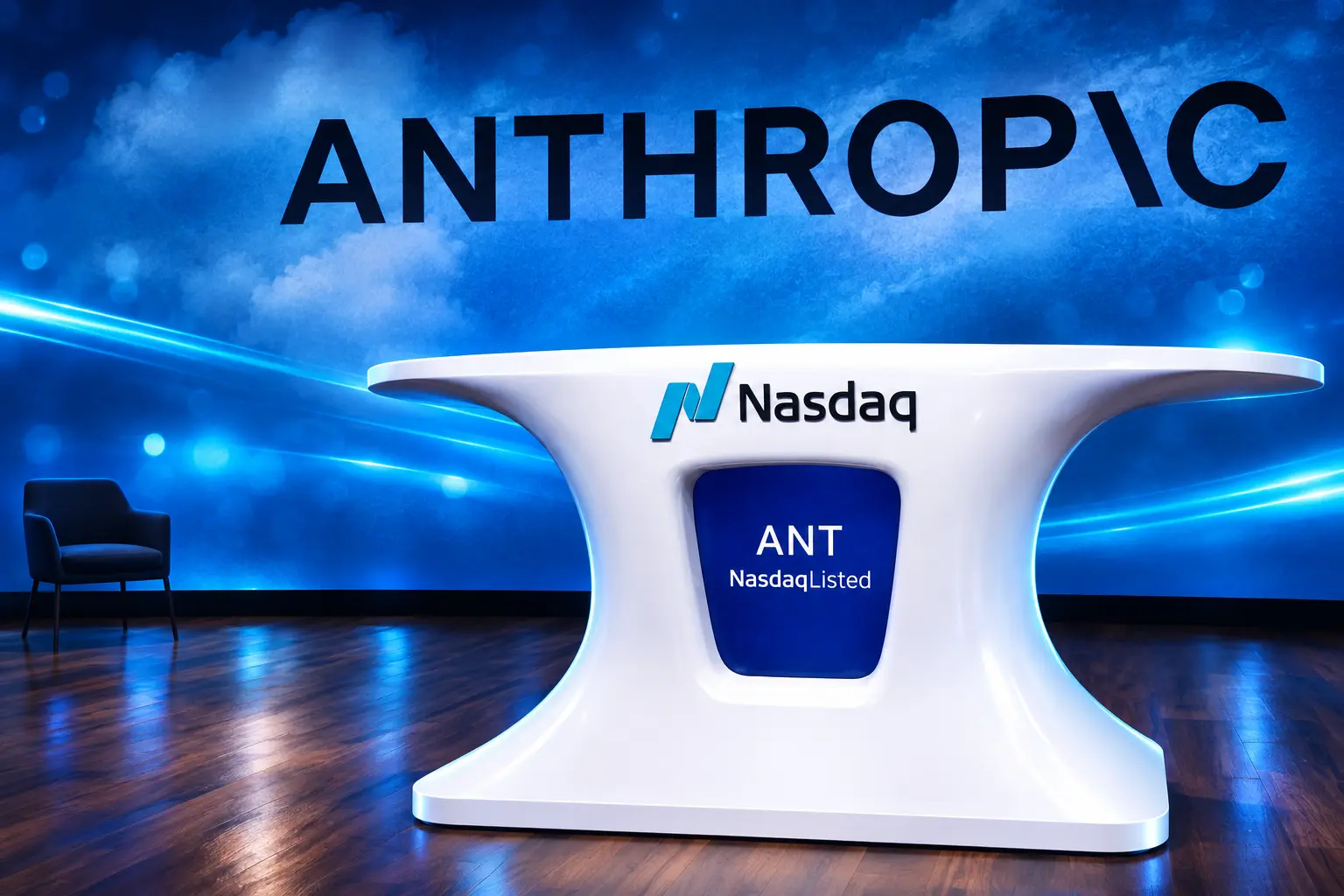
Anthropic Priced ANT at $83 a Share
Anthropic priced the offering at $83 a share on November 18, above a $70 to $78 range, and the Class A stock began trading the next day on Nasdaq as ANT. The public sale covered 980 million shares and was sized at $81.3 billion, which beat SpaceX’s 2026 debut for the largest listing on record.
The final prospectus for the Nasdaq listing puts a $26 billion private placement beside it at the same price, with Google, Nvidia, AMD, Broadcom, Micron, Microsoft, and TSMC as the named buyers. Net proceeds to Anthropic, including that sale, are about $104.8 billion. Banks also held an option on 147 million extra shares, worth about $12.2 billion if taken.
At the offer price the company was valued at about $1.5 trillion on a fully diluted basis, counting options and other awards. Shares closed the first session at $97.17, 17% above $83, then changed hands at $88.91 on November 20.
ANTHROPIC’S OFFERING AT $83
| Item | Figure |
|---|---|
| Offer price | $83 a share |
| Prior range | $70 to $78 |
| Shares in the public sale | 980 million |
| Public offering | $81.3 billion |
| Private placement | $26.0 billion |
| First-day close | $97.17 |
| Net proceeds to Anthropic | About $104.8 billion |
| Run-rate revenue at October 31 | About $81 billion |
That cash pile sits against a compute bill the filing puts at about $900.9 billion in compute commitments, with about $70.7 billion due in the 12 months after September. The listing funds a frontier lab’s chip and cloud contracts. It does not write checks to the trucking office or the restaurant payroll clerk in Rangel’s pitch.
THE LISTING WEEK
- October 26, 2026: Anthropic makes its S-1 public after a confidential draft in June.
- November 10, 2026: An amended filing sets the $70 to $78 range on 825 million shares, later upsized.
- November 17, 2026: Novo launches AI across banking, payroll, tax, and credit.
- November 18, 2026: Anthropic prices at $83 on 980 million shares.
- November 19, 2026: ANT debuts on Nasdaq and closes at $97.17.
- November 20, 2026: The shares trade at $88.91.
By the time Rangel’s gold-rush line was circulating, the stock had already given back a slice of the first-day close. The paper gain was still real. It was also already in motion.
The Fortune Landed Inside the Lab
Talk after the opening bell clustered on who got rich on the inside, not on whether a diner had started using Claude. At $83, CEO Dario Amodei’s 237 million shares were worth about $19.7 billion, and each of the seven co-founders sold 3.4 million shares, about $280 million apiece. Together those seven sold 23.6 million shares in the deal.
The customer book behind that price is not a swarm of one-person shops. Over 11,900 customers pay $100,000 or more a year, over 1,900 pay $1 million or more, and about 250 pay $10 million or more. In the first nine months of 2026, 79% of revenue, or $26.3 billion, was billed by usage, with $6.9 billion, or 21%, from subscriptions. The five largest customers made up about 25% of revenue, and 44% of revenue ran through cloud marketplaces.
Third-quarter revenue reached $17.0 billion. That is an enterprise usage machine sold through clouds, with a handful of huge accounts in the mix. Public buyers were underwriting that mix, not a checkout line of solopreneurs. The fortune the listing created sat in founder stock, staff awards, and those large contracts. Small firms were invited to the slogan, not to the cap table.
Trucking Doubled by Automating Invoices
When Rangel named the segment that actually moved, it was not the employee-free founder in his rocket-ship line. Trucking, he said, was the single slice with the biggest year-over-year rise in AI use, and it doubled from 2025 to now. He was careful about the job the models are doing.
AI cannot yet drive the trucks, he said. It can rewire the office. Accounting, payments, invoice management, and scheduling can be automated if owners invest the time to set the system up. Restaurants, in his telling, are doing the same thing with payroll, clerical work, and healthcare paperwork.
WHERE THE ADOPTION IS ACTUALLY SHOWING UP
- Trucking offices: Rangel said the analog segment doubled AI use from 2025 to now, led by accounting, payments, invoices, and scheduling rather than the cab.
- Restaurant back rooms: Payroll, clerical work, and healthcare paperwork, which he groups as the back office, are the tasks being handed to software.
- The holdouts: He still sees a long tail of analog industries that have to find the hours to rebuild habits and systems.
That is a quieter gold rush than the one in the quote. A dispatcher who stops retyping rate confirmations is not a 50-person company in a laptop. Fleet vendors have been selling exactly that work, document capture, appointment calls, and invoice matching, which matches Rangel’s map even when it undercuts the solopreneur poster.
A Quarter of U.S. Firms Used AI in Mid-November
The national count is higher than Novo’s one in eight and still nowhere near a sweep. In the Census Bureau’s biweekly business survey, 25.0% of U.S. employer firms said they used AI in any business function in the two weeks ending November 15, 2026. That is up 7.7 points from 17.3% in the two weeks ending November 30, 2025. Some 28.2% said they expect to use AI within six months.
Among firms with one to four employees, the two-week rate was 23.4%. Among firms with 250 or more, it was 44.0%. Information businesses led at 49.6%. Manufacturing sat at 22.4% and retail at 21.6%. The Census question is broad, any function in a two-week window, with machine learning, language tools, virtual agents, and voice recognition as examples. Novo’s one in eight is Rangel’s read of his own clients, a different group asked a different way, so the two figures are not a race.
HOW THE COUNTS DIFFER
| Measure | Share using AI | What it counts |
|---|---|---|
| Novo client book | One in eight | Clients Rangel says use AI |
| Census, all employer firms | 25.0% | Any function in the two weeks ending November 15, 2026 |
| Census, 1 to 4 employees | 23.4% | The same two-week question |
| Census, expected in six months | 28.2% | Firms that think they will use AI |
Both books agree on the shape. Use is rising, the smallest shops still trail the largest, and most firms in any given snapshot are not in the column. A quarter of American businesses ticking a two-week box is a real move from last winter. It is also a thin base on which to hang a national gold rush.
Novo Shipped an AI Bank Before the Bell
Two days before ANT traded, Novo put its own product in the window. On November 17 it launched AI across banking, payroll, tax, and credit, tying payments and a credit line to an assistant that answers from the owner’s numbers. Jackson Barnes, the chief executive, said businesses that grow with AI run leaner and will expect the same from their bank.
The businesses growing with AI run leaner and move faster, and they’re going to expect the same from their bank. We rebuilt Novo payments, payroll, banking, and credit to all live in one place, connected by AI.
Jackson Barnes, CEO of Novo, November 17 product announcement
The same release said monthly spending on those AI tools grew 493% among Novo customers between November 2024 and June 2026, naming Cursor, Lovable, Replit, ElevenLabs, Midjourney, and HeyGen. The number of businesses paying for that set rose 145%. Customers with $250,000 or more in annual revenue who pay for AI tools finished the year with 2x more cash on hand than those who do not; those over $500,000 had 4x more, Novo said, attributing the gap to higher sales, lower costs, or both.
That 493% line is a builder stack, code editors, image and video generators, not a trucker’s invoice inbox. Novo already routes work through models from OpenAI, Anthropic, and Google for onboarding and expense labels, so the platform pitching the gold rush is also a distribution layer for the newly public lab. Rangel has said the hard part is that the tools move faster than owners can learn them, and that he is watching what Anthropic builds for less technical users.
Analog Shops Still Need Years to Change Habits
Rangel says he is extremely bullish on AI for small firms and still refuses the clean ending. Analog businesses, he said, still have to pick up the tools and find the hours to invest so they can raise the ceiling on the company. That will take a lot of time, a long, long time, for small businesses to change habits and systems.
Put the week next to that warning. A lab listed at about $1.5 trillion fully diluted, with usage-heavy revenue and giant accounts. A founder of a 250,000-client bank called it the start of a solopreneur rocket ship while his own book sat at one in eight. The fastest jump he can point to is trucking paperwork. Census, asking a wider question, has a quarter of firms in a two-week window and a six-month expectation of 28.2%. Novo, two days before the bell, shipped an assistant and published a 493% spike in spend on Cursor and Replit.
The listing made a public market for Claude’s maker. The gold rush Rangel described is still a minority of his clients, a back-office chore in analog trades, and a habit he says will not snap overnight.
Disclaimer: This article is news reporting and analysis for information only. It is not investment advice, a solicitation to buy or sell Anthropic stock or any other security, or a recommendation of any banking or AI product. Readers who are considering an investment, a banking switch, or a software purchase should consult a licensed financial adviser, accountant, or other qualified professional who can review their own facts. Share prices, offering terms, customer counts, and adoption rates reflect the filings, company statements, and Census figures cited here and can change.

The Strip Bojangles That Charged $100 for 10 Minutes

The Security Fixes Took Microsoft and the NSA Offline

iOS 27 Finally Shrinks the Giant iPhone Lock Screen Clock

AirPods Pro 3 Are $179 Again, Below Last Year’s Cut

Dragon Returns ISS Samples Only It Can Bring Home

Microsoft 365 Auth Fault Took Down Exchange and Teams

OpenClaw 2.0 Ships a Team Workplace With Host-Trust Defaults

Xbox Caps Game Pass Cloud Gaming at 15 Hours

OpenAI Unveils GPT-6 Astra With a Critical Cyber Label

Squishy Dumpling Toys Recalled After Hiding Illegal Water Beads
-
 NEWS3 months ago
Microsoft 365 Auth Fault Took Down Exchange and Teams
-
 NEWS3 months ago
OpenClaw 2.0 Ships a Team Workplace With Host-Trust Defaults
-
 GAMING3 months ago
Xbox Caps Game Pass Cloud Gaming at 15 Hours
-
 NEWS3 months ago
OpenAI Unveils GPT-6 Astra With a Critical Cyber Label
-
 LIFESTYLE3 months ago
Squishy Dumpling Toys Recalled After Hiding Illegal Water Beads
-
 BUSINESS3 months ago
Diesel Breaks Its Record as the White House Claims Credit
-

 NEWS3 months ago
IFA 2026’s Weird Gadgets Are Building a Sensor Home
-
 BUSINESS3 months ago
ChargePoint Stock Rally Prices Wilmer’s Three-Year Cash Plan