
NEWS
Ole Rømer’s Failed Clock Gave Light a Speed
Hired to turn Jupiter’s moon Io into a ship clock, Ole Rømer showed in 1676 that the lag was light itself taking time to travel.

On 21 November 1676, Ole Rømer told the Royal Academy of Sciences that light takes time to travel, a claim he had just tested on Jupiter’s moon Io. He had been hired in Paris to turn that moon into a clock for ships, and the clock’s failure is what showed the speed of light is not instant.
He Was Hired to Build a Clock for Ships
The job that brought Rømer to Paris was longitude, not a hunt for a law of nature. A captain out of sight of land still guessed east and west by dead reckoning, and Philip III of Spain had put a prize on a better method as early as 1598.
Galileo Galilei found Jupiter’s four large moons in January 1610 and offered the Spanish crown a sky clock in 1616 and 1617. Time an eclipse of a Jovian moon, compare it with a table for a home meridian, and read the gap as longitude. The scheme died on a ship’s deck, where no one could hold a telescope steady.
On land it worked. Giovanni Domenico Cassini, director of the new Royal Observatory in Paris, published practical tables of the moons in 1668. Louis XIV’s observatory opened in 1671 with those tables at the centre of a mapping program. Cassini sent Jean Picard to Tycho Brahe’s old site at Uraniborg on Hven to time the same eclipses Cassini timed in Paris.
If Picard saw an eclipse end at 9 hours 43 minutes 54 seconds after midday and Cassini saw it at 9 hours 1 minute 44 seconds, the 42 minutes 10 seconds between them converted to 10 degrees 32 minutes 30 seconds of longitude. Picard hired a young Dane from the University of Copenhagen as his assistant, then brought Ole Rømer back to Paris in 1672 to work under Cassini. Rømer was 27.
The satellite program existed because mechanical clocks were still too poor for sea trade, and the Paris Observatory still describes that early brief as a bid to use jovian satellites to determine longitudes. Rømer’s task was to make Cassini’s Io tables keep better time.
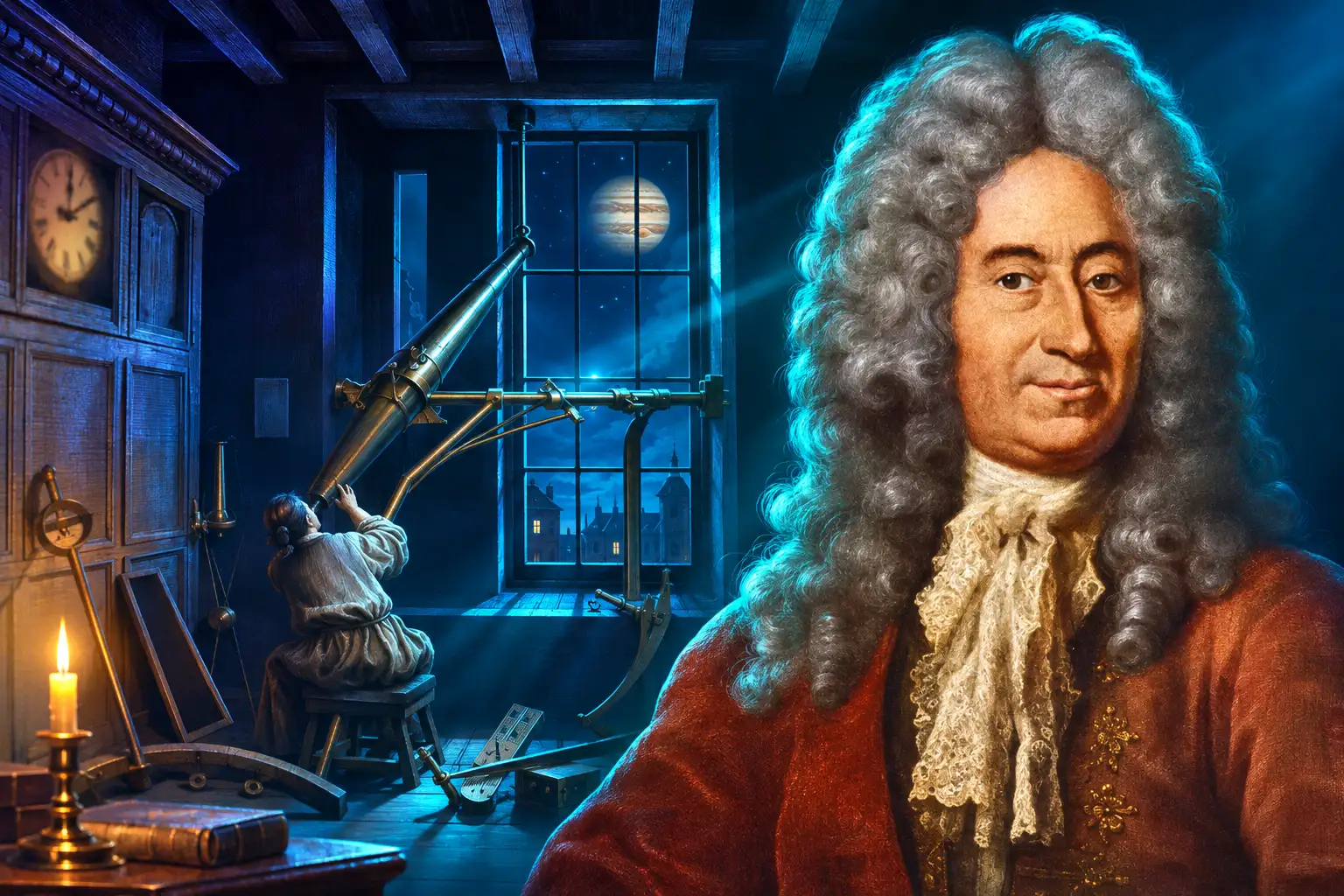
Io’s Eclipses Would Not Keep Time
Io is the innermost of the four moons Galileo saw, and Rømer and Cassini called it the first satellite of Jupiter. It goes around the planet once every 42½ hours, close enough to Jupiter’s orbital plane that it spends part of each lap in the planet’s shadow.
From Earth you never see both ends of the same eclipse. For about four months before opposition you watch Io vanish (an immersion). For about four months after, you watch it reappear (an emersion). Around conjunction the planet sits too near the Sun, and the clock goes dark for five or six months.
The times between those events were not steady. When Earth and Jupiter were drawing apart, the gap grew. When the planets closed, the gap shrank. Rømer was sure Io’s true period was not changing, so the swing had to live in the changing distance the light had to cover.
A single lap hides the lag. In modern terms each 42½-hour orbit shifts by only about 15 seconds as Earth moves, and 17th-century eclipse timings were already uncertain by tens of seconds because Io fades slowly into the shadow. Stack about 40 orbits and the extra seconds become about 10 minutes, which a pendulum clock can catch.
The 1672 series makes the creep visible. Jupiter was in opposition on 2 March. Emergences on 7 March at 07:58:25 and 14 March at 09:52:30, four orbits apart, gave a period of 42 hours 28 minutes 31¼ seconds. By 29 April at 10:30:06, after 30 orbits from 7 March, the apparent period had stretched to 42 hours 29 minutes 3 seconds. That is a 32-second drift, and it put the last reappearance a quarter-hour behind the first pair.
The Ten-Minute Forecast He Made in September
Cassini spoke first. On 22 August 1676 he told the Academy he would change the basis of his Io tables and floated a new lag of about 10 to 11 minutes for a distance equal to the half-diameter of Earth’s orbit, the Sun-Earth span. He did not hold the idea. Rømer did, and he put a date on it.
From the beginning of September he told the Academy that the reappearance of 9 November 1676 would run about 10 minutes later than tables built from the August timings, when Earth had been much nearer Jupiter. The moon was seen leaving the shadow at Paris at 5:35:45 p.m., 10 minutes late, matching the forecast. On 21 November he read the result to the Academy. He was 32.
THE 1676 SEQUENCE
- 22 August 1676: Cassini tells the Academy the Io tables will change and cites a new lag of about 10 to 11 minutes.
- Early September 1676: Rømer predicts that the 9 November reappearance will run about 10 minutes late.
- 9 November 1676: Io leaves Jupiter’s shadow at Paris at 5:35:45 p.m., 10 minutes behind the August-based tables.
- 21 November 1676: Rømer reads a paper to the Academy showing that the motion of light is not instant.
- 7 December 1676: An unsigned report of the talk appears in the Journal des sçavans; an English version runs in Philosophical Transactions on 25 July 1677.
The original minutes of that Saturday meeting were later lost, but a copy of the record survives in later scholarship and is blunt about what he claimed.
Mr Rømer has read a paper to the Academy, where he shows that the motion of light is not instantaneous, which he has demonstrated from the inequality of the immersions and emersions of the first satellite.
Minutes of the Royal Academy of Sciences, 21 November 1676
The Journal report, a demonstration concerning the motion of light written in the third person by an unnamed reporter, said light needs 22 minutes to cross the diameter of Earth’s orbit. It also said eight years of Academy and observatory timings backed the new delay, with the 9 November emersion as the public check. Rømer never printed a full method of his own, in part because Cassini and Picard opposed the reading.
Cassini Never Accepted the Light Delay
Cassini preferred to park the lag in Io’s path, as an off-centre orbit or some other hitch in the moon’s motion. Cartesian physics treated light as instant, like a push down a rigid stick, and that school did not fold. Christiaan Huygens and Isaac Newton took Rømer’s side quickly. Cassini, who ran the building, never fully signed off, and the Academy was slow to drop the rival accounts.
Rømer ruled out the usual suspects in the Journal report. A hitch tied to Io’s own orbit would follow Io around Jupiter. A hitch tied to Jupiter’s changing speed would follow Jupiter around the Sun on a cycle of about 12 years. The lag he had followed the Earth-Jupiter distance and repeated on the synodic clock of about 13 months. That is why a public hit on 9 November mattered more than another fudge in the tables.
The sea clock still failed, and not only because of light. You cannot hold a long telescope on a pitching deck, which Galileo already knew. Eclipses vanish for months near solar conjunction, and many more fall in daylight or below the local horizon. Light-time was a correction the tables could absorb once someone admitted it. Cassini wanted the correction without the physics. Rømer wanted the physics, even if it left sailors waiting for a mechanical chronometer.
22 Minutes Across Earth’s Orbit
Rømer did not write a speed in Earth units. He wrote a time. Using today’s orbit sizes, those 22 minutes would mean 226,663 kilometres per second, which is 24.4 percent below 299,792 kilometres per second. He also argued, as an order of magnitude, that light is far faster than one Earth-diameter per second, because a slow value would have shown a 7-minute swing between the two quadratures, and no such swing appeared.
Huygens did the division Rømer skipped. Working in Paris until 1681, he took the 22-minute crossing and his own figure for the size of Earth’s orbit and, in Traité de la lumière, published in 1690, put the speed at about 230,000 kilometres per second, some 600,000 times the speed of sound. That 230,000 uses Huygens’s orbit size, so it is not the same quantity as the 226,663 that appears when modern distances are poured into Rømer’s 22 minutes.
The modern crossing time for one astronomical unit is 499 seconds, which is 8 minutes 19 seconds. Light therefore needs 16 minutes 38 seconds to cross the diameter Rømer timed at 22 minutes. He was high on the delay and low on the speed, and he was no longer treating the speed as infinite.
HOW THE DELAY WAS WRITTEN DOWN
| Who | When | The claim |
|---|---|---|
| Rømer | 1676 | 22 minutes to cross Earth’s orbital diameter |
| Rømer and Cassini | 1676 | 10 to 11 minutes for the half-diameter (Sun to Earth) |
| Huygens | 1690 | About 230,000 km per second |
| Bradley | 1729 | 8 minutes 12 seconds, Sun to Earth |
| Modern light time | 1 AU | 8 minutes 19 seconds (499 seconds) |
| 17th CGPM | 1983 | 299,792,458 metres per second, exact |
In 1983 the 17th General Conference on Weights and Measures stopped measuring the speed and started defining length from it. The metre became the path travelled by light in vacuum during 1/299,792,458 of a second, so 299,792,458 metres per second is exact by rule. A delay isolated to fix a moon table now sits under the metre stick.
Bradley Found the Same Lag in Starlight
Rømer left Paris in 1681 at the summons of Christian V and became royal mathematician and professor of astronomy at the University of Copenhagen. He had already gone to England in 1679 and met Isaac Newton, John Flamsteed and Edmond Halley. Cassini was still unmoved. Independent proof arrived after Rømer’s death on 19 September 1710.
James Bradley, hunting stellar parallax in Gamma Draconis, found an annual wobble of about 20 arcseconds whose phase was wrong for parallax. In a letter published in 1729 he treated it as aberration: Earth’s motion through a stream of light that is fast but not instant. He wrote that light is propagated as far as from the Sun to the Earth in 8 minutes 12 seconds. That is 7 seconds shy of the modern 8 minutes 19 seconds, and it closed the argument Rømer had opened with Io.
Bradley was not trying to save a longitude table either. He was trying to watch a star hold still, and the star would not. The same lag that ruined Io as a simple metronome showed up as a tilt in starlight, which is how a failed clock became a second proof that Earth itself is moving.
Copenhagen Is Marking 350 Years of That Delay
350 years after the Academy meeting, Copenhagen has given the finding a full calendar. The Round Tower, the old university observatory Rømer later used, billed 2026 as Light Year and opened a show on his work. On 21 November 2026 the city planetarium ran a dome program on the night Io ran late, with talks from Jens Olaf Pepke Pedersen, Bjørk Matias Friis and Flemming Hansen starting at 19:15.
LIGHT YEAR 2026 IN COPENHAGEN
- The tower show: Rundetaarn’s exhibition on Rømer runs from 6 February 2026 through 3 January 2027 as a full year dedicated to light.
- The dome night: The planetarium marked 21 November 2026, 350 years to the day after the Academy paper, with a two-part program under the cupola.
- The live moon: Danish science museums marked 9 November 2026, the date of the 10-minute emersion, and pointed visitors to fresh Io eclipses that week.
- The restored dome: The Round Tower’s nearly 100-year-old public observatory, with a telescope dating from 1929, was taken down for repair in 2026 and built back into the same anniversary year.
After Paris, Rømer’s days were full of clocks of another kind. He introduced Denmark’s first national weights and measures on 1 May 1683, pushed through the Gregorian calendar, and in 1705 became mayor and police chief of Copenhagen, a post he used to put up the first streetlights with oil lamps. The man who showed that light is slow spent his last years hanging lamps so the streets would not be.
The Round Tower exhibition runs through 3 January 2027, in the building where he later watched the same sky that had refused to keep time for Cassini’s sailors.
Frequently Asked Questions
What Happened to Ole Rømer’s Original Observations?
Most of his papers burned in the Copenhagen Fire of 1728. One handwritten aide-mémoire with about 60 Io eclipse times from 1668 to 1678 survived and was rediscovered in 1913, and a letter he sent Huygens on 30 September 1677 says the 1671 to 1673 timings were the basis of his calculation.
What Is the Rømer Delay in Pulsar Timing?
Pulsar-timing models still correct for the extra light-travel time across Earth’s orbit as the planet moves, and that geometric term is called the Rømer delay, the same lag he isolated with Io in 1676, now applied to radio ticks from spinning neutron stars.
Did Ole Rømer Create a Temperature Scale?
Yes. In Copenhagen he built one of the first temperature scales, and Daniel Gabriel Fahrenheit visited him in 1708 and used that work when he drafted the scale that still bears Fahrenheit’s name.
When Did Denmark Change Calendars Under Rømer?
In 1700, as royal mathematician, he had Denmark-Norway skip from 18 February straight to 1 March to join the Gregorian calendar, a change Tycho Brahe had failed to win about a century earlier.

The Strip Bojangles That Charged $100 for 10 Minutes

The Security Fixes Took Microsoft and the NSA Offline

iOS 27 Finally Shrinks the Giant iPhone Lock Screen Clock

AirPods Pro 3 Are $179 Again, Below Last Year’s Cut

Dragon Returns ISS Samples Only It Can Bring Home

Microsoft 365 Auth Fault Took Down Exchange and Teams

OpenClaw 2.0 Ships a Team Workplace With Host-Trust Defaults

Xbox Caps Game Pass Cloud Gaming at 15 Hours

OpenAI Unveils GPT-6 Astra With a Critical Cyber Label

Squishy Dumpling Toys Recalled After Hiding Illegal Water Beads
-
 NEWS3 months ago
Microsoft 365 Auth Fault Took Down Exchange and Teams
-
 NEWS3 months ago
OpenClaw 2.0 Ships a Team Workplace With Host-Trust Defaults
-
 GAMING3 months ago
Xbox Caps Game Pass Cloud Gaming at 15 Hours
-
 NEWS3 months ago
OpenAI Unveils GPT-6 Astra With a Critical Cyber Label
-
 LIFESTYLE3 months ago
Squishy Dumpling Toys Recalled After Hiding Illegal Water Beads
-

 BUSINESS3 months ago
Diesel Breaks Its Record as the White House Claims Credit
-

 NEWS3 months ago
IFA 2026’s Weird Gadgets Are Building a Sensor Home
-

 BUSINESS3 months ago
ChargePoint Stock Rally Prices Wilmer’s Three-Year Cash Plan