
GAMING
GTA VI Turned Thursday Into a Paid Sick-Day Holiday
GTA VI posted $3.79 billion on day one as HR logged a PTO spike, while the $1 billion scare and the brain-training pitch both overreached.

Take-Two said Grand Theft Auto VI generated $3.79 billion in day-one retail sales after it launched on November 19. Rockstar’s parent called it the biggest entertainment launch on record, with 32.5 million copies sold before release.
Payroll systems logged a real jump in time off the same day. Economists waved off a viral $1 billion “loss,” and wellness copy recast a crime sandbox as brain work.
$3.79 Billion by Thursday Night
On November 20, Take-Two put a number on the night. In a release dated that Friday, Rockstar said day-one retail sales reached $3.79 billion, based on company estimates through the end of November 19 worldwide, and that the game sold 32.5 million units pre-release.
The studio also claimed a Metacritic score of 99 and billed the title as the highest-rated game of all time. The cheapest version costs $80. Grand Theft Auto V launched in 2013 at $60 and took in about $800 million in its first 24 hours, then $1 billion in three days. Take-Two’s new haul is nearly five times that opening day, at a higher sticker price.
Sensor Tower, a market-intelligence firm, said more than 80 percent of preorders were the $100 Ultimate Edition. Stream Charts counted more than 132 million hours of launch-day viewing across Twitch, YouTube and Kick.
LAUNCH MONEY, SIDE BY SIDE
| Title | What was counted | Figure |
|---|---|---|
| Grand Theft Auto VI | Day-one retail sales through Nov. 19 | $3.79 billion |
| Grand Theft Auto VI | Pre-release units | 32.5 million |
| Grand Theft Auto V (2013) | First 24 hours | about $800 million |
| Avengers: Endgame | Full theatrical run (Rentrak) | $2.94 billion |
Those rows are not the same kind of money. The game figure is a company estimate for one day of retail sales, including preorders. The film figure is a lifetime box-office total. Take-Two still used the comparison, and the series behind it is already huge: Grand Theft Auto has sold nearly 480 million units, and Grand Theft Auto V alone has sold in nearly 235 million.
It is with immense gratitude that we enter a new chapter of Rockstar Games with the release of Grand Theft Auto VI. We are incredibly humbled by the response from players around the world and we couldn’t be more excited to share this moment with you.
Sam Houser, President and Founder, Rockstar Games, Take-Two release
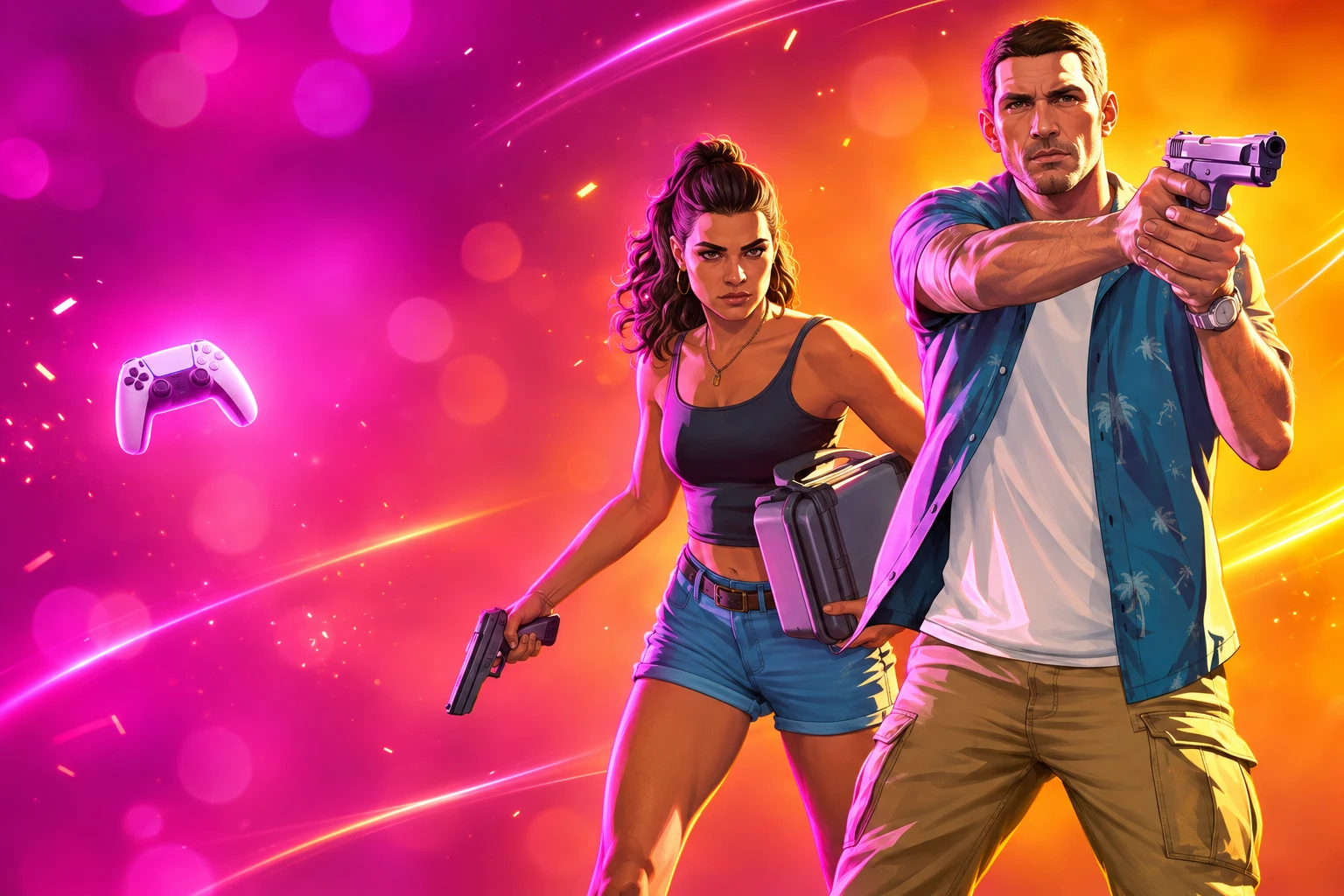
The plot the company is selling is simple. Jason and Lucia botch an easy score and land in a conspiracy stretching across the state of Leonida, a fictional Florida with Vice City at its center. The ESRB rated it M for Mature. Consoles got it first, on PlayStation 5 and Xbox Series X|S, after delays from fall 2025 and then May.
Thursday Became a Holiday HR Could Measure
Strauss Zelnick, Take-Two’s chairman and chief executive, had already sketched the labor story. At a Las Vegas conference in April he said “a lot of people will be calling in sick on November 19.” HR software spent the autumn counting how many tried to do it on the books.
BambooHR, whose US dataset covers more than 3.4 million employees, found that PTO requests ran 13 percent above prior years for the launch date, compared with equivalent days in 2024 and 2025. Requests for Friday, November 20, were up about 11 percent. That snapshot was taken on October 19, a month out, so it captures planned leave, not whoever called in at 7 a.m.
A separate BambooHR survey of 1,530 full-time US workers, fielded October 9 to 20, found 18 percent of salaried staff planned to take the day. The share rose to 32 percent among Gen Z workers and 27 percent among millennials. Half of people taking time off for a game release said they would call in sick instead of booking leave. The firm noted that 38 percent of workers say a sick call is easier than planning PTO.
WHAT PAYROLL FILES SHOWED
- BambooHR platform: Time-off requests for November 19 ran nearly 13 percent above comparable Thursdays in 2024 and 2025.
- BambooHR survey: 18 percent of salaried US workers said they planned to take launch day, including 32 percent of Gen Z.
- Gusto: PTO on November 19 ran 9 percent above the two prior Thursdays, and 17 percent higher among workers in their 20s.
- BrightHR (UK): Sickness absence on November 19 jumped 56 percent versus November 12, with about 83,000 days already booked to play.
Gusto, a payroll firm, also split the US spike by age. Time off rose 8 percent among workers in their 30s and 4 percent among those in their 40s, against earlier November Thursdays. About 40 percent of Gusto’s increase came from businesses that had nobody booked off earlier in the month, which means the gap was not confined to one industry or one giant employer.
In the UK, BrightHR said average lateness rose to 29 minutes from 24 the previous Thursday, and 9 percent of late staff said they overslept, up from 4 percent. Employment Hero, tracking more than 870,000 Australian workers, found annual leave for November 19 was 24 percent higher than the comparable Thursday a year earlier, and 81 percent higher among men aged 18 to 44. Remote, an employer-of-record platform, said launch-day leave among people it employs was 32 percent above the same Thursday in 2025.
Among players, booking the day had already become ordinary. Sports-radio voices still scolded adults for skipping a shift. The files look more like a holiday that a slice of the workforce funded with leave they already owned.
The Billion-Dollar Sick Day That Did Not Add Up
A round number traveled farther than the payroll data. Posts and write-ups repeated a forecast of 1.5 million US workers out and $1 billion in lost output, often hung on José García-Montalvo, an economist at Pompeu Fabra University in Barcelona. PolitiFact found no published study that produced either figure, and García-Montalvo did not reply when asked.
Nicholas Bloom, a Stanford economist, estimated that perhaps 5 percent of full-time US workers play Grand Theft Auto, and that only a fraction of those would take the day rather than wait until evening.
I really don’t believe these numbers unless it’s backed up by a population-representative survey. It seems more like social media clickbait.
Nicholas Bloom, Professor of Economics, Stanford University
The Bureau of Labor Statistics put the daily absence rate among 121 million full-time salaried workers at 3.2 percent in 2025, or about 3.9 million people already out on a normal day, more than twice the viral 1.5 million. About 2.2 percent of those absences were illness or injury. If people used sick time or PTO, those were days employers were already paying for.
WHERE THE $1 BILLION SPLITS
- The viral claim: 1.5 million US workers out, $1 billion in lost output, with no public worksheet behind the math.
- Bloom’s view: The headcount looks like clickbait without a population-representative survey.
- Huntington-Klein’s view: If November 19 replaced some other day off, the yearly hit is “pretty near 0.”
Nicholas Huntington-Klein, an associate economics professor at Seattle University, called 1.5 million “quite high.” He said the useful question is whether people took November 19 instead of another day. If they did, he said, the overall economic impact would be pretty near zero. A PCMag survey put the “will take PTO or shift a schedule” share at 8 percent of US adult gamers, which that poll translated as about 12.5 million people, a different group and a different question from 1.5 million workers gone for a full day.
Bosses Heard This One in 2013
Offices have run this drill. When Grand Theft Auto V arrived on September 17, 2013, IGN asked 10,995 readers what they would do. Forty-six percent said they had booked the day as holiday. Nineteen percent said they would phone in sick. Dutch absence checkers later said sick reports rose 25 percent on September 18 and 20 percent on September 19, the first two days after that launch.
UK employment lawyers revived the nickname this month. Scottish Engineering, briefing members on “GTA flu,” noted that the phrase was coined in 2013 for people pulling sickies to play the last mainline game. The legal advice was the same as any other fake-sick case: a genuine illness is one thing, pretending is another, and a launch-day absence is not, by itself, gross misconduct.
THE LONG WAIT FOR A THURSDAY OFF
- September 17, 2013: Grand Theft Auto V launches, and an IGN poll finds 46 percent of readers have booked holiday and 19 percent plan to call in sick.
- September 18-19, 2013: A Dutch absence firm records sick reports up 25 percent, then 20 percent, in the two days after launch.
- April 2026: Zelnick tells a Las Vegas conference that a lot of people will call in sick on November 19.
- October 22, 2026: BambooHR publishes the 13 percent PTO-request lift and the 18 percent survey share.
- November 19, 2026: Grand Theft Auto VI launches on PS5 and Xbox Series X|S, 13 years after V.
Davide Ancelotti, manager of Lille, put the same tension in sports terms after the launch. He said he is a gamer with children at home, so he cannot play, and that players without children can play at home because the squad does not hotel before matches. He added that they are professional footballers, their bodies are their tools for work, and they need to look after them.
How a Crime Game Became Wellness Copy
The other story laid over those hours was kinder. Wellness desks noted that people were skipping work to play, then reached for older studies that say action games train attention, speed, and decision-making. That research is real. It does not describe an eight-hour Thursday.
Adrian Owen, a cognitive neuroscientist at Western University in Canada, led the Brain and Body study with the Science and Industry Museum in Manchester. About 1,000 people finished a lifestyle survey and a battery of Creyos tests of memory, attention, reasoning, and verbal skill. Owen said frequent players tested like people 13.7 years younger than non-players, if they spent five or more hours a week on a single type of game. People who played less than five hours a week across all games tested like people 5.2 years younger.
Circana’s launch-day averages sit in a different bucket. Players who opened Grand Theft Auto VI on November 19 averaged 513 minutes on PS5, which is 8 hours and 33 minutes, and 494 minutes on Xbox, which is 8 hours and 14 minutes. That is more than Owen’s weekly “frequent” dose, packed into one date. The study measured a habit. Thursday measured a binge.
Owen also said the games frequent players choose now are highly engaging and strategic, and that they may sharpen visual attention, processing speed, and problem-solving through repetition. He noted that they are built to hit the brain’s reward systems and release dopamine. He did not argue that one launch day rewires a workforce.
A 2025 Scientific Reports paper on long-term action-game play found regular players were about 190 milliseconds faster without an accuracy tradeoff on time-sensitive visuomotor decisions. A 2022 fMRI study in Neuroimage: Reports found video-game players were overall about 190 milliseconds faster and 2 percent more accurate than non-players on decision tasks. Those papers describe people who already play a lot, not a single night in Leonida.
Empathy Survived Two Months of Los Santos
The franchise has been a lab tool for 20 years, usually to test harm. The cleaner experiments keep failing to find a lasting personality change, which is why the new wellness gloss had room to grow.
Simone Kühn and colleagues in Germany ran a randomized trial published in 2019 in Molecular Psychiatry. They recruited 90 healthy adult non-gamers; 77 finished. For two months, 25 people played Grand Theft Auto V, 24 played The Sims 3, and 28 played nothing, about 30 minutes a day. Researchers waited at least a full day after the last session, then tested aggression, empathy, impulsivity, sexist attitudes, mental health, and cognitive control, 52 outcomes in all.
Across 208 statistical comparisons, only eight tests hit conventional significance before adjustment, fewer than the roughly 10 false positives expected by chance, and just three of those eight pointed toward harm. None survived corrections for running so many tests. Bayesian checks favored no detrimental impact from two months of Grand Theft Auto V.
WHAT THE GTA TRIALS ACTUALLY DID
- Kühn, 2019: Two months at about 30 minutes a day produced no lasting harm signal after correction.
- Lengersdorff, 2023: Eighty-nine men with no recent violent-game history played seven lab hours; the violent group averaged 2,845 kills, the control group 3,055 in-game photos, with no clear empathy drop.
- Ritchie, 2024: One hour of violent Grand Theft Auto V missions versus racing and flying showed no solid change in core empathy regions on fMRI.
A University of Vienna team led by Lukas Leopold Lengersdorff and Claus Lamm tightened the design in 2023. Half the men earned points for killing as many characters as possible inside a modified Grand Theft Auto V. The others used the same engine with the violence stripped out. Scans at least 24 hours later found substantial evidence against a desensitizing effect on empathy ratings, and weak-to-moderate evidence of no change in empathy-related brain areas or the amygdala.
Short sessions can still spike anger. In 2016, Robert B. Lull and Brad J. Bushman had 194 students play Grand Theft Auto IV for 15 minutes, either killing bystanders or bowling. Violent play produced more self-reported anger, strongest in 3D. That is a mood, minutes later, not a new temperament. The Kühn protocol, 30 minutes a day for two months, is also not 513 minutes on a Thursday.
A Full Shift Inside Leonida
Circana’s Player Engagement Tracker is the cleanest picture of what people actually did with the holiday. Mat Piscatella, a senior director at the firm, said that among people already playing on November 19, 61 percent of active US PlayStation 5 accounts and 56 percent of active Xbox players worldwide engaged with Grand Theft Auto VI. Fortnite was second, at 10 percent of active players across both platforms. Piscatella called the daily-active and minutes-played rates “absolutely bonkers.”
Those percentages are not a share of every console in a closet. They are a share of accounts that were on that day. Someone whose PS5 stayed off is outside the 61 percent. The averages also do not require one sitting. A morning session and a late return still add to 513 minutes.
Eight and a half hours is a workday. It is also several times the daily dose Kühn used when she found no lasting harm, and more than Owen’s weekly bar for a “frequent” player, spent before Friday. Offices that already approved the leave paid for those hours in advance. Offices that ate surprise sick calls paid for some of them twice, once in wages and once in cover. In both cases the product on the other side of the timesheet was a crime epic, not a cognitive-training app.
Take-Two has the receipt for the launch. HR software has the receipt for the empty chairs. The brain papers describe a different schedule than the one Circana timed on November 19, and the $1 billion scare never produced a worksheet. Thursday still disappeared into Leonida, one approved day and one long session at a time.

The Strip Bojangles That Charged $100 for 10 Minutes

The Security Fixes Took Microsoft and the NSA Offline

iOS 27 Finally Shrinks the Giant iPhone Lock Screen Clock

AirPods Pro 3 Are $179 Again, Below Last Year’s Cut

Dragon Returns ISS Samples Only It Can Bring Home

Microsoft 365 Auth Fault Took Down Exchange and Teams

OpenClaw 2.0 Ships a Team Workplace With Host-Trust Defaults

Xbox Caps Game Pass Cloud Gaming at 15 Hours

OpenAI Unveils GPT-6 Astra With a Critical Cyber Label

Squishy Dumpling Toys Recalled After Hiding Illegal Water Beads
-
 NEWS3 months ago
Microsoft 365 Auth Fault Took Down Exchange and Teams
-
 NEWS3 months ago
OpenClaw 2.0 Ships a Team Workplace With Host-Trust Defaults
-
 GAMING3 months ago
Xbox Caps Game Pass Cloud Gaming at 15 Hours
-
 NEWS3 months ago
OpenAI Unveils GPT-6 Astra With a Critical Cyber Label
-
 LIFESTYLE3 months ago
Squishy Dumpling Toys Recalled After Hiding Illegal Water Beads
-

 BUSINESS3 months ago
Diesel Breaks Its Record as the White House Claims Credit
-

 NEWS3 months ago
IFA 2026’s Weird Gadgets Are Building a Sensor Home
-
 BUSINESS3 months ago
ChargePoint Stock Rally Prices Wilmer’s Three-Year Cash Plan