
NEWS
Samsung Galaxy S26 FE Loses DeX After a $200 Cut
Samsung’s Galaxy S26 FE is $499.99 after $200 off, but USB 2.0 kills monitor DeX and the 8MP zoom has not moved since the S24 FE.

Samsung’s Galaxy S26 FE cannot drive a monitor over USB-C, and the 128GB model is $499.99 after a $200 cut. The Fan Edition still has a 120Hz AMOLED panel, IP68, and seven years of software. The port is the product split the $699.99 list price never advertised.
Independent tests of a 128GB unit also found an 8MP 3x camera that has barely moved since the S24 FE, plus Wi-Fi web runtime of 15 hours 24 minutes. The street price makes the phone easy to consider. It does not put DeX, USB 3, or a modern telephoto back in the box.
A USB Port That Cannot Drive a Monitor
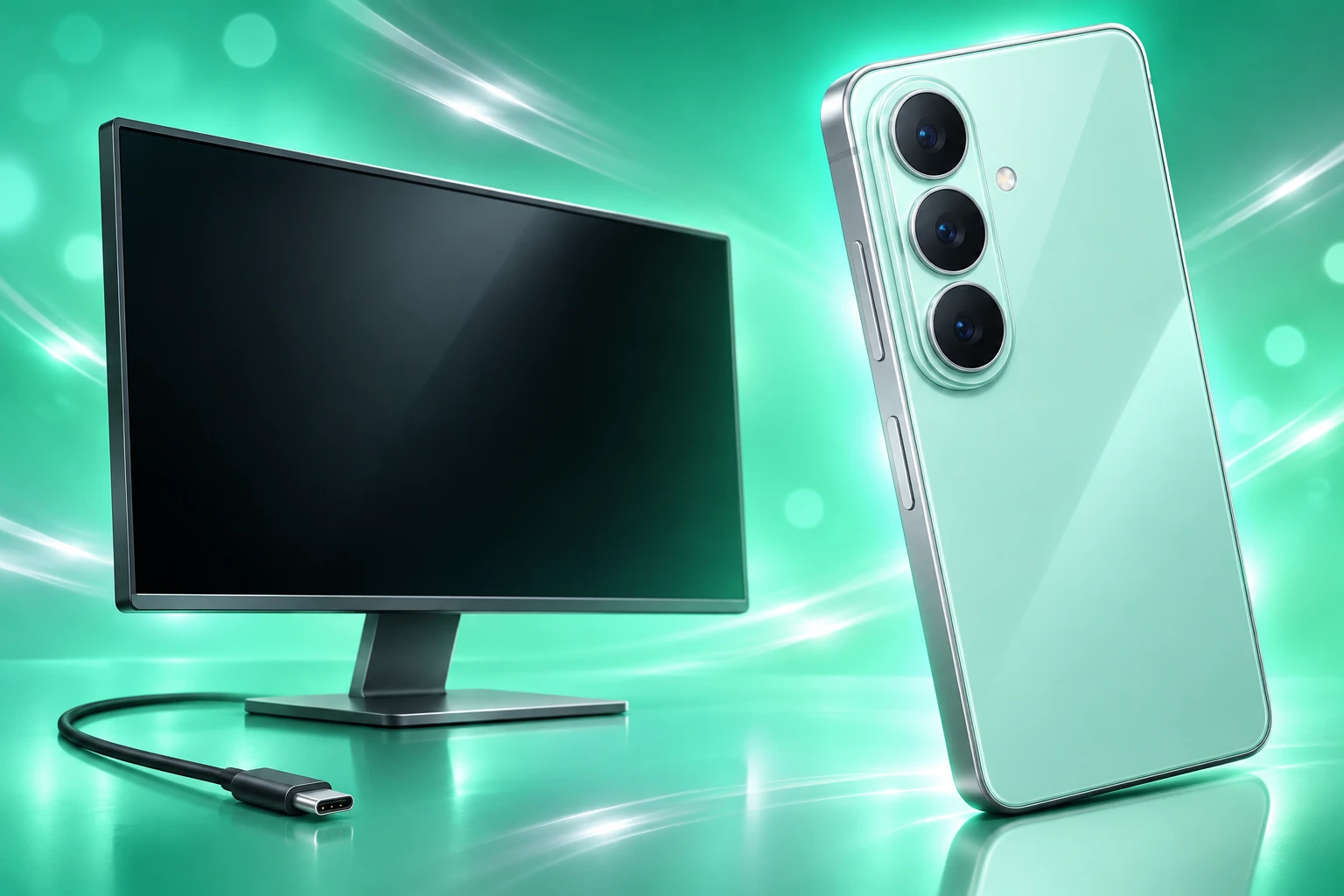
Samsung shipped the Galaxy S26 FE with USB Type-C 2.0. Spec sheets for the S24 FE and S25 FE listed USB 3.2 and desktop DeX. The new port is a step back, not a rename, and it is why a Fan Edition no longer behaves like a cheap S phone on a desk.
Wired video out is gone, so a USB-C hub will not throw a desktop at a display. Samsung’s DeX FAQ still lists the S26 series, then says the FE is not compatible with HDMI or wireless DeX on a TV or monitor. The Z Flip7 FE gets the same carve-out. FE is becoming the Galaxy that stays in your hand.
The S26 FE is not compatible with DeX using a HDMI cable or wireless DeX with a TV or monitor.
Samsung DeX compatibility note, Samsung US
File copies suffer with the same silicon. Paired with a Samsung Portable SSD T7, the test phone moved data at about 35 Mbit/s. USB-IF still lists a hi-speed rate of 480 Mb/s as the USB 2.0 ceiling, so the measured result is slow even for this generation of the bus. OTG charging and a USB-C headphone dongle still work. A dock for work does not.
WHAT WE KNOW
- The port: USB Type-C 2.0 with OTG, no DisplayPort video.
- Monitor DeX: HDMI cable use is out, and wireless DeX to a TV or monitor is out on Samsung’s own list.
- The predecessor: S25 FE spec sheets listed USB 3.2 and wired DeX.
WHAT IS UNCONFIRMED
- On-phone windows: Samsung’s DeX FAQ still describes opening desktop spaces on the device itself, and that path has not been proven on this FE.
- How long $200 lasts: the US product page frames the cut as a Black Friday deal, not a new list price.
Jay Kim, head of customer experience in Samsung’s mobile business, said the phone was “purposefully designed to deliver the signature strengths of the Galaxy S series.” DeX has been one of those strengths since the S8. Taking it off the FE, and off the Flip7 FE in the same footnote, reads as a platform fence, not a parts-bin accident.
Samsung Cuts $200 Without a Trade-In
Samsung Electronics America announced the Galaxy S26 FE on August 27, 2026, as the first S26 phone to ship with One UI 9 on Android 17. Select carriers had it on September 3, and Samsung.com, carriers, and retailers had it nationwide on September 4. Pricing started at $699.99 for 128GB, with Graphite, Blueberry, and Pistachio in the US, and 128GB plus 256GB as the listed capacities.
The US product page now advertises $200 off without a trade-in, or up to $400 as instant trade-in credit. That is how the 128GB unlocked Graphite, Blueberry, and Pistachio listings sit at $499.99, with 256GB at $599.99. The cut is doing the work the hardware did not do at launch.
US STREET PRICE AGAINST LIST
| Storage | Launch list | Advertised street |
|---|---|---|
| 128GB, 8GB RAM | $699.99 | $499.99 |
| 256GB, 8GB RAM | Starts from $699.99 (US launch copy listed two sizes) | $599.99 |
The 128GB test unit still uses UFS 3.1, with about 105GB free out of the box. Larger capacities use UFS 4.0. Sequential reads on that 128GB pack landed around 2,009 MB/s, which is fine for apps and photos and not the reason to pick 256GB. The box includes a USB-C cable and a SIM tool. The 45W adapter is sold separately, as is Care+ if you want accident cover on top of the legal warranty.
THE FE CALENDAR
- October 3, 2024: Galaxy S24 FE ships with USB 3.2, DeX, and the 50MP plus 8MP plus 12MP rear set.
- September 4, 2025: Galaxy S25 FE keeps USB 3.2 and the same zoom hardware, with Exynos 2400 and a 4,900 mAh cell.
- August 27, 2026: Samsung announces the Galaxy S26 FE at $699.99 with Exynos 2500, USB 2.0, and the same 8MP 3x module.
- September 4, 2026: US retail sale begins at the $699.99 starting price.
- November 2026: Samsung’s US store advertises $200 off without a trade-in, and 128GB listings sit at $499.99.
People who already own an S25 FE keep circling the same point. A newer GPU and NPU do not replace a port that can fill a disk or fill a monitor. If last year’s FE already does DeX on a cable, this one is not an upgrade path. It is a different product at a sale price.
The Same 8MP Zoom Has Sat Still Since the S24 FE
Samsung’s launch copy talks about a more capable camera and 3x optical zoom. The glass is the FE set you have seen since 2024: a 50MP main camera at f/1.8 with OIS, an 8MP telephoto at f/2.4 with 3x and OIS, and a 12MP ultrawide at f/2.2 with a 123-degree view. The front camera is 12MP. Video still reaches 8K at 30fps and 4K at 60fps on the rear.
The 50MP main camera is the one part that still earns the S badge in daylight and at night. Color is steady, Nightography holds detail, and Photo Assist will rewrite a frame from a prompt after the fact. My FanCam, which first showed up on recent foldables, can crop a clip so one person stays centered. Super Steady with Horizontal Lock can keep a shot level, though Samsung’s own note says the image is cropped and tops out around QHD at 30fps on wide and ultrawide.
The other two rear lenses are why reviewers keep calling this a compromise. The 8MP telephoto uses a 1/4.4-inch sensor at 75 mm equivalent. Outside bright sun it smears, and even outdoors it lacks bite. The 12MP ultrawide sits on a 1/3.2-inch sensor and drops the same way. A 2026 phone at a $699.99 list should not still be selling 8MP zoom as a flagship extra.
THREE FAN EDITIONS, ONE ZOOM MODULE
| Phone | USB | DeX on a monitor | Rear zoom |
|---|---|---|---|
| Galaxy S24 FE | USB 3.2 | Yes | 8MP, 3x |
| Galaxy S25 FE | USB 3.2 | Yes | 8MP, 3x |
| Galaxy S26 FE | USB 2.0 | No | 8MP, 3x |
Software is doing the talking Samsung will not do with a new telephoto. Gemini Omni can build clips from the Gallery if you take the six-month Google AI Pro trial, which Samsung values at $19.99 a month with 5TB of cloud storage. That is editing after the shot. It does not add photons to an 8MP crop. The next Galaxy camera island drawn for the Pro is already the place Samsung is putting real zoom glass. The FE is not on that drawing.
THE REAR LENSES IN PRACTICE
- 50MP main: f/1.8, 24 mm, OIS, the lens that still looks like an S phone in mixed light.
- 8MP telephoto: f/2.4, 3x optical, 1/4.4-inch sensor, usable in sun and a stretch after dark.
- 12MP ultrawide: f/2.2, 123 degrees, 1/3.2-inch sensor, fine for a group and short on fine detail.
If your photos are mostly 1x, the main camera plus Photo Assist will feel current. If you live on 3x portraits or travel crops, this hardware is the S24 FE’s module with a new ISP around it. That is the quieter camera story, and it is older than the $200 promo.
What the 6.7-Inch Panel Still Gets Right
The 6.7-inch Dynamic AMOLED 2X panel is 2340×1080, about 385 PPI, with a 120Hz cap, HDR10+, and Gorilla Glass Victus+ on the face. Samsung rates peak brightness at 1,900 nits. Full-field lab readings with an X-Rite probe sat near 1,197 cd/m2 at the center, which is a different pattern from the APL18 peak that tracks the 1,900-nit claim. In the hand the sheet is bright, smooth, and color-honest, with a ColorChecker delta E around 2.3.
It is not LTPO. The test unit jumped between 120Hz and 60Hz and did not show extra steps. Response times are fast enough for games. The weak spot is dimming. Pulse-width modulation runs at 240 Hz with an amplitude around 16.76%, a low frequency that some eyes will see as flicker. Xiaomi’s mid-range sets in the same tests used high-frequency PWM near 3,846 Hz, or DC dimming. Samsung did not.
DISPLAY AND COMFORT SNAPSHOT
- Rated peak: 1,900 nits on Samsung’s spec sheet, with HDR peaks in the same band in APL18 tests.
- Flicker: 240 Hz PWM, no high-frequency dimming on this FE.
- Build: 161.6 x 76.9 x 7.4 mm, 193 g, aluminum frame, Victus+ front and back, IP68 to 1.5 m for 30 minutes.
- Unlock: optical under-display fingerprint that often needs a firm press and a second or third try; 2D face unlock is the backup.
The chassis feels expensive for the class, if a bit sharp at the edges. Stereo speakers hit about 91.5 dB with thin bass. Wi-Fi is 6E, not Wi-Fi 7, and Bluetooth is 5.4. Dual-band GNSS locked outdoors to about 3 meters, which is enough for walking directions. Dual SIM plus eSIM is here, with two lines active at once. None of that replaces a port, and none of it is why the list price cracked.
Last Year’s Exynos Meets an 8GB Ceiling
The Galaxy S26 FE does not use the Exynos 2600 from the S26+. It uses the Exynos 2500, a 3 nm 10-core chip with a 3.3 GHz Cortex-X925, an Xclipse 950 GPU, and 8GB of LPDDR5X. That is last year’s flagship silicon in this year’s cheaper body. Geekbench 6.7 scored about 2411 single-core and 8055 multi-core on the FE, against about 3209 and 11034 on the S26+.
Games still run. Wild Life Extreme landed around 5381, and 4K Aztec Ruins High held about 47 fps offscreen, so modern titles are playable at the panel’s 120Hz. After a long load the picture changes. Wild Life stress stability was 69.7%, and sustained performance fell by about 40%. The glass peaked around 43.7 C on the front, which is warm rather than alarming. The S25 FE throttled harder. This one is better, not free.
The 4,900 mAh pack (4,755 mAh rated) is the same size class as the S25 FE and the S26+. Samsung’s US sheet says a 45W brick can reach 65% in about 30 minutes, with 15W wireless charging on the WPC spec and reverse wireless in the mix. The Wi-Fi web-surfing test ran 15 hours 24 minutes, or 15.4 hours, then needed about 80 minutes to fill. That is a full day for a lot of people. It is not a win in a year when 6,500 mAh and 7,000 mAh rivals are on the same shelves. Idle draw above 2 W, peaking around 2.25 W, leaves some easy energy on the table. Under a hard stress test the pack even lost charge, which is a poor look on a 4,900 mAh phone.
Eight gigabytes of RAM is the other ceiling. The S26+ starts at 12GB. Samsung did not sell a 12GB FE this round. If you keep 20 apps open and live in DeX-style windows, you are not this phone’s customer anyway, because the monitor path is gone. If you want a light S slab that will still get One UI bumps, 8GB is the tax.
Who Still Has a Reason to Buy It
Samsung’s US FAQ says the Galaxy S26 FE gets 7 major Android upgrades and up to 7 years of security patches from the global launch, starting on Android 17 and One UI 9. The newsroom repeats seven generations of OS upgrades and seven years of security updates. That clock, not the 8MP zoom, is the spec that still matches the S26 family. At $499.99 it is also the spec that undercuts phones with faster ports and shorter software promises.
The rest of the pitch is Galaxy software. Smart Switch can move iOS 26.6 data with a QR code, including passkeys and eSIM. Now Brief and Now Nudge sit on top of One UI 9. Circle to Search can grab more than one object in a frame. Knox is on board. None of that needs USB 3. All of it needs you to care more about seven years of Android than about a cable to a monitor.
BUY IT, OR LEAVE IT
- Buy it if: you want a 6.7-inch Samsung slab, IP68, the 50MP main camera, and seven years of updates, and $499.99 is the budget.
- Skip it if: you dock for DeX, move big files over a cable, or shoot at 3x in mixed light.
- Keep last year’s FE if: you already have USB 3.2 and wired DeX; the Exynos 2500 bump is not worth the slower port.
- Look at S26+ if: you want Exynos 2600, 12GB RAM, an LTPO panel, and a phone that still belongs on a desk.
The Fan Edition label used to mean most of the S phone at a lower price. This one keeps the glass, the water rating, and the update clock, then spends its savings on USB 2.0 and a telephoto Samsung has been recycling since the S24 FE. At $699.99 that mix did not hold. At $499.99 it is a seven-year Android radio with a good main camera, as long as you never need the desk.
Frequently Asked Questions
Does the Galaxy S26 FE Support Samsung DeX?
Samsung’s DeX page groups the S26 series as compatible, then adds that the S26 FE cannot use DeX over an HDMI cable or wireless DeX with a TV or monitor, a note it also applies to the Z Flip7 FE. On-device desktop spaces are still described in the same FAQ, but they have not been demonstrated as a substitute for a monitor. Link to Windows is the path Samsung now points at when DeX on a PC is gone.
How Long Does the Galaxy S26 FE Get Software Updates?
Samsung guarantees 7 major OS upgrades and up to 7 years of security patches from the global launch date, and the phone ships on One UI 9 and Android 17, so the software clock runs into the early 2030s. The US product footnote also mentions seven years from global manufacture in Q2 2026, which is a slightly earlier start than the September 4, 2026 US on-sale date. Timing can still vary by carrier and country.
What Cameras Does the Galaxy S26 FE Use?
The rear set is 50MP wide at f/1.8 with OIS, 8MP telephoto at f/2.4 with 3x optical and up to 30x digital zoom, and 12MP ultrawide at f/2.2, plus a 12MP front camera with a wider field of view than the S25 FE’s 80-degree selfie. Samsung’s comparison note frames the selfie field of view as the upgrade versus S25 FE, not a new telephoto sensor. Photo Assist resizes generative edits up to 12MP.
Is the Galaxy S26 FE USB-C Port USB 3.2?
No. The port is USB 2.0, while S24 FE and S25 FE spec sheets listed USB 3.2. USB 2.0 still allows charging, USB-C audio, and OTG. It does not carry DisplayPort video, which is why wired DeX and USB-C display glasses drop off this model.
Samsung can move the 128GB Fan Edition at $499.99 because the update clock is real and the main camera still works. It cannot put DeX back on a USB 2.0 port, and it has not put a new zoom module in that island since the S24 FE. That is the phone you are actually buying.

The Strip Bojangles That Charged $100 for 10 Minutes

The Security Fixes Took Microsoft and the NSA Offline

iOS 27 Finally Shrinks the Giant iPhone Lock Screen Clock

AirPods Pro 3 Are $179 Again, Below Last Year’s Cut

Dragon Returns ISS Samples Only It Can Bring Home

Microsoft 365 Auth Fault Took Down Exchange and Teams

OpenClaw 2.0 Ships a Team Workplace With Host-Trust Defaults

Xbox Caps Game Pass Cloud Gaming at 15 Hours

OpenAI Unveils GPT-6 Astra With a Critical Cyber Label

Squishy Dumpling Toys Recalled After Hiding Illegal Water Beads
-
 NEWS3 months ago
Microsoft 365 Auth Fault Took Down Exchange and Teams
-
 NEWS3 months ago
OpenClaw 2.0 Ships a Team Workplace With Host-Trust Defaults
-
 GAMING3 months ago
Xbox Caps Game Pass Cloud Gaming at 15 Hours
-
 NEWS3 months ago
OpenAI Unveils GPT-6 Astra With a Critical Cyber Label
-
 LIFESTYLE3 months ago
Squishy Dumpling Toys Recalled After Hiding Illegal Water Beads
-

 BUSINESS3 months ago
Diesel Breaks Its Record as the White House Claims Credit
-

 NEWS3 months ago
IFA 2026’s Weird Gadgets Are Building a Sensor Home
-
 BUSINESS3 months ago
ChargePoint Stock Rally Prices Wilmer’s Three-Year Cash Plan