
AUTO
The Ferrari 296 Challenge Stradale Laps Fiorano Without a Hybrid
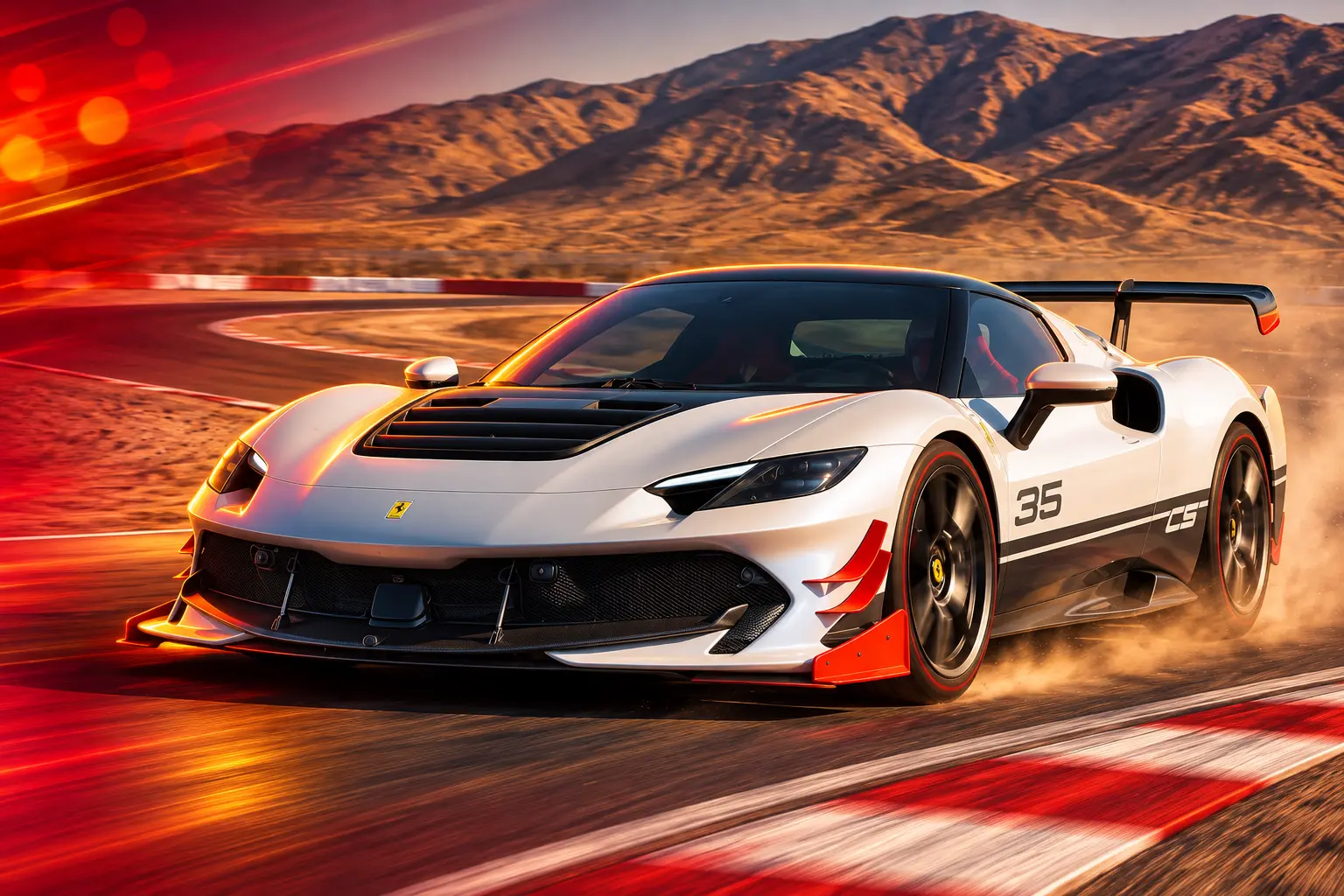
Ferrari’s 296 Challenge Stradale dumps the hybrid, weighs 1,330 kg, and laps Fiorano in 1:18.5, half a second quicker than the 880 cv Speciale.

Ferrari’s 296 Challenge Stradale makes 670 cv, weighs 1,330 kg dry, and has lapped Fiorano in 1:18.5 with no hybrid system.
The road car arrived at the 2026 Ferrari Finali Mondiali in Barcelona beside the 296 Challenge Evo, the 700 cv racer for 2027.
Ferrari Parks a Race-Weight 296 on the Road
The two cars shared the spotlight at Barcelona-Catalunya during the 34th Finali Mondiali, held from 17 to 23 November 2026, and they share more than a stage. Each uses a 2,992 cc 120-degree twin-turbo V6 with no hybrid hardware, and each is quoted at 1,330 kg dry, the same mass Ferrari gives the race car.
That figure is 140 kg below the 296 GTB’s 1,470 kg dry weight. The Stradale sends power through an eight-speed dual-clutch gearbox. The Evo uses a seven-speed unit and makes 700 cv at 7,500 rpm, with a specific output of 234 cv/l. The road car peaks at 8,000 rpm and 224 cv/l, and both engines will still run to 8,500 rpm.
THE BARCELONA PAIR
- Road car: 670 cv, eight speeds, road-legal aero good for 617 kg of downforce at 250 km/h.
- Race car: 700 cv, seven speeds, a High Downforce kit plus a Low Drag kit that cuts minimum drag by 4%.
- Shared mass: 1,330 kg dry for both, with the Evo the tenth car built for Ferrari Challenge.
- Shared brief: consistency over a long run, not a one-lap party trick, ahead of 2027’s longer races.
Ferrari Japan posted the pair from the paddock after the unveil on 21 November.
一切の妥協を排した、新型 Ferrari 296 Challenge Stradale と Ferrari 296 Challenge Evo。
内燃機関のみのアーキテクチャ、徹底した軽量化、研ぎ澄まされたレスポンス、レーシング由来の空力性能。公道を舞台とする、最高出力670cvの #Ferrari296ChallengeStradale… pic.twitter.com/Lw5u7Ah1ON
— Ferrari Japan (@FerrariJPN) November 21, 2026
Almost eighty 296 Challenge cars were already on the Spanish circuit for the Trofeo Pirelli season finale. The new road car is the one you can register. The Evo is the one privateers will need when the 2027 European and North American series begin.
The Speciale Already Claimed This Inheritance
On 29 April 2025, Ferrari placed the 296 Speciale in the line that runs from the original Challenge Stradale through the 430 Scuderia, the 458 Speciale and the 488 Pista. That car keeps the plug-in hybrid. Combined output is 880 cv, the V6 itself makes 700 cv, and the dry weight is 1,410 kg, 60 kg under the GTB.
The Speciale’s Fiorano time is 1:19. The Challenge Stradale, with 210 cv less and no electric fill-in on corner exit, is quoted at 1:18.5. The GTB’s mark is 1:21. Around Maranello’s home track, pulling the battery and adding a race wing beats adding more hybrid power.
THREE ROAD 296S AT FIORano
| Figure | 296 GTB | 296 Speciale | 296 Challenge Stradale |
|---|---|---|---|
| System power | 830 cv hybrid | 880 cv hybrid | 670 cv, no hybrid |
| Dry weight | 1,470 kg | 1,410 kg | 1,330 kg |
| Downforce at 250 km/h | GTB baseline | 435 kg | 617 kg |
| 0-100 km/h | 2.9 s | 2.8 s | 2.8 s |
| 0-200 km/h | 7.3 s | 7.0 s | 7.9 s |
| 200-0 km/h | 107 m | 106 m | 101 m |
| Fiorano lap | 1:21 | 1:19 | 1:18.5 |
| Top speed | >330 km/h | >330 km/h | >300 km/h |
In a straight line the electric motor still covers turbo lag, which is why the Speciale keeps the 0-200 km/h sprint. On a lap, the extra wing and the missing battery pay back. Ferrari test driver Marc Gené put the road car on Mugello and spoke as if the licence plates were a technicality.
Guys, it’s exactly like driving an actual racecar!
Marc Gené, Ferrari test driver, after testing at Mugello
A lighter, more winged 296 that is quicker at Fiorano with 210 cv less leaves the Speciale’s extra motor looking like the heavier daily. Hardcore buyers have been asking makers to throw the battery overboard for the weight. Maranello just did it and kept the number plates.
A Starter-Generator Replaces the Battery Pack
The 296 GTB was sold on that V6 plus an electric motor between the engine and the gearbox. The Stradale keeps the 120-degree hot-V layout and the 88 x 82 mm bore and stroke, then deletes the motor, the 7.45 kWh pack and the decoupling clutch. Peak torque is 740 Nm at 6,250 rpm, the same 740 Nm the GTB quotes, and Ferrari says dynamic torque in a given move rises more than 32% against the GTB because boost and cam phasers were recut for response.
The V6 itself is not a meek GTB engine with the hybrid unplugged. It makes 670 cv against the GTB’s 663 cv from petrol alone, though it still trails the Speciale’s 700 cv combustion peak. A knock-control method taken from Formula 1 watches each cycle so the engine can run closer to the limit without cooking pistons. Turbochargers and heat shields come from the 296 Challenge, which let engineers drop extra heat shielding in the bay.
WHAT FILLS THE HOLE THE HYBRID LEFT
- Belt Starter Generator: One unit does starter and alternator duty, the first time Ferrari has used this layout on a road car, and it has been beefed up for hard use.
- Mechanical compressor: Air conditioning no longer rides on an electric loop, because there is no hybrid loop left to tap.
- New flexplate: A single shaft carries torque from the flywheel to the gearbox and holds the inertia the hybrid hardware used to supply.
- Lighter casings: The timing cover moves to die casting and the bedplate to shell mould casting, both to cut mass and to live with race loads.
The eight-speed gearbox runs two maps. At high load and high revs, shifts land around 170 ms on logic taken from the 296 Challenge. At low and medium revs, the map stretches to about 250 ms, a calibration Ferrari first used on the SF90 XX Stradale, so the car is less savage in town. A larger twin-tailpipe exhaust cuts back pressure and feeds the hot-tube pipes that dump intake and exhaust noise into the cabin up to 8,500 rpm.
617 kg of Downforce at 250 km/h
The Stradale makes 617 kg of downforce at 250 km/h, 72% more than the 296 GTB. The Speciale, which still uses an active rear spoiler, is quoted at 435 kg at the same speed. A fixed wing taken from the Challenge Evo accounts for 270 kg of the Stradale’s load, and it sits high on hollow struts so the driver can still see out.
The rest of the package is a closed underbody, a long splitter, flicks, side wings, an aero damper that ties the floor to the upper body, and vortex generators in threes at the front and pairs at the rear. Two water radiators and two condensers sit ahead of the front wheels. Hot air dumps through the bonnet and is fenced toward the screen so it does not wreck the wing or the climate intakes. The front floor sits high enough for speed bumps, a limit the Evo does not have to meet.
Springs are about twice as stiff as earlier 296 road setups, so Ferrari added a helper spring in series, a race trick taken from the Evo that stops the main spring from chatting on rebound. Semi-active dampers hold ride height and balance. Against the GTB, Ferrari quotes 7% more peak lateral performance, 34% more stability and a 68% drop in roll gradient. ABS Evo runs in every Manettino mode, Wet through ESC Off, with the Race map taking over from Race upward. Predictive slip control tuned for a track, a first on a Ferrari road car, is meant to nibble rather than slam.
Pirelli built a casing, tread and compound for this chassis on the P Zero R and the road-homologated P Zero Trofeo RS, the semi-slick the Italian firm sells as original equipment for hard road cars. Color Edition inserts can be vulcanised into the tyre if a buyer wants the sidewall as a trim piece. Carbon-ceramic discs measure 398 x 38 mm at the front with aero calipers and 380 x 34 mm at the rear, and the cooling ducts had to grow because there is no regen to share the stopping.
The Name They Last Used in 2003
Ferrari last put Challenge Stradale on a car in 2003, when the 360-based model took lessons from the one-make series and from FIA GT racing and put them on a licence plate. That car used a 3,586.20 cc naturally aspirated V8 good for 425 hp at 8,500 rpm, weighed 1,180 kg dry, and reached 100 km/h in 4.1 seconds on the way to 300 km/h. The wheelbase was 2,600 mm, the same figure Ferrari still uses on the 296.
Twenty-three years later the recipe is familiar and the hardware is not. The new car is 201 mm longer at 4,678 mm, 117 mm wider at 2,039 mm, and much taller at 1,301 mm because of the wing. Weight distribution sits at 41.5% front and 58.5% rear. Flavio Manzoni’s studio cut visual bulk so the technical bits read at a glance: a bonnet with a radiator dump, a bumper wing hung between body-coloured claws, a black mesh tail that leaves the pipes in view, and seven-twin-spoke wheels with a race look.
The 360 car added power and lost mass against the 360 Modena. The 430 Scuderia, 458 Speciale and 488 Pista did the same against their GTBs. This 296 is the first in that orbit that makes less system power than the road car beside it, because the thing it had to lose was the hybrid that defined the 296 in the first place.
Why the Evo Exists for 40-Minute Races
The Evo is not a styling exercise for the Stradale’s photos. On 11 September 2026 in Budapest, Ferrari said the 2027 Ferrari Challenge Trofeo Pirelli Europe calendar will split in two. Three of the seven rounds, Mugello, Hockenheim and Valencia, will each run two races of 40 minutes plus one lap, with a mandatory pit stop between minutes 15 and 25 and the option of a driver change. Misano, Donington, Spa-Francorchamps and the Finali Mondiali round stay as sprints, and endurance rounds will carry more points. North America gets the same idea.
That is why the Evo’s engineers spent their time on tyre life, brake feel and a wider aero window rather than a single headline lap. High Downforce is for tight tracks. The Low Drag kit is for fast ones, and the gap in load between those two setups has more than doubled. Drivers can raise rear ride height by up to 10 mm for about 30 kg more downforce at 250 km/h. Ferrari says the car was 0.8 seconds faster than the current 296 Challenge at Mugello in comparative tests, and faster at every other circuit it ran.
THE 2027 EUROPEAN CHALLENGE CALENDAR
- 1-4 April 2027: Misano World Circuit Marco Simoncelli opens the season as a sprint round.
- 29 April-2 May 2027: Mugello hosts the first endurance weekend on Ferrari’s own track.
- 3-6 June 2027: Hockenheimring runs the second endurance format.
- 1-4 July 2027: Circuit Ricardo Tormo in Valencia completes the three long-race stops.
- 23-25 July 2027: Donington Park returns to the sprint timetable.
- 16-19 September 2027: Spa-Francorchamps is the last regular sprint before the Finali Mondiali, whose date and venue are still to be named.
Carbon-ceramic CCM-R Plus discs and ABS Evo Track, with four ABS maps for wet and dry, are there so a gentleman driver can still modulate a 40-minute stint. A new cluster puts traction-control levels, tyre pressures and lap times where a driver can read them at speed. Massimiliano Di Silvestre, Ferrari’s marketing chief, said Evo deliveries are due in the first quarter of 2027 so client drivers can make that season. The Stradale is the version of the same 1,330 kg idea you can drive home.
Even the Clinical Cockpit Keeps Cruise Control
Ferrari describes the Stradale as stripped-back and almost clinical, and the cabin follows through. The door card is a single carbon piece with no armrest and no pocket. The tunnel is a carbon fork that holds the gate, a cupholder and a wireless charger. Buyers can order a spec that peels the trim from under the seats, the lower carpets and the console so part of the chassis is left in view, a first on a Ferrari production car. Tubular seats from the SF90 XX Stradale sit in the same brief.
The car still has to live on public roads, so the clinical brief stops at the sensor pack. Adaptive Cruise Control, automatic emergency braking with car, pedestrian and cyclist detection, lane keeping, traffic-sign assist, drowsiness and distraction monitors, blind-spot and rear-cross alerts, and a dual camera for parking are all listed. Front and rear radars and two cameras feed those functions. Matrix LED lights can shape the high beam. The Manettino still offers Wet for a wet motorway, not only Race and ESC Off.
ROAD SYSTEMS THAT STAYED ON THE CAR
- Cruise and braking: Adaptive Cruise Control and automatic emergency braking with pedestrian and cyclist detection.
- Lane and signs: Lane departure warning, lane keeping and traffic-sign assistance.
- Driver watch: Drowsiness, distraction and gaze tracking, plus blind-spot and rear-cross alerts.
- Lights and cameras: Matrix LED high beams and a front-and-rear dual camera for low-speed work.
A livery with a bonnet badge, roof graphics and a lower stripe is optional, as are wheel finishes in Matte Grigio Corsa, Matte Nero or Matte Bianco Fuji. Alcantara can be Nero, Charcoal, Rosso, Azzurro Dino, Giallo Modena, Blu Elettrico or Rosso Dino. The design studio left the racing cues on the outside and the assistance stack in the software, because type approval does not care how many kilos the hybrid saved.
Buyers can order the cabin with the chassis left bare under the seats, a first on a Ferrari production car, and still drive home with cruise control on the same wheel.
Frequently Asked Questions
Is a Track Exhaust Available for the 296 Challenge Stradale?
Yes. Ferrari developed a track-only exhaust for this car that official dealers can fit and later remove, so the V6 can run the higher notes the type-approved road system has to tame, and the hardware is not a permanent conversion.
How Much Weight Do the Forged Wheels and Carbon Bonnet Save?
Forged seven-twin-spoke wheels cut about 11.9 kg of unsprung mass, the carbon-fibre bonnet trim saves 0.7 kg, and the carbon wheels already offered on the 296 GTB stay on the list, while the tubular seats taken from the SF90 XX Stradale are quoted as 25% lighter than standard racing seats.
What Maintenance Programme Comes With the Car?
Ferrari’s Genuine Maintenance plan, which runs across the range, covers scheduled servicing for the first seven years at 20,000 km or once a year with no mileage cap, using genuine parts and diagnostics from staff trained at the Ferrari Training Centre in Maranello.
How Much Luggage Space Does the 296 Challenge Stradale Have?
The front compartment holds 67 litres and is left almost empty when the bonnet opens, in line with the race-car brief, while a rear bench adds 88 litres and the fuel tank is 64.5 litres.

The Strip Bojangles That Charged $100 for 10 Minutes

The Security Fixes Took Microsoft and the NSA Offline

iOS 27 Finally Shrinks the Giant iPhone Lock Screen Clock

AirPods Pro 3 Are $179 Again, Below Last Year’s Cut

Dragon Returns ISS Samples Only It Can Bring Home

Microsoft 365 Auth Fault Took Down Exchange and Teams

OpenClaw 2.0 Ships a Team Workplace With Host-Trust Defaults

Xbox Caps Game Pass Cloud Gaming at 15 Hours

OpenAI Unveils GPT-6 Astra With a Critical Cyber Label

Squishy Dumpling Toys Recalled After Hiding Illegal Water Beads
-
 NEWS3 months ago
Microsoft 365 Auth Fault Took Down Exchange and Teams
-
 NEWS3 months ago
OpenClaw 2.0 Ships a Team Workplace With Host-Trust Defaults
-
 GAMING3 months ago
Xbox Caps Game Pass Cloud Gaming at 15 Hours
-
 NEWS3 months ago
OpenAI Unveils GPT-6 Astra With a Critical Cyber Label
-
 LIFESTYLE3 months ago
Squishy Dumpling Toys Recalled After Hiding Illegal Water Beads
-

 BUSINESS3 months ago
Diesel Breaks Its Record as the White House Claims Credit
-

 NEWS3 months ago
IFA 2026’s Weird Gadgets Are Building a Sensor Home
-
 BUSINESS3 months ago
ChargePoint Stock Rally Prices Wilmer’s Three-Year Cash Plan