
NEWS
Enhertu Combo Cleared Mouse Tumors With Clone-Specific Memory
An Enhertu and CD28 bispecific combo cleared all nine mouse tumors, but the immune memory did not stop a second HER2-positive cancer.

A Regeneron combination of Enhertu and a CD28 bispecific antibody wiped out breast tumors in all nine treated mice and left them able to reject the same cancer weeks later. The same animals did not reject a different HER2-positive tumor. Nature Communications published the Tarrytown, NY team’s paper on 15 November 2026.
The pairing does more than add cell killing. It turns Enhertu’s debris into a lesson the T-cell system remembers, and that lesson is narrower than a HER2 vaccine.
All Nine Mice Lost Their Tumors
Dylan Kwart and Qiaozhi Wei led the work, with Bei Wang and Dimitris Skokos as joint supervisors. All authors are current or former Regeneron employees, and the company funded the study. They used mice whose tissues carried human CD28 and a hybrid HER2 protein, then implanted EO771 breast tumor cells engineered to display the human targets.
Enhertu is trastuzumab deruxtecan, a HER2-directed antibody-drug conjugate already used in several breast, stomach, lung, and other HER2-positive cancers. At 10 mg/kg, the highest dose tested, it produced complete responses in fewer than 50% of mice. The experimental antibody binds HER2 on tumor cells and CD28 on T cells, and it does not compete with trastuzumab or pertuzumab. Together the drugs produced complete tumor rejection in all treated mice, including the nine animals in the main breast-cancer cohort.
The mix also shrank established tumors larger than 200 mm³ when treatment started late, and it prolonged survival. HER2xCD28 still helped when Tras-DXd doses fell by as much as 25-fold. An EGFR-directed CD28 bispecific already in human trials, given with Enhertu, produced tumor rejection in about 75% of mice in a breast model that resisted the conjugate alone.
THE MOUSE COMBINATION RESULTS
| Arm | Tumor model | Tumors cleared |
|---|---|---|
| Tras-DXd alone at 10 mg/kg | EO771-HER2 breast | Fewer than 50% |
| Tras-DXd plus HER2xCD28 | EO771-HER2 breast | All 9 mice |
| Tras-DXd plus EGFRxCD28 | EO771-HER2/EGFR, more resistant | About 75% |
| 5-FU plus EGFRxCD28 | MC38 colorectal | Growth slowed; either drug alone did little |
Body weight and serum liver enzymes did not move in a meaningful way. Interferon-gamma edged up with the CD28 antibody, a sign of on-target T-cell activity, and adding Enhertu did not push that cytokine higher. Neutropenia from the conjugate did not get worse when the bispecific was added.
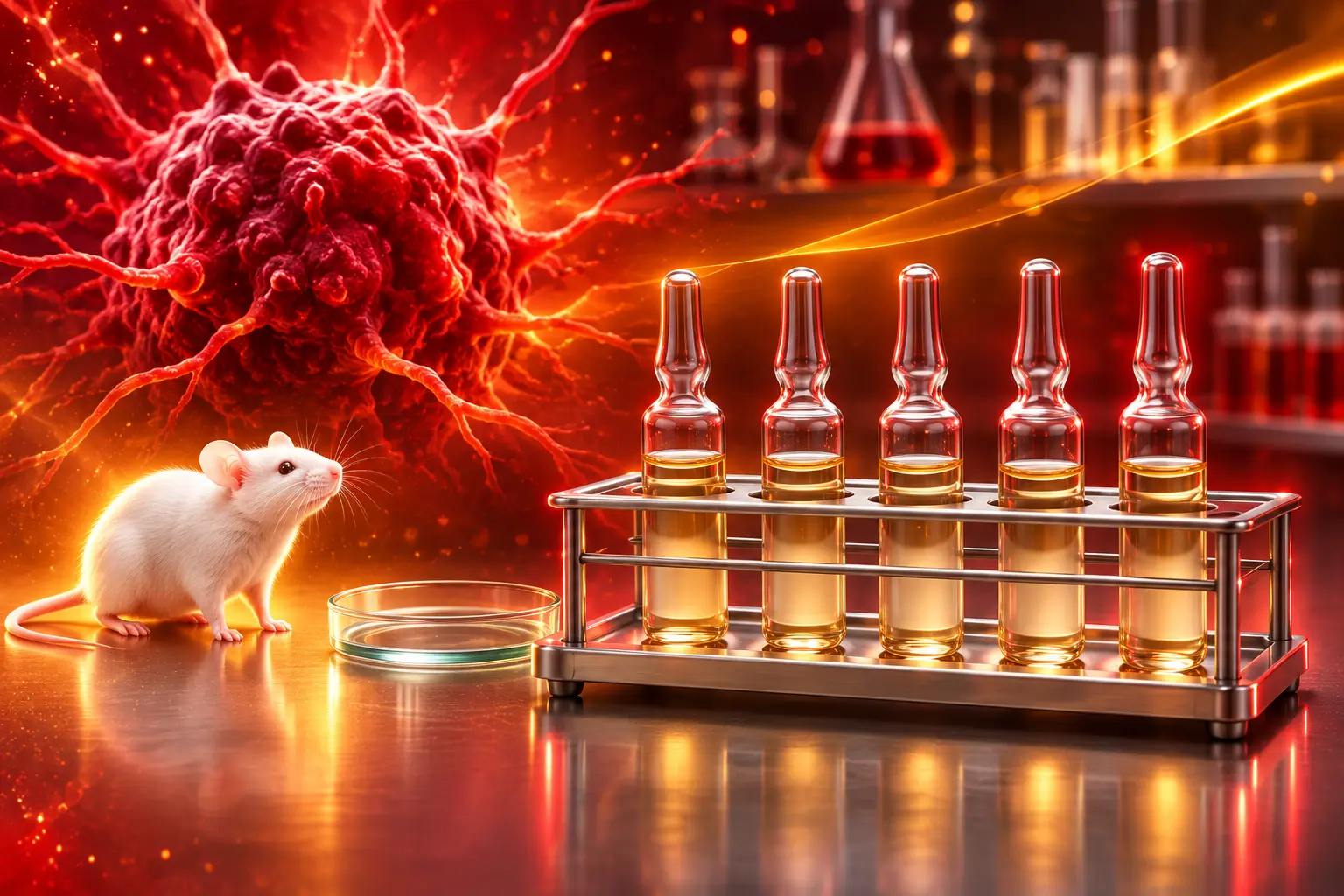
The Immune Memory Was Clone-Specific
Mice that had stayed tumor-free for at least four weeks got a second injection of the original EO771-HER2 breast cells, with no further drug. They rejected that line. A different colorectal line, MC38-HER2, still grew even though those cells also carried HER2.
The paper says the memory tracked endogenous EO771 antigens, not the shared HER2 protein. That finding cuts against a simple reading of the work as a HER2 vaccine. The animals learned the tumor they had already beaten. They did not learn the surface marker the drugs used to find it.
Stripping out CD8 T cells erased the combination’s benefit in the first treatment. Those killer cells were required for clearance, not an optional extra. The later protection, then, is a CD8 memory of that clone, not a standing defense against every HER2-positive cancer.
Without Dendritic Cells, the Combination Stopped Working
Enhertu expanded and activated conventional dendritic cells, the cells that display tumor fragments to T cells. In mice genetically lacking a particular group of those cells, the Enhertu-antibody combination lost its effect entirely. The conjugate was not only punching holes in tumor cells. It was handing antigen to the innate system, and the CD28 bispecific was the second signal that turned that dump into a lasting CD8 response.
The combinations increased active T cells while keeping a less mature, stem-like pool that can seed later responses. They also widened the mix of T-cell receptors, which may help the system see more than one tumor feature. Israel Lowy, Regeneron’s senior vice president of translational and clinical oncology, has described the company’s CD28 program in those same terms.
Our costimulatory bispecifics were designed with the goal of turning cancer cells into antigen presenting cells, thereby converting historically immunotherapy unresponsive tumors from ‘cold’ to ‘hot’.
Israel Lowy, Senior Vice President, Translational and Clinical Oncology, Regeneron, 23 May 2024 company statement
Skokos, a Regeneron vice president and a corresponding author on the mouse paper, has argued that tumor-targeted CD28 bispecifics can work with antibody-drug conjugates and with chemotherapy to expand tumor-reactive CD8 cells. The new data give that claim a mechanism: the cytotoxic drug supplies the innate rewiring, and CD28 supplies the costimulatory shove.
Fluorouracil Needed T Cells and Natural Killers
The EGFR-CD28 antibody also paired with fluorouracil, or 5-FU, a chemotherapy long used in colorectal cancer. In an MC38 model, the two together slowed tumor growth when either treatment alone did little. That synergy used a different innate route from Enhertu.
THE TWO INNATE ROUTES
- Enhertu path: The conjugate expands and activates conventional dendritic cells that present tumor material to T cells.
- Fluorouracil path: The chemo shifts suppressive myeloid cells toward a state that supports an immune attack.
- CD8 requirement: Removing CD8 T cells wiped out the Enhertu combination’s benefit.
- Shared killers: The 5-FU combination kept some activity if CD8 cells or natural killer cells were missing, and lost it when both were gone.
The practical claim in both pairings is a lower cytotoxic burden. Some mixes still worked with reduced drug doses or with less frequent chemo in these mice. That is the piece worth carrying into human dose-finding, if the immune arm holds, because Enhertu’s own harms scale with exposure.
What REGN7075 Has Shown in People
The EGFR-CD28 antibody in the mouse paper is REGN7075, which Regeneron’s 2026 filings also list as marlotamig, for solid tumors. It is in a Phase 1/2 study, NCT04626635, with Regeneron’s PD-1 antibody cemiplimab (Libtayo). On 23 May 2024 the company said dose-escalation showed clinical activity in microsatellite stable colorectal cancer, a setting that usually ignores checkpoint drugs.
Neil H. Segal, a medical oncologist at Memorial Sloan Kettering Cancer Center and a trial investigator, said MSS colorectal cancer “has historically been unresponsive to immunotherapy,” and called the early EGFRxCD28 plus Libtayo results encouraging in a hard-to-treat cancer. The human study is not the Enhertu pairing. It is the same CD28 idea, aimed at EGFR, stacked with a PD-1 drug.
REGN7075 DOSE-ESCALATION SNAPSHOT
- Patients treated: 94 people received REGN7075 up to 900 mg IV; median age was 55.0 years, and 48.9% were female.
- MSS colorectal share: 65% (n=61) had microsatellite stable colorectal cancer, and 51 of those were treated at an active dose.
- Active-dose MSS CRC: Overall response was 6% (n=3 of 51) and disease control was 29% (n=15), with 1 complete response, 2 partial responses, and 12 patients with stable disease.
- No liver metastases: Among 15 patients without liver metastases, overall response was 20% (n=3) and disease control was 80% (n=12); among 36 with liver metastases, 3 had stable disease and 1 later had a partial response.
Safety was scored in 84 patients. Treatment-emergent events of any grade occurred in 98%, and grade 3 or 4 events in 35%. Treatment-related events occurred in 90%, with 7% grade 3 or 4. Infusion-related reactions were the most common related event, at 58%, and 5% of patients stopped because of related events. No dose-limiting toxicities were reported, and the maximum tolerated dose was not reached. The ASCO 2024 presentation recorded one patient with grade 1 cytokine release syndrome, a contrast the investigators drew with older CD28 superagonists and with CD3 bispecifics.
Those human numbers are modest, and they come from a PD-1 combination, not from Enhertu. Liver metastases still look like a colder immune setting. The mouse paper’s promise is that an ADC or a chemo drug might supply the innate push that PD-1 alone does not. That pairing has not been tested in patients.
The Mouse Models Missed Enhertu’s Known Lung Harm
The FDA label for Enhertu carries a boxed warning for interstitial lung disease and embryo-fetal toxicity. At the 5.4 mg/kg dose used in several indications, ILD occurred in 12% of patients, and fatal ILD or pneumonitis occurred in 0.9%. The Regeneron team checked lungs from combination-treated mice and saw no rise in immune-cell infiltration, with only occasional bronchus-associated lymphoid tissue. They also saw no extra liver-enzyme signal and no extra neutropenia beyond the conjugate alone.
Those checks do not reproduce the lung, gut, heart, and skin injuries people can get. Wafik El-Deiry, a physician-scientist who posted a recap of the paper on 16 November 2026, wrote that CD28 costimulatory bispecifics “carry a known clinical history of cytokine-mediated toxicity that these models are not designed to reproduce.” The cytokine toxicity these models miss is the same class of risk Regeneron has tried to design around by requiring tumor-antigen clustering instead of a free CD28 superagonist.
Provisional patent applications related to the work have been filed. Regeneron is attaching its CD28 platform to a conjugate it does not sell, and to a chemo drug any oncology ward already stocks. The mouse result that will matter, if it holds, is not a universal cancer vaccine. It is a clone-specific memory that appears when a cytotoxic drug wakes the right innate cells and a CD28 bispecific keeps the T cells from fading. The EGFR antibody is already in people. The Enhertu pairing is not.
Disclaimer: This article is news reporting on a laboratory study and related clinical-trial disclosures. It is informational only and is not medical advice, a treatment recommendation, or a safety judgment about Enhertu, REGN7075, cemiplimab, fluorouracil, or any other drug. Readers should consult a licensed oncologist or other qualified physician before considering trial enrollment, a new cancer regimen, or any change to prescribed treatment. Figures, trial statuses, and product warnings reflect the cited paper, company statement, and FDA label as those documents are dated, and they may change as human studies continue.

The Strip Bojangles That Charged $100 for 10 Minutes

The Security Fixes Took Microsoft and the NSA Offline

iOS 27 Finally Shrinks the Giant iPhone Lock Screen Clock

AirPods Pro 3 Are $179 Again, Below Last Year’s Cut

Dragon Returns ISS Samples Only It Can Bring Home

Microsoft 365 Auth Fault Took Down Exchange and Teams

OpenClaw 2.0 Ships a Team Workplace With Host-Trust Defaults

Xbox Caps Game Pass Cloud Gaming at 15 Hours

OpenAI Unveils GPT-6 Astra With a Critical Cyber Label

Squishy Dumpling Toys Recalled After Hiding Illegal Water Beads
-
 NEWS3 months ago
Microsoft 365 Auth Fault Took Down Exchange and Teams
-
 NEWS3 months ago
OpenClaw 2.0 Ships a Team Workplace With Host-Trust Defaults
-
 GAMING3 months ago
Xbox Caps Game Pass Cloud Gaming at 15 Hours
-
 NEWS3 months ago
OpenAI Unveils GPT-6 Astra With a Critical Cyber Label
-
 LIFESTYLE3 months ago
Squishy Dumpling Toys Recalled After Hiding Illegal Water Beads
-

 BUSINESS3 months ago
Diesel Breaks Its Record as the White House Claims Credit
-

 NEWS3 months ago
IFA 2026’s Weird Gadgets Are Building a Sensor Home
-

 BUSINESS3 months ago
ChargePoint Stock Rally Prices Wilmer’s Three-Year Cash Plan