
NEWS
Bangkok Drowned in Rain After Preparing for a River
Bangkok floods left eastern districts as stagnant lakes after almost 300mm of rain the city’s river defences were not built to stop.

Almost 300 millimetres of rain fell on Bangkok in 48 hours from 24 September, filling every canal and turning eastern neighbourhoods into stagnant lakes.
Central roads flooded and then receded, the usual pattern in a rainy-season capital. In the east, water sat for days around 1970s housing blocks, with car roofs just breaking the surface.
Almost 300mm of Rain Filled Every Canal
The dump began on the afternoon of Thursday, 24 September, under a low-pressure system that had crossed a warm South China Sea and stalled over a relatively cool city, according to Copernicus Climate Pulse data. Governor Chadchart Sittipunt said almost 300 millimetres fell from that afternoon. Eastern gauges were among the highest: 274.5 millimetres in Min Buri and 273 millimetres in Khlong Sam Wa, with more water arriving from Nonthaburi and Pathum Thani.
Chadchart put the load on the capital at about 30 million cubic metres. City pumps ran at a combined 1,200 cubic metres a second, and the Bangkok Metropolitan Administration prepared one million sandbags. It was already a wet month. The BMA Drainage and Sewerage Department recorded 487 millimetres from 1 to 25 September, against a 1991-2020 average of 269 millimetres for the same stretch, an 81 per cent surplus before the final cloudburst had even finished.
THE WEEK THE CANALS FILLED
- 24 September 2026: Heavy rain begins in the afternoon and does not break in the usual evening window.
- 25 September 2026: Nong Chok, Suan Luang and Khan Na Yao are declared disaster areas. Chadchart warns Min Buri, Lat Krabang and Sai Mai to move belongings higher.
- 26 September 2026: The declaration covers all 50 districts. Pumps run at 1,200 cubic metres a second.
- 28 September 2026: City schools close. Thai Airways bags begin piling at Suvarnabhumi Airport, which stays open.
- 29 September 2026: Twenty-one districts leave disaster status. About 7,000 people are in more than 230 shelters. Cabinet approves a 165 billion baht river diversion canal.
- 30 September 2026: Government spokesman Ekkapob Pianpises, citing the Public Health Ministry, puts nationwide flood deaths at 40. Some 748 communities in 15 Bangkok districts remain wet.
- 2 October 2026: Thai Airways suspends its chief executive. The navy runs 14 boats in Lat Krabang. Ground is visible again at Khlong Chan.
- 3 October 2026: Four main roads are still listed as flood hotspots. Rom Klao streets hold 20 to 30 centimetres of water.
The Public Health Ministry’s 40 deaths cover floods across four regions from mid-September, over about 2,700 square kilometres. The Department of Disaster Prevention and Mitigation had earlier counted four of those deaths in Bangkok, with drowning and accidental electrocution among the causes described by officials. Nationwide, DDPM said 2,602,309 people in 940,300 households were affected across 29 provinces, and about 329,000 households, roughly 700,000 people, in the capital.
Seree’s Model Rules Out a 2011 Repeat
Comparisons to 2011 arrived within hours of the first waist-deep streets. That earlier disaster was a slow basin flood. Assoc Prof Seree Supratid, director of Rangsit University’s Climate Change and Disaster Center and vice-chairman of the National Disaster Warning Council Foundation, told a briefing on 2 October that this year’s river numbers are a different species.
About 4.3 billion cubic metres has passed through Nakhon Sawan, against 15 billion in 2011. Peak flow is running about 2,500 to 2,600 cubic metres a second, against 4,600 then. Northern accumulated rainfall is about 1,200 millimetres against 1,500, and the central region about 1,000 against 1,400. Seree put 2011 deaths at 815 and damage at more than 1.4 trillion baht. He expects this year’s river flooding to last no more than a month, not two to three.
RIVER WATER, THEN AND NOW
| Measure | 2011 | 2026, Seree’s briefing |
|---|---|---|
| Volume through Nakhon Sawan | 15 billion cubic metres | 4.3 billion cubic metres |
| Peak flow | 4,600 cubic metres a second | about 2,500 to 2,600 |
| North accumulated rain | 1,500mm | about 1,200mm |
| Central accumulated rain | 1,400mm | about 1,000mm |
| Inner Bangkok river risk | City inundated for months | Virtually none in the likely case |
Under a 2,500 cubic metres-a-second run, Seree said inner Bangkok faces virtually no river flood. Nonthaburi and northern Pathum Thani still do. Ayutthaya’s low districts of Sena, Bang Ban and Phak Hai take the heavier hit once Chao Phraya Dam releases exceed 700 cubic metres a second. The dam itself can take about 2,700. Chadchart said upstream Chao Phraya flow was about 2,000 cubic metres a second on 29 September, inside the city’s river walls. The water that ruined Khlong Chan did not come down that river.
Fifteen Years of Floodways Still on Paper
After 2011, Yingluck Shinawatra’s government issued an emergency decree allowing the Finance Ministry to borrow up to ฿350 billion for a national water system. The listed modules were reservoirs at 50 billion baht, land-use planning and barriers at 26 billion, farm land converted to retention at 10 billion, major waterway work at 17 billion, floodways and diversion channels at 153 billion, and data and warning systems at 4 billion. The Public Debt Management Office later selected nine projects worth 284.755 billion baht. The Central Administrative Court then required fresh public consultations, and the 2014 coup buried the original scheme.
Later governments recast the work as nine Chao Phraya plans. The cheap pieces got done: Chao Phraya drainage improvements at 2.553 billion baht, flood protection outside embankments at 6.366 billion in 13 of 14 areas, retention and farm-calendar work. The giants did not. Lower eastern irrigation at 95 billion baht won Cabinet approval on 15 September 2026, with construction sketched for 2027-2032, lifting 22 canals from 210 to 400 cubic metres a second. A Chainat-Pasak-Gulf diversion at 165 billion baht was approved on 29 September, while 29 Bangkok districts were still disaster zones, with work dated 2027-2034. A Third Ring Road drainage canal at 169.216 billion baht remains in study. Western irrigation at 51 billion baht has a finished design and no build. The Bang Ban-Bang Sai diversion, budgeted at 25.4 billion baht and started in 2019, has been stretched to 2030 over land fights. Those four large unbuilt items exceed 480 billion baht.
Every one of those channels was drawn to shunt basin water around the Chao Phraya, the 2011 problem. They would not have emptied a courtyard in Bang Kapi after two days of rain on the city itself.
Why the Drains Are Sized for a Few Hours
Naim Laeni, a consultant and part-time lecturer who co-authored a study on Bangkok flood resilience, said the city underestimated rains that lasted for days. Drainage canals can take about 60 millimetres an hour, and about 80 millimetres in upgraded stretches. Local bursts went above that and left too little quiet time between pulses.
The government did not communicate the seriousness. Usually in Bangkok we receive heavy rain for a few hours, not for days.
Naim Laeni, consultant and lecturer
Three main drainage tunnels were running at about 150 cubic metres a second, a tenth of the big pumps: Bueng Makkasan at 45, Bang Sue at 45, Phra Khanong at 60. Chadchart said the first job was to drop main canals so community water could move, then pump the trapped pockets. Until Saen Saeb, Prawet Burirom and Lat Phrao fell, the east had nowhere to go. Street pipes blocked by trash never even fed the tunnels. Nikolaos Skliris, an ocean scientist at the University of Southampton who has studied heavy rain in the region, said central Thailand already shows a small trend toward extreme rainfall, and that models point to more of it. Scientists have not attributed this stalling system to climate breakdown without a dedicated study. An abnormally strong El Niño, which usually dries this monsoon, can still worsen extreme rain days.
Khlong Chan’s Own Wall Trapped the Water
The 1970s Khlong Chan flats in north-east Bangkok, 30 blocks, became the photograph of the week: brown water, car roofs, stairs to the ground floor still submerged. Chadchart said Saen Saeb overflowed into the compound. The main canal later dropped about 10 centimetres, but water inside could not drain past a protective embankment, so crews had to pump it out as a special job. The wall built to keep a flood out held this one in.
Suleemas Kurangkul, 73, lives on the second floor, above the waterline. She said the rain was not the usual evening storm but constant, “like all day, all night.” By the time a mobile warning arrived, street water was waist-high. “The water just kept rising,” she said. After a break in the rain she was glad of the sun and sick of what it revealed.
People are so happy to see the sunshine. Yet, the smell is getting stronger. So much debris and rubbish floating all over the place.
Suleemas Kurangkul, Khlong Chan resident
Chaleerat Chamrasporn, 55, called it a lesson for children raised on doomsday clips. “The kids are into doomsday-themed content, so now they can see what the ‘end of the world’ is actually like, or rather, that this is just the beginning.” Neighbours used paddling pools and, in one case, a floating fridge as boats. One man was arrested for riding a jet ski on a main road. Sai Mai councillor Somchai Leeswadtrakul said nearly his whole district was flooded, with 80 centimetres in some communities, and argued the city had treated Sai Mai as a barrier. Lat Krabang councillor Surajit Pongsingwitthaya said his low district was left out of the first disaster list, that boxed meals arrived late and spoiled, and that propulsion boats came after six days and lacked fuel. The east took the water the rest of Bangkok was trying to throw away.
Baan Eua Arthorn Bang Khen, a housing complex of more than 10,000 people, still had standing water when Prime Minister Anutin Charnvirakul walked through on the night of 29 September after cutting short a London investment trip. A resident asked him why he was there. Anutin said Bangkok aid would be a special case and that agencies had been told to speed damage surveys. On 1 October the BMA also warned 11 communities outside river embankments in six districts, 320 households, as Chao Phraya Dam discharge rose with the tide.
Eastern Homes Grounded Thai Airways
Suvarnabhumi Airport never closed. The failure sat in the housing the workforce goes home to. Thai Airways said many ground staff live in eastern Bangkok, where water rose more than a metre, and that some could not reach the airport even after the airline sent vehicles. Some baggage carts were out of service. Kittipong Kittikhachorn, Suvarnabhumi’s director under Airports of Thailand, said the staff shortage showed up on 26 September and ran into the next day.
Chief executive Chai Eamsiri said almost 100 per cent of flights over two days were delayed, with fewer than 3 per cent on schedule, and that the airline would cut about 30 per cent of planned Bangkok departures for at least three days. Bags from 52 flights on 26 and 27 September were still being sorted on 29 September, when the airline put stranded pieces at 5,600. By 30 September, Transport Minister Phiphat Ratchakitprakarn said nearly 10,000 had stacked up, 1,800 had gone back to passengers, and about 8,000 remained, with no new pile since 29 September. About 100 Royal Thai Air Force personnel were assigned to unload some 4,000 suitcases still in a transfer area.
Some staff couldn’t leave home. It’s a natural disaster. It’s not anyone’s intention to not come to work if they could.
Phiphat Ratchakitprakarn, transport minister
The airline cancelled 15 flights on 1 October and nine on 2 October, and said a full schedule would return on 3 October. That same day the board, chaired by Lavaron Sangsnit, suspended Chai and named director Samrit Samniang as acting chief, citing the luggage chaos and the hit to reputation. The runways had been usable the whole time. The city that feeds the terminal had not.
Standing Water Still Covers Rom Klao
On 29 September Chadchart disaster designation in 21 districts was lifted, leaving 29 in force, 15 of them assessed as severe and 14 as moderate. The dry list was mostly the old river-side and inner core: Phra Nakhon, Sathon, Pathum Wan, Bang Rak, Thon Buri and their neighbours. The wet list was the east and the northern rim. He talked of a guerrilla pumping round with large Phraya Naga pumps aimed at communities once canals had room. Khlong Chan got high-flow pipes; by 2 October the ground there was visible and crews shifted kit toward Lat Krabang.
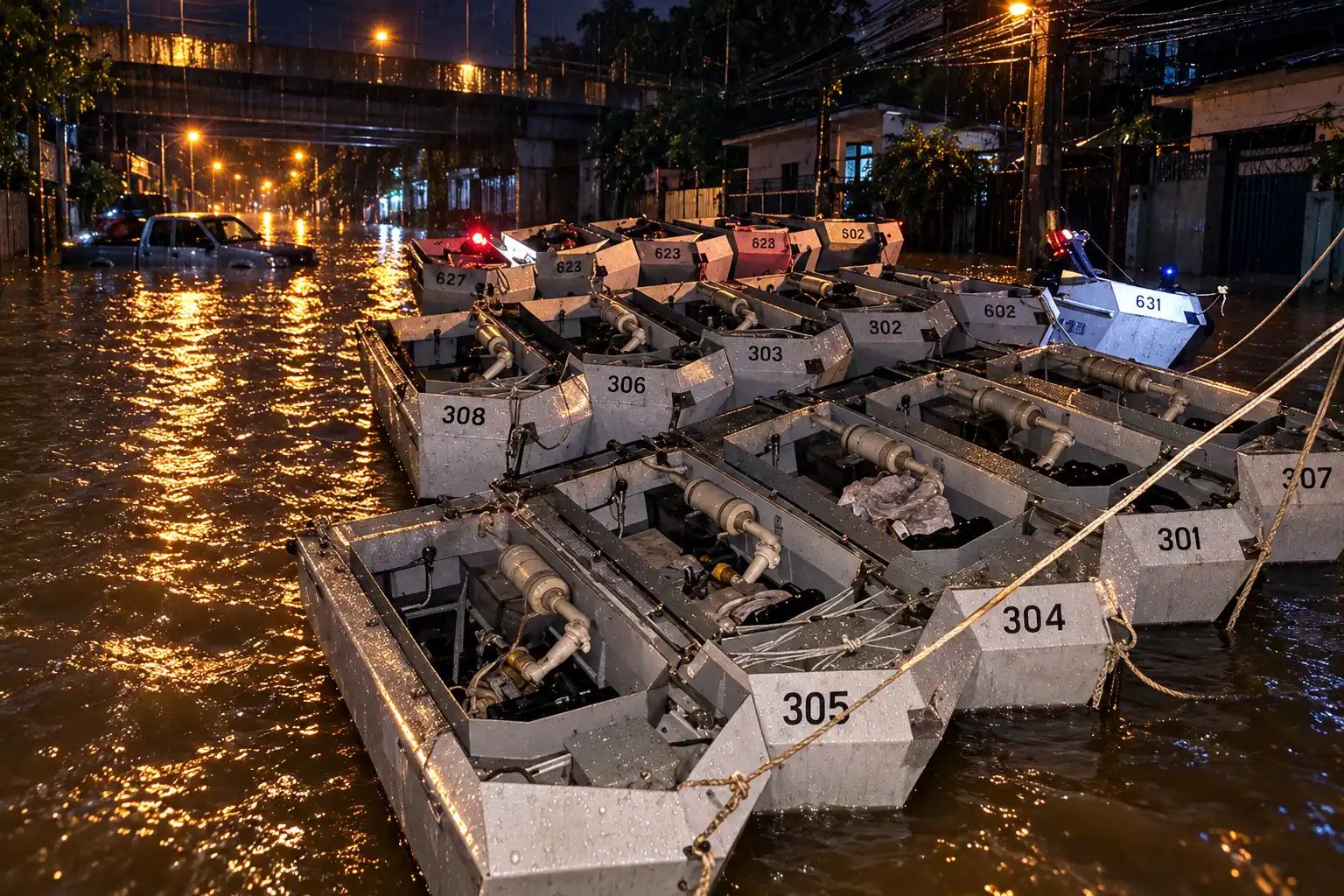
Rom Klao, a low basin off Prawet Burirom, was the place that would not empty. On 2 October, the seventh day of water in that estate, stagnant pools had begun to show decay. The navy said it was running 14 water-propelling boats in Lat Krabang from 8 a.m. to midnight, moving more than 1 million cubic metres a day, with two more boats due on Prawet Burirom. Fisheries Department crews had already taken 1,000 meal boxes and about 18,000 UHT cartons in by rubber boat. The longer the water sits, the stronger the smell, and the worse the risk from cuts and dirty water on bare skin.
ROADS STILL UNDER WATER
- Phahonyothin Road: The stretch between Thupatemi Stadium and Phahonyothin Soi 60 remains a listed hotspot.
- Suwinthawong Road: Sections from the Ramkhamhaeng intersection to Khlong Tonod are still flooded.
- Luang Paeng Road: Parts of the route are on the 3 October avoid list.
- Lat Krabang Road: Water remains in front of the Lat Krabang District Office, with Min Buri, Nong Chok, Prawet, Saphan Sung and Sai Mai still watched.
Deputy government spokesperson Lalida Pertwivatana said on 3 October that Rom Klao water had dropped about 30 centimetres and that streets there still held about 20 to 30 centimetres. Deputy Bangkok permanent secretary Jesada Chantraprapha said gates were being opened on Prem Prachakorn, Canal 2, Saen Saeb and Prawet Burirom while pumps worked the pockets. Suleemas said she would stay with her neighbours. “It’s hard, yes, very hard,” she said. “But together we are fighting and biting through it. When we get together to help one another like this, our spirit can keep us on our feet; we can get through it all together.”
The river Bangkok spent 15 years planning for is still south of the danger line Seree drew. The rain that actually came is in the sois, in a housing estate that needed boats on the ninth day, and in an airline boardroom that sacked a chief executive over bags at an airport that never closed.

Liberty Parks MotoGP on Formula 1’s Austin Stage

The Salary Cap Fight That Can Freeze Baseball’s TV Payday

The 2027 Mercedes GLE and GLS Keep Alabama Busy

Margaret Hamilton Dies at 90 With a Harder Fight Unfinished

Unity Parks Its Engine Inside Google’s Prompt Games

Microsoft 365 Auth Fault Took Down Exchange and Teams

Diesel Breaks Its Record as the White House Claims Credit

Xbox Caps Game Pass Cloud Gaming at 15 Hours

IFA 2026’s Weird Gadgets Are Building a Sensor Home

Tesla Puts Its Wheel-Free Cybercab on Austin Streets
-
 NEWS2 months ago
Microsoft 365 Auth Fault Took Down Exchange and Teams
-
 GAMING2 months ago
Xbox Caps Game Pass Cloud Gaming at 15 Hours
-
 BUSINESS2 months ago
Diesel Breaks Its Record as the White House Claims Credit
-
 AUTO2 months ago
Tesla Puts Its Wheel-Free Cybercab on Austin Streets
-
 NEWS2 months ago
IFA 2026’s Weird Gadgets Are Building a Sensor Home
-

 NEWS2 months ago
OpenAI Unveils GPT-6 Astra With a Critical Cyber Label
-

 NEWS2 months ago
OpenClaw 2.0 Ships a Team Workplace With Host-Trust Defaults
-

 NEWS2 months ago
Sony and Warner Sue Anthropic Over Torrented Song Lyrics