
BUSINESS
Saudi Pipeline Halt Traps Gulf Oil at Both Ends
Oil jumped after Saudi Arabia halted its Hormuz-bypass pipeline, leaving Red Sea tanks with days of crude as US diesel set a record.

Brent crude rose $2.90 to $107.51 a barrel on Monday after Saudi Arabia halted the East-West oil pipeline that had been carrying crude around a mostly closed Strait of Hormuz. West Texas Intermediate gained $2.27 to $102.32. US stock futures had already slipped a little over 0.5 percent when the same scare hit Sunday night.
The print is the first move. The harder problem is the map: the land line that replaced Hormuz is offline, Houthi fighters now sit on the Red Sea exit it feeds, and the tanks at Yanbu can support exports for five to seven days.
The Bypass That Replaced Hormuz
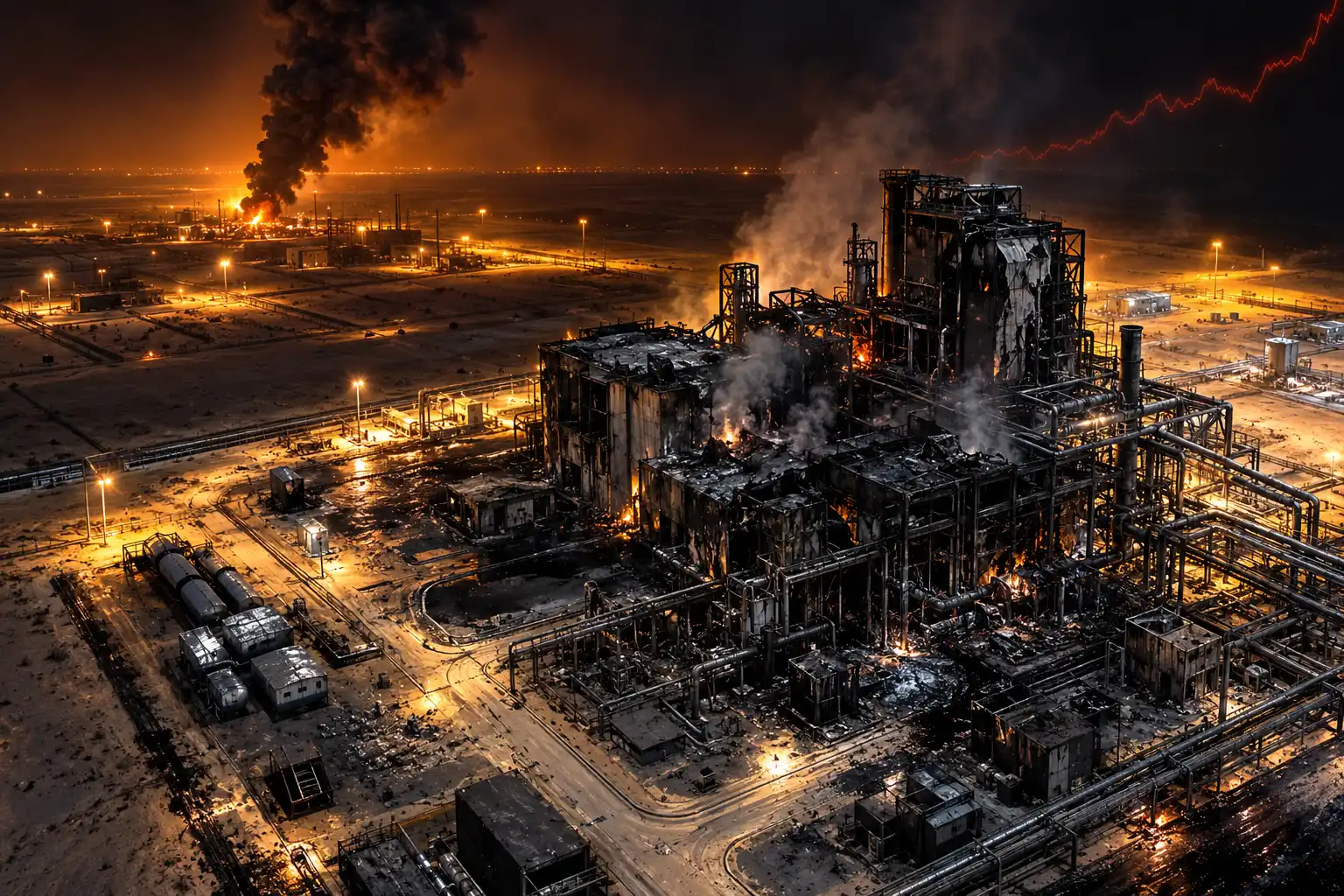
Drones launched from Iraq hit the East-West line on the morning of September 10 in Riyadh province and in the Medina region. The Saudi Ministry of Energy said on September 11 that the pipeline had been stopped as a precaution while crews secured the route and checked its safety. The Foreign Ministry said the strikes caused injuries and some damage, and that Riyadh would not answer at this stage after a request from Iraqi Prime Minister Ali al-Zaidi.
#Statement | East–West Pipeline shut down as a precaution following multiple attacks. pic.twitter.com/I9LWwsi53Z
— وزارة الطاقة (@MoEnergy_Saudi) September 11, 2026
Zaidi’s office confirmed the drones left Maysan province, which borders Iran, and dismissed the operations commander there. No group claimed the attack. President Trump said Iran was probably behind it.
The 1,200-kilometer (745-mile) line runs from the Abqaiq processing center near the Gulf to Yanbu on the Red Sea. The US Energy Information Administration describes a pipeline that can move 5 million barrels a day, with room to push that to 7 million after 2019 conversions. That extra capacity is why the kingdom could keep selling crude after Iran choked Hormuz following the start of the war on February 28.
IEA analysts wrote in June that Yanbu loadings rose from 2 million barrels a day before the fighting to more than 5 million barrels a day in early June. Traders tracking the same route in September put recent flows around 4 million barrels a day, about 4 percent of world supply. Satellite images after the strike showed fires at pumping stations. A shutdown sold as a precaution sits poorly next to a burned pump house.
Houthis Close the Red Sea Door
The pipeline only works if tankers can leave Yanbu. In the same week, Iran-aligned Houthi forces in Yemen took the land and islands that sit on that exit.
THREE ROUTES NOW BOXED IN
- Strait of Hormuz: IEA figures show flows falling from about 20 million barrels a day before the war to an average of 2.7 million in March, April and May, with most Gulf shipping still halted.
- East-West pipeline: The land workaround to Yanbu has been shut since September 11 after the Iraq-launched drones.
- Bab el-Mandeb: Houthi fighters seized the port of Mokha on September 10 and Perim Island, also called Mayun, on September 11, then pushed across Yemen’s western coast and the Hanish islands.
Perim sits about 3.5 kilometers (2 miles) off Yemen’s west coast and splits the strait’s two shipping channels. Yemeni officials said government troops had lost the western shore, Dhubab, Zuqar Island, and Greater and Lesser Hanish. The group had already declared a maritime blockade of Saudi shipping in July and has been firing on energy sites in the kingdom’s south.
Oil that cannot go east through Hormuz was supposed to go west to the Red Sea and then south through Bab el-Mandeb, or north toward Suez. Both doors are now in play at once.
Five to Seven Days in the Tanks
With the line down, Yanbu is living off oil already in storage. Three industry sources who work the Saudi export system said those stocks can keep loadings going for five to seven days. Yanbu’s tanks hold about 35 million barrels on paper. They are not full.
Saudi barrels also sit at Egypt’s Ain Sukhna terminal on the Red Sea, about 18 million barrels of capacity, and at Sidi Kerir on the Mediterranean, about 20 million. A fourth source said those depots can cover customers for several more days. After that, the crude has to move through a pipe that is not pumping, or through a strait that is not open.
THE WEEK THE BYPASS FAILED
- September 10: Drones from Iraq hit the East-West line in the Riyadh and Medina regions, and Houthi forces take Mokha on Yemen’s Red Sea coast.
- September 11: The Energy Ministry shuts the pipeline as a precaution; Houthi fighters take Perim Island in Bab el-Mandeb.
- September 13: Satellite photos show a charred pumping station; Oman postpones a Monday meeting on Hormuz; Brent opens near $108 a barrel.
- September 14: Brent trades at $107.51 and WTI at $102.32 as fresh strikes hit Saudi territory and ships in the Gulf.
One buyer told colleagues the damage could take up to six weeks to fix. Another said partial pumping might resume sooner. Riyadh has not given a restart date. Friday’s settle was $104.61 on Brent and $100.05 on WTI, so Monday’s gain is on top of a week that had already pushed both contracts back through $100.
US Diesel Hits a Record Before Crude Opens
American drivers did not need Monday’s futures print to feel the squeeze. The AAA motor club’s national average of $4.31 a gallon for regular on September 13 was little changed from the day before. Diesel was another matter. The club’s diesel average hit a record $6.20 a gallon that day, the highest in its series, after clearing $6 for the first time on September 11.
NATIONAL PUMP PRICES ON SEPTEMBER 13
| Fuel | Sept. 13 | Week earlier | Year earlier |
|---|---|---|---|
| Regular gasoline | $4.31 | $4.15 | $3.18 |
| Diesel | $6.20 | $5.90 | $3.70 |
Regular is up 16 cents in a week and $1.13 from a year earlier. Diesel is up 80 cents from a month earlier, when it averaged $5.40, and $2.50 from a year earlier. That is the fuel that moves food, freight, and farm equipment, so the pass-through is broader than the gasoline average implies.
The IEA’s September report separated the wholesale market from the pump. US diesel futures surpassed $200 a barrel in early September, 94 percent above pre-war levels, a different price from the $6.20 gallon at the station and a sign of how tight middle distillates already were before the pipeline stop.
Why the Salalah Meeting Did Not Happen
A session meant to put some order back into Hormuz did not meet. Oman had called Gulf foreign ministers and Iran to Salalah on September 14 to discuss shipping arrangements. Foreign Minister Badr Albusaidi called it off on September 13.
In the interests of consensus the regional meeting set for tomorrow in Salalah has been postponed. We remain committed to fostering dialogue that supports stability and lasting cooperation in our region.
Badr Albusaidi, Oman foreign minister, on X
Iranian officials said some regional governments asked for the delay and that Tehran and Muscat would set a new date. Bahrain had already said it would skip the talks. The agenda, as described by Iranian media, was not a full reopening of Hormuz. It was a narrower plan for entry and exit routes under Iranian arrangements, with the waterway itself still closed.
Sunday brought more shooting around the same geography. Saudi state media showed damage to homes and a mosque in Jazan province after what it called a Houthi strike. Iran said one person was killed and crew were wounded on a commercial ship hit off its coast. The United Kingdom Maritime Trade Operations center reported a tanker fire in Hormuz the same day.
The IEA’s 5.7 Million Barrel Cut
Monday’s rally is a new scare on top of a hole the IEA had already drawn. In its September Oil Market Report, the agency said world oil supply is now projected to fall by 5.7 million barrels a day this year, to 100.7 million, with any full Gulf recovery pushed to 2027.
WHAT THE IEA COUNTED IN AUGUST
- Output: Global production fell 1.6 million barrels a day from July to 100.1 million, with more than 10 million barrels a day of Gulf output still shut in.
- Saudi crude: Supply dropped to 5.97 million barrels a day from 8.24 million in July, 4.45 million below the implied target of 10.42 million.
- Gulf exports: Total oil leaving Gulf countries was about 13 million barrels a day, nearly half the pre-war level; net diesel and gasoil from the Gulf was 390,000 barrels a day, just over a quarter of the February pace.
- Stocks: Observed inventories have fallen 507 million barrels since February, including 95 million in August alone.
Demand is shrinking too, which is the only relief valve left. The IEA now sees world oil use down 2.5 million barrels a day in 2026, a steeper drop than it published in August, with the losses concentrated in diesel, jet fuel, and petrochemical feedstock, especially in Asia. Combined net diesel exports from the Gulf and Russia in August were 1.6 million barrels a day below February, when those two sources made up almost 45 percent of seaborne diesel trade.
That is why a five-to-seven-day clock at Yanbu matters more than a $3 bounce in Brent. The market has already burned through half a billion barrels of stored oil since February. Refiners in the Atlantic Basin are running for record diesel cracks. The last large Gulf workaround was a pipe across Saudi Arabia and a port on the Red Sea. The pipe is shut. The port’s tanks are on a short fuse. And the strait at the other end of that voyage is now held by the same camp that has been shooting at Saudi tankers since July.
Brent’s Monday print of $107.51 does not reopen Hormuz, repair a pumping station, or put oil back in Yanbu. Until one of those three things happens, the barrels that used to leave the Gulf have fewer places to go, and the fuel that was already at $6.20 a gallon has room to move again.
Disclaimer: This article is news reporting and analysis of oil markets, shipping routes, and retail fuel prices, and it is for information only. It is not investment advice, a recommendation to buy or sell crude, refined products, energy stocks, or any other security, and it is not a forecast you should trade against. Readers who are considering energy investments, fuel contracts, or related financial decisions should consult a licensed financial adviser or commodities professional who can review their own situation. Prices, production figures, and shipping statuses are those published by the agencies, ministries, and data providers named above as of the dates in the story and can change as the pipeline, the straits, and the talks in Oman move.

Liberty Parks MotoGP on Formula 1’s Austin Stage

The Salary Cap Fight That Can Freeze Baseball’s TV Payday

The 2027 Mercedes GLE and GLS Keep Alabama Busy

Margaret Hamilton Dies at 90 With a Harder Fight Unfinished

Unity Parks Its Engine Inside Google’s Prompt Games

Microsoft 365 Auth Fault Took Down Exchange and Teams

Diesel Breaks Its Record as the White House Claims Credit

Xbox Caps Game Pass Cloud Gaming at 15 Hours

Squishy Dumpling Toys Recalled After Hiding Illegal Water Beads

IFA 2026’s Weird Gadgets Are Building a Sensor Home
-
 NEWS2 months ago
Microsoft 365 Auth Fault Took Down Exchange and Teams
-
 GAMING2 months ago
Xbox Caps Game Pass Cloud Gaming at 15 Hours
-
 BUSINESS2 months ago
Diesel Breaks Its Record as the White House Claims Credit
-

 AUTO2 months ago
Tesla Puts Its Wheel-Free Cybercab on Austin Streets
-

 NEWS2 months ago
OpenClaw 2.0 Ships a Team Workplace With Host-Trust Defaults
-

 NEWS2 months ago
Sony and Warner Sue Anthropic Over Torrented Song Lyrics
-
 LIFESTYLE2 months ago
Squishy Dumpling Toys Recalled After Hiding Illegal Water Beads
-

 BUSINESS2 months ago
ChargePoint Stock Rally Prices Wilmer’s Three-Year Cash Plan