
NEWS
Apple Built a Huge iPhone Duo Showcase on Thin Stock
Apple opens iPhone Duo pre-orders on October 16 with a huge store showcase and factory yields still just over 60 percent.

Apple will open iPhone Duo pre-orders on October 16 with a store showcase built for a hit and a factory still running just over 60 percent yield. The foldable goes on sale October 23 in more than 70 countries, after Apple pulled the date forward from a later November window it feared two months earlier. Mark Gurman, in his Power On newsletter, says anyone who wants one should plan ahead.
The company is about to teach millions of people how the phone opens. It does not have a matching pile of boxes behind the table.
Fifth Avenue’s 150 Demo Units
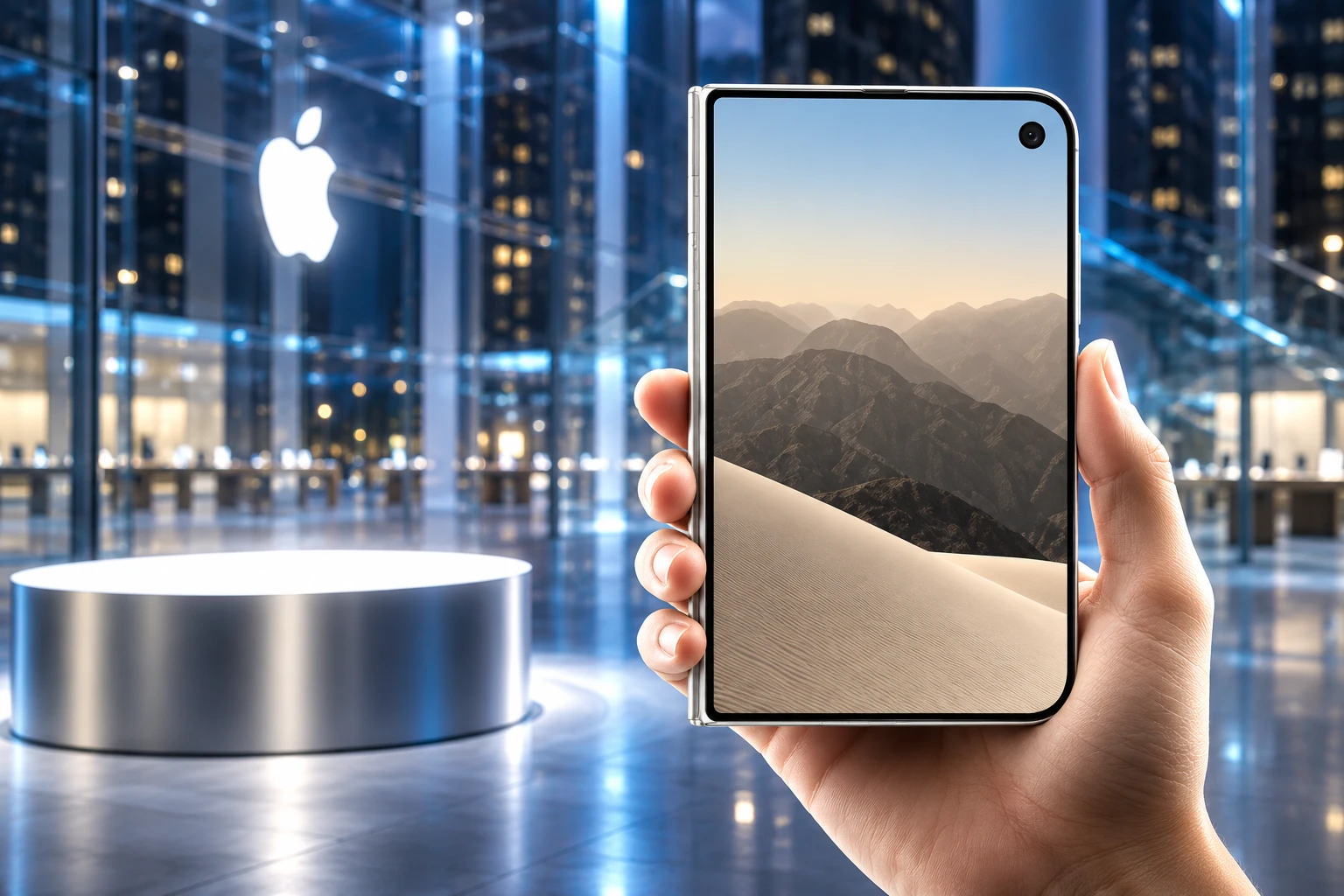
Apple is treating the first foldable iPhone like a product people must touch. Most stores will add a second spotlight table with a white top and a new fixture that opens and closes the phone. Fifth Avenue in New York gets its own takeover zone. A MagSafe stand will hold an open Duo next to two regular iPhones so shoppers can see the jump in size. U.S. stores will also run Presto machines that load software through the sealed box and put the buyer’s name on the first “Hello” screen, in English or Spanish.
Gurman says the Fifth Avenue store is expected to have more than 150 demo units for hands-on use and fixtures, with nearly 100 headed to the Apple Park Visitor Center. Those are phones that stay in the building. Sellable stock, he says, is still limited.
Apple’s Fifth Avenue store is expected to have more than 150 iPhone Duo demo units for the Oct. 23 launch. Apple Park Visitor Center will have nearly 100. There’s also a new fixture showing the phone opening and closing.
Mark Gurman, Power On newsletter, on X
The split is the joke people keep making in plain language: one New York store can put more than 150 foldables on glass, and a typical store still gets about 20 to try, while the advice for paying customers is to plan ahead. Demo hardware is a marketing budget. It is not a shipping forecast.
IPHONE DUO DEMO ALLOCATIONS
| Store | Demo units |
|---|---|
| Fifth Avenue, New York | more than 150 |
| Apple Park Visitor Center | nearly 100 |
| Michigan Avenue, The Grove, Upper West Side | about 30 to 40 each |
| Typical non-flagship store | about 20 |
Shoppers who do get a few minutes on a demo will be handling the cameras Apple is already pushing in its Shot on iPhone Duo campaign. Desire is not the weak point. Count is.
Apple Pulled October In Ahead of the Factory
Apple unveiled the iPhone Duo on September 9, on the same day as the iPhone 18 Pro models. Pre-orders begin at 5 a.m. Pacific on October 16. Phones are due in stores and on doorsteps October 23. A second wave of 28 countries and regions follows on October 30. The 18 Pro line has been in shops since September 18. The foldable is the last of that trio to go on sale, and it is the one Apple almost parked in November.
Gurman wrote that around August, production trouble looked bad enough that sales might not start until later in November. Apple then gathered enough stock for an October launch, though he still describes that stock as limited and tighter than the company had mapped internally earlier in the year. Get Ready opened in the Apple Store app on October 12, so buyers can lock color, storage, carrier, AppleCare, and trade-in before the clock starts. That tool exists because the first minutes will be a race.
THE IPHONE DUO LAUNCH CALENDAR
- September 9, 2026: Apple unveils the iPhone Duo in star white and night sky, from $1,999.
- September 17, 2026: A Foxconn-chain source puts final assembly yield at just over 60 percent, with the first batch called small.
- October 11, 2026: Gurman details the store showcase and says launch stock will stay limited.
- October 12, 2026: Get Ready goes live in the Apple Store app.
- October 16, 2026: Pre-orders open at 5 a.m. Pacific.
- October 23, 2026: Sales start in more than 70 countries and regions.
- October 30, 2026: Another 28 markets join.
Holding October is a win on a slide. It is also why the first weeks look thin. Apple did not wait for the line to grow up. It shipped the calendar it had, then filled stores with phones nobody can take home.
Just Over 60 Percent Still Pass at Foxconn
The number that sits under all of this is not a rumor about cracked screens in pockets. It is a factory pass rate. A person close to Foxconn’s supply chain said on September 17 that whole-device assembly yield for the iPhone Duo was just over 60 percent. Under Apple’s current quality bar, that person said, a mature yield could take six months to a year. Foxconn was still changing equipment, steps, and settings while the line ran, which is what a first foldable looks like when the customer is Apple.
Suppliers were waiting to see whether Apple would ease those checks so volume could rise. No such move has been described since. Units that miss the check are not dead phones in a landfill; they go back for rework, parts, or another pass. They also do not go in a pre-order queue on October 16. Early iPhone lines always throw away a lot of finished work until the tools settle. The Duo’s problem is that Apple scheduled the settling for after people are allowed to pay.
THE MID-SEPTEMBER LINE
- Pass rate: Final assembly at Foxconn sat just over 60 percent as of September 17.
- First batch: The same source called early output small.
- Mature yield: Six months to a year, if Apple keeps today’s quality bar.
- Quality call: The chain was waiting on Apple, and no easing has been reported.
That mid-September reading is the last hard yield figure on the record. It is not a new October audit. It is also the backdrop for a launch Apple refused to slide into November once it had “enough” phones for a limited sale.
Why the Hinge Keeps the Line Slow
The yield is not one broken part. It is a stack. Samsung Display makes the folding OLED. Those panels, and some hinge pieces, had low yields, late deliveries, and design changes, which ate the time Foxconn needed to tune final assembly. Apple also tested liquid metal in some hinge parts, then dropped that path before mass production, which forced other suppliers to redo samples. Mizuho Securities said in a September 3 note that hinge specs and crease trouble were slowing the ramp, and that Apple had to weigh its quality bar against full-scale output.
Opened, the Duo is the thinnest iPhone, with a 7.6-inch inner display Apple says is 50 percent larger than the iPhone 18 Pro Max. Closed, the 5.4-inch outer screen has 90 percent of the iPhone 18 Pro’s screen area, and both faces share the same aspect ratio. The inner canvas is built for two apps at once, a split view on the inner screen that is a large part of why people will queue. The hinge has to hold that sheet flat, fold it, and keep the titanium body stiff.
WHAT IS STILL STACKED ON THE LINE
- The hinge: More than 100 parts must fit and move inside tight limits, or the crease deepens and the open-close feel goes wrong.
- The panel: Samsung Display’s foldable OLED had low yields, late shipments, and design changes on the way into Foxconn.
- The material swap: A liquid-metal hinge path was tested and then dropped, which reset samples down the chain.
- The bar: Apple has not been described as loosening the checks that keep pass rates at just over 60 percent.
Tom Marieb, Apple’s new head of hardware engineering, was asked about the crease getting bigger over time and said, “Hold us accountable to that, please.” That is the voice of a company that would rather miss a box in October than ship a hinge it will have to explain in April. It is also why Gurman’s plan-ahead note exists.
A 6 Million Year Against a Pro Cycle
Counterpoint senior analyst Ivan Lam said Apple is on track to sell about 6 million iPhone Duo units in 2026, a figure he tied to how fast the new hardware can ramp. That is a foldable-scale year, not an iPhone-scale year. A person in the supply chain put Apple’s global stocking target at 6 million to 8 million units for 2026. A retail-channel source put sales guidance above 5 million. A mainstream Pro or Pro Max model usually ships 20 million to 30 million units over a full cycle.
Analyst Junho Kim at UBI Research wrote that Samsung Display’s foldable panel shipments for Apple are expected to exceed 7 million units in 2026. Panels are not finished phones. Extra sheets are exactly what a just-over-60-percent assembly line burns while it learns. IDC estimates global foldable shipments will rise 13 percent to 22.9 million units this year with Apple in the mix, and that the category would have fallen without the Duo. A 6 million-unit Apple year would be a large slice of a still-small pile.
In early October, a supply-chain source said Apple had raised Duo orders by 30 percent, with the total still under 10 million units. That bump is an order-book change, not extra phones on a Friday pallet. It can mean Apple now wants more Duos by December. It does not cancel a thin October 23.
2026 IPHONE DUO VOLUME READS
| Read | Figure | What it counts |
|---|---|---|
| Counterpoint, Ivan Lam | about 6 million | expected 2026 sales |
| Supply-chain stocking target | 6 million to 8 million | global stock for 2026 |
| Retail-channel guidance | more than 5 million | sales guidance |
| Early October order revision | still under 10 million | orders after a 30 percent increase |
| Typical iPhone Pro cycle | 20 million to 30 million | full-cycle shipments of one Pro model |
U.S. pricing is $1,999 for 256GB, $2,199 for 512GB, $2,599 for 1TB, and $3,199 for 2TB. That is the dearest iPhone Apple has sold. Six million of a $1,999 phone is still a serious business. It is not a volume that forgives a slow line in the first month.
Samsung Already Has Foldables on the Line
Samsung has been making book-style foldables for years, and it is still building them through the same autumn Apple is entering. For October and November it planned about 1.14 million Galaxy Z8-series phones, with the Galaxy Z Fold 8 taking the largest share at around 500,000. That two-month run is smaller than its August-September burst, which is what a post-launch taper looks like when the factory already exists.
The Korean line was not calm either. Fold 8 demand ran ahead of display-driver chip supply this summer, and Samsung shifted 2027 DDI volume into 2026 phones to keep building. Experience did not cancel a shortage. It meant Samsung had a product on sale in August while it fought that shortage, instead of a fixture in a store and a date in October.
People who want a foldable in their pocket before Apple’s first shipment can already buy one. Apple is asking them to wait for a $1,999 iPhone, then warning that the wait may stretch past October 23. Some of that overflow will stay in the iPhone queue on loyalty. Some of it will not.
What Happens When Pre-Orders Open October 16
Apple has run this movie. When iPhone X pre-orders opened on October 27, 2017, launch-day supply was gone in minutes and U.S. ship estimates ran out to five to six weeks. Ming-Chi Kuo, then at KGI, had put launch stock at only 2 to 3 million units. Apple called demand “off the charts” and kept taking orders. The Duo starts at twice that era’s flagship price, in fewer colors, with a harder factory. Gurman has already said shortages and overseas resale could follow, and that the squeeze could run past the Mac shortages tied to the AI buildout.
Get Ready is the tell. Apple is letting people choose star white or night sky, storage, carrier, care plans, and trade-in now so that October 16 is a single tap at 5 a.m. Pacific. That is a courtesy. It is also an admission that the form will not wait for anyone still typing a billing address. Former Apple engineer Paul Solt’s public note that he is buying a test device, and may not keep it, fits the mood around a $1,999 first foldable: curiosity is high, patience for a late ship date is not.
The fixture on Fifth Avenue will open and close a Duo that stays on the table. Pre-orders open at 5 a.m. Pacific on October 16. First customer phones are due October 23. Gurman’s advice is still to plan ahead.

Final Fantasy Resonance Turns a Dead Gacha Into HD-2D

PHP2Shell Forced Sites Offline While Exploits Stalled

Kindle+ Folds AI Audiobooks Into the Page-Read Fund

Chip Stocks Fall as the Bond Rally Cheapens AI Spend

Comcast’s Record Odyssey Quarter Doubles as the Exit

Microsoft 365 Auth Fault Took Down Exchange and Teams

Xbox Caps Game Pass Cloud Gaming at 15 Hours

OpenClaw 2.0 Ships a Team Workplace With Host-Trust Defaults

OpenAI Unveils GPT-6 Astra With a Critical Cyber Label

Diesel Breaks Its Record as the White House Claims Credit
-
 NEWS2 months ago
Microsoft 365 Auth Fault Took Down Exchange and Teams
-
 GAMING2 months ago
Xbox Caps Game Pass Cloud Gaming at 15 Hours
-
 NEWS2 months ago
OpenAI Unveils GPT-6 Astra With a Critical Cyber Label
-
 NEWS2 months ago
OpenClaw 2.0 Ships a Team Workplace With Host-Trust Defaults
-
 BUSINESS2 months ago
Diesel Breaks Its Record as the White House Claims Credit
-

 LIFESTYLE2 months ago
Squishy Dumpling Toys Recalled After Hiding Illegal Water Beads
-

 BUSINESS2 months ago
ChargePoint Stock Rally Prices Wilmer’s Three-Year Cash Plan
-

 AUTO2 months ago
Tesla Puts Its Wheel-Free Cybercab on Austin Streets