
BUSINESS
L.L.Bean Bets Stores and Catalogs Can Beat AI
Greg Elder is betting a $50 million Freeport flagship, print catalogs, and human photos can unstick L.L.Bean’s three years of $1.7 billion sales.

L.L.Bean reopens its Freeport flagship on Sept. 18, a $50 million wager that stores, print catalogs, and human photos can still sell outdoor gear. CEO Greg Elder, named in January, says the book stays in the mail and AI stays out of the pictures, after sales sat at $1.7 billion in 2025 for a third straight year.
Family owners can fund that pause. Public outdoor chains, watching catalogs die and AI rewrite product pages, have not given themselves the same room.
A $50 Million Flagship Opens on Sept. 18
The company promoted Greg Elder to chief executive on Jan. 9, 2026, after nearly two decades inside the retailer, most recently as chief retail officer. He took over from Stephen Smith, who had run the firm for 10 years and stayed as an adviser through March. Elder joined in 2007 from Eddie Bauer and Dayton Hudson, now Target, and had already been the executive walking the Freeport rebuild.
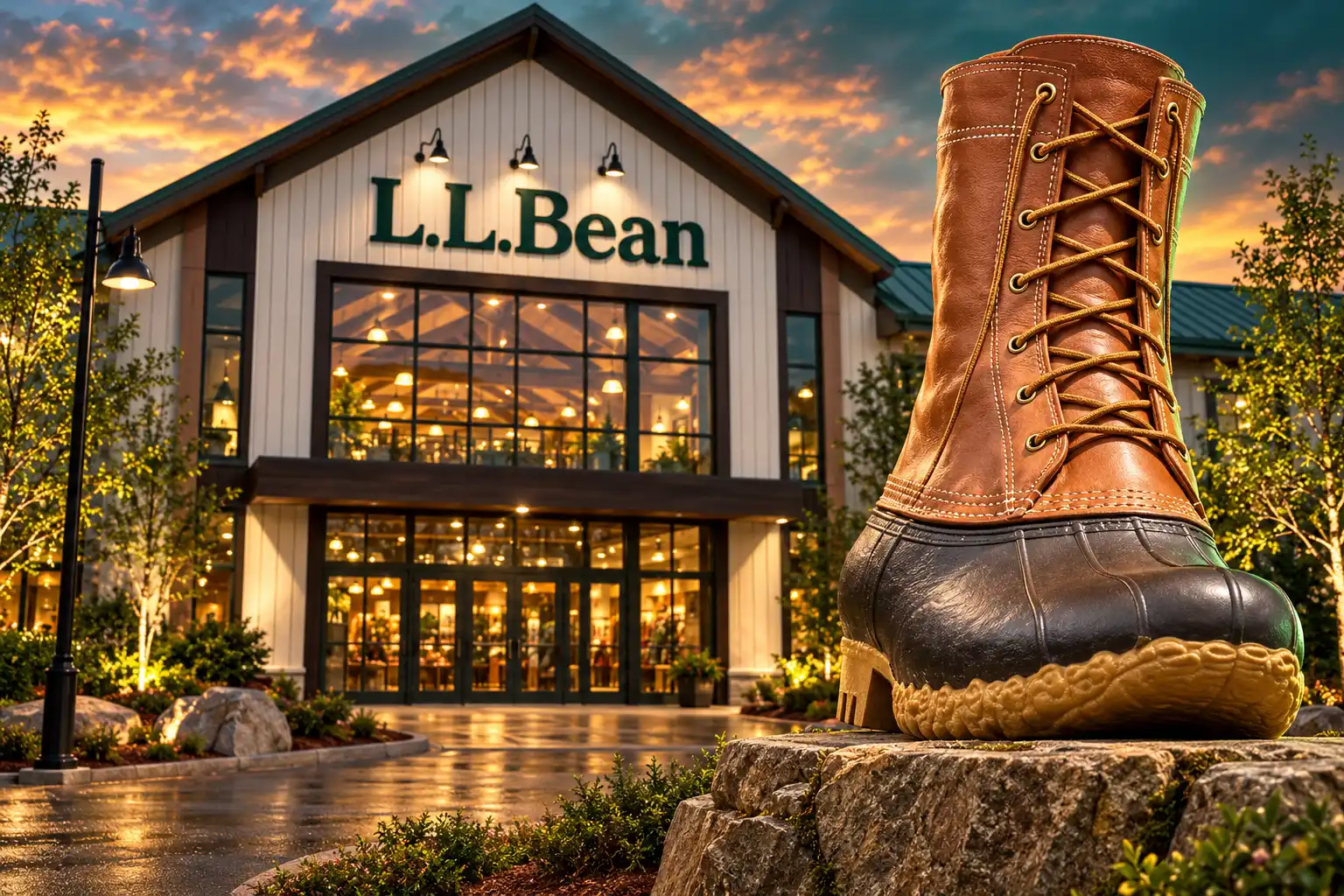
That rebuild is the first public test of his tenure. L.L.Bean announced the Flagship Re-Boot on Jan. 25, 2023, as a multi-year, $50 million job on the 220,000-square-foot campus at 95 Main Street, which the company says draws more than 3 million visitors a year and ranks as Maine’s second-most-visited tourist stop. For much of the work, apparel sat in Camp L.L.Bean, a 28,000-square-foot hard-sided tent in a parking lot, while the Hunting and Fishing store kept selling boots and totes around the clock.
The Hunting and Fishing shop has been open 24 hours a day, 365 days a year since 1951, built for hunters rolling through from Boston and New York on the way to camp. It is still the only stand-alone L.L.Bean store on that clock. A headquarters makeover next door cost $110 million and finished in 2023.
WHAT THE RE-BOOT ADDS
- Trout pond: A two-tier pool, twice the old size, sits in front of a new grand staircase so more people can watch the fish.
- Stream tank: The tank doubles the water volume and adds underwater viewing along an expanded run.
- 1912 Café: The in-store restaurant grows to 3,000 square feet with a wider menu and a view across the floor.
- Custom Shop: Monogramming, engraving, and live Boat and Tote stitching move into a larger personalization bay.
- Kids’ floor: A remodeled department, shaped with a children’s focus group, borrows the feel of a Maine summer camp.
- Discovery Park: Extra lawn and paths in the middle of campus, built for concerts and outdoor classes.
Visit Freeport lists a grand opening weekend of Sept. 18-20, then five more themed weekends through Oct. 25. Country singer Kip Moore plays Discovery Park at 7 p.m. on Friday. Heritage Weekend on Sept. 25-27 brings a vintage product drop and repairs. Later dates fold in the Freeport Fall Festival, a makers weekend, Camp Sunshine’s Pumpkinfest, and a Home Team Weekend with the Boston Red Sox and Portland’s Hearts of Pine, plus a Wallflowers set.
The mix is a tell. As the campus comes back, the company is dropping bike retail at Freeport and folding boats and skis into the main store, saying it wants to lean on hunting, fishing, family camping, watersports, and winter. The bet is not “more of everything.” It is more of the things the brand already knows how to stage in person.
Three Flat Years at $1.7 Billion
The reopen lands on a plateau, not a boom. Sales were $1.7 billion in 2025, the same mark as 2024 and 2023, after a $1.8 billion peak in 2021 when volume jumped 14 percent. The board still paid a performance bonus, but the check got smaller each year the top line refused to move.
SALES AND THE STAFF BONUS
| Year | Sales | Bonus | What else moved |
|---|---|---|---|
| 2021 | $1.8 billion | 20% | Peak year, sales up 14% |
| 2023 | $1.7 billion | 9% (5% cash, 4% 401(k)) | About 5,600 staff; HQ rebuild done |
| 2024 | $1.7 billion | 6.5% | Company donated $6.8 million |
| 2025 | $1.7 billion | 6% (3.5% cash, 2.5% 401(k)) | About 5,700 year-round staff; 7 new U.S. stores |
In 2022 the bonus was 13.5 percent even as sales slipped 1 percent, so the 2025 payout sits well below that pandemic-era run. Elder, already in the chair when the 2025 numbers went out, said teams “stayed focused on what matters most, delivering quality outdoor lifestyle products and showing up for our customers.” Chairman Shawn Gorman, the founder’s great-grandson, thanked Elder and Smith for a quiet handoff and called the year “solid.”
Solid, in this shop, means holding $1.7 billion while opening stores and finishing a flagship. It does not mean the top line is growing. That is the part of Elder’s wager the interview did not put on a slide.
Bean Is Adding Stores as Outdoor Retail Shrinks
At the end of 2025 L.L.Bean ran 68 U.S. stores in 19 states, plus partner shops in Japan and Canada with Jaytex Group. It opened seven U.S. locations last year, six full-price and one outlet, including its first in Florida, and said those shops beat plan while existing stores grew. The 2026 slate is eight more, the first in Alabama and Tennessee, which the company said would take the U.S. fleet to 76 stores in 21 states. Another eight to 10 are penciled in for 2027, aimed at the Midwest and Southeast.
The named 2026 file is Huntsville, Alabama; Glen Mills, Pennsylvania; Maple Grove, Minnesota; Franklin, Tennessee; Beavercreek, Ohio; Naperville, Illinois; Colorado Springs, Colorado; and Ann Arbor, Michigan. Elder, still chief retail officer when that list went out in December 2025, called physical retail “an essential part of our growth strategy.”
The rest of outdoor retail has been walking the other way. Orvis, the Vermont fishing house, said it would shut 31 full-price stores and five outlets. Dick’s Sporting Goods has shrunk Public Lands to three shops and folded the Moosejaw name. REI cut staff more than once. Patagonia trimmed its workforce. L.L.Bean itself announced two layoff rounds in 2024. The Outdoor Industry Association put 2024 outdoor retail sales at $27.5 billion, down 3 percent.
Stores are still the growth plan inside Freeport, and they already strained a company built for catalogs and parcels. Corey Bouyea, vice president of stores and retail operations, told a Retail Industry Leaders Association session that pressure “started to show its ugly head” once the chain crossed 50 shops, and that it got worse as the count neared 70, because the supply chain was still wired to ship one order to one porch. Vision 2030, as he described it, wants 10 or more new shops a year. That only works if the warehouses catch up with the floors.
Wholesale is the quieter channel. In 2025 the company said it added Free People, Backcountry, and 94 independent outdoor shops, putting Bean product in 125 new storefronts and 60 new websites. Nordstrom, Dillard’s, Scheels, and Staples were already on the U.S. list. The stores get the speeches. The wholesale rack is how a stalled $1.7 billion brand finds doors it does not have to lease.
What Happens to a Catalog That Shrinks 10% a Year?
The print book is older than the Freeport floor. Leon Leonwood Bean mailed the first catalog in 1912, the same year he stitched a rubber bottom to a leather upper after a hunting trip left him with wet feet. Elder, retelling that origin, said Bean’s line was simple: “What if I developed the waterproofness of a rubber bottom and stitched on a leather upper?” Ninety of the first 100 Maine Hunting Shoes came back defective. He refunded them, and the return habit became the company’s reputation.
The Smithsonian’s National Postal Museum records how large that mail pile grew. By the mid-1950s L.L.Bean was sending over 400,000 catalogs twice a year. By the 1980s it was more than 75 million catalogs a year. Elder now puts the decline in daily mailing volume at an estimated 10% to 14% each year. He also said the book is not leaving. “There is nothing in the foreseeable future that would suggest we’re going to eliminate the catalog.”
Orvis made the other choice. After 170 years of mail from Vermont, it killed the catalog and cited more than 2,500 tons of paper a year. Lands’ End went the other way on software, using AI to spin catalog pages and marketplace copy. Matt Trainor, then a Lands’ End marketing vice president, called his own book “slow moving” and “non-personalized” and asked what AI could fix. Bean is doing neither. Elder said the photos still have to be “old-school photography with real products on a real human.”
That rule is narrower than the headlines. It is a ban on generated models in the look book, not a claim that no one in Freeport will ever open a chat window. A listing that asks an art director to know AI would not, by itself, undo a photography standard. The catalog is brand insurance. It is also a cost line that shrinks 10% to 14% a year and still has to earn its postage.
Paper is not a side issue for a company that sells itself as outdoor and green. Orvis used the paper tonnage as a reason to quit. Bean kept the format and, through a spokesperson in late 2024, called the catalog an icon that still matters to loyal buyers even as digital spend rises. Elder’s own climate file is the reason he gives for staying off AI image tools. The catalog is the place those two instincts collide.
The Family That Still Owns the Company
Public retailers do not get three flat years, a $50 million hometown rebuild, and a catalog that management refuses to kill. L.L.Bean does, because the equity still sits with Leon Leonwood Bean’s descendants. Shawn Gorman has chaired the board since 2013. Dozens of relatives sit on an owners’ council that feeds dissent up to the directors. The company has not gone public. Elder is not family, and neither was Smith, the first outsider in the chief’s chair, but the Gormans still decide whether Freeport stays home.
“We are a family-owned, privately held company,” Elder said. “The family remains steadfast in their desire to keep this based in Freeport, Maine, where we’ve always been.” Gorman, on the reopen, pointed back to 1917, when L.L. rented space above the Freeport post office. “He never imagined what it would become, our home for more than 110 years and the unofficial hub of downtown, welcoming more than 3 million visitors a year.”
Maine is the HQ story, not the whole factory map. Boat and Tote bags are still stitched in Brunswick, and the opening weekend puts those stitchers in the Custom Shop so shoppers can watch. A lot of the fleece, shells, and knitwear in the same catalog still come through the same Asian supply chain every outdoor brand uses. The old-school bet is on the store, the book, and the town. It is not a claim that every SKU is cut in New England.
THE LONG CLOCK IN FREEPORT
- 1912: Leon Leonwood Bean founds the company around the Maine Hunting Shoe and a mail-order circular.
- 1917: The first retail room opens above the Freeport post office.
- 1951: The flagship goes to 24-hour hours for hunters passing through overnight.
- February 9, 2018: The lifetime, no-questions return promise becomes a one-year refund with proof of purchase, after Gorman said a small group treated it as free replacements for worn-out gear and yard-sale finds.
- January 25, 2023: The company announces the $50 million Flagship Re-Boot.
- January 9, 2026: Elder is named president and CEO.
- September 18, 2026: Grand opening weekend starts on the rebuilt campus.
The 2018 guarantee change is the last time the family publicly admitted a beloved rule had gotten too expensive. Customers still get a year, and defects after that are handled case by case. The catalog and the 24-hour store have not had that reckoning yet. Elder is betting they will not need one on his watch.
Elder’s AI Line Starts With Power and Pictures
Asked how L.L.Bean is using AI, Elder said the company is “curious” about where it might “fit for our brand,” and is not hunting for places to plug it in. “That’s not who we are. That’s not in our DNA. We still revolve around the personal selling experience,” he said. “We’re quite cautious about some of the risks.” The risk he named is not a deepfake boot. It is electricity and water.
This computing power has an impact on the environment without question. I’m really hoping that we can find the beautiful intersection of the use of this technology that provides employee and customer productivity, still takes heed to the needs of sustainability, and retains and protects the humanity that is uniquely culturally L.L.Bean.
Greg Elder, CEO, L.L.Bean
The International Energy Agency’s Energy and AI work puts that caution on a chart. It projects data-centre power more than doubling this decade, from 460 TWh in 2024 to over 1,000 TWh in 2030 in its base case. Coal still supplies about 30 percent of the power those halls use, with renewables around 27 percent and gas 26 percent. For a brand that sells itself on trails and trout, that mix is a problem even if the models never touch a catalog page.
Bean has spent the last few years putting numbers on its own footprint. The company says it has cut owned-facility greenhouse gases in half from 2019 levels at U.S. sites it controls, matching a 2025 goal, and it wants a 25 percent cut in Scope 3 emissions by 2030 through the Outdoor Industry Association’s Climate Action Corps. It claims 100 percent of Maine electricity use is matched with U.S. wind and solar. In 2024 it recycled 87 percent of waste at Maine facilities. Since 2022 it has dropped 5.2 million pounds of single-use plastic from fulfillment mailers. As of 2025, 87 percent of outerwear and 61 percent of activewear use preferred materials such as recycled polyester and organic cotton. Labeled products moved to PFAS-free water-repellent finishes in fall 2024, and the firm put $150,000 into PFAS research at the University of Maine.
Those are owned-building and packaging wins. They do not settle whether a generated catalog page is dirtier than a truck of paper. Elder is not pretending they do. He is buying time until the “beautiful intersection” shows up, and until then he is willing to look, in his word, “atypical.”
Rivals are not waiting. Lands’ End is already letting models write product copy for Amazon. Adobe has told retailers that shoppers sent by AI convert at higher rates than shoppers who arrive on their own. REI and Amazon dominate the answers when chat tools pick outdoor kits. A brand that refuses to feed those machines can keep its voice. It can also go missing in the aisle where a new customer now starts.
Kip Moore Plays Discovery Park on Opening Night
Friday’s concert is the easy picture. A country headliner on a new lawn, a bigger trout pond, stitchers from Brunswick working a Boat and Tote in public, shuttles from headquarters at 15 Casco Street when the Main Street lot fills. The harder picture is the spreadsheet behind it: $1.7 billion that will not move, a catalog whose daily mailings fall 10% to 14% a year, eight new stores in a trade that is closing doors, and a photography rule that costs more than a prompt.
Elder’s line on the whole posture was short. “It may be a little atypical,” he said. “But you know, that’s who we are.” The family can fund atypical for a long time. The flagship that opens on Sept. 18 is where shoppers get to decide whether they will fund it too.

Liberty Parks MotoGP on Formula 1’s Austin Stage

The Salary Cap Fight That Can Freeze Baseball’s TV Payday

The 2027 Mercedes GLE and GLS Keep Alabama Busy

Margaret Hamilton Dies at 90 With a Harder Fight Unfinished

Unity Parks Its Engine Inside Google’s Prompt Games

Microsoft 365 Auth Fault Took Down Exchange and Teams

Diesel Breaks Its Record as the White House Claims Credit

Xbox Caps Game Pass Cloud Gaming at 15 Hours

Squishy Dumpling Toys Recalled After Hiding Illegal Water Beads

IFA 2026’s Weird Gadgets Are Building a Sensor Home
-
 NEWS2 months ago
Microsoft 365 Auth Fault Took Down Exchange and Teams
-
 GAMING2 months ago
Xbox Caps Game Pass Cloud Gaming at 15 Hours
-
 BUSINESS2 months ago
Diesel Breaks Its Record as the White House Claims Credit
-

 AUTO2 months ago
Tesla Puts Its Wheel-Free Cybercab on Austin Streets
-

 NEWS2 months ago
OpenClaw 2.0 Ships a Team Workplace With Host-Trust Defaults
-

 NEWS2 months ago
Sony and Warner Sue Anthropic Over Torrented Song Lyrics
-
 LIFESTYLE2 months ago
Squishy Dumpling Toys Recalled After Hiding Illegal Water Beads
-
 NEWS2 months ago
IFA 2026’s Weird Gadgets Are Building a Sensor Home