
NEWS
Iran Threat Sends America’s B-1 Bombers Home From Fairford
Washington flew 12 B-1 bombers out of RAF Fairford after an Iran-linked drone warning, ending a seven-month stay and cutting Europe’s fastest path to Iran.

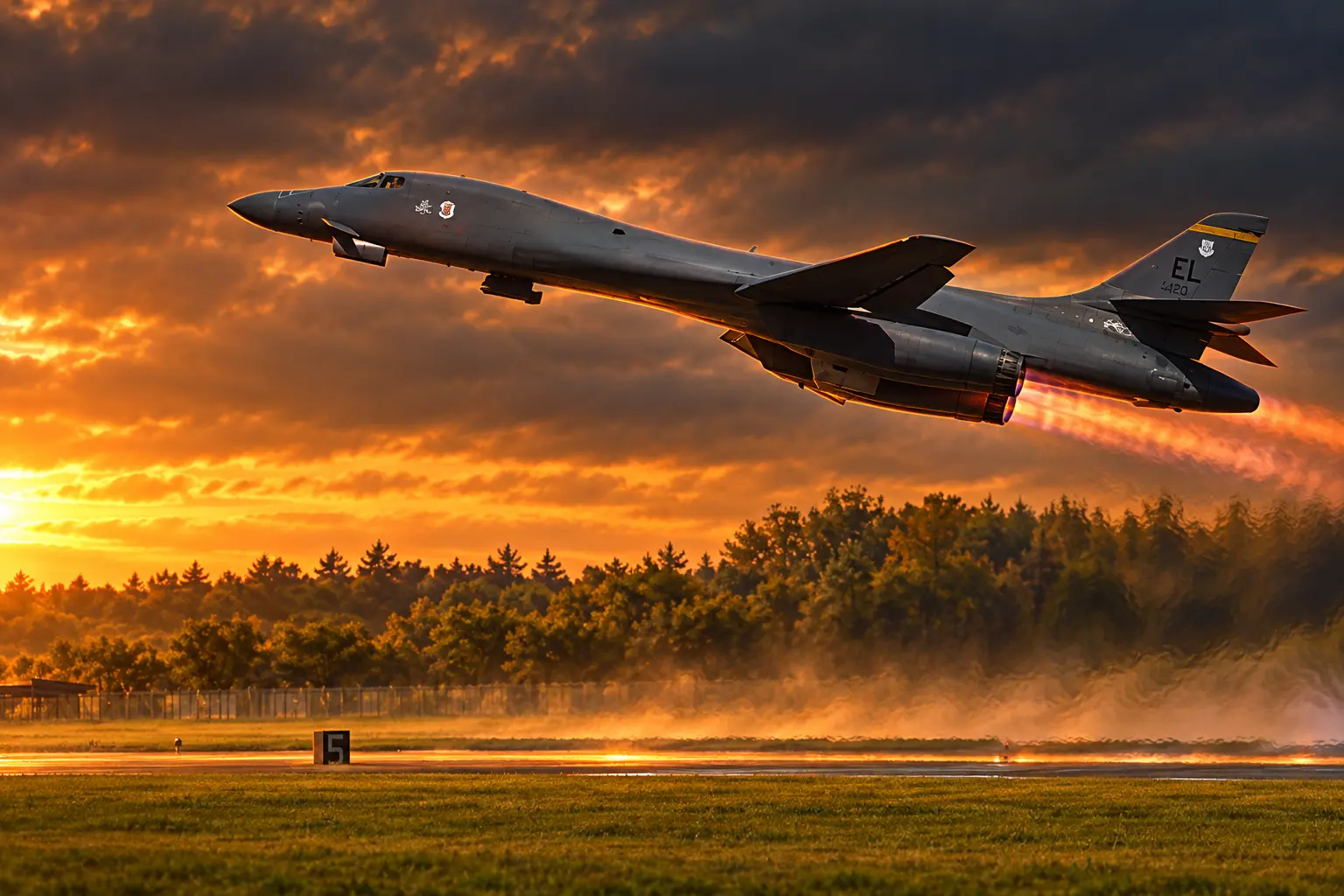
The United States flew all 12 B-1B Lancers out of RAF Fairford on October 4, ending a seven-month bomber stay after an Iran-linked threat. President Donald Trump said the jets were moved because Washington had a threat and knew who made it.
The lift emptied America’s preferred European pad for heavy bombers just as Britain still limits the base to defensive strikes on Iran. The planes went home to Texas and South Dakota, not to another runway closer to the war.
Twelve B-1s Left Fairford in a Single Day
Spotters watched the last squadron leave the Gloucestershire field in cells through Sunday, with tankers from RAF Mildenhall still being lined up as some of the bombers rolled. A Pentagon official and US European Command both said every US bomber sent to Fairford had gone back to home stations in the United States, and that operational security had blocked any confirmation while the jets were moving.
“The Airmen that operate America’s bomber force, including B-1s, B-2s, and B-52s, remain ready to deliver precision global strike capabilities, including through operations that launch and recover from the continental United States, anywhere, anytime,” the statement said.
One Lancer had arrived only about a week earlier as a replacement, which is not how a planned drawdown looks. Officials later called it unusual to send the jets all the way home rather than to another base in the region. Fairford sits 90 miles (145 km) west of London and is one of the few European fields that can handle the B-1.
THE FAIRFORD BOMBER STAY
| Measure | Figure |
|---|---|
| Peak on the ramp | About 18 B-1Bs and 6 B-52Hs |
| Separate bombers through the war | 29 airframes |
| Combat sorties tracked | 64 |
| Training sorties tracked | More than 190 |
| B-1Bs still in Air Force service | 45 of 100 built |
The open-source Military Air Tracking Alliance logged 29 bombers and 64 combat sorties from the Cotswolds runway after the first jets arrived in early March, plus more than 190 training flights once the hottest stretch of Operation Epic Fury cooled. B-52s that shared the ramp left months ago. The 12 Lancers that remained were a large share of a type the Air Force no longer builds.
A Drone Warning Sent the Bombers Home
Trump, speaking on October 5, tied the move to a threat and to Iran. He said it costs very little money to move the planes, and that shifting them “sort of alleviates” the danger.
We had an idea that there might be a threat, and why would I leave them there? It costs very little money to move them. So we had a threat, and if we’re going to be threatened, we just move them, and that sort of alleviates that. And we actually know the people that made the threat.
Donald Trump, US president, to reporters, October 5, 2026
Asked if those people were linked to Iran, he said, “They would be linked to Iran.” Vice President JD Vance said the jets were moved out of an abundance of caution, and that Iran was trying to do what the Iranian state has done for 49 years, which is engage in acts of terrorism against the United States and others.
By October 6, US and British officials were describing the warning in more specific terms: a possible drone attack ordered by Iran’s Islamic Revolutionary Guard Corps, aimed at aircraft and at some of the several hundred American personnel still on the base. Officials said the suspected plot was complex and multipronged, and that it had echoes of Ukraine’s 2025 raid on Russian bomber bases, when drones brought in by truck were launched from close range. Some of the Fairford jets left while aerial refueling aircraft were still being scrambled.
That is a different picture from the vans found near the fence on September 27. The later warning, officials said, grew out of threat reporting that had already been circulating and then sharpened in the 24 hours before the lift.
Burnham Insists the Gloucestershire Base Is Safe
Secretary of State Marco Rubio would not draw a straight line from the suspected plot to the sudden removal. He said the Pentagon is constantly reallocating resources where they need to be, and that the United States has confidence in the security of all its bases. A NATO military source still called Iran an acute threat to US assets in the United Kingdom, while a senior NATO official said the removal would have no impact on the alliance of 32 nations.
Prime Minister Andy Burnham’s spokesman, asked if Fairford was safe, said yes. British officials also said they were not aware of a new terrorism threat to the base a week after the arrests, and that they would be surprised if Iran could mount a fresh operation that fast. The Ministry of Defence has not commented on the departure. BBC reporting relayed that the call was military rather than political, taken at an operational level and passed from the US military to British counterparts.
WHERE THE ACCOUNTS DIVERGE
- Trump: There was an Iran-linked threat, the people behind it are known, and moving the jets removes the target.
- Rubio: There is no direct link between the suspected plot and the removal; the Pentagon shifts aircraft as a matter of course.
- Burnham’s office: The base is safe, even as the bombers leave it.
Ezra Cohen, a defense official in Trump’s first term, called the move prudent because the B-1 is a strategic asset that is no longer in production. “These are very, very unique platforms that aren’t being produced any more, and we have a limited number of them,” he said. British officials, speaking separately, said there is an ongoing high tempo of threat from Iran to the United Kingdom, and that US air bases would sit high on any targeting list.
London Already Barred Offensive Strikes From Fairford
The empty ramp is not only a security story. It is the end of a posting that London had already fenced in. Then-Prime Minister Keir Starmer first refused to let the Trump administration use Fairford for strikes on Iran, saying he would not join “regime change from the skies.” On March 1 he accepted a US request for a specific and limited defensive purpose: hitting Iranian missile capabilities at source. The Ministry of Defence later named Fairford and Diego Garcia as the fields covered, and on March 20 said the same permission also covered US action against missile sites used to attack shipping in the Strait of Hormuz.
Burnham has kept that line. During the current conflict the United States had permission to use Fairford only for those defensive strikes. London refused permission for offensive strikes on Iran, and that split has strained a partnership that is usually among Washington’s closest.
HOW FAIRFORD FILLED, THEN EMPTIED
- March 1, 2026: Starmer grants permission for defensive US use of British bases, including Fairford and Diego Garcia.
- March 6, 2026: The first B-1B arrives in the evening; more follow, and the Ministry of Defence confirms US use of British bases the next day.
- March 10, 2026: B-1s take off from Fairford on what US Defense Secretary Pete Hegseth called the most intense day of strikes since Operation Epic Fury began.
- April 2026: A shaky ceasefire takes hold; the bombers at Fairford shift mostly to training, and the B-52s later go home.
- July 23, 2026: The IRGC names any base used against Iranian territory a legitimate target after B-1 missions from Fairford.
- September 27, 2026: Five British men are arrested near the base; 85 homes are evacuated.
- October 4, 2026: All 12 remaining B-1s depart for the United States in a single day.
At the height of the stay the United States had about two dozen bombers at Fairford at once. Stationing them there cut the flight time needed to reach Iran compared with a round trip from the continental United States. That advantage is what Sunday’s lift gave up.
What Empty Fairford Costs a Prolonged Iran Campaign
Christoph Bergs, a research analyst at the Royal United Services Institute, said the redeployment would in the short term reduce US capacity to quickly surge sorties against Iran, reducing the threat level somewhat. He also noted that use of Fairford was already limited by London’s defensive-only rule. Dania Thafer of the Gulf International Forum said Washington had lost a convenient launchpad, not the ability to strike.
The jets can still fly from Dyess Air Force Base in Texas and Ellsworth Air Force Base in South Dakota, the two homes of the Lancer force. Those missions need longer profiles and more tanker support from aircraft such as the KC-135 and KC-46. Bergs said the planes could in theory go to Diego Garcia or to bases in the Gulf, which would cut the extra distance, but that would depend on space, talks with allies, and security. Sending them to the American plains instead of those nearer fields is the choice that matters for how fast a new pulse of strikes could be generated from Europe.
WHAT LEAVING EUROPE CHANGES
- The fleet share: The 12 jets were part of a force that now numbers 45 of the 100 B-1Bs built, with the type funded to fly through 2037 while the B-21 Raider arrives.
- The tanker bill: Home-station strikes on Iran need more refueling than a hop from the Cotswolds, and Sunday’s crossing itself required a scramble of tankers.
- The ramp that remains: Fairford still hosts a US support presence under the 501st Combat Support Wing, and several hundred American personnel were still there when the bombers left.
- The legal gate: Even if the Lancers return, they would still fly under Britain’s defensive-only permission unless London changes it.
A B-1B is 45 metres (146 ft) long and can carry 24 cruise missiles. Putting a dozen of them on a British runway gave planners a short path to the Gulf. Taking them off it does not end the war. It does make a long bombing campaign from European soil harder to sustain at the pace Fairford allowed in March.
The IRGC Put Fairford on a Target List in July
Iran’s Revolutionary Guards had already done the political work of naming the field. In a July 23 statement they said any base used for aggression against Iranian territory was a legitimate target, after B-1s flying from Fairford joined the fight once, the Guards claimed, naval cruise-missile stocks in the Indian Ocean had run low. “Any base used for aggression against Iranian soil is a legitimate target for us,” the statement said. Foreign Minister Abbas Araghchi warned that those who contributed to such attacks, whatever the kind of support, would also be considered legitimate targets.
On September 30, after Burnham said there were “strong indications” Iran played a part in the Fairford incident, Araghchi answered on X.
PM Burnham says the UK Government "can confirm our belief that we believe Iran to have played a part" in the RAF Fairford incident.
I can confirm Iran's belief that releasing supposed terrorists working for foreign states really says it all.
You're barking up the wrong tree.
— Seyed Abbas Araghchi (@araghchi) September 30, 2026
“I can confirm Iran’s belief that releasing supposed terrorists working for foreign states really says it all. You’re barking up the wrong tree,” he wrote. Iran has called the accusations baseless. The Guards’ July warning still sits on the record: a British airfield used by American bombers had been placed inside Tehran’s stated target set months before the vans appeared in Whelford.
The Suspects Remain on Bail, Uncharged
In the early hours of September 27, five British men in their 20s were arrested after being seen running into fields from three white vans parked near the base, in the village of Whelford, two miles from Fairford. A local farmer called 999 at 1:36 a.m. after finding the vans blocking a road. Police said no explosive devices were found, but a quantity of petrol was present. About 85 homes were evacuated and a bomb disposal robot was sent in. The men, all from London and aged 23 to 25, were held first on explosives offences and then on suspicion of preparing terrorist acts.
Assistant Commissioner Laurence Taylor, head of Counter Terrorism Policing, said on September 28 that after extensive interviews the five were being released on police bail, with stringent conditions on movement and contact. “This does not mean that the investigation is over,” he said. They have not been charged. A sixth man, a dual UK-Iranian national, was arrested on suspicion of preparing terrorist acts four days later and has also been released on bail.
Trump said at the time of the first arrests that the plot had planned “big damage” and that it might have been connected to Iran. He later said he would not have released the suspects on bail. Burnham chaired a Cobra meeting, defended the bail terms as the strictest possible, and told interviewers he had complete confidence in how British security services were handling the case. “There are strong indications that Iran played a part in what happened over the weekend at RAF Fairford, but of course it remains an ongoing, complex, and serious police investigation,” he said.
The men on bail and the bombers in Texas and South Dakota are now the two facts that remain. Fairford is still a British base with an American support unit on it. The Lancers that used it to hit Iranian missile sites are not there, and the investigation that began in a Gloucestershire lane has not produced a charge.

Final Fantasy Resonance Turns a Dead Gacha Into HD-2D

PHP2Shell Forced Sites Offline While Exploits Stalled

Kindle+ Folds AI Audiobooks Into the Page-Read Fund

Chip Stocks Fall as the Bond Rally Cheapens AI Spend

Comcast’s Record Odyssey Quarter Doubles as the Exit

Microsoft 365 Auth Fault Took Down Exchange and Teams

Xbox Caps Game Pass Cloud Gaming at 15 Hours

OpenClaw 2.0 Ships a Team Workplace With Host-Trust Defaults

OpenAI Unveils GPT-6 Astra With a Critical Cyber Label

Diesel Breaks Its Record as the White House Claims Credit
-
 NEWS2 months ago
Microsoft 365 Auth Fault Took Down Exchange and Teams
-
 GAMING2 months ago
Xbox Caps Game Pass Cloud Gaming at 15 Hours
-
 NEWS2 months ago
OpenAI Unveils GPT-6 Astra With a Critical Cyber Label
-
 NEWS2 months ago
OpenClaw 2.0 Ships a Team Workplace With Host-Trust Defaults
-
 BUSINESS2 months ago
Diesel Breaks Its Record as the White House Claims Credit
-

 LIFESTYLE2 months ago
Squishy Dumpling Toys Recalled After Hiding Illegal Water Beads
-

 BUSINESS2 months ago
ChargePoint Stock Rally Prices Wilmer’s Three-Year Cash Plan
-

 AUTO2 months ago
Tesla Puts Its Wheel-Free Cybercab on Austin Streets