
AUTO
China’s Record Car Exports Run Into Closing Markets
China shipped 1.053 million vehicles in September as home retail heads for 18.5 million, and the overflow is already running into new trade walls.

1.053 million vehicles left China in September, up 61.4% from a year earlier, while passenger-car retail at home is heading for 18.5 million in 2026. That is a 22% drop from 2025 and below the 19.29 million sold in 2020.
The same autumn that Beijing showrooms went quiet, the European Union moved to throttle the hybrid models that had slipped around earlier electric-car duties. The shipment record is now the evidence trading partners use to close the valve.
Empty Showrooms in the Peak Buying Season
Autumn is supposed to be the easy sell in China, the stretch dealers call golden September and silver October. This year many halls on the edge of Beijing are empty or shut. Li Ke, a salesman with 26 years on the floor, said that other than the Covid-19 pandemic it is the slowest peak he has seen.
In past years, customers would come to the showrooms nonstop. We would have deals to sign every day. But nowadays we see only two to three deals a week. It’s a dramatic drop.
Li Ke, car salesman, Beijing
The China Passenger Car Association put passenger-car retail at 13.33 million units through September, down 21.7% from a year earlier. On October 23 it estimated October retail at 1.60 million, down 28.9%. New-energy vehicles, the mix of battery-electric and plug-in hybrid cars that once carried the market, are slipping too. Association figures show NEV retail down 12.8% from January through September, with September itself off 16.7% at 1.084 million.
Jobs feel unstable and property prices are still sliding, so households treat a car as a bill they can postpone. Beijing has also pulled back cash-for-clunkers money and some electric-car tax breaks, salespeople said. Li moved his store off a costly street to a cheaper box with less foot traffic. He sees little point in another discount round. “Chinese buyers would rather wait,” he said.
The China Association of Automobile Manufacturers, which counts a wider sales total than the passenger-car group’s retail series, said domestic vehicle sales fell 26.0% in September to 1,904,000 and 22.4% from January to September to 15,066,000. Factory-wide vehicle sales still only fell 8.4% in September, to 2,956,000, because exports filled part of the hole. In September the extra shipments offset about 60% of the domestic drop, which is relief, not a cure.
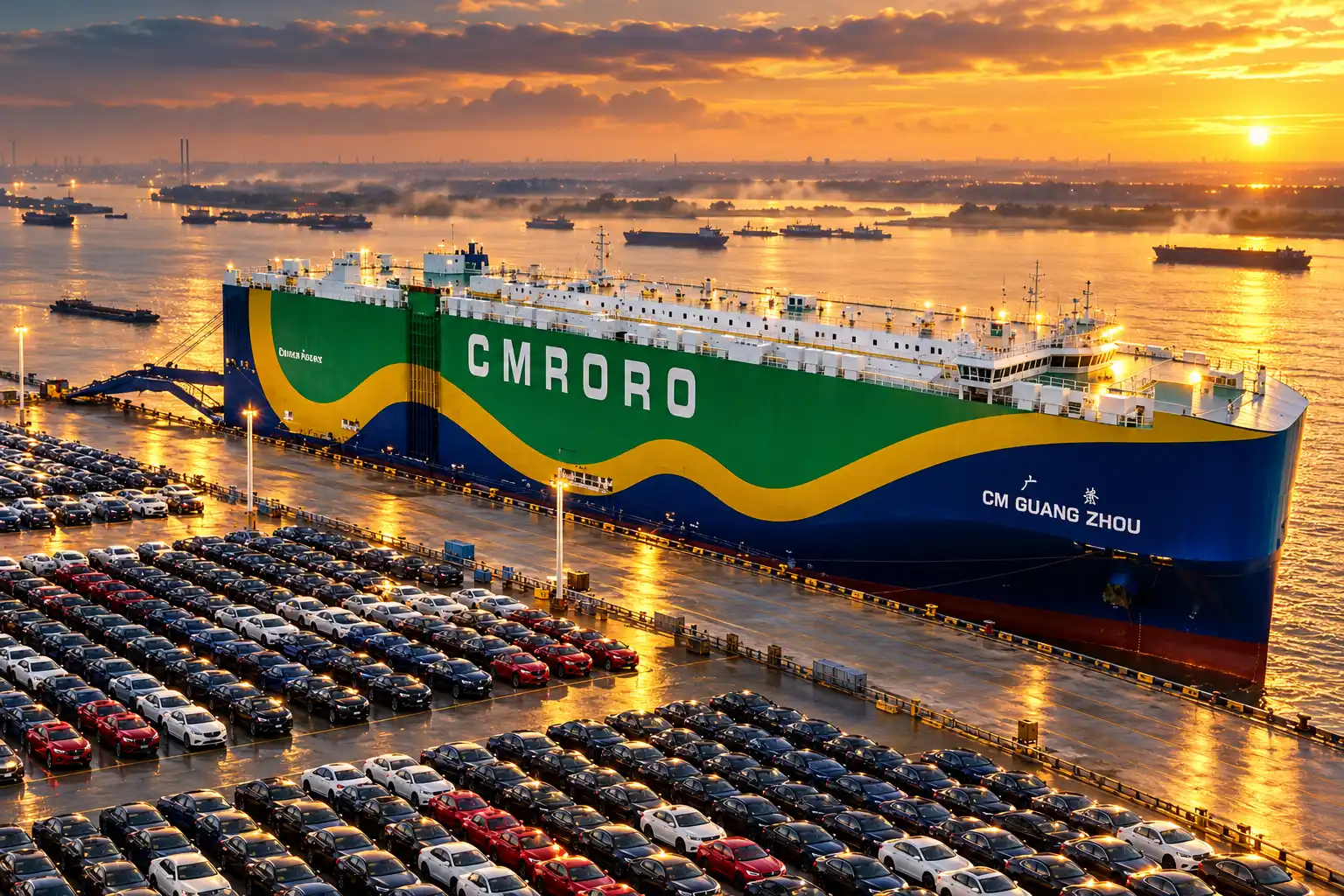
China Shipped 1.053 Million Vehicles in September
CAAM’s October 12 release is the cleanest picture of the overflow. September exports hit 1,053,000, up 61.4% year on year and 4.2% from August, the fourth straight month above 1 million. Passenger vehicles were 919,000 of that, up 64.2%. New-energy models were 571,000, about 54% of the month and up 160%.
CHINA VEHICLE SHIPMENTS IN 2026
| Measure | September | January to September |
|---|---|---|
| Total vehicle exports | 1,053,000 (+61.4%) | 8,205,000 (+65.8%) |
| Passenger vehicle exports | 919,000 (+64.2%) | 7,167,000 (+70.6%) |
| NEV exports | 571,000 (+160%) | 4,006,000 (+130%) |
| Domestic vehicle sales (CAAM) | 1,904,000 (-26.0%) | 15,066,000 (-22.4%) |
Gasoline and diesel cars have not vanished from the docks. Conventional fuel exports were still 482,000 in September, up 12%. Over nine months they reached 4.19 million, up 31.6%, beside 4 million NEVs. Battery-electric shipments were 2.4 million of the NEV total and plug-in hybrids 1.5 million, up 148%.
The passenger-car association said exports were 36% of manufacturers’ sales in September, against 19% a year earlier. Chery alone shipped about 205,000 vehicles that month. CAAM’s own label for the split is cold inside, hot outside. National Bureau of Statistics figures make the cash version of that split plain: industrial profits for the first nine months were up 15.5%, while auto-making profits shrank 22.8%.
Where the Surplus Cars Are Landing
Russia, Brazil and Britain took the largest shares of China’s passenger-car exports from January to July, according to Gasgoo Automotive Research Institute, while Mexico and the UAE already bought fewer cars than a year earlier. The overflow is not a single wave hitting every port. It is a scramble into the markets that are still open, and a retreat from some that have started to push back.
PASSENGER-CAR EXPORTS, JANUARY TO JULY 2026
- Russia: 524,428 units, up 143.4% from a year earlier.
- Brazil: 408,393 units, up 148.4%.
- United Kingdom: 315,653 units, up 94.8%.
- Belgium: 266,050 units, up 48.8%, a common EU gateway.
- Australia: 261,182 units, up 91.1%.
- Mexico: 191,418 units, down 24.8%.
- Italy: 171,454 units, up 129.7%.
- UAE: 156,615 units, down 38.7%.
Chinese customs data put passenger-car shipments to Russia at 806,300 from January to September, about double the year before. Brazil’s climb has been even faster, and local rules there are already pushing more of the business toward kit assembly and plants on the ground. Mexico and the UAE show the other edge of the same story. Last year’s boom markets can shrink once tariffs, local-content rules or credit tighten.
Trade maps of top destinations for Chinese cars still put Russia, the UAE, Britain, Belgium and Mexico among the large value markets, even as the unit ranking shifts month to month. Latin America now takes more than a fifth of the volume in some half-year tallies. Europe is where the mix is changing fastest, because hybrids filled a hole that battery-electric duties had opened.
Europe Closes the Hybrid Door It Left Open
Eurostat figures compiled by the ECG association show the EU imported 1,105,239 passenger cars from China in the first eight months of 2026, already more than the 1,011,563 it took in all of 2025. August alone was 227,810, up 151% from 90,498. Hybrids were 474,475 of the January-August total, battery-electrics 464,216 and combustion cars 164,699, or about 43%, 42% and 15%.
That hybrid share is the loophole. In 2024 the EU put extra duties on China-made battery-electric cars after finding subsidies in the supply chain. Hybrids were left out, and the flow jumped. Eurostat counted 107,000 hybrid imports from China in 2024 and 302,000 in 2025.
HOW THE EXPORT DOORS STARTED TO CLOSE
- October 30, 2024: The European Commission applies five-year extra duties on China-made battery-electric cars, on top of the standard 10% tariff.
- October 8 to 9, 2026: Trade commissioner Maroš Šefčovič and Commerce Minister Wang Wentao reach an understanding in Beijing to moderate Chinese hybrid and plug-in hybrid shipments to the EU.
- October 12, 2026: China’s finance ministry and tax administration say the NEV export VAT rebate will fall from 13% to 9% on April 1, 2027.
- Model year 2027: A US Commerce rule restricts Chinese-controlled connected vehicles, including some built in America, unless they win authorisation.
The Commission’s own schedule lists countervailing duties of 17% on BYD, 18.8% on Geely and 35.3% on SAIC. Tesla’s Shanghai-made cars were set at 7.8%, other cooperating firms at 20.7%, and non-cooperating firms at 35.3%. Stacked on the 10% tariff, BYD’s combined rate is about 27% and SAIC’s about 45.3%.
Hybrids became the workaround, and then the next target. After the Beijing talks Šefčovič told reporters the two sides had a shared reading that could cut China’s hybrid and plug-in hybrid exports by more than half against a no-change path, and would keep several million cars out of the EU over four years.
We have reached a shared understanding to moderate China’s exports of hybrids and plug-in hybrids to the European Union. This opens the prospect of cutting China’s exports by more than half.
Maroš Šefčovič, EU trade commissioner, Beijing press conference, October 9, 2026
He also called it a first step, not the end. Beijing describes the same paper differently. The commerce ministry says the arrangement uses 2025’s 302,000 hybrids as a baseline and leaves room to grow, with China’s quota no lower than any other supplier’s, under WTO rules. Planning figures that circulated in Brussels after the talks put a hard ceiling near 350,000, but that number is not in the joint text, and Šefčovič said he still needed EU leaders’ endorsement. Until member states lock it in, the two capitals are selling opposite stories about the same deal.
Q: European Commissioner for Trade and Economic Security Maroš Šefčovič said last Friday that the China-EU consensus on hybrid vehicle exports stemmed from China’s understanding of European public opinion. What is China’s response to this? (MOFCOM Regular Press Conference…
— 中华人民共和国商务部MOFCOM (@MOFCOM_China) October 20, 2026
The United States is using a different tool. Under the Commerce Department’s connected-vehicle rule, Chinese-controlled brands face sales limits from model year 2027 even when the car is assembled in America, unless they obtain authorisation. Local production does not, by itself, buy a US showroom. On October 7 the US and 14 other economies also pledged to share data and coordinate on excess capacity in electric vehicles, batteries and solar panels. Brazil, China, Indonesia, Russia, Saudi Arabia and South Africa did not join that list.
US Treasury Secretary Scott Bessent, speaking in Charlotte, North Carolina, put the price complaint in one line aimed at BYD: “It is the best $70,000 car that $35,000 can buy, it is heavily subsidized.” European brands spent years treating China as a profit pool. The flow has reversed, and the prices coming back are the ones Brussels says its cost base cannot match.
63 Million Units of Capacity and No Shakeout
Exports keep plants running. They do not retire the extra lines. Mobility Global’s capacity tally, cited across industry accounts of the 2026 slump, puts Chinese factories at about 63 million passenger vehicles a year. Against 18.5 million expected domestic retail sales, that is more than three times what home buyers are likely to take. The two series are not a perfect match, because some of the capacity is for export and the vehicle definitions differ, but the gap is the point.
THE HOME MARKET VERSUS THE PLANTS
- 2026 retail: The passenger-car association expects 18.5 million, below 2020 and the weakest year since 2014.
- 2025 peak: 23.74 million passenger cars, the comparison base for the 22% drop.
- Model split: Zhang Yongwei, president of the China EV100 research institute, said the top 20% of models took 85% of sales, while 70% of models averaged fewer than 1,000 a month.
- Skyworth Auto: A plant rated at 100,000 a year sold 660 cars in China through September.
Mary Barra, chief executive of General Motors, told analysts in July that China has so many competitors that “there’s a lot of sorting that’s going to happen, needs to happen for long-term viability.” The sorting is slow because a closed plant is a local fiscal and jobs problem. Cities that paid for the lines have little incentive to idle them. Zhang described the domestic market as strong supply and weak demand. Cui Dongshu, secretary-general of the passenger-car association, now calls 2026 an abnormal slide and sees only a weak recovery in 2027, with a central forecast of 2% and a range from zero to 5%.
Japan’s 1980s path is the comparison Beijing cannot copy cleanly. Voluntary export restraints in 1981 still allowed Japanese factories inside the US market to serve American buyers, and Japan’s home output peaked in 1990 as production moved abroad. Patrick Xue, a research scholar at the Australian National University, notes that the US connected-vehicle rule blocks that substitute when the concern is data and control, not only price. The EU has left the plant door open. BYD began trial production in Hungary in 2026. Executive vice-president Stella Li said at the Paris Motor Show that large-scale output there is due in the fourth quarter of 2026, with a second and third European plant in planning and France among the sites. The Hungary works is designed for an eventual 300,000 vehicles a year. Geely has a deal to use Ford’s Valencia plant. SAIC is setting up in Spain. Those lines help the firms that can pay for them. They do not help a dealer in Beijing, and they do not shrink a 100,000-unit hall that sold 660 cars.
Beijing Cuts the Rebate That Paid for the Glut
On October 12 the finance ministry and the State Taxation Administration issued Announcement No. 29 of 2026. From April 1, 2027 the NEV export rebate from 13% to 9% applies to a list of battery-electric and plug-in hybrid passenger cars, plus some electric buses and truck tractors. The rate follows the export date on the customs form. E-cigarette devices lose their rebate on the same day. Photovoltaic rebates were already stripped from April 1, 2026, and battery rebates are on a path to zero in 2027, so the car cut sits in a wider effort to stop cheap export races.
Cui Dongshu said the change is meant to curb low-price export fights and to push more output into overseas plants, which helps the brands that already have them. Deutsche Bank estimated the four-point gap would trim about 5,000 yuan ($743) of net profit from each exported BYD. For firms living on thin export margins, that is a real hit, and it arrives after the home price war has already chewed through dealer cash.
Chinese brands took 73.9% of the passenger market in the first nine months, up 4.9 points, so the collapse is not a foreign-brand story. It is a glut story. The passenger-car association found most leading makers had reached less than 60% of their annual targets after three quarters. The cars that do not sell on Li Ke’s floor still leave the factory gate. They go to Russia and Brazil and, until the paperwork hardens, into EU hybrid lots. Then they meet a duty, a quota talk, a rebate cut, or a security rule.
Li’s store already traded a busy street for cheaper rent. He will not chase the next markdown. The plants behind him still have every reason to keep building, because a quiet line is a local crisis and a loaded ship is still a sale. From April 2027 even that sale gets a smaller tax cheque. The buyers he used to see every afternoon would rather wait.

Xiaomi 18 Pro Goes Global as Its Privacy Filter Falters

iFixit Finds HomeView Glued Shut After Repair Gains

Polymetallic Nodules Shelter 4,139 Animals Miners Want

One UI 9.5 Puts Now Brief Behind a System Agent

Framework’s $99 Keyboard Brings Laptop Repair to the Couch

Microsoft 365 Auth Fault Took Down Exchange and Teams

OpenClaw 2.0 Ships a Team Workplace With Host-Trust Defaults

Xbox Caps Game Pass Cloud Gaming at 15 Hours

OpenAI Unveils GPT-6 Astra With a Critical Cyber Label

Squishy Dumpling Toys Recalled After Hiding Illegal Water Beads
-
 NEWS3 months ago
Microsoft 365 Auth Fault Took Down Exchange and Teams
-
 NEWS3 months ago
OpenClaw 2.0 Ships a Team Workplace With Host-Trust Defaults
-
 GAMING3 months ago
Xbox Caps Game Pass Cloud Gaming at 15 Hours
-
 NEWS3 months ago
OpenAI Unveils GPT-6 Astra With a Critical Cyber Label
-
 LIFESTYLE3 months ago
Squishy Dumpling Toys Recalled After Hiding Illegal Water Beads
-

 BUSINESS3 months ago
Diesel Breaks Its Record as the White House Claims Credit
-

 NEWS3 months ago
IFA 2026’s Weird Gadgets Are Building a Sensor Home
-

 BUSINESS3 months ago
ChargePoint Stock Rally Prices Wilmer’s Three-Year Cash Plan