
NEWS
Voyager 1 Hits a Light-Day as Earth Falls Two Days Behind
Voyager 1 reaches one light-day on Nov. 18 as radio replies stretch to two days and engineers keep cutting science to save watts.

Voyager 1 will be 16.094 billion miles (25.902 billion kilometers) from Earth at 5:16:07 a.m. EST on Wednesday, Nov. 18, a full light-day out. Radio from the ground will then take 24 hours to arrive and 24 hours to return, so a hello becomes a two-day wait. NASA is asking people after sunset on Tuesday, Nov. 17, to point a phone or flashlight at the sky and blink the craft’s call sign, V-G-R, in Morse code.
The agency calls the rite a symbolic wave of golden light. Nothing on the spacecraft will change when the mile marker ticks over, and the people still flying it already work on a delay that is about to become a round trip of two full days.
A Wave of Flashlights Voyager Will Never See
After sunset on Tuesday, Nov. 17, NASA wants a band of gold light around the night side of Earth. The invite is open: a flashlight, a glow stick, a bike lamp, a porch bulb, a phone screen. The pattern is the mission call sign, and the agency built a web flasher so a phone can flash V-G-R in Morse code without anyone memorizing dots.
A photon from a backyard torch will not ping the spacecraft. NASA says any light from Earth takes 24 hours to cover the gap, and the greeting is meant for the people holding the lights. The official line is blunt and small: a simple act, a shared moment, a celebration of humanity’s farthest reach.
No other traveler has ever journeyed so far from home.
Voyager 1 is about to become the first human-made object to reach a distance of one light-day from Earth, or about 16 billion miles. ½ pic.twitter.com/uETo8DHUF1
— NASA Solar System (@NASASolarSystem) November 10, 2026
THE V-G-R SIGNAL
- Letter V: Three quick flashes and one long flash, then a pause of a second or more.
- Letter G: Two long flashes and one quick flash, then another pause between letters.
- Letter R: One quick flash, one long flash, and one more quick flash.
- How long: Repeat the three letters for about a minute, or until the arm giving the signal gets tired.
NASA wants photos and video tagged @NASA, and it built a 55-second how-to so the pattern is visible before anyone steps outside. Dots are flashes shorter than a second. Dashes last about a second. The whole rite is scheduled the night before the mile marker, which is the honest part of the choreography: a command beamed on Tuesday evening would reach the spacecraft after the light-day has already been crossed.
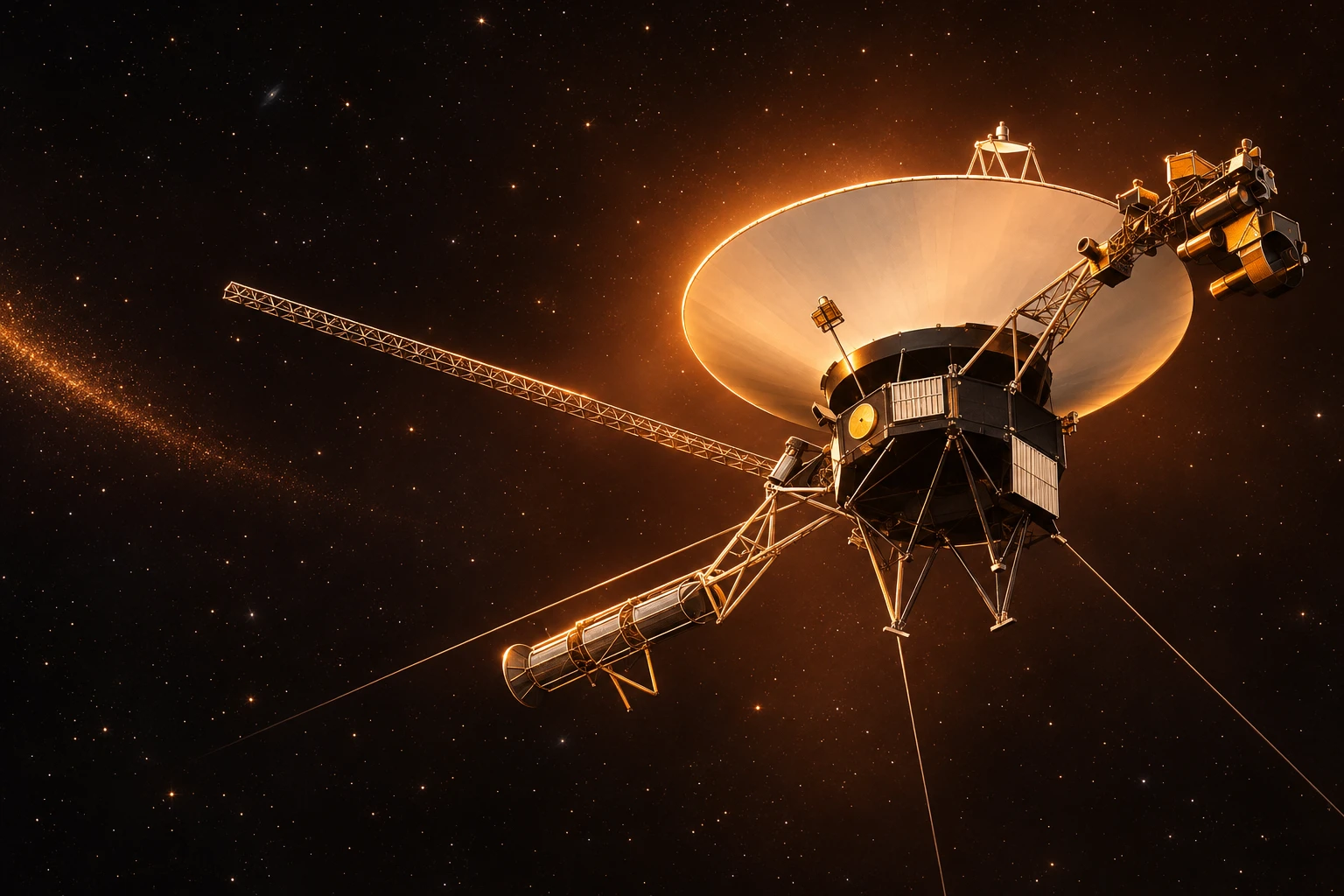
A Hello Sent Monday Comes Back Wednesday
A light-day is a distance, not a clock. It is how far light travels in 24 hours, and on Nov. 18 that distance and Voyager 1’s range from Earth meet. Radio is light in a different band, so the wait is the same. Suzanne Dodd, Voyager project manager at NASA’s Jet Propulsion Laboratory, has been saying the operational version out loud.
If you want to say ‘hello’ to Voyager, you send your message and then you go home and you wait two days before you finally get a response.
Suzanne Dodd, Voyager project manager, NASA JPL
JPL puts the spacecraft at 38,000 mph (61,155 kph) as it closes on the mark. The probe will not feel a bump. Fault software on board will, from that morning, face any new problem for a full day before a ground command can arrive, and another day before anyone in Pasadena sees the reply. The team already had to wait two days for a response during a scare in October, when the craft went quiet and then saved itself.
Forty-nine years of flight have covered what a photon covers before tomorrow’s breakfast. That gap is the content of the milestone. The flashlight party makes the wait visible on Earth. The radio loop is what the mission actually has to live with.
October’s 48-Hour Silence Came First
The celebration is arriving three weeks after Voyager 1 dropped out of contact and came back without a command from the ground. NASA’s Deep Space Network, the large antennas at three sites used to talk to missions beyond the Moon, heard nothing on Oct. 18 and again on Oct. 19, two scheduled passes 24 hours apart. The signal reappeared on Oct. 20. Engineers had not yet uplinked a fix.
JPL later found that one group of thrusters had gone offline and that the backups had turned on. That swap is written into fault protection, the onboard logic that puts the spacecraft in a stable state and pauses normal work so the ground can diagnose a problem. At 16 billion miles (24 billion kilometers), the ground was already a day behind the fault.
This is the first time we’ve seen the spacecraft do something like this, but we are also at a point in the mission where we have to expect the unexpected. We’re relieved to be back in contact with Voyager 1 and are eager to understand what happened.
Kareem Badaruddin, Voyager mission manager, NASA JPL
FROM THE BIG BANG TO THE LIGHT-DAY
- Early September 2026: Completes a three-device power swap, nicknamed the Big Bang, after the same change on Voyager 2 about six weeks earlier.
- October 18, 2026: Deep Space Network fails to detect the radio signal on a scheduled pass.
- October 19, 2026: A second pass, 24 hours later, is also silent.
- October 20, 2026: The signal returns on its own, about 48 hours after the first missed pass.
- November 17, 2026: NASA asks the public to flash V-G-R after sunset.
- November 18, 2026: Voyager 1 reaches 16.094 billion miles from Earth at 5:16:07 a.m. EST.
The October cause is still under review. Badaruddin’s team is treating the event as a preview, not a one-off, because the round trip is about to lock in at two days for every remaining year of the mission.
What NASA Shut Off to Keep Voyager Alive
On April 17, 2026, JPL sent commands that turned off Voyager 1’s Low-energy Charged Particles experiment, the instrument that had been mapping ions, electrons and cosmic rays almost without a break since 1977. The nuclear generators lose about 4 watts a year as their plutonium cools. After a planned roll on Feb. 27, 2026, power fell far enough that undervoltage protection was close to firing on its own, so the team cut science first.
Kareem Badaruddin said shutting down an instrument was nobody’s preference and that it was the best option left. The April commands took about 23 hours to arrive. The shutdown itself ran 3 hours and 15 minutes. A 0.5-watt motor that spins the LECP sensor was left on, in case extra power ever appears and the instrument can be revived.
INSTRUMENTS STILL RUNNING
| Instrument | Voyager 1 status | What it still does |
|---|---|---|
| Magnetometer | On | Measures magnetic fields in interstellar space |
| Plasma wave instrument | On | Listens for waves in the charged gas around the craft |
| Low-energy Charged Particles | Off since April 17, 2026 | Mapped particle structure; 0.5-watt scan motor left on |
Each Voyager launched with 10 science instruments. Planetary flybys ended decades ago, and the remaining work is the thin gas and magnetic field beyond the heliosphere, the Sun’s bubble of particles and magnetic fields. Voyager 1 crossed that boundary in August 2012. Voyager 2, on a slower path, did so in 2018. They are still the only craft that have measured that region up close.
The September Big Bang turned off three heater-related devices and brought three lower-power substitutes online at the same time, because heat has to stay even across the bus or fuel lines freeze. Without that swap, JPL said another Voyager 1 instrument would have been in line to go dark as early as summer 2027. The watts recovered were not published. The point of the work was time: keep the magnetometer and the plasma wave instrument running longer than the old power curve allowed.
People keep asking whether the probe still sends measurements or only a carrier that says it is alive. It still sends both. The two instruments Badaruddin named are working, in his words, from a region no other human-made craft has explored.
16.094 Billion Miles, and Nothing Aboard Changes
NASA’s own accounting puts the crossing at 5:16:07 a.m. EST on Wednesday, Nov. 18, which is 2:16:07 a.m. Pacific Time, when the range hits 16.094 billion miles (25.902 billion kilometers). JPL says the spacecraft will not detect a change in its surroundings and that nothing aboard will switch state because of the number. The mile marker is for Earth.
Light covers the average Earth-Moon gap, 238,855 miles, in 1.3 seconds. The same physics stretched over a day is the light-day. Voyager 1 has been adding that distance the slow way since it left Cape Canaveral on Sept. 5, 1977, on a Titan IIIE-Centaur, using a planetary lineup that comes around every 176 years.
THE WAIT AT THE MARK
| Leg | Time on Nov. 18 |
|---|---|
| Command, Earth to Voyager 1 | 24 hours |
| Reply, Voyager 1 to Earth | 24 hours |
| Full round trip | 48 hours |
Closest approach to Jupiter was March 5, 1979, when the spacecraft found a faint ring. Closest approach to Saturn was Nov. 12, 1980. On Feb. 17, 1998, it passed Pioneer 10 and became the most distant object people have built, a record it has held since. The light-day does not add a new environment. It adds a round-trip that is long enough to make every recovery look like October.
The Golden Record Already Speaks Morse
Both Voyagers carry a 12-inch gold-plated copper phonograph disk, the Golden Record, a time capsule assembled for NASA by a committee Carl Sagan chaired. The disk holds 115 images and greetings in 55 languages, plus surf, wind, thunder, birds, whales and a 90-minute spread of music. Printed notes from President Jimmy Carter and U.N. Secretary-General Kurt Waldheim ride with the audio. Instructions on the cover, in symbols, show how to play it and where the probe came from.
WHAT THE DISK CARRIES
- The pictures: 115 images encoded in analog form, chosen to show life and culture on Earth.
- The voices: Spoken greetings from Akkadian, once used in Sumer, through to Wu, a modern Chinese dialect.
- The Morse already on board: The Latin line “Ad astra per aspera,” through struggle to the stars, pressed in Morse on the Golden Record itself.
NASA’s own Shine Bright page notes that Voyager already knows Morse. Tuesday’s backyard flashes are a delayed echo of a message soldered onto the spacecraft in 1977. Sagan put the odds in one sentence that still governs the disk.
The spacecraft will be encountered and the record played only if there are advanced spacefaring civilizations in interstellar space.
Carl Sagan, planetary scientist, NASA Golden Record notes
The record is the part of the mission that does not care about watts or round-trip time. The magnetometer can go quiet. The disk keeps its grooves. The flashlight night is for the living operators and for anyone willing to blink three letters at a craft that has been flying longer than many of them have been alive.
Thursday’s Briefing and a 2027 Anniversary Film
On Thursday, Nov. 19, at 12 p.m. EST (9 a.m. PST), JPL will host a discussion with mission members in von Kármán Auditorium, the same room used for Voyager briefings during the outer-planet flybys. Nicky Fox, associate administrator of NASA’s Science Mission Directorate, is on the roster with Dodd, Badaruddin, project scientist Linda Spilker, JPL chief scientist Jonathan Lunine, and deputy project scientist Jamie Rankin of Princeton. A question period follows. The agency will also preview a NASA+ Voyager documentary planned for 2027, the mission’s 50th year.
The Deep Space Network still has to find a faint downlink from a transmitter that has been running since the Carter administration, on generators that shed about 4 watts a year. The October silence is not closed. Summer 2027 is the old date by which another instrument would have been switched off if the Big Bang had failed. The new date has not been posted.
The crossing will not ring an alarm on the spacecraft. The people who still fly it will wait out a two-day loop for every command, the same loop that already let Voyager 1 save itself in October before Earth could speak.

Xiaomi 18 Pro Goes Global as Its Privacy Filter Falters

iFixit Finds HomeView Glued Shut After Repair Gains

Polymetallic Nodules Shelter 4,139 Animals Miners Want

One UI 9.5 Puts Now Brief Behind a System Agent

Framework’s $99 Keyboard Brings Laptop Repair to the Couch

Microsoft 365 Auth Fault Took Down Exchange and Teams

OpenClaw 2.0 Ships a Team Workplace With Host-Trust Defaults

Xbox Caps Game Pass Cloud Gaming at 15 Hours

OpenAI Unveils GPT-6 Astra With a Critical Cyber Label

Squishy Dumpling Toys Recalled After Hiding Illegal Water Beads
-
 NEWS3 months ago
Microsoft 365 Auth Fault Took Down Exchange and Teams
-
 GAMING3 months ago
Xbox Caps Game Pass Cloud Gaming at 15 Hours
-
 NEWS3 months ago
OpenClaw 2.0 Ships a Team Workplace With Host-Trust Defaults
-
 NEWS3 months ago
OpenAI Unveils GPT-6 Astra With a Critical Cyber Label
-
 LIFESTYLE3 months ago
Squishy Dumpling Toys Recalled After Hiding Illegal Water Beads
-

 BUSINESS3 months ago
Diesel Breaks Its Record as the White House Claims Credit
-

 NEWS3 months ago
IFA 2026’s Weird Gadgets Are Building a Sensor Home
-

 BUSINESS3 months ago
ChargePoint Stock Rally Prices Wilmer’s Three-Year Cash Plan