
NEWS
Heilongjiang Photographers Catch Mars and Jupiter Before Dawn
Eleven Heilongjiang cities photographed Mars and Jupiter 1.2 degrees apart before dawn Monday, a global pairing whose closest instant arrived after sunrise in China.

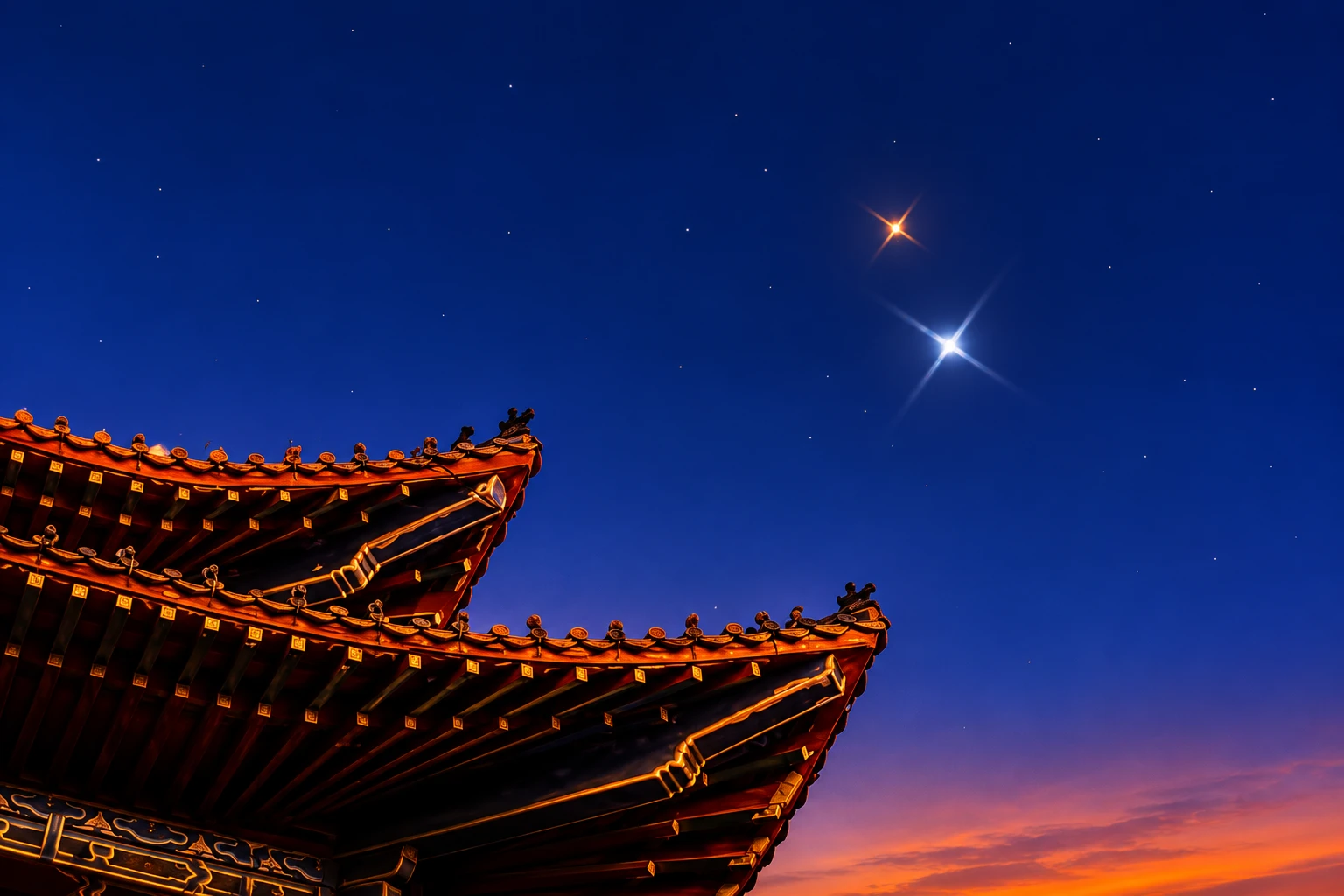
Photographers in 11 Heilongjiang cities caught Mars and Jupiter 1.2 degrees apart before dawn on Monday, November 16. The two planets sat in Leo, high in the south, with Jupiter the bright white point and Mars the fainter orange one. A Harbin photo packet put 13 frames on the wire by mid-afternoon.
NASA had already flagged the mornings of November 15 and 16, and the closest instant at 02:04 UTC landed at 10:04 a.m. in China, after sunrise. The stills are the last dark hour of a pairing the whole planet could see.
Eleven Cities Went Out Before Dawn
The packet is a map of the province, not a single overlook. Shuangyashan, Daqing, Qiqihar, Jiamusi, Bei’an and Baiquan County all filed frames dated November 16. So did Mudanjiang and Fujin, twice each, with different photographers on each pass. A tourism resort in the Mongolian Autonomous County of Dorbod sits in the set beside Fuyuan, far to the east.
Yichun is the odd date. Photographer Li Jiaxing’s frame is marked November 15, when the gap was already near its minimum and a cloudy Monday would have cost little. The other 12 stills are Monday morning.
THE ASSIGNMENT ON THE GROUND
- The count: 13 photographs from 11 cities, with 13 named photographers on the captions.
- The double pass: Mudanjiang credited Wang Baoxun and Zeng Dong; Fujin credited Qu Yubao and Geng Xiqing.
- The early frame: Yichun shot on November 15, one morning before the rest of the packet.
- The wide net: Han Yang in Shuangyashan, Chi Shiyong at the Dorbod resort, and Li Yongjun in Fuyuan give the set its east-west span.
That is a lot of alarms for two points of light. The geometry asked for it. In mid-November the pair is up all night and highest just before the sky turns, so the only usable dark sits in a short band before 6:30 a.m.
How Close Did Mars and Jupiter Get?
NASA’s November skywatching tips put the two worlds 1.2 degrees apart before sunrise on November 15 and 16, a little more than the width of two full Moons side by side. You do not need a telescope. Jupiter is the one that looks like a lamp. Mars is the dimmer orange point, and NASA’s Mars page calls it a bright red point of light even on ordinary nights.
An ephemeris page for the close approach puts Mars about 195 million kilometers from Earth (1.31 AU) and Jupiter about 788 million kilometers (5.27 AU). The two planets themselves stood about 592 million kilometers apart, or 368 million miles. The intimacy is a line of sight.
MARS AND JUPITER ON NOVEMBER 16
| Measure | Mars | Jupiter |
|---|---|---|
| Brightness | magnitude +0.7 | magnitude -2.1 |
| Distance from Earth | 195 million km (1.31 AU) | 788 million km (5.27 AU) |
| Apparent disk | 7.2 arcseconds | 37.4 arcseconds |
| Look in the photos | orange-red, fainter | white, dominant |
Jupiter’s disk was about five times wider than Mars’s. In binoculars both fit in one field, with Leo’s star Regulus nearby as a third point. Early risers who stayed with the scene could read that triangle without a chart, Mars north of Jupiter from northern latitudes.
The Closest Instant Fell After Sunrise
The sky app Star Walk timed closest approach at 02:04 GMT on November 16. That is 10:04 a.m. in Heilongjiang, more than three hours after sunrise in Harbin. Photographers there were not shooting the mathematical minimum. They were shooting the last dark hour on the morning that minimum fell, when the gap had barely moved overnight.
MONDAY’S CLOCK IN HARBIN
- Closest instant: 02:04 UTC, 10:04 a.m. China Standard Time.
- Sunrise: 6:33 a.m. on November 16, with dawn listed at 6:01 a.m.
- Daylight: 9 hours 28 minutes, so night ran 14 hours 32 minutes.
- The usable window: the hour before 6:33 a.m., after the pair had already climbed high in the south.
Night-sky tables for Mao’er Shan in Heilongjiang list Mars and Jupiter rise times near 10:40 p.m., with the pair on the meridian around 5:40 a.m. That is the slot the stills come from: high, south, and still dark. NASA’s November note had told observers to look southeast before sunrise on those two mornings, and the agency’s own post put the pairing on the month’s short list beside the Leonids and a supermoon.
They’ll appear about 1.2 degrees apart, a little more than the width of two full Moons side by side. Jupiter is the brighter point of light, with reddish Mars nearby.
Raquel Villanueva, NASA Science, November 2026 skywatching tips
What’s up in the night sky for November? This month, you can look forward to:
– Multiple meteor showers reaching their peak
– Jupiter meeting up with Mars in the wee hours
– A supermoon lighting up the night skyMore skywatching tips: https://t.co/70oE63lKpz pic.twitter.com/rV9ZShYsxM
— NASA (@NASA) November 2, 2026
From Heilongjiang the view is Mars above Jupiter. Southern sites see the stack the other way up, which is why a Sydney sky chart looks flipped next to a Harbin frame. The photos do not lie. They just record one hemisphere’s morning.
A Province That Keeps Shooting the Morning Sky
Heilongjiang is far enough north that mid-November nights last more than 14 hours, and sunrise in Harbin is not until 6:33 a.m. The air is cold and often dry. Cities are strung across that latitude with open horizons toward the south, which is where this pair stood at its highest. That is a working advantage, not a lucky cloud break.
On November 3, 13 days before the closest pairing, the same province filed another set with the Moon beside Mars and Jupiter. The November 16 packet is the second chapter of that job, not a one-off. Photographers who already knew the two points in Leo only had to go back out when the Moon was gone and the gap had shrunk.
The public conversation on English-language feeds leaned toward Leo-sign horoscopes. The Heilongjiang stills are the other product of the same geometry: landscape frames, snow and streetlight, two planets treated as weather. Venus and Mercury were also up, low in the east, but those two sit near the horizon and did not make the captions. The assignment was the tight pair, and the pair is what the cameras held.
August 2024 Was Four Times Tighter
Mars laps Jupiter about every 2.2 years, so a meeting in the sky is a calendar item, not a rarity. The last one, on August 14, 2024, closed to around 0.3 degrees in 2024, less than the width of a full Moon, on figures timeanddate computed from JPL’s DE431 ephemeris. Monday’s 1.2-degree gap is four times that width. Both planets were also near their long-run average brightness, Jupiter at -2.1 and Mars at +0.7, so this was an easy pairing rather than a peak one.
That is why a dozen-plus photographers could work it with ordinary lenses. A 0.3-degree stack can look like a double star. A 1.2-degree stack reads as two objects, which is what the Heilongjiang frames show: a white lamp and an orange spark sharing a piece of Leo. The 2024 meeting will not have a tighter follow-up until 2033. This one was for people who would get out of bed, not for people waiting on a once-a-decade crush.
Venus, Mercury and the Leonids Share the Week
The same dark hour still holds more than two planets. Star Walk’s observing note for November 15 and 16 told early risers to take Venus and Mercury as well, low above the eastern horizon, a four-planet morning that runs until around November 22. NASA’s month list then points at the Leonids on November 17 and 18, with an ideal rate near 15 meteors an hour after moonset, and at Mercury’s greatest western elongation on November 20.
THE REST OF THE PRE-DAWN SKY
- November 3, 2026: Heilongjiang files the Moon beside Mars and Jupiter, the first pass of this month’s pair.
- November 15-16, 2026: Mars and Jupiter 1.2 degrees apart; 13 frames go out from 11 cities.
- November 17-18, 2026: Leonid peak, NASA’s guide listing about 15 meteors an hour in a dark sky after moonset.
- November 20, 2026: Mercury at greatest western elongation in the morning east.
- November 22, 2026: the four-planet morning window Star Walk flagged begins to fade.
It is the same viewing year that already produced September’s five-planet sky week, with Saturn still a clean evening object in November. The Heilongjiang cameras did not wait for a rarer crush. They used the long night they already had, on the morning the almanac had circled, and they filed before the sun came up on the closest day.
Frequently Asked Questions
How Often Do Mars and Jupiter Line Up in the Sky?
About every 2.2 years. Mars finishes a lap of the Sun in 1.88 years and Jupiter in 11.86 years, so the inner planet catches the outer one on a fairly short cycle. Some of those meetings are wide, some are tight, and Monday’s 1.2-degree gap sits in the easy middle of that range.
When Will the Two Planets Appear Closer Than This?
Sky calendars put the next tighter stack on December 1, 2033, at about 0.2 degrees, closer even than the 0.3-degree meeting of August 14, 2024. A 2029 pass is on the books as well, but at 1.6 degrees it is wider than this week’s pairing, so it will look looser in a photograph, not tighter.
How Large Did Mars and Jupiter Look in a Telescope?
Mars spanned 7.2 arcseconds and Jupiter 37.4 arcseconds at the close approach, so Jupiter’s disk was about five times wider. A small telescope will show Jupiter as a disk with moons nearby, while Mars remains a tiny ochre speck; binoculars are enough if you only want both planets in one view.
Did the Moon Spoil the November Pairing?
No. The Moon was a waxing crescent that set in the evening, leaving the pre-dawn sky dark on November 15 and 16. NASA’s month guide treated moonlight as a non-issue for this pairing and saved the Moon for later, including the full supermoon on November 24.

Xiaomi 18 Pro Goes Global as Its Privacy Filter Falters

iFixit Finds HomeView Glued Shut After Repair Gains

Polymetallic Nodules Shelter 4,139 Animals Miners Want

One UI 9.5 Puts Now Brief Behind a System Agent

Framework’s $99 Keyboard Brings Laptop Repair to the Couch

Microsoft 365 Auth Fault Took Down Exchange and Teams

OpenClaw 2.0 Ships a Team Workplace With Host-Trust Defaults

Xbox Caps Game Pass Cloud Gaming at 15 Hours

OpenAI Unveils GPT-6 Astra With a Critical Cyber Label

Squishy Dumpling Toys Recalled After Hiding Illegal Water Beads
-
 NEWS3 months ago
Microsoft 365 Auth Fault Took Down Exchange and Teams
-
 GAMING3 months ago
Xbox Caps Game Pass Cloud Gaming at 15 Hours
-
 NEWS3 months ago
OpenClaw 2.0 Ships a Team Workplace With Host-Trust Defaults
-
 NEWS3 months ago
OpenAI Unveils GPT-6 Astra With a Critical Cyber Label
-
 LIFESTYLE3 months ago
Squishy Dumpling Toys Recalled After Hiding Illegal Water Beads
-

 BUSINESS3 months ago
Diesel Breaks Its Record as the White House Claims Credit
-

 NEWS3 months ago
IFA 2026’s Weird Gadgets Are Building a Sensor Home
-

 BUSINESS3 months ago
ChargePoint Stock Rally Prices Wilmer’s Three-Year Cash Plan