
NEWS
Polymetallic Nodules Shelter 4,139 Animals Miners Want
Crevice animals inside Pacific polymetallic nodules differ from seafloor mud, so mining collectors would remove a habitat sediment surveys never counted.

Researchers counted 4,139 tiny animals inside 244 metal-rich nodules from the Pacific seafloor, the same rocks a new mining industry wants to lift. The tally, published on November 11, 2026, in Scientific Reports, comes from cracks inside the lumps, not from the mud around them.
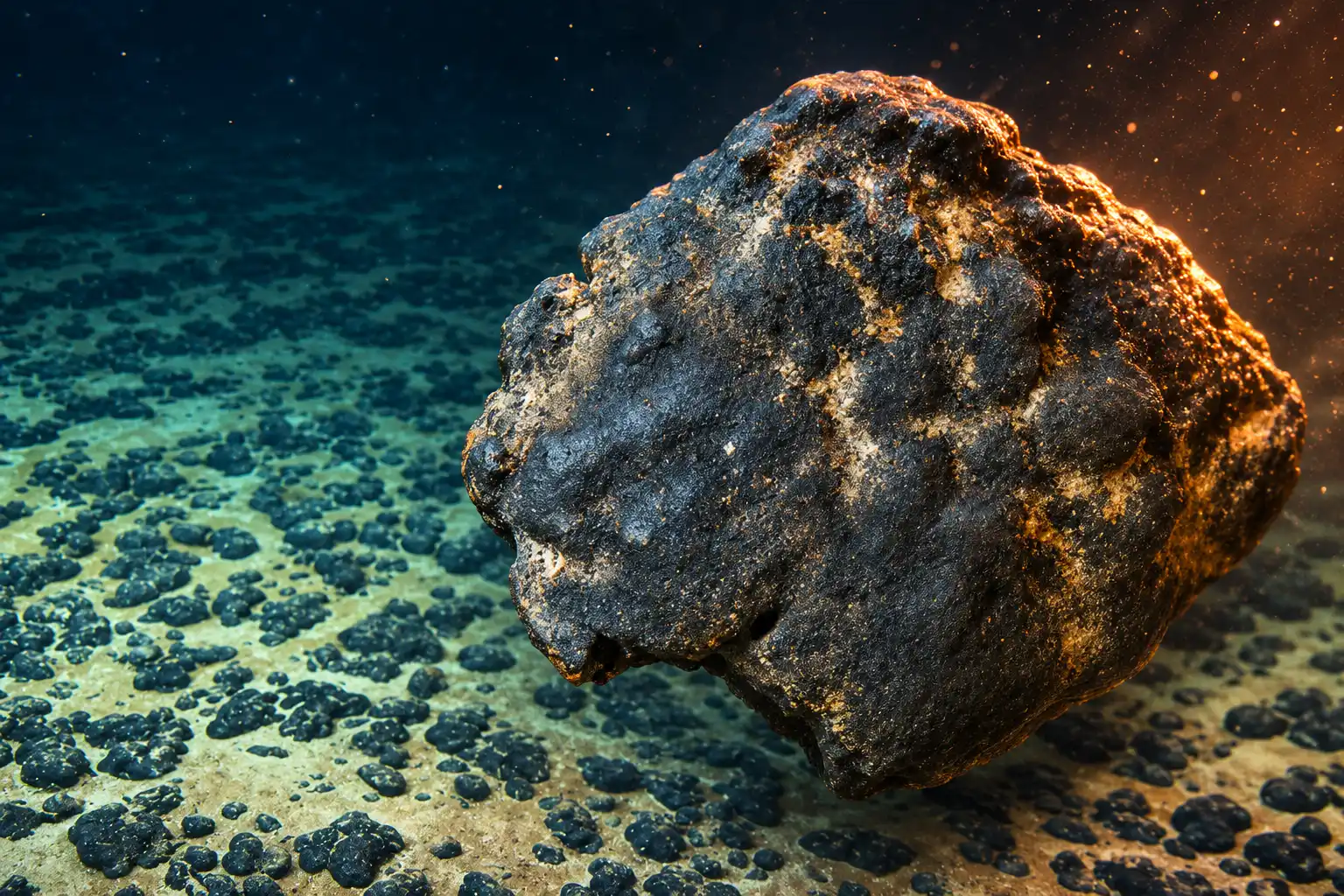
Those polymetallic nodules sit in the Clarion-Clipperton Zone, between Hawaii and Mexico, at 4,000 to 6,000 meters. The animals in the cracks form groups that look alike even when the rocks sat about 1,000 kilometers apart, and they do not match the fauna in nearby mud. A baseline written from sediment cores can miss the habitat a collector is built to take.
Researchers Counted 4,139 Animals in 244 Nodules
Coral Diaz-Recio Lorenzo led the work from the Royal Netherlands Institute for Sea Research and Roscoff Biological Research Station, with Tanja Stratmann of MARUM at the University of Bremen as equal first author. In 2019, on the German ship Sonne during expedition SO268, the team took box cores in two licensed Pacific blocks, then froze the nodules at minus 20 degrees C for 24 hours so the rocks crumbled and released whatever lived in the cracks, which were sieved at 32 microns.
The 4,139 animals from 244 nodules work out to about 17 per rock. One nodule held 245. Stratmann said the cracks are large enough to house animals smaller than a millimeter. On 24 extra rocks the group mapped pores and cracks with electron microscopes; porosity averaged about 23 percent, and some cracks ran all the way to the surface.
THE 2019 NODULE SAMPLE
| Measure | Figure |
|---|---|
| Nodules opened | 244 |
| From the German BGR area | 153 |
| From the Belgian GSR area | 91 |
| Animals counted | 4,139 |
| Average per nodule | about 17 |
| Most crowded nodule | 245 |
Each time nodule volume doubled, total animal counts rose 34.4 percent, but not in lockstep with size, so smaller rocks packed more life per unit of volume. A harvest that takes every size still pulls those dense small lumps.
Roundworms, Copepods and a Crevice Specialist
The paper, titled Polymetallic nodules provide a distinct habitat for abyssal meiofauna, is the first to put DNA on these crevice tenants and the first to count copepods inside the rocks in a systematic way. Only seven earlier studies had looked in the cracks, all by appearance under a microscope.
WHO LIVED IN THE CRACKS
- Nematodes: These roundworms made up 52.9 to 84.0 percent of the crevice animals, depending on the contract area.
- Copepods: Small crustaceans accounted for 7.41 to 13.4 percent of the same counts.
- Foraminifera: Single-celled shell builders, including the common Thurammina sp. 1, ranged from 5.64 to 29.4 percent.
- Polychaetes: Bristle worms were a thin slice, 2.24 to 2.47 percent.
Fewer animals live inside the rocks than in the mud around them. Nodule nematodes equal about 10 percent of the nematode count in nearby sediment, and nodule copepods equal about 25 percent of the copepod count there. The point is not the raw total. The mix of species is different, and Thurammina sp. 1 is common in the shelters and scarce in the ooze. If the rocks go, that specialist loses the only rooms the team can assign to it.
Across 1,000 Kilometers, Crevice DNA Matched
Using 18S rRNA, nematode and copepod groups from the cracks clustered with one another even though the German and Belgian sample sites sit about 1,000 kilometers apart. Those same groups diverged from nematodes and copepods taken in sediment on the same expedition, in the same contract areas. Habitat, not distance, sorted the communities.
The crevices in the polymetallic nodules function as small shelters and provide a home for animals that we do not encounter in the soft sediment of the seafloor.
Coral Diaz-Recio Lorenzo, NIOZ and Roscoff Biological Research Station
Nodules add the only hard, lasting structure on an otherwise muddy plain. They grow as iron and manganese oxides around a shard of rock, a shell, or even a shark tooth, in layers that switch between slow hydrogenetic growth of a few millimeters per million years and faster diagenetic growth. Fist-sized and potato-shaped, they are, on a human clock, a one-time habitat. More than 5,000 unnamed seafloor animal species have already been recorded in the Clarion-Clipperton Zone, and richness curves for larger fauna have not flattened.
Why Collectors Cannot Leave the Habitat Behind
A nodule collector does not skim metal off the mud. It lifts the rock, and the rock is the apartment. Sediment animals can, in principle, crawl or settle back into disturbed silt. Crevice animals lose the structure itself, and the paper says that structure will not return at a mined site on any timescale used in a mine plan.
Sabine Gollner of NIOZ, a co-author, put the management problem in one line: the loss would be of unique, still-undescribed life tied to the nodules, and it has to sit inside environmental rules for the industry. Preservation patches that protect mud while allowing nodule removal would keep the wrong habitat. Reference areas drawn from sediment cores would describe a community the collector is not primarily erasing.
Hardware is already on the bottom. In October 2022, a prototype collector in the NORI-D area, held by a subsidiary of The Metals Company, tracked about 80 kilometers of seafloor and lifted more than 3,000 tonnes of nodules. A 2025 Nature study of a 1970s Pacific test that stripped nodules found biological damage still present four decades later, even where some sediment animals had begun to return. The crevice fauna in the new paper never get that second chance at the same spot, because the house is the ore.
Two Licensed Pacific Blocks, 244 Nodules
Every rock in the study came from ground already mapped under exploration contracts for polymetallic nodules issued by the International Seabed Authority. The German block belongs to the Federal Institute for Geosciences and Natural Resources. The Belgian block belongs to Global Sea Mineral Resources, whose contract runs from January 14, 2013, to January 14, 2028.
THE CONTRACT AREAS THAT GAVE THE ROCKS
| Area | Contractor | Size and sample |
|---|---|---|
| BGR, Germany | Federal Institute for Geosciences and Natural Resources | 74,724 km2; 153 nodules |
| GSR, Belgium | Global Sea Mineral Resources | 74,990 km2; 91 nodules |
Those two blocks are not the only claims on the zone. The Metals Company is pushing a separate U.S. track through NOAA under the Deep Seabed Hard Mineral Resources Act, outside the ISA process, for commercial recovery of the same class of rock.
NOAA Set a Mid-December Certification Date
TMC USA filed a consolidated application on January 22, 2026, for an exploration license and a commercial recovery permit over the USA-A area, about 65,000 square kilometers of the eastern Clarion-Clipperton Zone with an estimated 619 million tonnes of wet nodules. NOAA found substantial compliance on March 6, 2026, and full compliance on April 28. The application went into the Federal Register on August 19.
The public comment window on that first-of-its-kind commercial recovery bid closed on October 19, 2026, after more than 1,600 comments. The crevice paper came out on November 11. The unique habitat inside the rocks was not in the file NOAA was already reading. Crevice counts have not had the public fight that photographs of larger seafloor animals have had, and they arrived after that window shut.
THE NOAA CLOCK ON TMC USA
- January 22, 2026: TMC USA files the consolidated USA-A application.
- March 6, 2026: NOAA finds substantial compliance.
- April 28, 2026: NOAA finds full compliance.
- May 26, 2026: NOAA certifies the separate USA-B exploration license over 121,830 km2.
- August 19, 2026: The USA-A application is published in the Federal Register.
- October 19, 2026: The USA-A comment period closes, with more than 1,600 comments.
- November 3, 2026: NOAA tells the company it now expects a certification call in mid-December, after reviewing those comments.
- November 11, 2026: Scientific Reports publishes the crevice-fauna study.
In a November 12 corporate update, The Metals Company said NOAA had moved the expected mid-December certification decision from NOAA off an end-of-October target. Certification would still leave an environmental impact statement, more comment, and a final permit decision. The company is aiming for offshore commissioning in the fourth quarter of 2027. In September 2026, the Conservation Council for Hawaii and the Center for Biological Diversity sued in federal court in Hawaii to vacate the USA-B certification.
The Habitat Does Not Grow Back
Gollner’s warning is narrower than a general plea to leave the deep sea alone. It is a sampling problem. If the animals that need the rocks do not appear in the mud, then an impact statement built on sediment cores can look complete while omitting the community the machine removes on purpose.
Our findings point out that commercial mining may result in an irreversible loss of undescribed and unique biodiversity associated with nodules. This needs to be considered in the environmental management of deep-sea mining.
Sabine Gollner, Royal Netherlands Institute for Sea Research
The authors say 244 nodules are a small draw from the zone, too small to map every crevice species or say which ones exist nowhere else. Future work has to test whether those tenants can live without the rocks. In November 2026, Stratmann was already on a follow-up expedition in the Clarion-Clipperton Zone, still opening the lumps a collector is designed to take.

Xiaomi 18 Pro Goes Global as Its Privacy Filter Falters

iFixit Finds HomeView Glued Shut After Repair Gains

Polymetallic Nodules Shelter 4,139 Animals Miners Want

One UI 9.5 Puts Now Brief Behind a System Agent

Framework’s $99 Keyboard Brings Laptop Repair to the Couch

Microsoft 365 Auth Fault Took Down Exchange and Teams

OpenClaw 2.0 Ships a Team Workplace With Host-Trust Defaults

Xbox Caps Game Pass Cloud Gaming at 15 Hours

OpenAI Unveils GPT-6 Astra With a Critical Cyber Label

Squishy Dumpling Toys Recalled After Hiding Illegal Water Beads
-
 NEWS3 months ago
Microsoft 365 Auth Fault Took Down Exchange and Teams
-
 GAMING3 months ago
Xbox Caps Game Pass Cloud Gaming at 15 Hours
-
 NEWS3 months ago
OpenClaw 2.0 Ships a Team Workplace With Host-Trust Defaults
-
 NEWS3 months ago
OpenAI Unveils GPT-6 Astra With a Critical Cyber Label
-
 LIFESTYLE3 months ago
Squishy Dumpling Toys Recalled After Hiding Illegal Water Beads
-

 BUSINESS3 months ago
Diesel Breaks Its Record as the White House Claims Credit
-

 NEWS3 months ago
IFA 2026’s Weird Gadgets Are Building a Sensor Home
-

 BUSINESS3 months ago
ChargePoint Stock Rally Prices Wilmer’s Three-Year Cash Plan