
NEWS
Eagle Talon Marks Hit Baboons Almost as Heavy as Lucy
Talon holes in 22.2 kg Sahara baboons, one 26.2 kg, extend the Taung-child eagle pattern from a 10 kg infant to adults near Lucy’s mass.

26.2 kilograms is the heaviest olive baboon tied to eagle talon damage in a new Sahara sample, and that mass sits 1.8 kilograms under Lucy. A 22-kilogram adult primate study published November 18, 2026 in the American Journal of Biological Anthropology describes nine baboons from Chad’s Ennedi plateau, eight of them adult males, with a mean estimated mass of 22.2 kilograms.
Catherine Hobaiter, a professor of psychology and neuroscience at the University of St Andrews, led the work with Nathaniel Dominy of Dartmouth College, Gisela Kopp of the University of Konstanz and the Max Planck Institute of Animal Behavior, and T.J.D. Akpona of African Parks. For about 2.5 million years, large-bodied hominins were treated as too heavy for raptors. No primate over 13 kilograms had a confirmed raptor kill. The Ennedi males sit above that line, and the heaviest is about twice it.
Talon Holes in Adult Male Skulls
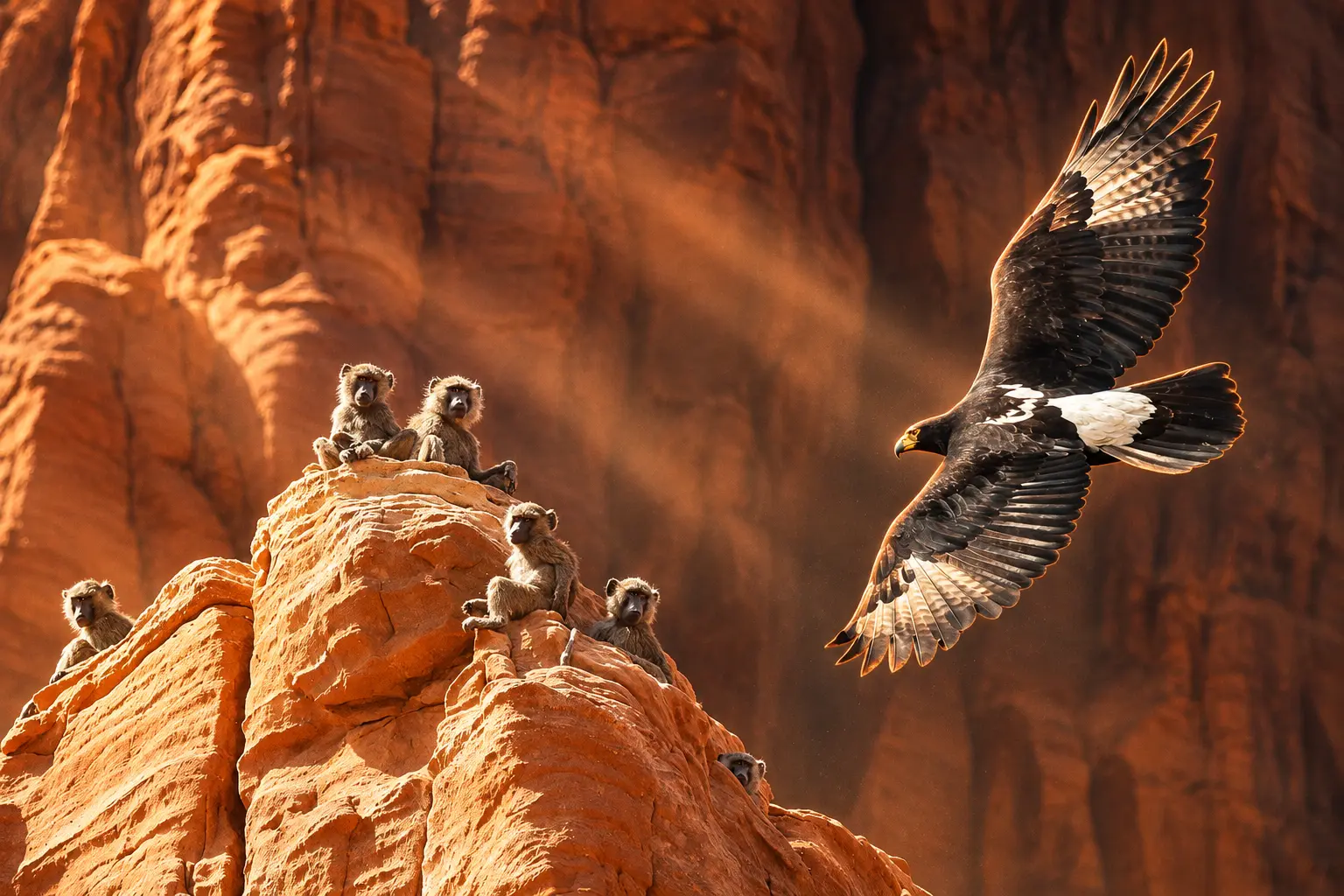
The team walked the debris slopes under sandstone cliffs inside the Ennedi Natural and Cultural Reserve and picked up skulls, shoulder blades, and the upper ends of thigh bones. Two skulls in the first set had punctured eye sockets. One shoulder blade was scraped in the long, parallel “rakes” left when a big eagle works a carcass. A later adult male, estimated at 26.2 kilograms, had talon punctures and heavy raking on both shoulder blades.
A large eagle grips a primate by the head and shoulders. That grip punches the orbital bones and drags across the scapula. The authors write that the depth of the holes is “suggestive of lethal interactions through a killing grip,” not a bird pecking a body that was already dead. They still frame the predator as “consistent with” Verreaux’s eagles, Aquila verreauxii, and they call the conclusion provisional.
We saw the eagles while we were searching for the baboons, but we never imagined that they might be a threat to them. Then we found the first skull with a puncture mark, and then another, and another.
Catherine Hobaiter, professor, University of St Andrews
Weight came from the femoral head, the ball of the hip, run through equations that link that measurement to body mass in Old World monkeys. The mean of 22.2 kilograms has a spread of 3.8 kilograms either way, and the thigh bones were in the same deposits as the marked skulls, not always from the same animal. Only one marked male in the first survey could be paired with a thigh bone, at 21.8 kilograms. The animals are olive baboons, Papio anubis. Adult males of that species average about 24 kilograms across Africa, so Ennedi did not hand the eagles a run of dwarfs.
The 13-Kilogram Record Was a Nest Sample
The ceiling that just moved was never a lab test of what a talon can crush. It was a confirmed-kill record, and it came out of forest nests.
In Ivory Coast’s Taï Forest, W. Scott McGraw and colleagues collected primate bones under African crowned eagle nests and showed those birds take adult male sooty mangabeys weighing at least 12 kilograms, and take them often. That work, published in 2006, also supplied the damage template, orbital punctures and skull scratches, that paleoanthropologists then carried to fossils. Some later writers rounded the safe zone up to 20 kilograms. Neither number was a law of lift. Both were what the sampled eagles had been caught doing.
THE SIZE-ESCAPE TIMELINE
- 1995: Lee Berger and Ron Clarke argue that a large raptor, not a cat, accumulated the Taung primate fossils, including the child skull that is the type specimen of Australopithecus africanus.
- 2006: McGraw’s Taï nest sample and Berger’s reinspection of the Taung orbits publish the modern match between eagle feeding damage and that child’s eye sockets.
- February to March 2025: Hobaiter’s team surveys Ennedi cliff bases and finds adult male baboon skulls with the same class of holes.
- June 2026: They recover the 26.2 kilogram male with punctures and raked shoulder blades on both sides.
- November 18, 2026: The American Journal of Biological Anthropology paper appears, with 3D scans of the marked bones placed in public archives.
McGraw, who was not on the Ennedi paper, has said early hominins may have been attractive targets because they were relatively small, especially as infants and juveniles, and that group living, alarm calling, and habitat choice are the usual primate answers to raptors. The new sample does not replace Taï. It adds a different eagle, a cliff desert, and adults at roughly double the old confirmed mass.
How Heavy Were Lucy and the Taung Child?
Hobaiter told colleagues the only confirmed hominin case remains the Taung child, an infant she puts at about 10 kilograms, taken by a large eagle around 2.8 million years ago. She also said several australopithecine species that lived around 1 million to 3 million years ago fall in the same weight band as the Ennedi adult males. Lucy, the Australopithecus afarensis skeleton from Ethiopia, dated to about 3.2 million years ago, is usually estimated to have weighed around 28 kilograms. The heaviest Ennedi male is 1.8 kilograms lighter.
THE WEIGHT LADDER
| Individual or limit | Mass | Why it sits here |
|---|---|---|
| Taung child | About 10 kg | Only confirmed hominin with eagle-type orbital damage |
| Old confirmed raptor-kill ceiling | 13 kg | No heavier primate had a published raptor kill |
| Ennedi sample mean | 22.2 kg | Nine baboons, eight of them adult males |
| Heaviest Ennedi male | 26.2 kg | Talon punctures and rakes on both shoulder blades |
| Lucy (A.L. 288-1) | About 28 kg | Common estimate for the 3.2-million-year-old adult female |
| Verreaux’s eagle | About 3 to 7 kg | The living bird tied to the Ennedi marks |
Lift was the wrong constraint if the bird never had to fly off with a whole adult. An eagle can kill on a ledge or on the ground and carry pieces to the nest. That is how the authors get past the old objection that a 3 to 7 kilogram raptor cannot hoist 26.2 kilograms of baboon. It does not prove an eagle ever killed an adult Australopithecus. There are no hominin fossils in this study. It shows a living eagle can leave killing-grip damage on a primate in Lucy’s weight class.
A Cliff Eagle That Usually Takes Hyraxes
Verreaux’s eagles hunt from cliff tops, sometimes in pairs, and their talons span a grip about 40 centimeters across. The bird weighs roughly 3 to 7 kilograms, with females larger than males, and the wings stretch about 1.8 to 2.3 meters. Field accounts say pairs knock prey over cliff ledges and share the kill. Rock hyraxes of 2 to 3 kilograms make up most of the diet. Prey above 4.5 kilograms is rarely written down. Monkeys and baboons already appear on the species’ recorded mammal list, which is why a Sahara kill at 22.2 kilograms is a leap in confirmed mass, not a brand-new prey item on paper.
Hobaiter watched the living troop answer the living birds. When a pair of Verreaux’s eagles swept over, the baboons gave alarm calls and dropped to cover. They stayed relaxed around other large raptors. Primates tend to spend that kind of alarm on predators that actually kill them. Dominy, the senior author, had to be talked into the idea by the bones.
At first, the idea of eagles hunting adult male baboons seemed to exist on the thin edge of possibility, until it didn’t. Our skepticism slowly gave way to acceptance. The evidence was convincing.
Nathaniel Dominy, professor of anthropology, Dartmouth College
Jean Didier Akpona, who has worked in the reserve for about three years, said he had often seen Verreaux’s eagles at the gueltas, the rock pools that hold water in the sandstone, and had not imagined they would target primates of this size until the skulls turned up.
No One Watched the Kill
Nobody saw an eagle take a baboon. The case is taphonomic, read from holes and scrapes, and the paper’s own wording leaves room for feeding on animals that died some other way. The sex bias is the authors’ best argument against pure scavenging. Lethal-style marks showed up on adult males, the animals that step forward to mob an aerial attacker, and Hobaiter has said a scavenger feeding on random carcasses would not be expected to leave that age-and-sex pattern.
WHAT WE KNOW
- The sample: Nine olive baboons, eight adult males, mean 22.2 kilograms, heaviest 26.2 kilograms, from cliff-base deposits on the Ennedi plateau.
- The marks: Orbital talon punctures and scapular rakes that match the killing grip used by large African eagles on monkeys.
- The behavior: The troop alarm-called and dropped when Verreaux’s eagles passed and ignored other big raptors.
- The method: Body mass estimated from femoral-head height; 3D scans of the marked bones are in public archives.
WHAT IS UNCONFIRMED
- A witnessed hunt: No kill was observed, and some raptor biologists still read similar marks as feeding after a fall, disease, or a different predator.
- Adult hominin prey: No fossil of an adult human relative carries this damage in the Ennedi paper.
- A wider habit: It is not known whether Verreaux’s eagles take adult baboons outside this isolated cliff-and-pool system.
The body-mass equations come from other monkey species, and most marked skulls lack a paired thigh bone, so each kilogram is an estimate with a published spread. The setting is also narrow. These baboons share a few water pockets in the middle of the Sahara with the eagles that nest on the same rock. That is a different stage from open savanna, where Lucy’s kind walked and where leopards and hyenas, not cliff eagles, dominate the predator talk.
Adult Males Take the Charge
Ground predators and aerial predators pull different defenses out of a primate group. Against cats and crocodiles, the answers are numbers, sentinels, and flight. Against eagles, the classic move is mobbing, with large adult males charging the bird to drive it off. If those males are the ones turning up with killing-grip holes, the defense has a body count. Eight of the nine Ennedi animals were adult males. That is the bill for standing up.
Modern monkeys that live under eagle pressure often travel in large mixed groups with other primate species, buying more eyes and more mobbers. Hobaiter and colleagues note that early hominins spent most of their history alongside other hominin species and other primates. The usual reading of that overlap is competition for food and space. Shared alarm calls and shared defense against a bird that can kill a 22.2 kilogram adult would cut the other way. The paper does not prove mixed-species groups evolved as anti-eagle insurance. It puts that idea back on the table for adults, not only for children the size of Taung.
If Hobaiter is right that primates up to at least 26 kilograms are vulnerable, then many early hominins, including adults, could have been on the same list. Communication, male coalition, and the habit of looking up would have stayed useful long after body size was supposed to have closed the file.
An Isolated Sahara Troop Keeps Breaking Rules
Ennedi is a bad place to assume textbook baboon behavior, which is why the skulls were found at all. The plateau is a sandstone maze of cliffs, arches, and canyons in north-east Chad. The massif was listed as World Heritage in 2016 for those landforms and for one of the Sahara’s largest rock-art groups. African Parks, which signed a management deal with Chad in February 2018, describes the Ennedi Natural and Cultural Reserve as more than 50,000 square kilometers, larger than the World Heritage polygon of 2,441,200 hectares, and says some 30,000 people move through it each year. More than 200 bird species use the massif. Permanent water in the biggest canyons keeps plants, wildlife, and people on the rock.
ENNEDI IN BRIEF
- The water: Gueltas, including Guelta d’Archei, are the pockets that make a Sahara cliff system livable for baboons and eagles alike.
- The birds: Verreaux’s eagles hunt those same walls; Akpona had watched them for years without linking them to adult primates.
- The monkeys: An isolated olive baboon population, rarely studied, sometimes so unused to people that after a couple of days they followed the researchers.
- The other breaks: Hobaiter said the first Ennedi watches already overturned expectations about diet and social life, before the skulls rewrote the predator list.
Gisela Kopp said primatology usually clusters in regions crowded with primate species, and that moving to a place with no prior primatological data is what made the work pay. Hobaiter called the trip a primatologist’s dream and said she wants to see which rule the troop breaks next. The scans of the punctured orbits and raked scapulae are already public. The next test is whether another cliff system, or a fossil adult, shows the same holes.
Frequently Asked Questions
How Tall Was Lucy, and What Is the Weight Range for Her Species?
Lucy stood about 1.05 meters tall. Her species, Australopithecus afarensis, lived from about 3.7 million to 3 million years ago in East Africa, with adults estimated at about 25 to 64 kilograms, a spread that tracks strong male-female size difference; Lucy herself, at about 28 kilograms, sits near the small end of that range and 1.8 kilograms above the heaviest Ennedi male.
Who Found the Taung Child, and What Species Is It?
Raymond Dart described the skull in 1925 from a find made in 1924 at Taung in South Africa, and it remains the holotype of Australopithecus africanus. Berger’s 2006 inspection of its orbital floors, matched to crowned-eagle monkey kills from Taï, is the modern basis for treating that child as eagle prey, a case Hobaiter still calls the only confirmed hominin example.
What Do Verreaux’s Eagles Eat When They Are Not Hunting Baboons?
Rock hyraxes dominate the diet, reaching about 90 percent of prey in dry Karoo country and about 50 to 60 percent in moister grassland, savanna, and fynbos, with other recorded mammals including monkeys, hares, squirrels, and small antelope, and with pairs known to share kills after knocking prey off rock.
How Big Is the Ennedi World Heritage Site Compared With the Reserve?
The UNESCO mixed site covers 2,441,200 hectares of the sandstone massif, while African Parks’ Ennedi Natural and Cultural Reserve is described as more than 50,000 square kilometers, a larger management area around the same cliffs, rock art, and gueltas, with addax and red-necked ostriches among animals reintroduced in recent years.

Xiaomi 18 Pro Goes Global as Its Privacy Filter Falters

iFixit Finds HomeView Glued Shut After Repair Gains

Polymetallic Nodules Shelter 4,139 Animals Miners Want

One UI 9.5 Puts Now Brief Behind a System Agent

Framework’s $99 Keyboard Brings Laptop Repair to the Couch

Microsoft 365 Auth Fault Took Down Exchange and Teams

OpenClaw 2.0 Ships a Team Workplace With Host-Trust Defaults

Xbox Caps Game Pass Cloud Gaming at 15 Hours

OpenAI Unveils GPT-6 Astra With a Critical Cyber Label

Squishy Dumpling Toys Recalled After Hiding Illegal Water Beads
-
 NEWS3 months ago
Microsoft 365 Auth Fault Took Down Exchange and Teams
-
 GAMING3 months ago
Xbox Caps Game Pass Cloud Gaming at 15 Hours
-
 NEWS3 months ago
OpenClaw 2.0 Ships a Team Workplace With Host-Trust Defaults
-
 NEWS3 months ago
OpenAI Unveils GPT-6 Astra With a Critical Cyber Label
-
 LIFESTYLE3 months ago
Squishy Dumpling Toys Recalled After Hiding Illegal Water Beads
-

 BUSINESS3 months ago
Diesel Breaks Its Record as the White House Claims Credit
-

 NEWS3 months ago
IFA 2026’s Weird Gadgets Are Building a Sensor Home
-

 BUSINESS3 months ago
ChargePoint Stock Rally Prices Wilmer’s Three-Year Cash Plan