AUTO
Electric Scooter Rules in Grand Junction: Where You Can Ride
Electric scooter rules in Grand Junction hinge on weight, watts, and throttle, so you can sort a trail scooter from a street-only Class 3 or moped.

You are on a Grand Junction sidewalk, or paused where the Riverfront Trail meets the street, with a small motor under your feet or between the pedals. Electric scooter rules in Grand Junction follow that machine, and the name in the ad is a weak way to guess the answer.
A qualifying stand-up scooter can use the same kinds of places as a bicycle. A Class 3 e-bike, a low-power scooter, or an off-road motorcycle generally cannot. The sections below sort each device, then cover shared Lime and Bird scooters, the license and decal, and the parks and sidewalks that stay closed.
How to Sort an E-Bike, Scooter, or Motorcycle
The Know Before You Ride city guide is the sheet Grand Junction points riders to, and it tracks Colorado’s three e-bike classes plus scooters, low-power scooters, motorcycles, and toy vehicles. Two machines can look alike in a shop photo and still land in different rows once you check pedals, a throttle, a class label, weight, and a clutch.
FIVE CHECKS ON THE DEVICE
- The pedals: Operable pedals point toward an e-bike, while a machine with no real pedals points toward a scooter, a motorcycle, or a toy.
- The throttle: A thumb throttle or a twist grip that moves the bike without pedaling is the mark of a Class 2 e-bike, when the other e-bike limits still hold.
- The label: Colorado expects a label with the class, the top assisted speed, and the motor wattage, and the city guide says to look near the bottom bracket or the seat tube.
- The stance: A stand-up electric scooter has handlebars and a rider who stands, with a motor-only top speed that stays at the bicycle line.
- The clutch: A manual clutch knocks the machine out of the low-power scooter category and into motorcycle rules, even when the engine is small.
Sellers have to disclose classification, motor wattage, and top speed at the point of sale. If a governor has been unlocked so the machine outruns its class, it is no longer treated as that e-bike, and motor-vehicle rules can apply instead. A missing label is a reason to read the sorting table before you aim for the riverfront.
| Device | What sorts it | License, plate, insurance | Where it can go |
|---|---|---|---|
| Class 1 e-bike | Pedal assist only; motor cuts out at 20 mph; motor under 750 watts | None | Streets, adjacent bike lanes, city trails, riverfront trails |
| Class 2 e-bike | Throttle and/or pedal assist; cuts out at 20 mph; motor under 750 watts | None | Same places as Class 1 |
| Class 3 e-bike | Pedal assist only; cuts out at 28 mph; motor under 750 watts; speedometer | None; operator at least 16; helmets under 18 | Streets and adjacent bike lanes only |
| Stand-up electric scooter | State electric-scooter definition; ridden standing | None under state law | Where bicycles can go, including city trails; sidewalks follow local signs |
| Low-power scooter | No manual clutch; not more than three wheels on the ground; gas not exceeding 50 cc or electric not exceeding 4,476 watts | Driver license, decal, insurance | Roadways only |
| Street-legal motorcycle | Over 4,476 watts electric, or a gas engine with a manual clutch; VIN and plate | License with a motorcycle endorsement, plus insurance | Roadways only |
| Off-road motorcycle | Marked off-road or missing street equipment | Not street-legal | Off-road areas or private property only |
| Toy vehicle | Mini-bike, go-ped, pocket bike, electric skateboard, or a scooter outside the electric-scooter definition | Cannot be registered | Private property only |
A throttle bike whose label reads Class 2 can take the riverfront when the rest of that row fits. The same style of frame with a Class 3 label stays on the street and the bike lane beside it, even if the rider is only turning the pedals on a quiet morning.
Class 1 and Class 2 E-Bikes on City Trails
Class 1 assists only while you pedal. Class 2 can also move on the throttle alone, and the city guide treats a thumb throttle or a twist grip as the thing that makes it Class 2. Neither class has a minimum age in that guide, and neither needs a driver license, a plate, or insurance under the state treatment the city repeats.
Both can use streets, the bike lanes next to those streets, and city trails and riverfront trails under Municipal Code Chapter 12.08. On a path or a sidewalk you still follow posted signs and the local bike rules, and you are expected to ride at a careful speed that fits the people walking, the grade, the width, and the surface.
When light is low, the city guide lists this gear for a Class 1 e-bike:
- A white front lamp visible from more than 500 feet
- A rear red reflector visible from more than 600 feet
- Side visibility or reflectors
The same guide does not print that lamp list again under Class 2, so check the bike against posted night rules before a late ride. Helmets are not listed as required for these two classes. The state safety campaign still urges one on every e-bike.
Class 3 E-Bikes and the Street-Only Rule
Class 3 still assists only while you pedal, and it is the class the city keeps off trails, paths, and sidewalks. The ride is limited to streets and the bike lanes adjacent to those streets. Police guidance posted on April 22, 2026, draws that same line for residents heading into warmer riding weather.
The operator has to be at least 16 years old. Riders and passengers under 18 need helmets, and the bike needs a speedometer, which is the piece you can look for when a seller’s listing is vague about the class.
That street-only rule is why a family ride splits at the trailhead. A Class 1 or Class 2 can continue onto the Riverfront Trail. The Class 3 turns onto the street, even when the path looks empty and the rider is pedaling slowly.
Stand-Up Electric Scooter Rules in Grand Junction
The state definition of an electric scooter starts with weight: the device has to weigh less than 100 pounds, with handlebars and an electric motor. On a paved level surface, with the motor as the only power, the top speed is 20 mph.
The city guide adds that the rider stands, and it treats a machine that meets those tests as neither a toy nor a motor vehicle, so state law does not require a driver license or a plate. The published definition does not use a watt number the way an e-bike class does. It uses weight, handlebars, and that motor-only speed cap.
Where a Personal Electric Scooter Can Go
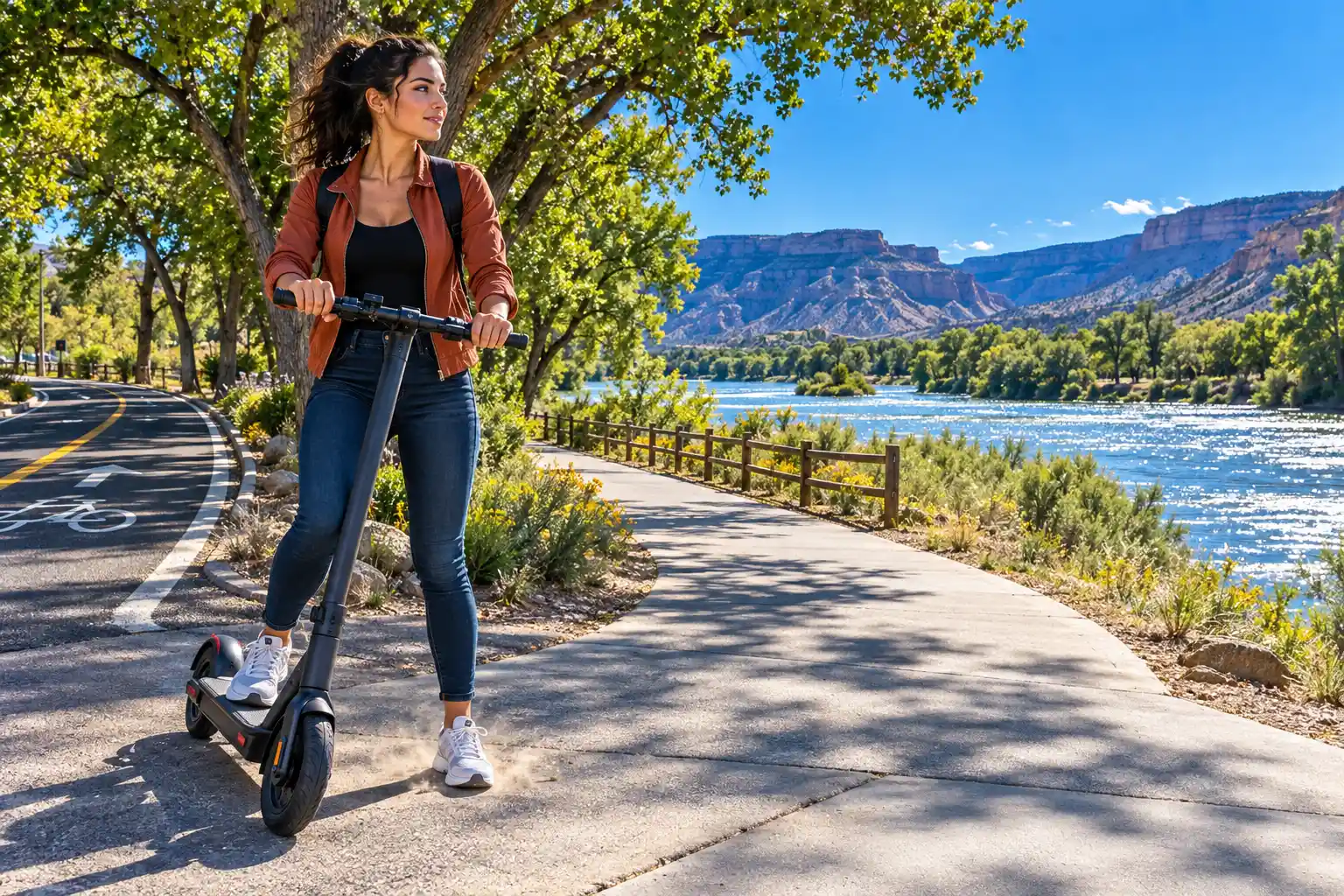
State law also says local electric-scooter rules must be no more restrictive than the rules for a Class 1 e-bike. Grand Junction’s trail rules already allow an electric motorized scooter on city trails, in the same breath as Class 1 and Class 2 e-bikes, and they keep other motor vehicles off those trails.
Sidewalk use still depends on local signs and local rules. A scooter you own is not automatically under the shared-fleet speed caps described later, so read the sign at the trailhead instead of copying the rental limit.
Picture a light stand-up scooter with handlebars and a motor that cuts out at the state speed on flat pavement. That machine can follow a bicycle onto a city trail. A heavier seated scooter with a tall windshield does not get trail access from this definition.
When the Scooter Is a Toy Vehicle?
The statute takes a true electric scooter out of the toy-vehicle category. The city still lists some stand-up scooters among toys, meaning the small gas or electric devices that were never built for a public highway, alongside mini-bikes, go-peds, and pocket bikes.
PRIVATE PROPERTY ONLY
- The test: If it cannot meet the electric-scooter definition, Grand Junction treats it as a toy that cannot be registered in Colorado.
- The ban: Toys stay off roads, sidewalks, trails, parks, parking lots, and other city property.
- The skateboard: An electric skateboard has no handlebars, so the city files it with toy vehicles rather than with electric scooters.
That split catches people who bought a cheap scooter online. The product photo looks street-ready, and the missing handlebars, the extra weight, or a motor that keeps pulling past the cap puts it on private property only. The sidewalk citation the city uses for that kind of riding is GJMC 10.04.710(3).
Shared Lime and Bird Scooter Limits
Lime and Bird rentals follow a separate rule set from a scooter you own, and the shared scooter FAQ from the city is the page that spells out speeds, sidewalks, and parking. You download the company app, create an account, and read the local riding guidelines before the first trip.
City Council unanimously backed an ongoing permit program at its February 19, 2025 hearing. The city’s project page then described the pilot as concluded as of March 2025. The FAQ still sketches a service area from 24 Road on the west to the 28 1/2 Road alignment on the east, and from I-70 and Horizon Drive on the north to the Colorado River and parts of Orchard Mesa, including the Mesa County Fairgrounds, so match a long ride against the map in the app.
The city guide nests these caps under shared micromobility, using Lime as the example, and the FAQ ties them to the city ordinance:
- 6 mph on a sidewalk
- 15 mph on a shared-use trail, including the Riverfront Trail
- On a roadway posted over 35 mph, use the sidewalk where one is available
Bike lanes are the preferred spot when they are available and safe. Walking the scooter is required in the dismount zones named on the city’s visitor listing for Lime: Colorado Mesa University, Canyon View Park, Lincoln Park, Sherwood Park, and the Grand Valley Transit downtown location.
Sidewalks Closed to Shared Scooters
Some downtown sidewalks are off limits even when a fast street would otherwise push you onto the concrete. The FAQ prohibits shared-scooter riding on these stretches:
- Main Street
- Colorado Avenue between 1st Street and 7th Street
- 7th Street between Grand Avenue and Colorado Avenue
A personal stand-up scooter still has to obey a posted sidewalk ban on those same blocks. The rental fleet is where the city wrote the street names into one FAQ, next to the request to be courteous on shared streets.
How to Park a Shared Scooter
Outside a few districts, parking is free-floating on a hard surface. Inside downtown, the Colorado Mesa University area, the Riverfront, North Avenue, and some parks, the ride has to end in a marked corral. The app shows those corrals, and the pavement carries scooter markings.
- Leave at least 3 feet of sidewalk clear so a person using a wheelchair can pass.
- Do not block a driveway, a door, a curb ramp, or a metered parking space.
- In a corral zone, park on the scooter markings instead of the nearest tree lawn.
If the scooter is left where the app will not close the trip, the rental can keep charging. For a broken scooter or a billing dispute, start in the app. Lime’s published support line is 1-888-LIME-345, and the email is support@li.me.
Low-Power Scooters and the License Decal
A low-power scooter is the street machine people often call a moped. It has no manual clutch, and it has not more than three wheels in contact with the ground. It is not a bicycle, an e-bike, a toy, a wheelchair, or a device built to help a person with a mobility disability use a sidewalk.
The power test and the wheel test sit in the sorting table. What surprises owners is the paperwork, because this row is a motor vehicle even though it can feel like a large scooter. The low-power scooter registration rules are the state page that lists the decal.
- A valid driver license, or a minor driver license, for the operator
- Insurance in force before the state will register the scooter
- One decal, a three-year registration, and a fee of $5.49 posted for July 1, 2025
The city guide is blunt about a machine that lacks the license, the decal, the insurance, or the required equipment: it stays on private property only. A documented low-power scooter can use roadways. It cannot use sidewalks, bike paths, or pedestrian trails.
Operators under 18 need a helmet, and passengers need a protective helmet. A manual clutch, or electric power over the 4,476 watts cap in the table, moves the machine into motorcycle rules instead of this decal.
Electric Motorcycles on the Street and Off It
A manual clutch is the city’s dividing line, and it moves a machine into motorcycle territory even when the engine is small. Electric machines cross that line once they are over the low-power watt cap. A street-legal motorcycle needs a VIN, a license plate, equipment that meets the rules, a driver license with a motorcycle endorsement, and insurance.
Eye protection is required, and a passenger needs a footrest. The ride stays on roadways. The CDOT e-bike safety campaign calls an over-class machine an e-moto, and it says that nickname is not defined in the state code. Grand Junction’s guide does not use the nickname. It files those machines as low-power scooters or as motorcycles, and the paperwork follows that filing.
Off-road electric motorcycles are often marked for off-road use only and lack street equipment. Police guidance posted on April 22, 2026, limits them to off-road areas and private property. They are not allowed on streets, public sidewalks, trails, or paths. Treating one like a Class 1 e-bike on the riverfront is the mistake the class table is built to stop.
Rules That Apply on Every Grand Junction Ride
Whatever the row in the table, the city guide applies the same conduct rules to e-bikes, scooters, motorcycles, and low-power scooters. You follow traffic laws, you yield to people walking, and you carry only as many passengers as the machine was built to carry.
Careless riding can bring a citation on the same terms as careless driving in a car, and the city names bicycles, e-bikes, scooters, and low-power scooters in that warning. Revving, racing, and stunts are prohibited citywide. Wheeled vehicles are not allowed on playgrounds, game courts, sports fields, pavilions, or park lawns.
For illegal use of these vehicles, call non-emergency dispatch at 970-242-6707. For an injury or a crime, the shared-scooter FAQ points you to 911.
Colorado’s e-bike safety materials describe a safety stop for a rider 15 or older, and for a younger rider who is with an adult. You can treat a stop sign as a yield, and a red light as a stop sign, only when the way is clear and you have the right of way. That guidance is about e-bikes. Do not read it as permission for a low-power scooter or a motorcycle.
Frequently Asked Questions
Do Stand-Up Electric Scooters Need a Helmet in Grand Junction?
The city guide does not require a helmet for a qualifying stand-up electric scooter, or for a Class 1 or Class 2 e-bike. Helmet rules show up for younger Class 3 riders and passengers, and for a younger low-power scooter operator and that scooter’s passengers. A rental app can still refuse to start a trip until you confirm a helmet, and the state campaign urges one on every e-bike class even where the city line is silent.
Can a Seated Scooter Use the Riverfront Trail?
A seat puts the machine outside the stand-up electric scooter the city describes, so it does not inherit the trail access that scooter has. When the wheels, the missing clutch, and the motor fit a low-power scooter, it belongs on a roadway with a license, a decal, and insurance, and those scooters are not supposed to ride more than two abreast. Past those limits it is a motorcycle or a toy, and the Riverfront Trail is closed to both.
Where Should You Report a Scooter Left on a Sidewalk?
Call non-emergency dispatch for a privately owned e-bike, scooter, or motorcycle used where it is forbidden. For a shared scooter, open the support tool in the Bird or Lime app; the city’s micromobility FAQ prints a Lime phone and email and notes that cash payment is also available, while Bird’s contact is on the device itself. Use the emergency number when someone is hurt or a crime is underway, not for a routine parking complaint.
What Happens If an E-Bike Is Unlocked to Go Faster?
Changing a speed governor so the bike exceeds its legal class limit causes the state safety campaign to treat it as a motor vehicle, and any change to top speed or wattage has to be matched with an updated class label. Breaking the manufacturing and classification rules is a class B traffic infraction with a $15 fine and a $6 surcharge. That pair of charges is not the careless-riding citation the city compares to a car ticket, which is a separate enforcement tool with no dollar amount printed in the city guide.
Before you leave the driveway, match the machine to one row: pedals, throttle, label, weight and stance, then clutch or wattage. The Riverfront Trail stays open to a Class 1 or Class 2 e-bike and to a qualifying stand-up scooter, and it stays closed to a Class 3, a low-power scooter, an off-road motorcycle, and a toy. A missing label is a reason to stay on the street until you can show which row is yours.
Disclaimer: This guide is general information about Grand Junction riding rules and is not legal advice. It does not replace the municipal code, state traffic statutes, posted signs, or a talk with a qualified attorney or the police department before you ride a device that needs a license, registration, or insurance. Speed limits, fees, and operator rules can change, and the figures here reflect the city guide, state pages, and related public materials used for this page. Check the device label and the rental app before you start, because a local sign or a permit condition can be tighter than a general class rule.


Xiaomi 18 Pro Goes Global as Its Privacy Filter Falters

iFixit Finds HomeView Glued Shut After Repair Gains

Polymetallic Nodules Shelter 4,139 Animals Miners Want

One UI 9.5 Puts Now Brief Behind a System Agent

Framework’s $99 Keyboard Brings Laptop Repair to the Couch

Microsoft 365 Auth Fault Took Down Exchange and Teams

OpenClaw 2.0 Ships a Team Workplace With Host-Trust Defaults

Xbox Caps Game Pass Cloud Gaming at 15 Hours

OpenAI Unveils GPT-6 Astra With a Critical Cyber Label

Squishy Dumpling Toys Recalled After Hiding Illegal Water Beads
-
 NEWS3 months ago
Microsoft 365 Auth Fault Took Down Exchange and Teams
-
 NEWS3 months ago
OpenClaw 2.0 Ships a Team Workplace With Host-Trust Defaults
-
 GAMING3 months ago
Xbox Caps Game Pass Cloud Gaming at 15 Hours
-
 NEWS3 months ago
OpenAI Unveils GPT-6 Astra With a Critical Cyber Label
-
 LIFESTYLE3 months ago
Squishy Dumpling Toys Recalled After Hiding Illegal Water Beads
-

 BUSINESS3 months ago
Diesel Breaks Its Record as the White House Claims Credit
-

 NEWS3 months ago
IFA 2026’s Weird Gadgets Are Building a Sensor Home
-

 BUSINESS3 months ago
ChargePoint Stock Rally Prices Wilmer’s Three-Year Cash Plan