
BUSINESS
Anthropic’s Chip Suppliers Put $26 Billion Beside the IPO
Anthropic’s IPO range is $70 to $78, but seven chip and cloud suppliers are buying $26.0 billion of nonvoting stock at the same price, with no underwriter lockup.

Anthropic set a $70 to $78 IPO range on Nov. 10 and added a $26.0 billion stock sale to seven of its own suppliers. The Claude maker is listing 825 million Class A shares on Nasdaq under ANT. At $78, the IPO raises $64.35 billion before costs, and the two sales together bring in $90.35 billion.
Public buyers are not the party writing the check that changes the structure. Google, Nvidia, AMD, Broadcom, Micron, Microsoft and TSMC agreed to buy nonvoting Class N stock at the IPO price, due to close right after the listing. Those firms already sell Anthropic the chips and cloud time the new cash is meant to buy.
Google and Nvidia Each Write a $10 Billion Check
Anthropic, a Delaware public benefit corporation, is selling 801,351,354 new Class A shares. The seven co-founders, including chief executive Dario Amodei and president Daniela Amodei, are selling 23,648,646 more, or 3,378,378 each. The company gets none of that founder sale. At the $74 midpoint, each co-founder would take about $250 million.
Goldman Sachs and Morgan Stanley are leading a 22-bank group. Underwriters can buy 123,750,000 extra company shares, a 15% option. Board members and related entities have said they may buy up to $303 million in the offering, a non-binding indication. Anthropic says retail accounts may get up to 20% of the shares, depending on demand.
The concurrent placement is a separate book. Dollar amounts are fixed; the share count moves with the final IPO price. Google’s $10.0 billion funds part of an earlier note deal and cuts a remaining $20.0 billion note facility to $10.0 billion. AMD’s $2.5 billion is half of a $5.0 billion equity promise tied to a hardware supply contract. Those two items are $12.5 billion of the $26.0 billion. The other $13.5 billion, and the placement as a package, showed up in the Nov. 10 amendment.
THE $26.0 BILLION PLACEMENT
| Buyer | Amount | What the filing ties it to |
|---|---|---|
| $10.0 billion | Part of a 2026 note agreement | |
| Nvidia | $10.0 billion | New Class N purchase at the IPO price |
| AMD | $2.5 billion | Half of a $5.0 billion hardware commitment |
| Broadcom | $1.0 billion | New Class N purchase at the IPO price |
| Micron | $1.0 billion | New Class N purchase at the IPO price |
| Microsoft | $1.0 billion | New Class N purchase at the IPO price |
| TSMC Partners | $0.5 billion | New Class N purchase at the IPO price |
| Total | $26.0 billion | Closes right after the IPO, if conditions hold |
At the midpoint, Anthropic estimates net proceeds from its own IPO shares plus the placement at about $84.6 billion, or about $93.7 billion if the extra shares are taken. It plans to use the money for general corporate purposes, including compute and infrastructure, and about $3.8 billion of tax on employee stock that vests with the listing.
$900.9 Billion Already Promised to the Chip Floor
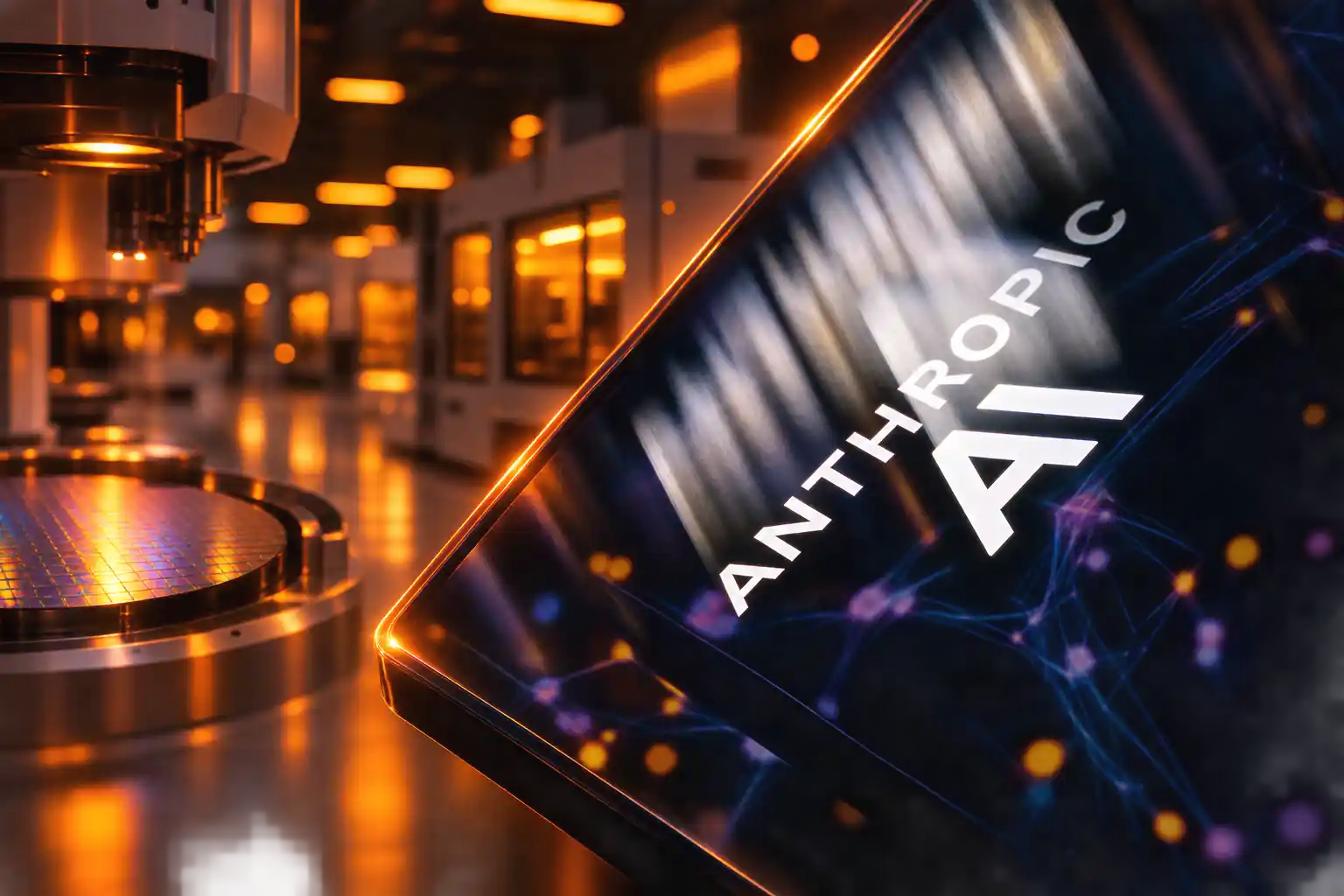
The new equity does not arrive into an empty ledger. As of and after Sept. 30, Anthropic lists $900.9 billion of purchase commitments and leases, substantially all for compute and infrastructure. About $70.7 billion comes due in the next 12 months. About $451.6 billion is expected by the end of 2030.
Third-quarter revenue was $17.0 billion, more than 12 times the year-earlier quarter and up 47% from the prior quarter. Compute and infrastructure took $9.86 billion, 58% of that revenue, and included $5.0 billion of short-term capacity that the company says costs much more than multi-year contracts. Run-rate revenue, a non-GAAP snapshot the filing warns is not a forecast, was about $81 billion as of Oct. 31, up $10 billion from Sept. 30.
NAMED COMPUTE BILLS
| Counterparty | Disclosed commitment | Window |
|---|---|---|
| Broadcom | About $161.2 billion in equipment leases | Five-year leases |
| At least $121.3 billion | April 2026 to July 2033 | |
| SpaceX AI unit | Up to $120.5 billion | Cancelable on 90 days’ notice from early 2027 |
| Amazon | At least $110 billion | May 2026 to April 2036 |
| Microsoft | At least $44.9 billion | November 2026 to May 2033 |
Google, Amazon and Microsoft bills are largely take-or-pay. They are owed whether Anthropic uses the machines or not. The SpaceX AI contract is the soft one: either side can walk with 90 days’ notice once the lock-in lifts in early 2027. That unit rents Nvidia-powered capacity, and it also builds its own models. Cash on hand was $131.8 billion at Sept. 30. The 12-month compute bill is larger than a quarter of revenue annualized at the third-quarter rate.
The One Cloud Giant Missing From the Placement
Amazon is Anthropic’s other long cloud partner, and it is not on the $26.0 billion list. It is still owed at least $110 billion under a 2026 deal that runs through April 2036, and it holds $6.2 billion of notes. Google and Nvidia are both writing $10.0 billion checks into Class N and collecting large compute bills on the other side of the same company.
That is the circular part of this listing. IPO cash is earmarked for compute. The firms that sell that compute are buying stock at the public price, then sending invoices back as the clusters come online. AMD is doing a smaller version of the same trade: equity that satisfies a hardware promise, stacked on top of more than $20 billion of possible chip purchases the company has described in other passages of the filing.
TSMC’s $0.5 billion is the smallest line and the most pointed. The prospectus warns that most of the world’s advanced chip-making capacity sits in Taiwan, mainly at TSMC, and that a delay there would hurt the business. The foundry is both a named supply risk and a buyer of nonvoting stock.
Why the Public Float Has No Say on the Board
The 825 million Class A shares are about 6% of the 13.09 billion shares that would be outstanding after the offering and the placement. Fully diluted, counting options, restricted stock and other issuances, the filing’s table reaches about 18.0 billion shares. At $78 that is about $1.4 trillion fully diluted, and about $1.02 trillion on shares outstanding alone. Those are different bases, not two prices for the same stock.
Voting is not proportional to that economics. A single Class F share, to be issued to a limited liability company of the seven co-founders, will carry 50.1% of the vote on matters put to stockholders, including election of the directors the trust does not pick. Class F has no economic rights. Class A has one vote a share and, the filing says, will generally not decide the outcome of a stockholder vote.
THE SHARE CLASSES AFTER LISTING
- Class A: The public stock, one vote a share, listed as ANT, no conversion into other classes.
- Class N: Full economics, no vote except as required by law, used for the $26.0 billion placement and for strategic holders; generally converts to Class A if sold to an unaffiliated buyer.
- Class F: One share at the Founder LLC, 50.1% of the general vote, no economic rights.
- Class T: One share at the Long-Term Benefit Trust, which generally elects and removes a majority of the board and has no economic rights.
- Class E: Employee-held, limited votes, no economic rights, excluding the co-founders.
The Long-Term Benefit Trust is a Delaware purpose trust with five authorized seats and one vacant. Trustees named in the filing are Dr. Neil Shah (chair), Richard Fontaine, Dr. Ben S. Bernanke and Dr. Christopher Stubbs. They pick Class T directors, who will be four of seven board seats. Named Class T directors include Reed Hastings, Vas Narasimhan and Christopher Liddell, plus a vacancy. Anthropic is a controlled company under Nasdaq rules because of that board math. Directors of a public benefit corporation must weigh stockholders’ money against people affected by the firm and against a charter purpose, “the responsible development and maintenance of advanced AI for the long-term benefit of humanity.” The filing says it cannot guarantee a conflict would be resolved in favor of stockholders’ cash interest.
Class N Comes With No Vote and No Lockup
The supplier stock is cheaper to hold, in market terms, than the founder stock. Directors, officers and most other holders are under lockups of up to 180 days, and up to 365 days for co-founders and some large holders. Class N in the placement is not in those underwriter lockups. It is still restricted under the Securities Act, so resale needs a registration statement or an exemption such as Rule 144. The underwriters collect no discount on it. The IPO does not depend on the placement closing. The placement does depend on the IPO, and on other conditions, including a stockholder vote.
The shares of Class N common stock sold in the concurrent private placement will not be registered in this offering and will not be subject to lock-up agreements with the underwriters, but will be “restricted securities” under the Securities Act of 1933, as amended (the “Securities Act”), and may be resold only pursuant to an effective registration statement or an available exemption from registration.
Anthropic, PBC, Form S-1/A Amendment No. 2, Nov. 10, 2026
That gap is the quiet transfer of power in the deal. Insiders who built the company wait. The chip vendors who already get paid on the compute contracts can, once a resale path opens, move stock sooner. They also have no vote, so they cannot use the new shares to push the trust or the Founder LLC. They buy economics, and they keep the customer.
After Thursday, the Asking Price Came In Lower
The $1.4 trillion fully diluted figure at $78 is a step-up from the last private round and a step-down from the talk that surrounded it. In May 2026 Anthropic raised $65 billion in a Series H at a $965 billion post-money value. Some prospective buyers had wanted about $1.5 trillion after AI stocks fell on Nov. 5, and a figure near $2 trillion had been discussed months earlier. The range came in below both.
The quarter under the roadshow is not a clean profit print. Anthropic booked a $974 million operating profit in the June quarter, then a $567 million operating loss in the September quarter, which it ties to the $5.0 billion of short-term compute and $2.0 billion of non-cash donation-matching charges. Adjusted operating income, a company measure that strips stock pay and those charges, was $2.46 billion. The net loss was $23.3 billion in the quarter. Most of that is not cash; it is the accounting for convertible notes and similar instruments that get more expensive on paper as the company’s value rises.
THE PATH TO ANT
- May 28, 2026: Closes a $65 billion Series H at a $965 billion post-money value.
- June 12, 2026: SpaceX prices 555.6 million Class A shares at $135 and raises $75 billion, the largest IPO proceeds at pricing.
- Oct. 26, 2026: Files a Form S-1 for a Nasdaq listing under ANT.
- Nov. 5, 2026: AI stocks sell off; buyers push the live valuation talk lower.
- Nov. 10, 2026: Files Amendment No. 2, sets $70 to $78, and opens the roadshow with the $26.0 billion Class N sale attached.
- Nov. 13, 2026: Amodei is due to appear with JPMorgan Chase chief executive Jamie Dimon around lunchtime in New York.
- Nov. 18, 2026: Expected pricing date, subject to clearance and demand.
- Nov. 19, 2026: Expected first trade on Nasdaq Global Select Market.
SpaceX’s $75 billion June listing is still larger than Anthropic’s IPO book alone. Add the $26.0 billion placement and Anthropic’s combined cash at the top of the range, $90.35 billion, is larger than that SpaceX total. It is also several times Saudi Aramco’s $25.6 billion listing in 2019, the record that stood until this year’s space and AI deals. Comparisons that mix IPO proceeds with a private placement are mixing two markets. That is the point of this structure.
THE SNAPSHOT
- $17.0 billion: Third-quarter revenue, up 47% from the prior quarter.
- $81 billion: Run-rate revenue as of Oct. 31, a non-GAAP figure the filing says is not a forecast.
- $900.9 billion: Compute and infrastructure commitments as of and after Sept. 30.
- $1.4 trillion: About the fully diluted value at $78, on roughly 18.0 billion shares.
Friday Lunch With Dimon, Then a Nov. 19 Open
On Nov. 10 Anthropic said it had opened the roadshow for its proposed initial public offering of Class A common stock. JPMorgan is handling U.S. retail marketing and allocations. A conversation between Amodei and Dimon is planned for around lunchtime in New York on Nov. 13. Both firms have declined to comment on that event. JPMorgan already uses Claude inside the bank, so the guest is a customer as well as a distributor of the stock.
Company materials say the shares are expected to begin publicly trading on Nov. 19, with the price set on Nov. 18, subject to regulators and the book. Orders have been described as several times the stock on offer, with some investors passing along slices of allocations for extra fees. Pre-IPO holders have been pitching stakes through special purpose vehicles. That does not change the cap table the filing describes. The trust still picks a board majority. The Founder LLC still holds 50.1% of the general vote. Class N still has no vote.
Large listings pull cash out of sibling trades. SpaceX’s June debut did that to other space names, and a book this size can do the same to chip and cloud stocks in the days around Nov. 19, including names that are buying ANT in the private placement. That rotation is a market fact of a deal this wide, not a verdict on Claude.
The placement is scheduled to close immediately after the IPO if its conditions are met. First trade is set for Nov. 19 under ANT.
Disclaimer: This article is news reporting and analysis of Anthropic’s proposed initial public offering and is for information only. It is not investment advice, a solicitation, or a recommendation to buy or sell ANT, any related security, or any derivative. Readers should consult a licensed financial adviser or broker about their own situation before acting on an IPO allocation or any stock purchase. Share counts, prices, valuations, proceeds and listing dates are taken from Anthropic’s Nov. 10, 2026 registration statement and company materials and may change before the offering is priced or sold.

Xiaomi 18 Pro Goes Global as Its Privacy Filter Falters

iFixit Finds HomeView Glued Shut After Repair Gains

Polymetallic Nodules Shelter 4,139 Animals Miners Want

One UI 9.5 Puts Now Brief Behind a System Agent

Framework’s $99 Keyboard Brings Laptop Repair to the Couch

Microsoft 365 Auth Fault Took Down Exchange and Teams

OpenClaw 2.0 Ships a Team Workplace With Host-Trust Defaults

Xbox Caps Game Pass Cloud Gaming at 15 Hours

OpenAI Unveils GPT-6 Astra With a Critical Cyber Label

Squishy Dumpling Toys Recalled After Hiding Illegal Water Beads
-
 NEWS3 months ago
Microsoft 365 Auth Fault Took Down Exchange and Teams
-
 NEWS3 months ago
OpenClaw 2.0 Ships a Team Workplace With Host-Trust Defaults
-
 GAMING3 months ago
Xbox Caps Game Pass Cloud Gaming at 15 Hours
-
 NEWS3 months ago
OpenAI Unveils GPT-6 Astra With a Critical Cyber Label
-
 LIFESTYLE3 months ago
Squishy Dumpling Toys Recalled After Hiding Illegal Water Beads
-

 BUSINESS3 months ago
Diesel Breaks Its Record as the White House Claims Credit
-

 NEWS3 months ago
IFA 2026’s Weird Gadgets Are Building a Sensor Home
-
 BUSINESS3 months ago
ChargePoint Stock Rally Prices Wilmer’s Three-Year Cash Plan