
BUSINESS
Apollo Weighs a $20 Billion Bid for DePuy Synthes
Apollo is in talks to buy J&J’s DePuy Synthes unit for close to $20 billion, a cash-flow bet on implants J&J no longer wants.

Apollo Global Management is in talks to buy Johnson & Johnson’s DePuy Synthes orthopedics unit for close to $20 billion. People familiar with the matter said an agreement could come within several weeks. They also said the talks could still collapse, another bidder could appear, or J&J could spin the unit as a public company instead. Apollo and J&J declined to comment.
The price being discussed is a cash-flow wager, not a growth story. J&J spent years telling investors this implant franchise no longer fits. Apollo is treating that same franchise as a large, stable asset it can finally put to work.
Apollo Bids on the Unit J&J Wants Off Its Books
On October 14, 2025, J&J announced its intent to separate its Orthopaedics business and run it as DePuy Synthes. Chairman and Chief Executive Joaquin Duato said the split would let J&J put more money into higher-growth work. The company named oncology, immunology, neuroscience, cardiovascular, surgery, and vision as the six areas it would keep.
This transaction enables Johnson & Johnson to further strengthen its focus and investment toward higher-growth areas where we can meaningfully extend and improve patient lives.
Joaquin Duato, Chairman and Chief Executive, Johnson & Johnson, October 14, 2025
Chief Financial Officer Joseph Wolk told investors the same week that the next phase of innovation in orthopedics was “beyond our scope and probably in better hands somewhere else.” He said the working plan was a tax-free spin for U.S. tax purposes, while other paths stayed open. Citi and Goldman Sachs & Co. LLC are advising J&J. Namal Nawana, a former Smith & Nephew chief executive who once ran DePuy Synthes Spine, was named worldwide president that day.
By February 2026, buyout firms were circling an outright sale. Several were said to be weighing joint bids. On September 11, 2026, those talks had narrowed enough that Apollo was the name in the room, with the unit valued at close to $20 billion. J&J shares were little changed that Friday at $265.58, a market value of $640 billion. Apollo shares rose 0.8% to $128.98, a market value of $76 billion.
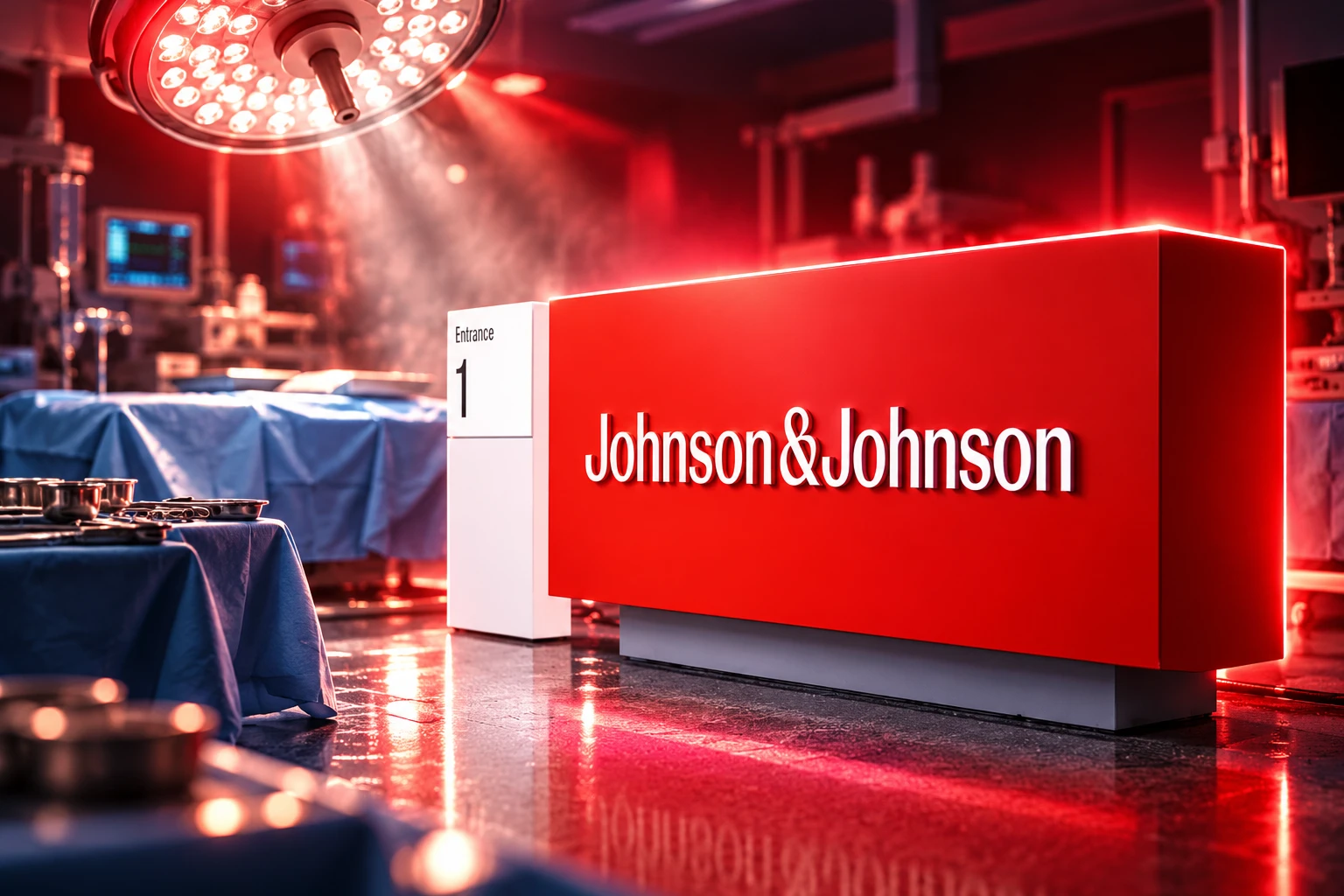
Fourteen Years After a $19.7 Billion Purchase
J&J finished buying Synthes on June 14, 2012, for $19.7 billion in cash and stock, and folded it into DePuy. The 2012 close created what J&J then called the world’s most complete orthopedics business. Fourteen years later, the sticker being discussed with Apollo is almost the same number.
THE SPLIT THAT TOOK 14 YEARS
- June 14, 2012: Completes the Synthes purchase for $19.7 billion and forms DePuy Synthes.
- 2023: Spins consumer health into Kenvue and starts an orthopedics restructuring that exits some markets and product lines.
- October 14, 2025: Announces a standalone DePuy Synthes, hires Nawana, and targets a finish in 18 to 24 months.
- February 2026: Opens a sale path beside the spin, with large buyout firms preparing bids.
- July 2026: Wolk says J&J still wants every option that helps shareholders and the unit, and is on track for a mid-2027 separation.
- September 11, 2026: Apollo is in talks at close to $20 billion, with a public listing still on the table.
The 2012 deal already came with a regulator’s price. The Federal Trade Commission made J&J sell its wrist-fracture plating system, and J&J sold its full U.S. trauma line to Biomet to clear the merger. A strategic buyer of DePuy Synthes now would walk into that same share-of-market problem. A buyout firm would not.
Stryker’s Orthopedics Book Grew 10.9%
DePuy Synthes posted $9.26 billion of sales in 2025, up 1.1% from $9.16 billion. That is about 10% of J&J’s $94.2 billion in 2025 sales. J&J told investors in October 2025 that stripping orthopedics out of MedTech would lift that segment’s growth and operating margin by at least 75 basis points on then-current figures.
The growth gap is not theoretical. Stryker’s orthopedics franchise did $9.28 billion in 2025 and grew 10.9%. Zimmer Biomet, a pure-play peer, did $8.23 billion and grew 7.2%. DePuy is the same size as Stryker’s ortho book and is growing at a fraction of that pace.
2025 ORTHOPEDICS SALES AND GROWTH
| Company | 2025 sales | Growth | Hips | Knees |
|---|---|---|---|---|
| DePuy Synthes | $9.26 billion | 1.1% | $1.67 billion, +2.1% | $1.59 billion, +2.7% |
| Stryker Orthopaedics | $9.28 billion | 10.9% | $1.87 billion, +9.5% | $2.66 billion, +8.5% |
| Zimmer Biomet | $8.23 billion | 7.2% | $2.09 billion, +4.7% | $3.32 billion, +4.7% |
The 2026 run rate is less grim than the 2025 full year. Orthopedics sales were $2.42 billion in the quarter ended June 28, 2026, up 4.9%, and $4.80 billion in the first half, up 5.6%. J&J as a whole did $25.31 billion in that quarter. A rebound does not erase the multi-year lag against Stryker, but it is the first hard number that helps a buyer argue the franchise is not stuck at 1%.
Synthes Trauma Hardware Still Throws Off the Cash
The unit is often tagged as a hips-and-knees business. Trauma hardware is the largest single line, a leftover of the Synthes purchase, and hips plus knees together are only slightly larger than trauma alone.
DEPUY SYNTHES 2025 SALES MIX
- Trauma: $3.15 billion, up 3.2%, the biggest product line.
- Spine, sports and other: $2.85 billion, down 2.6%, the drag inside the book.
- Hips: $1.67 billion, up 2.1%.
- Knees: $1.59 billion, up 2.7%.
J&J says DePuy Synthes serves about seven million patients a year in a global market it puts at more than $50 billion. Joint replacement is sticky work. Surgeons train on a system, hospitals stock the trays, and switching a hip or a trauma set is slow. That lock-in is what a buyout model can finance even when the top line crawls.
DePuy still sells enabling tech beside the metal. Its VELYS Hip Solutions navigation tools sit with the ATTUNE knee and a robotic-assisted knee platform. Those tools have not closed the growth gap with Stryker. They are, though, the kind of add-on a new owner can fund without competing against J&J’s oncology budget.
Why a 2.2 Times Sales Check Works for Apollo
Close to $20 billion on $9.26 billion of 2025 sales is about 2.2 times revenue. Analyst Matt Henriksson has put a debt-inclusive value on the same business at $28 billion, a different figure from the equity number in the Apollo talks. The gap is the argument. One camp says $20 billion already pays for a slow grower. The other says the cash engine is still cheap once leverage is counted.
Apollo’s private equity platform listed $70 billion of assets, more than 190 portfolio companies, and more than 100 investment professionals as of June 30, 2026. The parent firm ran $1.05 trillion of assets. Its equity page names corporate carveouts as a core deal type, the purchase of a standalone asset that once sat inside a larger company. DePuy Synthes is that trade at a rare size.
A sale would let Apollo put a large check to work in a business with repeat procedures and an aging customer base. It would also load the unit with deal debt that a J&J subsidiary never had to carry. The open question on the trade is which side keeps the better half: cash and a cleaner J&J, or a levered claim on every hip, knee, and trauma case the franchise already owns.
Hospitals that buy those implants already worry about list prices, GPO contracts, and tray costs. A new owner that needs to service a $20 billion check has a reason to push price and mix, not to run the business as a quiet division of a AAA-rated parent. That is the practical risk inside the multiple, not a separate story.
Apollo’s Hospital Chains Already Buy Implants
Apollo is not a new visitor to the hospital loading dock. The Private Equity Stakeholder Project’s July 2026 hospital tracker counts Apollo as the largest private equity hospital owner in the United States, with about 200 U.S. hospitals through Lifepoint Health and ScionHealth. The same tracker counts 447 private-equity-owned hospitals nationwide, about 9.5% of private hospitals.
Those hospitals and DePuy Synthes would not have to sit in the same fund. They would still sit inside the same alternative-asset firm, one that already collects facility revenue and, if this deal closes, would also collect implant revenue. For purchasing officers, that is a new counterparty with two ways to make money off the same case.
J&J has been paying to unstitch the unit even before a buyer is signed. Orthopaedics separation costs were $0.2 billion in the second quarter of 2026 and $0.4 billion in the first half. That spend only makes sense if New Brunswick is serious about getting the business off the books, whether Apollo writes the check or a new ticker does.
The Mid-2027 Clock and a Tax-Free Spin
Wolk said on the July 2026 earnings call that J&J continues to “evaluate all separation options that create shareholder value and set the DePuy Synthes business up for success long-term.” He said the company was pleased with progress and still aimed at a mid-2027 finish, 18 to 24 months from the October 2025 announcement. A tax-free spin would send DePuy shares to J&J holders and avoid a large tax bill. A $20 billion sale would bring cash J&J could put into drugs, cardiovascular devices, and buybacks, at the cost of that tax treatment and of whatever cash the unit would have kept throwing off.
Nawana is the person in the middle of both paths. He reports to Duato through the split and is slated to keep running DePuy Synthes after it leaves. In October 2025 he said he was honored to lead “a global market leader with a deep heritage of innovation and a strong commercial platform that is well positioned to succeed as a standalone company.” Standalone, in that sentence, still meant a public company. It can also mean a portfolio company.
WHAT WE KNOW
- The talks: Apollo has been discussing a purchase at close to $20 billion, with several other private equity firms also interested.
- The clock: J&J is still pointing to a mid-2027 separation and said in July it would share more later in 2026.
- The business: $9.26 billion of 2025 sales, about seven million patients, and a mix led by trauma hardware.
WHAT IS UNCONFIRMED
- A signed deal: No agreement is done, and both firms declined to comment.
- The final structure: Sale, joint PE bid, or public spin all remain live.
- The enterprise value: The $28 billion debt-inclusive estimate is an analyst figure, not a bid.
PATHS THAT REMAIN OPEN
- Apollo alone: A carve-out buyout near $20 billion, the talks described on September 11, 2026.
- A PE group: The joint-bid idea that surfaced in February, still compatible with a failed exclusive.
- A public DePuy Synthes: The tax-free spin J&J has been building toward since October 2025.
- No deal: The outcome the people close to the talks already flagged as possible.
If Apollo signs, J&J walks away from a franchise it paid $19.7 billion to build and that still books more than $9 billion a year. If it does not, Nawana still has to get DePuy Synthes to a mid-2027 listing with trauma screws paying the bills. Either way, the better half of that trade is not settled until someone writes a number in a contract.
Disclaimer: This article is news reporting and analysis of a possible transaction, and it is for information only. It is not investment advice, a solicitation to buy or sell any security, or a recommendation on J&J, Apollo, or DePuy Synthes. Readers should consult a licensed financial adviser or other qualified professional before making any investment decision. Deal terms, valuations, and company statuses are those given by the cited statements and filings as of the dates named above and can change if talks end, a rival bid appears, or J&J chooses a spin instead of a sale.

Liberty Parks MotoGP on Formula 1’s Austin Stage

The Salary Cap Fight That Can Freeze Baseball’s TV Payday

The 2027 Mercedes GLE and GLS Keep Alabama Busy

Margaret Hamilton Dies at 90 With a Harder Fight Unfinished

Unity Parks Its Engine Inside Google’s Prompt Games

Microsoft 365 Auth Fault Took Down Exchange and Teams

Diesel Breaks Its Record as the White House Claims Credit

Xbox Caps Game Pass Cloud Gaming at 15 Hours

IFA 2026’s Weird Gadgets Are Building a Sensor Home

Tesla Puts Its Wheel-Free Cybercab on Austin Streets
-
 NEWS2 months ago
Microsoft 365 Auth Fault Took Down Exchange and Teams
-
 GAMING2 months ago
Xbox Caps Game Pass Cloud Gaming at 15 Hours
-
 BUSINESS2 months ago
Diesel Breaks Its Record as the White House Claims Credit
-
 AUTO2 months ago
Tesla Puts Its Wheel-Free Cybercab on Austin Streets
-
 NEWS2 months ago
IFA 2026’s Weird Gadgets Are Building a Sensor Home
-
 NEWS2 months ago
OpenAI Unveils GPT-6 Astra With a Critical Cyber Label
-

 NEWS2 months ago
OpenClaw 2.0 Ships a Team Workplace With Host-Trust Defaults
-

 NEWS2 months ago
Sony and Warner Sue Anthropic Over Torrented Song Lyrics