
BUSINESS
California Diesel Pumps Max Out at $9.999 a Gallon
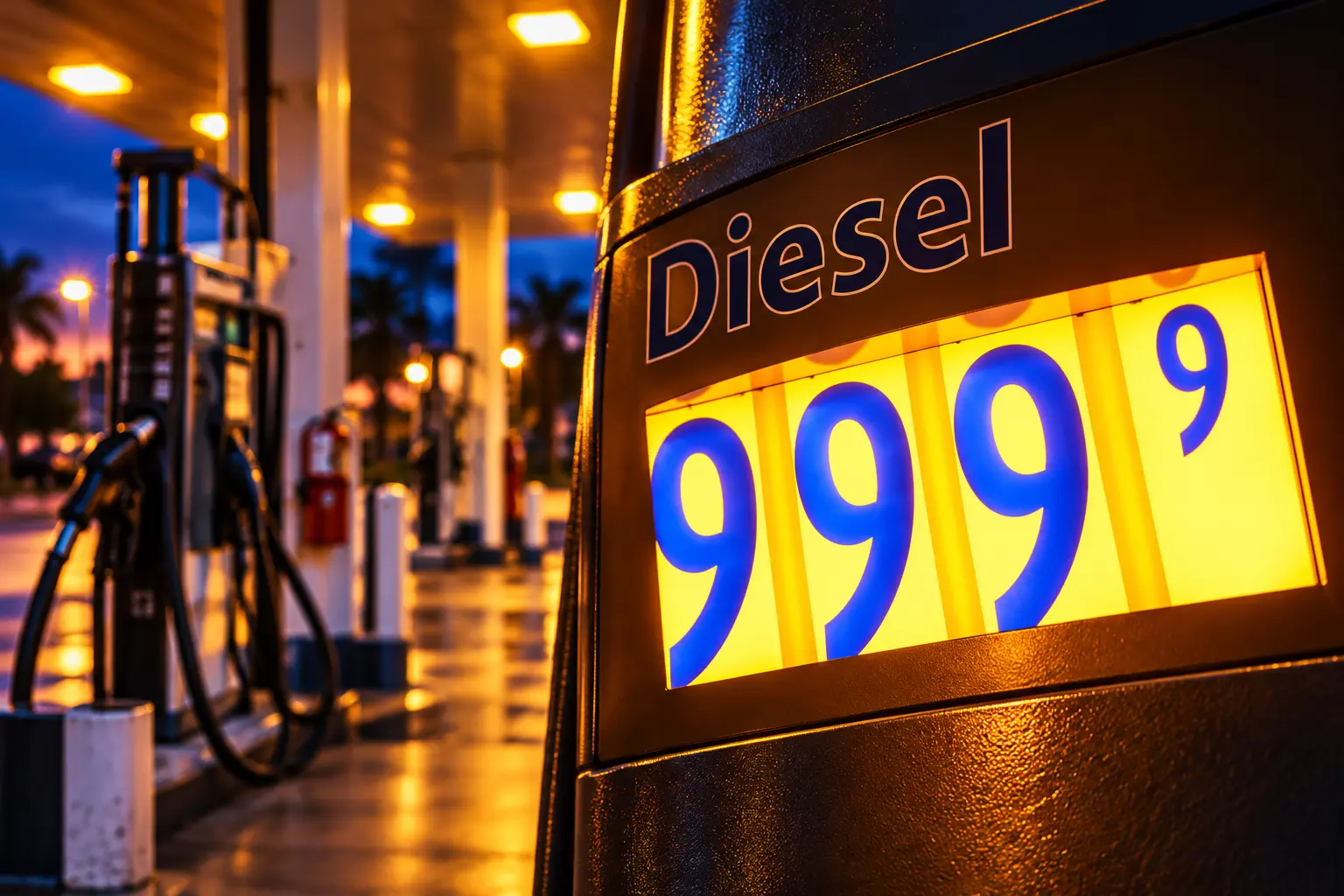
Four-digit pumps in California posted $9.999 diesel, a hardware ceiling that also flags empty tanks, while the state average sat at $7.76.

Five California stations posted diesel at $9.999 a gallon on Sept. 10, the top figure most four-digit pumps can show. Patrick De Haan, GasBuddy’s head of petroleum analysis, later cut that list to three after some $9.999 prints turned out to be empty tanks.
The U.S. Energy Information Administration still put the state average at $7.764 for the week of Sept. 7. The viral number on the pole is a hardware ceiling, an outage code, and, in at least one case, a real sale.
Why Some California Diesel Pumps Show $9.999
De Haan’s morning post on Sept. 10 said GasBuddy data showed five California stations “selling diesel at the dispensers highest possible price: $9.999/gal.” Crowdsourced listings that day pointed to San Jose, Serra Mesa, Santa Clara, and Paso Robles, including Arco and Shell sites. He followed the post with a one-word caption, “yuck,” and a screenshot of the $9.99 prints.
MAXXED OUT at $9.999!! GasBuddy data showing 5 stations in California that have hit the limit and are selling diesel at the dispensers highest possible price: $9.999/gal
— Patrick De Haan (@GasBuddyGuy) September 10, 2026
By afternoon he posted an update of his own. Some of those $9.999 reports were stations that had run out of diesel, “a common way stations report outages of certain fuel types.” The live count, he said, was three. He had earlier seen as many as six. After calling a couple of sites, he told an interviewer the signs said $9.99 because the tanks were dry. “One appears that it does have fuel,” he said.
WHAT $9.999 ON THE BOARD CAN MEAN
- A hardware ceiling: Most grade-price windows hold four digits, so $9.999 is the last number they can legally display without a software change.
- An empty-tank flag: Stations often push the display to the max to tell apps and drivers that diesel is gone, not that it costs $10.
- A live sale: De Haan said at least one of the Sept. 10 prints lined up with a transaction, so the cap is not only a glitch.
That overlap is the mess. A driver rolling up to a $9.999 diesel pole cannot tell from the digits whether the station is gouging, sold out, or simply unable to print $10.08. The machine built to post the price now hides it. A taped-on extra “1” in front of the board would be a cheaper fix than a new dispenser, and it would still leave the receipt as the first honest number a customer sees.
Pumps Ran Out of Digits Once Before
This is not a new kind of failure. In 2008, when regular gasoline blew through $4, older mechanical pumps could not show more than $3.99 a gallon. Some owners priced by the half-gallon, posted a sign, and doubled the total at the register. New pump computers ran about $400 each. Full replacements ran $10,000 to $15,000 a unit, a bill many independent operators could not eat, and parts makers built backlogs measured in weeks.
Today’s $9.999 cap is that episode with one extra digit of headroom. Digital heads replaced the spinning wheels, but the industry still designed the window for a world in which a gallon stayed in single digits. De Haan said many pumps “only have 4 digits for their individual grade price display,” which “could be problematic for displaying a true and accurate price unless a software update of sorts could be made.” A day earlier he had warned that some California stations “may have to figure out software updates for potentially double-digit diesel prices.”
A software patch is cheaper than a new island. It still has to satisfy weights-and-measures rules that the posted price match what the customer pays. Until that patch lands, a station that truly needs $10.49 has two ugly options: under-display the price, or stop selling diesel.
$7.76 Statewide, and the Top 15 Start With 9
The EIA’s weekly survey, released Sept. 9, is the boring number that holds up. California diesel averaged $7.764 a gallon for the week of Sept. 7, up 54.6 cents from $7.218 the week before and up $2.806 from a year earlier. The U.S. on-highway average was $5.967, up 36.8 cents week over week and $2.201 year over year. California regular gasoline, for context, was $5.678.
EIA ON-HIGHWAY DIESEL, WEEK OF SEPT. 7
| Market | Week of Sept. 7 | Prior week | Week change | Year change |
|---|---|---|---|---|
| California diesel | $7.764 | $7.218 | +54.6 cents | +$2.806 |
| U.S. diesel | $5.967 | $5.599 | +36.8 cents | +$2.201 |
GasBuddy’s live feed moved faster than the survey. On Sept. 10 the company’s national diesel average reached $6 a gallon for the first time. On Sept. 11 De Haan said California’s live average had hit $8 a gallon, another first. He had already forecast that the state “probably will surpass $8” and “could get to $8.25.” He added that on his list of the 15 most expensive California diesel stations, “the most expensive 15 all start with a nine already.”
So the $9.999 prints sit on the far tail of a distribution that has already shifted. A statewide $7.76 average with a cluster of nines is a working market under stress, not a handful of broken signs. National diesel already broke its old record earlier in this Iran-war spike; the four-digit window is just where that move became visible on the island.
The Fuel That Moves Groceries Just Set a Record
Passenger cars can shop regular gasoline, delay a trip, or skip a fill. Diesel does not give that option to the people who move food. California sells about 3.5 billion gallons of diesel a year, more than any other state, and it is the second most common fuel purchased there. De Haan put the national extra fuel bill, gasoline and diesel together, at $700 million a day above a year earlier, or nearly $5 billion a week, with diesel near $6 and gasoline around $4.27.
HISTORY: California diesel has hit $8/gal average for the first time ever, per live GasBuddy data. the state that grows a third of america’s vegetables and two thirds of its fruits just made your grocery bill more expensive
Patrick De Haan, head of petroleum analysis at GasBuddy, on X, Sept. 11, 2026
Short diesel supply is the core problem, he said, with the Iran war and the Russia-Ukraine war both squeezing refined fuel. About 20% of global petroleum liquids consumption moved through the Strait of Hormuz in the first half of 2025, per EIA figures cited as the waterway closed. Seasonal farm demand in California and heating-oil fills in rural states that share the diesel barrel add another bid each fall. Stations that run out of diesel are not a side show. They are the shortage showing up as a dark pump.
Households that never buy a gallon still pay. Freight, rail, farm gear, and job-site machines run on the same fuel. When that fuel jumps $2.20 in a year at the national average, and more than $2.80 in California, the markup lands in produce, parcels, and building materials on a lag, not on the day the pole flips.
A 13% Sales Tax Rides Every Extra Dollar
California stacks tax on top of an already isolated market. The state has no major pipelines to other U.S. refining centers, so it leans on in-state plants and cargoes when supply tightens, the California Energy Commission has long noted. Then the tax code takes a cut that grows with the sticker price.
THE TAX STACK ON A CALIFORNIA DIESEL GALLON
- Federal levy: The on-highway diesel tax is 24.40 cents a gallon, including the 0.1-cent leaking-tank fee, per the EIA.
- State excise: California adds a 48.2-cent-per-gallon diesel excise tax, per the California Department of Tax and Fee Administration.
- Sales tax: Retail diesel also carries a 13% state sales tax on diesel, plus local district taxes, so the take rises as the gallon gets more expensive.
- At the cap: De Haan calculated that at $9.999, “California’s diesel sales tax is siphoning $1.30 per gallon to the state. 13% adds up.”
Unlike a fixed excise, the 13% levy is a percentage of the price. A $5 taxable gallon yields about 65 cents in state sales tax before local add-ons. A $9 gallon yields about $1.17. San Jose’s general sales tax rate moved to 10% in April after Santa Clara County voters approved an extra 0.625%, which is one reason a Bay Area $9.999 print is not a mystery of crude alone.
A Watchdog File That Predates the Digit Wall
Sacramento was already watching outlier stations before any pump ran out of nines. The Division of Petroleum Market Oversight, set up under the 2023 gas-price gouging law Senate Bill X1-2, issued an enforcement bulletin and consumer advisory on March 19, 2026, as the Iran conflict lifted street prices. Director Tai Milder, a former federal antitrust prosecutor appointed by Gov. Gavin Newsom, said in a June 12 update that the conflict had already cost California households more than $200 in extra gasoline, and that branded pump prices were “unacceptable for Californians who need to get to work.”
That same letter flagged diesel-market plumbing, including how the Oil Price Information Service assesses West Coast product, and said the state’s investigation of high-priced stations was underway. Investigators had contacted about 20 of the highest-priced gasoline sites, generally above $7 to $8 a gallon. No public finding has pinned the Sept. 10 $9.999 diesel prints on illegal gouging. Milder’s own June note said California’s overall increase had tracked the rest of the country even as the branded-unbranded gap widened.
A $9.999 display does not, by itself, prove a station broke the law. It does give the watchdog a short list of sites whose poles no longer describe the transaction.
Shop Around, Because the Spread Is $2.50
President Donald Trump said on Sept. 9 that oil prices are unlikely to fall until after the midterm elections, then “tumbling downward,” and that he thinks gasoline can go “below $2 a gallon.” De Haan was asked about that timeline and declined it. “I’m not on the same train there,” he said. “There’s not really any catalyst, whether it’s tomorrow, in a week, in a month, or in a year, that at this point looks like there’s any real guaranteed savings yet.” If the wars end, he added, “there will likely be plenty of downward room for prices to fall.”
Until then his advice is local, not presidential. “Shop around. There are huge variances in prices within California, probably on the magnitude of $2-2.50 a gallon.” That spread is larger than a typical weekly move in the EIA survey. It is also the practical answer to a four-digit window that has started to lie. The receipt, the next station, and the app are now more honest than the pole that was built to be the last word.

Liberty Parks MotoGP on Formula 1’s Austin Stage

The Salary Cap Fight That Can Freeze Baseball’s TV Payday

The 2027 Mercedes GLE and GLS Keep Alabama Busy

Margaret Hamilton Dies at 90 With a Harder Fight Unfinished

Unity Parks Its Engine Inside Google’s Prompt Games

Microsoft 365 Auth Fault Took Down Exchange and Teams

IFA 2026’s Weird Gadgets Are Building a Sensor Home

Tesla Puts Its Wheel-Free Cybercab on Austin Streets

Diesel Breaks Its Record as the White House Claims Credit

Xbox Caps Game Pass Cloud Gaming at 15 Hours
-
 NEWS2 months ago
Microsoft 365 Auth Fault Took Down Exchange and Teams
-
 GAMING2 months ago
Xbox Caps Game Pass Cloud Gaming at 15 Hours
-
 AUTO2 months ago
Tesla Puts Its Wheel-Free Cybercab on Austin Streets
-
 NEWS2 months ago
IFA 2026’s Weird Gadgets Are Building a Sensor Home
-
 BUSINESS2 months ago
Diesel Breaks Its Record as the White House Claims Credit
-

 NEWS2 months ago
OpenAI Unveils GPT-6 Astra With a Critical Cyber Label
-

 NEWS2 months ago
OpenClaw 2.0 Ships a Team Workplace With Host-Trust Defaults
-

 LIFESTYLE2 months ago
Squishy Dumpling Toys Recalled After Hiding Illegal Water Beads