
BUSINESS
Private Colorado Rivers Now Carry a $2 Million-a-Mile Price
Lawmakers skipped a 2026 right-to-float bill after a study priced private Colorado river miles at about $2 million each.

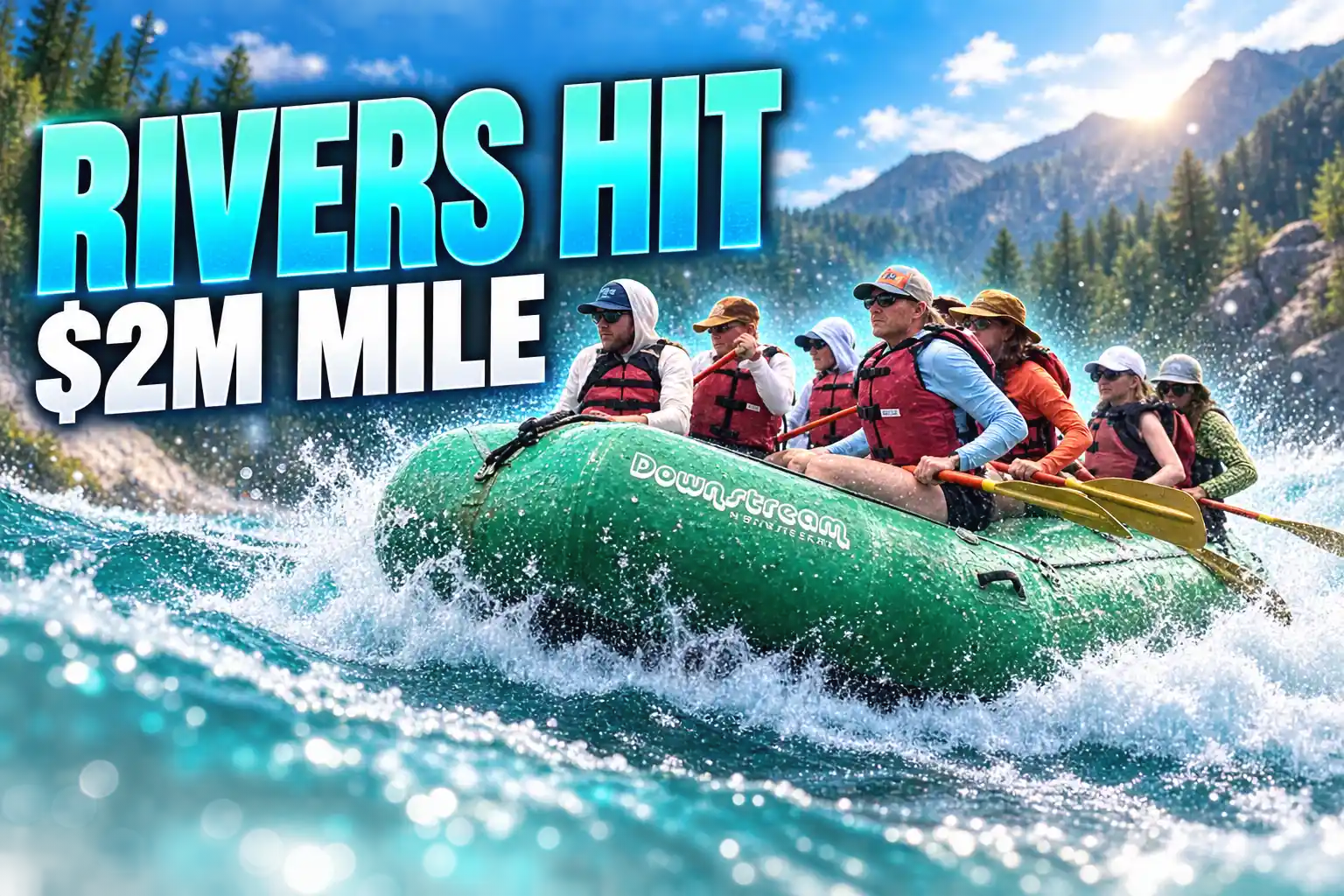
Colorado stream access on private land now carries a printed price of $2.75 billion to $3.4 billion for 1,375 to 1,700 floatable miles. The Common Sense Institute put those figures in an April 2, 2026, paper by Greg Walcher, Mike King, and Cole Anderson, using stream sales that averaged just under $2 million a mile from 2007 to 2024.
On May 13, 2026, the 120-day legislative session ended without a right-to-float bill. The unofficial custom, float the water and do not touch the bed, survived another year because writing it down would reopen title to land that appraisers already treat as most of the ranch.
A $2 Million Price on a Mile of Private River
The U.S. Geological Survey’s National Hydrography Dataset puts Colorado at 107,000 to 110,000 river and stream miles, perennial and intermittent together. The institute estimates 55,000 to 65,000 of those miles sit on private land, including 20,000 to 30,000 miles of named rivers and streams. Only a slice of that map is a realistic float.
There is no statewide GIS file that overlays every floatable reach on parcel lines, and the authors say building one would be prohibitive. They narrowed the count to named channels that hold a raft, kayak, canoe, or tube for part of a typical year. That filter produces 1,375 to 1,700 privately owned floatable miles, with the high end adding seasonal and high-water runs.
Headwaters tend to sit on federal land, about 36% of the state, while farms, ranches, and towns filled the valleys. Private land is about 57% of Colorado, and the share is higher on the named rivers people actually float. The institute tracked 91 sales from 2007 to 2024 on waters that include the Elk, Yampa, Taylor, Blue, Arkansas, and Colorado. Prices ran from about $500,000 to $5.9 million per mile.
In Routt County, Elk River mileage sold for $2.9 million per mile in 2005 and $4.7 million by the end of 2024. Those comps, rounded to just under $2 million a mile, are how 1,375 miles become $2.75 billion and 1,700 miles become $3.4 billion. The figure is the stream itself, not the pasture around it.
American Whitewater, which spent the session pushing a narrower float bill, counted from its own run list and got a different total with a similar private-mile core.
TWO COUNTS OF THE SAME WATER
| Measure | Common Sense Institute | American Whitewater |
|---|---|---|
| Statewide river miles | 107,000 to 110,000 | 107,403 |
| Floatable miles in the file | 1,375 to 1,700, private only | 3,353 on 287 segments |
| Private floatable miles | 1,375 to 1,700 | 1,656, or 49% |
| Reaches entirely on public land | Not stated | 26 of 287, or 9% |
Whitewater’s 1,656 private miles sit inside the institute’s range. Its larger 3,353-mile total includes public water the think tank never priced. Of 287 recreational segments, 91% at least clip private land, which is the closure risk the paddling groups kept bringing to the Capitol.
Lawmakers Left the 2026 Float Bill Unwritten
Boating groups spent more than a year on a bill that would let people float through private property and touch the bed or bank only to pass a fence, a lowhead dam, or a dumped boat. American Whitewater and Colorado Whitewater split from the Colorado Stream Access Coalition and formed the Responsible River Recreation Alliance to keep wading out of the draft. The coalition still wants anglers on the bed, on the theory that the land under the water was public at statehood in 1876.
Sen. Dylan Roberts, a Frisco Democrat, said in early April that talks were open and that he had not seen a draft. No bill was introduced in the 2026 session. Roberts later said he had hoped both sides would reach some type of agreement. They did not.
A New Bridge Strategy poll released by American Whitewater found that 84% of Colorado voters backed a float through private property with brief contact for safety and liability protection for landowners. In the same survey, 82% supported brief, necessary contact with banks or bottoms, 88% supported limiting suits against landowners unless they act recklessly, and 92% called river recreation important to the state’s economy. Fifty-two percent said they would view a legislator more favorably for clarifying the law; 14% said less favorably.
Landowner groups treated the blank calendar as the point. The Colorado Water Conservation Alliance said on May 13 that months of pressure, a film tour, and lobbying had not produced a bill, and that legislators had preserved the float, don’t touch system that works. Former Gov. Bill Ritter, who employed King at the Department of Natural Resources, warned that a right-to-float bill could lead courts to reaffirm that no right to float exists, prompting owners to restrict access that now happens by habit.
That is the bind. The custom has no statute behind it, so a new buyer can string a cable and end a run. A statute that names the bed, even for a portage, is the document that would be tested as a taking.
Why the Handshake Float Is So Easy to Break
Colorado’s constitution says the water in natural streams belongs to the public. The land under that water, on a non-navigable reach, belongs to the adjoining owner. The state has never declared a river navigable for title. Deeds, taxes, and ranch sales have treated the bed as private for 150 years.
THE ACCESS RULES THAT STILL GOVERN A FLOAT
- 1906: In Hartman v. Tresise, the Colorado Supreme Court holds that the owner of a non-navigable bed has the exclusive right of fishery in the water above it.
- 1979: In People v. Emmert, rafters who passed a barbed-wire fence on the Colorado River near Parshall are convicted of criminal trespass after touching a private bed the parties stipulated was non-navigable.
- 1983: Attorney General Duane Woodard opines that floating through private land without touching banks or beds is not a criminal trespass. The opinion is advice, not a public easement, and it leaves civil trespass open.
- 2010: House Bill 10-1188, aimed at a Taylor River fight in Gunnison County, would have shielded licensed rafting companies from civil trespass for incidental contact. It dies in conference committee.
- 2023: The Colorado Supreme Court rules that angler Roger Hill has no standing to claim the Arkansas River was navigable at statehood. Only the state can bring that title case, and it has not.
- April 2, 2026: The Common Sense Institute publishes the valuation paper.
- May 13, 2026: The legislative session ends with no access bill.
Legislative Council Staff’s August 2025 river access issue brief walks the same chain and notes that several later bills and ballot tries also failed. The 1979 Colorado Supreme Court trespass ruling is still the controlling case. The court read Article XVI, Section 5 as a rule about appropriating water, not a recreational easement over someone else’s bed.
As a public land access guy, which I am, it sounds superficially, yeah, this would be great, but there are so many constraints that it’s not possible.
Mike King, former Colorado Department of Natural Resources executive director, on the April 2026 report
King, who also served under Gov. John Hickenlooper and later at Denver Water, said a legislative opening, rather than buying access bit by bit through Great Outdoors Colorado and Colorado Parks and Wildlife, is how a court fight gets to tens of billions if the properties were taken. Walcher, another former DNR chief, is the paper’s other lead author.
Hattie Johnson, stewardship director at American Whitewater, has described the physical problem in one line: if you have to chase down a kayak and get back in it, you are going to have contact with the bed and banks. The institute says the same thing in appraisal language. Floating a Colorado river and never touching a rock is, as a practical matter, virtually impossible. Outfitters and owners have ignored incidental contact for years. That truce is what a new subdivision can end, and what a statute would have to replace.
Tarryall Creek and the 75 Percent Haircut
Appraisers who work mountain ranches do not treat a creek as scenery. They add stream value on top of dirt and buildings, then test it against sales. The institute says those appraisals frequently assign 50% to 85% of a riverside parcel to the river. One Yampa sale sat even higher.
WHAT THREE SALES DID WITH THE RIVER
| Property | Sale | Share assigned to the river | What lost exclusivity did |
|---|---|---|---|
| Yampa River, 118 acres, 0.64 miles, no utilities | $4.6 million, November 2020 | 87.2%, about $6.3 million a mile; land $590,000, or 12.8% | In January 2026 dollars the same split is $5.32 million on the river and $780,800 on the land, on a $6.1 million total |
| Middle Fork of the South Platte, 460 acres, 4.3 miles, shared bed | $2.65 million, August 2022 | 77%; river at $500,000 a mile, or $2.05 million; land $600,000 | In January 2026 dollars, $2.84 million total with $2.12 million on the river |
| Tarryall Creek, restricted private fishing | Nearly $1.6 million, 2018 | A limited private fishing easement cut river value from about $850,000 a mile to $300,000, about 65% | Unrestricted public access was estimated to cut the whole property to about $407,000, a drop of nearly 75% |
The Yampa 87.2% figure is one sale, not the 50% to 85% band the authors call typical. The Tarryall 65% cut is the river line after a limited easement. The nearly 75% cut is the whole place after a shift to unrestricted public access. Farm and ranch values in the appraiser’s file were almost flat from 2007 to 2015, then rose about 5% a year until 2019, then jumped 17% in 2020 and 20% in 2021.
A 2021 conservation deal near Phippsburg added 476 acres and 2.4 miles of the Yampa to earlier easements, protecting nearly 7 miles of river and 2,300 acres. Routt County and Colorado Parks and Wildlife split a $268,000 cost; the owner donated about half the value. The CPW money bought public fishing access and had to clear state lawyers. Eleven prior sales were used, and the river came in at roughly 85% of total value.
Landowners told the authors they would stop spending on habitat if the stream were no longer theirs. The second paper in the institute’s series already counted tens of millions of dollars a year in private fishery work. That spending is not in the $2.75 billion to $3.4 billion total, and it is one of the first things that would stop.
Counties Bank Taxes on Water They Do Not Own
The water is public. The premium on the tax roll is the right to keep other people off the bed. When that right shrinks, assessed value follows it, and county budgets sit on the other side of the ledger.
The institute says there is no database that lists every river mile with the acres beside it, so no one can add up the property tax those owners pay now or the cut if the river premium vanished. “Whatever that number might be, it isn’t zero,” the paper says. It finds a very large loss of property value in every major river basin, which would hit revenue to varying degrees in most Colorado counties.
That is the quiet constituency. A Front Range voter can love an 84% poll and still never see the mill levy in Routt, Grand, Gunnison, or Chaffee. Schools, roads, and sheriff budgets in those counties are not funded by a takings judgment in Denver. They are funded by the same exclusive miles the recreation bills want to open.
King’s preferred path, buying easements through Great Outdoors Colorado and Colorado Parks and Wildlife, is slower and leaves the rest of the ranch private. It is also how Colorado already puts ramps and fishing pull-offs on the Arkansas without rewriting title statewide. A one-shot statute would reprice every comparable sale the assessor uses, including parcels that never see a raft.
The Arkansas Already Mixes Public Ramps With Private Beds
The Arkansas is the most floated river in the United States, with 250,000 to 800,000 people a year between Leadville and Pueblo. The institute calls it a miniature of the statewide fight, because the same channel crosses national forest, BLM, state parks, wildlife areas, and private ranches, and because it is close to the Front Range.
HOW THE ARKANSAS IS ALREADY SPLIT
- State park: The Arkansas Headwaters Recreation Area is a linear park 152 miles long, with 27 state wildlife areas and public fishing easements, plus boat ramps and a kayak park in Salida.
- Leadville to Salida: About 57 miles, with approximately 41 miles of public water and about 16 miles of private land.
- Leadville to Granite: An estimated 15 miles of public water and 5 miles of private.
- Buena Vista to Salida: Roughly 20 miles of public water and 8 miles of private.
- Gold Medal water: More than 100 miles between Parkdale and the Lake Fork confluence near Leadville, among the longest such stretches in the state.
- Private work: One owner on the 11 Mile Reach between California Gulch and Two-Bit Gulch put river improvements at $465,000 per mile, working with CPW.
Some of the highest-priced miles in the sales file are not on the Arkansas at all. They sit on the Fryingpan, Blue, Yampa, Elk, and Taylor, closer to second homes than to Salida’s boat ramp. Location still sets the price. The Poudre, Big Thompson, St. Vrain, South Boulder Creek, Clear Creek, and Tarryall show high values because they sit near the people who pay them.
On the Taylor, landowners have strung cables to block passage through restored private banks. Those cables are the handshake failing in public. They are also why paddlers wanted a portage rule, and why owners heard a title fight.
Could have monumental consequences for water rights in Colorado and could lead to significant litigation challenging existing property rights.
Phil Weiser, Colorado attorney general, arguing the state’s 2023 Hill case
Weiser told the court that a navigability claim would upend nearly 150 years of transfers and force a statewide hunt for commercial use in 1876. The institute says a float or wade bill would likely copy New Mexico’s hearing process, with advocates and owners litigating each stretch, then appealing. New Mexico’s supreme court later stopped that process. Colorado would still have to pay for the hearings before any taking claim landed.
Tens of Thousands of Miles if Wading Counts
A float bill aimed at 1,375 to 1,700 miles is already a multi-billion-dollar title problem if a court treats lost exclusivity as a taking. A wade bill is a different map. If the public may stand on every private bed, the institute says the cost could attach to the full 55,000 to 65,000 private miles, a bill in the tens of billions or more.
Basin math shows why the fight concentrates on a few names. About 60% of the Colorado River and its major tributaries meet the named, private, and floatable tests. The Arkansas basin is about 28%. The Platte basin is about 12%, because so much of that mileage is eastern farm ditch rather than mountain run. Widen the filter to seasonal water, and 1,375 private miles moves toward 1,700. Widen it to wading, and the floatable file is no longer the file.
Colorado still has no official floatable-mile number. The 2026 session never wrote one into law. The miles are still private, the float is still a custom, and the price list is now in print.

The Salary Cap Fight That Can Freeze Baseball’s TV Payday

The 2027 Mercedes GLE and GLS Keep Alabama Busy

Margaret Hamilton Dies at 90 With a Harder Fight Unfinished

Unity Parks Its Engine Inside Google’s Prompt Games

The Hidden Vendor Cut in 403(b) vs 401(k) Plans

Microsoft 365 Auth Fault Took Down Exchange and Teams

IFA 2026’s Weird Gadgets Are Building a Sensor Home

Xbox Caps Game Pass Cloud Gaming at 15 Hours

Squishy Dumpling Toys Recalled After Hiding Illegal Water Beads

Tesla Puts Its Wheel-Free Cybercab on Austin Streets
-
 NEWS1 month ago
Microsoft 365 Auth Fault Took Down Exchange and Teams
-
 GAMING1 month ago
Xbox Caps Game Pass Cloud Gaming at 15 Hours
-
 NEWS1 month ago
IFA 2026’s Weird Gadgets Are Building a Sensor Home
-

 NEWS1 month ago
OpenAI Unveils GPT-6 Astra With a Critical Cyber Label
-
 AUTO1 month ago
Tesla Puts Its Wheel-Free Cybercab on Austin Streets
-

 NEWS1 month ago
OpenClaw 2.0 Ships a Team Workplace With Host-Trust Defaults
-

 NEWS1 month ago
Sony and Warner Sue Anthropic Over Torrented Song Lyrics
-
 LIFESTYLE1 month ago
Squishy Dumpling Toys Recalled After Hiding Illegal Water Beads