
NEWS
Google Bets That Schools Will Keep Search With AI
Google is betting New York, Los Angeles and Chicago will swallow AI in Search. The districts say they can change the default overnight.

New York, Los Angeles and Chicago public schools are weighing a break with Google Search after the company refused an AI-free version for students. In early 2027, Search, Gemini and related tools go off by default on K-12 student accounts. Schools may turn Search back on. They may not have it without AI Overviews and AI Mode.
Google is betting those districts will flip Search on anyway, because Chromebooks and Classroom already run the school day. The districts are betting they can move the address bar, and that a public fight will force a split Google says it will not build.
Google Put Search on the AI Side of the Line
Chris Phillips, Google’s vice president and general manager of education, set the new rules on November 3, 2026. Gemini, Gemini Notebook, Gemini in Classroom and Google Search will sit entirely off for K-12 student accounts until school leaders turn them on. He told reporters that “Search and AI are deeply integrated,” and that schools that refuse the AI features “will not have access to Search.”
Students in those schools, he said, will see a message from their district that Search is not available. If a school “simply wants AI off,” Phillips said, “they have the choice to not have search on at all.”
HOW THE STANDOFF LINED UP
- August 2026: Google turns Gemini on by default inside Google Classroom, then faces pushback from districts writing AI bans.
- September 2, 2026: New York City announces a one-year student AI ban for younger grades. Los Angeles Unified blocks generative AI on district devices the same day.
- November 3, 2026: Phillips posts the new school controls and puts Search on the same default-off list as Gemini.
- November 13, 2026: New York City Council leaders write Google chief executive Sundar Pichai and demand an AI-free Search option.
- Early 2027: The new defaults take effect on K-12 student accounts.
Hours after the post, Google’s news account said the change gives schools “more choice, not less,” and that leaders can turn Gemini, Gemini Notebook and Search on one at a time.
We want to clarify what we announced today about our education services. Today’s announcements give schools more choice, not less. Here’s what we announced:
– Gemini, Gemini Notebook, and Search will be OFF 🔴 by default. This is based on K-12 schools asking for more control…
— News from Google (@NewsFromGoogle) November 3, 2026
That toggle is real. The missing product is Search with the chatbot layer stripped out. For student accounts that get Search, AI Mode and AI Overviews stay in the results. Google’s offer is standard AI Search or a Guided Learning version of the same layer, not a page of blue links.
THE FOUR SWITCHES ON A STUDENT ACCOUNT
| Product | Default after the change | Can a school enable it alone? |
|---|---|---|
| Gemini | Off | Yes |
| Gemini Notebook | Off | Yes |
| Gemini in Classroom | Off | Yes |
| Google Search | Off, with AI Overviews and AI Mode | Yes, but the AI features stay in Search |
Teacher-facing tools and college accounts sit outside the K-12 student rules Phillips described. The fight is about the logged-in child on a school Chromebook.
New York’s Moratorium Cannot Live With AI Search
Mayor Zohran Mamdani and Chancellor Kamar H. Samuels announced a one-year moratorium for grades 2-K through 8 on September 2, 2026. It covers nearly 600,000 public school students, which the mayor’s office called two-thirds of enrollment, and it takes effect in the 2026-27 school year.
Children need teachers and human connection in order to learn and grow. They need to develop skills alongside their peers, build relationships with educators and wrestle with tough problems on their own. The tech industry wants us to believe that A.I.-powered early education is not only inevitable, but necessary. We do not see it that way.
Zohran Mamdani, Mayor of New York City, City Hall announcement
Samuels said the city’s job is to protect “the human connection, curiosity and creativity that help children grow.” After Google’s November post, he drew a harder line on Search: “If Google doesn’t reconsider their position, we will explore other search options.” He also said the city “will not accept the false binary that Google has presented us with.”
Mamdani put the same charge in blunter words on X, writing that Google was trying “to use its monopoly power to force AI into our public schools.” Sen. Bernie Sanders of Vermont called the policy “extortion,” writing that Google was threatening schools: if they stop students from using AI, Search goes away.
WHAT THE NEW YORK BAN COVERS
- The grade band: Student-facing generative AI is barred for 2-K through eighth grade for one school year, including any software that uses it.
- Companion bots: Chatbots built for companionship are barred in every grade, including high school.
- High school: All high school students get two 45-minute AI literacy lessons a year. Pilots are capped at a maximum of 50,000 general-education students, which City Hall called about 5% of enrollment, and at five classes per school.
- Screens: Individual 1:1 screen time is restricted through second grade, with recommended caps of 30 minutes a day in grades 3-5 and 45 minutes in grades 6-8.
Teachers may still use AI for planning if the tools meet city safety rules. Exceptions exist for assistive technology, multilingual learners and some career programs. That does not solve the Search problem for a fifth grader. If Search is an AI product, turning it on for that child breaks the moratorium. Turning it off takes away the research box teachers have used for a decade.
Los Angeles Says the Switch Can Happen Overnight
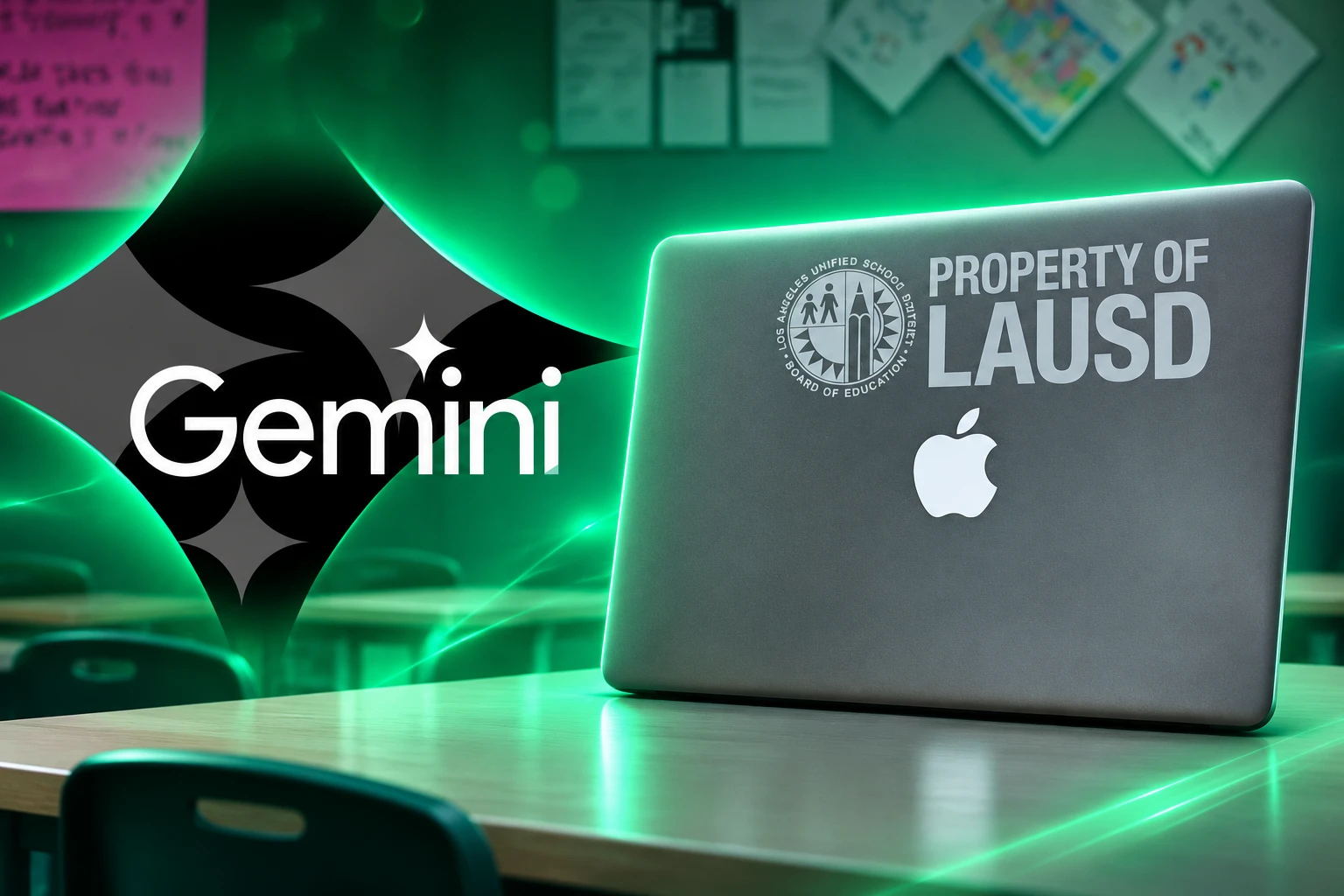
Los Angeles Unified blocked generative AI on student laptops and tablets on September 2, 2026, the same day New York announced its ban. The filter is Lightspeed on Chromebooks, with a matching tool on tablets. It covers an estimated 378,000 students. Pia Sadaqatmal, the district’s chief academic officer, said the aim was to keep “teaching and learning at the center” while the board’s new AI committee writes longer-term rules.
The district has already turned off Google’s AI Overviews for students. Jack Kelanic, the chief information officer, told the board’s AI committee the default search engine could be changed “literally overnight.”
Chicago Public Schools, with 304,687 students on its official 20th-day count for 2026-27, has asked Google for Search without the AI layer. If that deal cannot be reached, the district said it “will look to other search solutions.”
WHERE THE THREE DISTRICTS STAND
| District | Public position on Search | What is already in force |
|---|---|---|
| New York City Public Schools | Will explore other search options if Google does not reconsider | One-year student AI ban, 2-K through 8 |
| Los Angeles Unified | Evaluating whether Search belongs in class; default can move overnight | Generative AI blocked on district devices; AI Overviews off |
| Chicago Public Schools | Will look to other search solutions if Google will not unbundle | Asked Google for Search without AI features |
No district has named a replacement or set a cutover date. The threat is the point of leverage. Parents also protested at Google offices in New York, Chicago and Los Angeles in mid-November, which gave the three chiefs a crowd at the door while they bargained over a search box.
The Chromebooks Stay Even If Search Goes
Changing the default engine on a managed Chromebook is a policy click. Leaving Google is not. New York City announced a plan in September 2025 for 350,000 internet-enabled Chromebooks for students, enrolled through Google Management Console so the district’s settings follow every laptop. Those machines still open Classroom, Drive, Docs and Gmail if the address bar points somewhere else.
That is the collateral behind Google’s wager. A research task that asks a student to find and compare sources is different work from a tutor that walks the same student through a physics problem. Google is merging those tasks and still calling the result Search. Districts can reject the merge in the browser and keep the rest of the stack. They cannot reject the merge and keep Google Search.
Los Angeles already treats the address bar as the easy lever. Lightspeed can block a category of AI sites. It can also point Chrome at another engine. Classroom lesson flow, assignment turn-in and the device fleet stay on Google either way. The company can lose the search box in three giant districts and still sit on the hardware and the homework.
That is why a full Google-free exit is a different project from the one on the table. The public fight is about Search. The lock that matters is the laptop image and the learning app teachers already built their year around.
A Privacy Engine Is Pitching a No-AI Address Bar
DuckDuckGo moved the day after Phillips posted. Founder and chief executive Gabriel Weinberg pointed school IT staff to a setup guide and wrote, “get in touch for help.” The guide says the change uses ordinary device-management policies, with “no custom software or additional licensing,” and that it does not touch Classroom, Drive or Docs. For districts that want the chatbot layer out, it points the default at noai.duckduckgo.com, which turns off AI-assisted answers and AI-generated images.
Kamyl Bazbaz, DuckDuckGo’s chief public affairs officer, framed the opening as a monopoly test: “Forcing AI on school children: how a monopolist behaves when they think people are powerless. Prove Google wrong.” Microsoft Bing is on the same short list, because it already lets administrators switch off AI-generated answers.
The pitch only works if teachers will live with a different results page. Habit is Google’s remaining hold on the address bar. Quality arguments will be fought in the first week a ninth grader cannot find a primary source the way last year’s class did. That is a classroom problem, not a Chromebook problem, and it is the part of the bet Google still likes.
What City Hall Asked Google’s Chief
Speaker Julie Menin and Council Member Shekar Krishnan, who chairs the Committee on Oversight and Investigations, sent Pichai a letter on November 13, 2026. They asked for written answers by November 19, 2026. The first question is the whole dispute: will New York City students get Google Search without AI Mode, AI Overviews, or any new student-facing generative tools?
The City Council will not permit Google or any private firm to abuse its market power to force its products into classrooms, particularly those that utilize AI. No private company should have an outsized influence on the way our children are educated. Rather than giving more choice to our educators, as the company claims, this decision would force schools to embrace AI products in order to maintain access to the most widely used online search tool.
Julie Menin, New York City Council Speaker, and Shekar Krishnan, Council Member, joint statement
The letter uses YouTube Kids as the comparison. Google already ships a child version of a flagship product with features stripped out. Menin and Krishnan asked why Search cannot get the same treatment. They also asked what student data Gemini collects, where it is stored, and whether Google earns money from it, plus how the company measures false answers in class, including reported errors on the 2020 presidential election.
Rohit Chopra, California’s secretary of business and consumer services, said large tech firms should not “strong-arm schools.” Lina Khan, the former Federal Trade Commission chair, wrote that Google was trying to “coerce schools into adopting AI.” The legal theory is still a question, not a case. The product fact is not: Google has not offered the child-safe Search the council described.
Homework Help Now Comes With a Coach
Google’s answer to the shortcut fear is Guided Learning. On November 3, 2026, the company made it available worldwide in Classroom as a teacher-assigned study tool tied to class material. A Search pilot at select U.S. schools was set to start later in November 2026, then widen in the following months. Phillips wrote that when the system thinks a student has pasted a hard physics problem or asked for help on a book report, Search will prompt them through the work “without going directly to the answer.”
Google says its own studies found measurable learning gains from that coaching style. Laura Breen, a Google spokesperson, said the company hears “parents and teachers’ concerns about students using AI to shortcut learning” and shares the goal of helping students learn. Next year, she said, Gemini app, Gemini Notebook and Search will be off by default until schools choose what to enable.
That sentence is how Google wants the story told: defaults off, schools in control, a tutor instead of a cheat sheet. It still leaves Mamdani’s 2-K-8 ban with no Google Search that obeys it. In early 2027, leaders in New York, Los Angeles and Chicago will either turn Search on with AI inside it, or point the Chromebook bar at someone else and learn whether the search box was ever the thing that bound them to Google. Classroom, Drive and the management console will still be Google’s either way.

The Strip Bojangles That Charged $100 for 10 Minutes

The Security Fixes Took Microsoft and the NSA Offline

iOS 27 Finally Shrinks the Giant iPhone Lock Screen Clock

AirPods Pro 3 Are $179 Again, Below Last Year’s Cut

Dragon Returns ISS Samples Only It Can Bring Home

Microsoft 365 Auth Fault Took Down Exchange and Teams

OpenClaw 2.0 Ships a Team Workplace With Host-Trust Defaults

Xbox Caps Game Pass Cloud Gaming at 15 Hours

OpenAI Unveils GPT-6 Astra With a Critical Cyber Label

Squishy Dumpling Toys Recalled After Hiding Illegal Water Beads
-
 NEWS3 months ago
Microsoft 365 Auth Fault Took Down Exchange and Teams
-
 NEWS3 months ago
OpenClaw 2.0 Ships a Team Workplace With Host-Trust Defaults
-
 GAMING3 months ago
Xbox Caps Game Pass Cloud Gaming at 15 Hours
-
 NEWS3 months ago
OpenAI Unveils GPT-6 Astra With a Critical Cyber Label
-
 LIFESTYLE3 months ago
Squishy Dumpling Toys Recalled After Hiding Illegal Water Beads
-

 BUSINESS3 months ago
Diesel Breaks Its Record as the White House Claims Credit
-

 NEWS3 months ago
IFA 2026’s Weird Gadgets Are Building a Sensor Home
-

 BUSINESS3 months ago
ChargePoint Stock Rally Prices Wilmer’s Three-Year Cash Plan