
NEWS
Farmers Found China’s 50-Centimeter D-rex Fungus First
Farmers in Yunnan photographed and tasted Dianjunus rex before botanists named the 50-centimeter fungus and built a new family around it.

Kunming botanists have named Dianjunus rex, a Yunnan fungus whose spore towers reach 50 centimeters (20 inches) and 2.2 kilograms (4.9 pounds). Farmers had already sent photos and taken a bite, and the institute then had to erect a new family, Dianjunaceae, to hold it.
The paper in Frontiers in Fungal Biology, published on 29 September 2026, calls those towers the largest fruiting bodies documented in Ascomycota, the sac fungi. A Kenyan bamboo fungus cited in the same study still outweighs them.
Farmers Sent Photos, Then Took a Bite
In 2024, Indunil C. Senanayake, an associate professor at the Germplasm Bank of Wild Species at the Kunming Institute of Botany, was surveying fungi in a Yunnan rainforest when local farmers sent photographs of an odd pale growth. Some of the farmers who had found it took a bite. The tipster, she said, “wanted to confirm whether it was edible or not.”
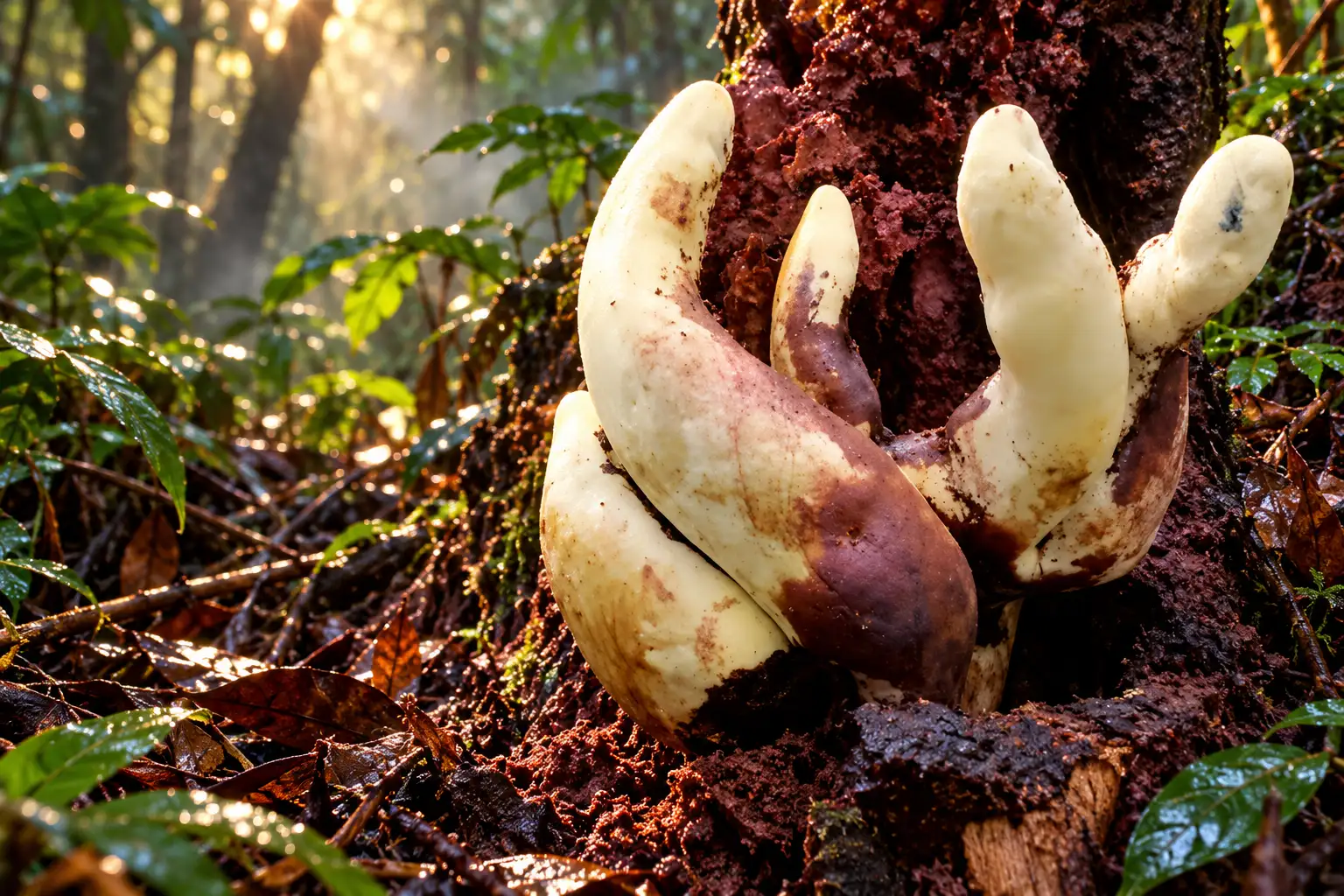
When the team reached the trees, they found yellowish, tentacle-like and spatula-like bodies coming off decaying roots, not caps on stems. Jing Song collected the holotype on 5 August 2024 at Damaidi, in Luquan Yi and Miao Autonomous County near Kunming, on roots of Chinese cork oak (Quercus variabilis). Senanayake took a paratype at the same place on 6 September 2024. Surveys from August 2024 to July 2025 added material from temperate forest near Yipinglang and tropical rainforest near Nanbang.
Fuqiang Yu of the same institute led the group with collaborators at Chiang Mai University, Colegio de Postgraduados in Mexico, Yunnan Minzu University, Yunnan Agricultural University, and Qujing Normal University. They deposited vouchers in the Kunming fungarium under HKAS numbers and grew ascospores on laboratory media. The living fungus had been obvious to people who walk those woods. It had no scientific name, no genus, and no family.
A Black Stalk and a Powdery Head
Dianjunus rex does not make a mushroom. It builds stromata, compact spore-bearing bodies, that stand upright and stay fleshy instead of turning into the hard black crusts typical of its order, Xylariales. A persistent powdery coat is whitish when young and dark yellow at maturity, over a black crust. The top is blunt. Finger-like branches can grow from it. Inside, the flesh is solid and spongy.
WHAT THE 50-CENTIMETER BODY IS MADE OF
- Total height: Stromata stand 20 to 50 centimeters tall, counting the buried portion.
- Fertile head: The aerial spore-bearing part is 10 to 20 centimeters high and 7 to 10 centimeters across, sometimes to 15 centimeters.
- Buried stalk: A long black stipe, 20 to 30 centimeters, roots in soil around host roots.
- Usual mass: The Chinese Academy of Sciences team reported that most specimens weighed 250 to 600 grams.
- Record mass: One two-lobed specimen reached 2.2 kilograms, the figure that travelled with the name D-rex.
Ascomycetes, with more than 64,000 named species, release spores from tiny sacs in or on those bodies rather than from gills. Relatives such as candlesnuff fungus and dead-man’s-fingers make fruiting bodies only a few centimeters tall. D-rex uses the same basic plan at a different scale, and a large share of that scale is underground, which is easy to miss if you are looking for a cap on the leaf litter.
Why a Knee-High Fungus Had No Scientific Name
Yunnan is not an unstudied corner of China. The Kunming Institute of Botany sits in the province. Modern collecting there goes back to the late nineteenth century, and the last 45 years have been busy. Senanayake still said fungal diversity in these woods has been underestimated because field sampling is hard, fruiting is seasonal and easy to miss, and surveys have leaned toward fungi with a market.
A pale lump on cork oak roots does not look like a porcini. Mushroom hunters clock caps, and a knee-high woody tower with a black stipe in the soil does not match that search image. Torda Varga, a mycologist at the Royal Botanic Gardens, Kew, who was not on the paper, put the gap more sharply.
What I find particularly remarkable is that a fungus with such an enormous fruiting body appears to have remained scientifically undocumented until now.
Torda Varga, mycologist, Royal Botanic Gardens, Kew
He added that his own work has mostly been in Europe, and that some truffle species get close in bulk. The point holds in Yunnan anyway: size did not get D-rex onto a list. DNA work on a root-zone seasonal stroma did.
A 3.2-Kilogram Rival on Kenyan Bamboo
The authors write that the stromata of D. rex are the largest fructifications documented in Ascomycota. Their own comparison species is Engleromyces goetzei, a two-lobed fungus that sits on bamboo. In a 1962 account from North Kenya by Gibson and Kimeria, those stromata reached a diameter of nearly 30 centimeters and a weight of about 3.2 kilograms, growing toward the tops of bamboo stems some 30 to 40 feet off the ground. Senanayake has used the same Kenyan figures when describing the old mark.
The Frontiers press release on 13 October 2026 framed the old ascomycete record as fruiting bodies 20 to 30 centimeters tall, which makes 50 centimeters a clear height jump. Mass is a different contest. The 2.2 kilogram Yunnan specimen is one two-lobed body. The Kenyan fungus is heavier.
HOW THE SIZE CLAIM SPLITS
| Fungus | Shape | Main measure | Mass | Setting |
|---|---|---|---|---|
| Dianjunus rex | Upright fleshy stromata | 20 to 50 cm tall | 250 to 600 g typical; 2.2 kg one two-lobed body | Yunnan, oak roots |
| Engleromyces goetzei | Subglobose, two-lobed | Nearly 30 cm across | About 3.2 kg | North Kenya, bamboo culms |
| Candlesnuff and dead-man’s-fingers | Small Xylariales stromata | A few centimeters tall | Grams | Dead wood, wide range |
Height, width, and weight are not one ranking. D-rex is the tall upright ascomycete in this comparison. E. goetzei remains the heavier stroma the paper itself put on the page. Neither number describes the whole underground fungus, only the spore tower.
DNA Forced a New Family in Xylariales
Field looks were not enough. The team sequenced four gene regions, ITS, LSU, RPB2, and TUB2, and ran whole genomes from three collections. Multilocus trees used 202 strains. A genome-scale tree placed the three new assemblies with 63 other fungi. Every analysis put the Yunnan fungus on its own branch, a sister clade to Graphostromataceae. The nearest named relative in the press materials is Graphostroma platystoma, a hardwood species of the northern hemisphere that is, by itself, that family.
Morphology backed the split. Ascospores carry an S-shaped germ slit. The ascus tip has an inverted-trapezoid ring that turns blue in Melzer’s reagent. The asexual stage is nodulisporium-like, with periconiella-like branching. Those traits, plus the fleshy pale stromata, do not match the 16 families already sitting in Xylariales in the authors’ account. They named a family Dianjunaceae, a genus Dianjunus, and the species Dianjunus rex. Dian recalls the ancient Dian kingdom in present-day Yunnan; jun is Chinese for fungus; rex is Latin for king.
FROM ROOT TO NAME
- 5 August 2024: Jing Song collects the holotype, HKAS148941, on Chinese cork oak roots at Damaidi.
- 6 September 2024: Senanayake collects the paratype, HKAS148942, at the same site.
- August 2024 to July 2025: The team samples temperate forest near Damaidi and Yipinglang and tropical rainforest near Nanbang.
- 29 September 2026: Frontiers in Fungal Biology publishes the names and the trees.
Senanayake called the species “a rare window into the evolution of extreme fungal body forms” and said the find shows how much fungus diversity remains to be described in East Asian forests. The open paper describes upright stromata up to 50 cm high and the family that holds them. A nickname, D-rex, followed the Latin. The taxonomy is the family, not the nickname.
About 6,000 of Yunnan’s Fungi Have Names
Bang Feng and Zhuliang Yang, also at the Kunming Institute of Botany, reviewed higher fungi in Yunnan in Plant Diversity in 2018. The province covers about 394,000 square kilometers, and about 84% of it is mountainous, from 76.4 meters above sea level in the south to 6,740 meters in the north. They counted 17,427 vascular plant species. Using David Hawksworth’s long-used ratio of about six fungal species per vascular plant, they expected about 104,000 fungi in Yunnan, including lichens. About 6,000 fungal species had been reported, among them about 3,000 higher fungi. That ledger, they wrote, means 95% of fungal species in Yunnan are likely still undocumented.
YUNNAN’S FUNGAL LEDGER
- Named so far: About 6,000 fungal species have been reported from the province.
- Expected total: About 104,000 fungal species, on a six-to-one ratio with 17,427 vascular plants.
- Still off the list: Feng and Yang put the gap at 95%.
- The setting: 394,000 square kilometers, about 84% mountains, two hotspot edges in the northwest and the south.
D-rex does not prove that every missing name is a 50-centimeter tower. It does show that the unnamed remainder is not only yeasts and moulds on a slide. A spore body you could trip over can sit in that 95% if it fruits from dying oak roots in a short season and does not look like the mushrooms people pick.
The Family Split After the Dinosaurs Died
A molecular-clock analysis put the origin of Dianjunaceae in the early Paleocene, about 65 million years ago, roughly one million years after the Cretaceous-Paleogene extinction. The paper notes that an estimated 75% of plant and animal species died in that event. Senanayake tied the date to dead wood.
This timing raises an intriguing possibility. After the mass extinction, forests experienced dramatic changes, including the sudden availability of large amounts of dead plant material. For wood-associated decomposing fungi, such environmental disruption may have created new ecological opportunities.
Indunil C. Senanayake, associate professor, Kunming Institute of Botany, Frontiers news release
She also said that in the dark, cold years after the impact, fungi that break down dead matter could keep working better than plants that need light. That is a hypothesis about a family split, not a claim that today’s D-rex stood in a Paleocene forest. The living fungus is a new collection. The date is the node that separates Dianjunaceae from Graphostromataceae.
Xylariales are known for secondary compounds and for enzymes that cut complex plant molecules, and the press materials suggest D-rex may use a similar kit on dead wood. The genomes complicate that picture. Three sequenced strains carry 220, 224, and 219 carbohydrate-active enzyme genes. Related wood-rot genera run much higher, Xylaria at 535 to 635 genes, Daldinia at 458 to 496, Hypoxylon at 423 to 577. The paper calls this the most severe species-wide CAZyme contraction on its tree, a cut by more than half, with pectin lyases almost gone. A giant spore tower does not require a giant enzyme list. Why the stromata run so tall is still open. Senanayake’s working idea is wind: a body that clears floor debris may shed spores farther, and that cost in tissue only pays in some forests.
Varga has suggested hunting environmental DNA for other members of the family when no stroma is standing. Farmers in Yunnan did the first sort with a camera and a taste test. The name came later, on 29 September 2026, for a fungus that had been heavy enough to bite and still light enough, as a record, to leave a heavier rival on Kenyan bamboo.
Frequently Asked Questions
When Was Dianjunus Rex Formally Named?
The names Dianjunaceae, Dianjunus, and Dianjunus rex were published on 29 September 2026 in Frontiers in Fungal Biology and registered in Index Fungorum as IF904757 (family), IF904733 (genus), and IF904732 (species). Jing Song and Zhuyue Yan are equal first authors; Senanayake and Fuqiang Yu are the corresponding authors. The ex-type culture is GBWSCC202508860, with a dried culture stored as HKAS151626.
Is Dianjunus Rex the Largest Fungus Ever Found?
No. The authors’ claim is the largest documented fruiting bodies in Ascomycota, and it is strongest as a height record at 50 centimeters. Engleromyces goetzei can weigh about 3.2 kilograms and, in the 1962 Kenyan account, grew 30 to 40 feet up bamboo, so mass and placement are different contests. Colony size in other groups, and truffle bulk that Varga noted, sit outside this ranking.
What Tree Does Dianjunus Rex Grow On?
The holotype, HKAS148941, was taken on roots of Chinese cork oak, Quercus variabilis, at Damaidi in Tuanjie Town, Luquan Yi and Miao Autonomous County, Kunming. Senanayake said the stromata grew on woody roots of that oak and emerged from the rhizosphere, the soil around the roots. Other collections came from decaying roots at the Yipinglang and Nanbang sites; the paper treats hosts as dying trees and that root zone, not as a mushroom on living trunks.
Why Did D-rex Get Its Own Fungal Family?
Four-locus trees and three genomes placed it beside Graphostromataceae without putting it inside that family, and the microscope added characters Xylariales did not already combine: an S-shaped germ slit, an inverted-trapezoid amyloid ascus ring, and a nodulisporium-like asexual stage with periconiella-like branching. The three genome assemblies are 31.09 Mb, 32.01 Mb, and 30.48 Mb. That package, not the nickname D-rex, is what forced Dianjunaceae.

Xiaomi 18 Pro Goes Global as Its Privacy Filter Falters

iFixit Finds HomeView Glued Shut After Repair Gains

Polymetallic Nodules Shelter 4,139 Animals Miners Want

One UI 9.5 Puts Now Brief Behind a System Agent

Framework’s $99 Keyboard Brings Laptop Repair to the Couch

Microsoft 365 Auth Fault Took Down Exchange and Teams

OpenClaw 2.0 Ships a Team Workplace With Host-Trust Defaults

Xbox Caps Game Pass Cloud Gaming at 15 Hours

OpenAI Unveils GPT-6 Astra With a Critical Cyber Label

Squishy Dumpling Toys Recalled After Hiding Illegal Water Beads
-
 NEWS3 months ago
Microsoft 365 Auth Fault Took Down Exchange and Teams
-
 GAMING3 months ago
Xbox Caps Game Pass Cloud Gaming at 15 Hours
-
 NEWS3 months ago
OpenClaw 2.0 Ships a Team Workplace With Host-Trust Defaults
-
 NEWS3 months ago
OpenAI Unveils GPT-6 Astra With a Critical Cyber Label
-
 LIFESTYLE3 months ago
Squishy Dumpling Toys Recalled After Hiding Illegal Water Beads
-

 BUSINESS3 months ago
Diesel Breaks Its Record as the White House Claims Credit
-

 NEWS3 months ago
IFA 2026’s Weird Gadgets Are Building a Sensor Home
-

 BUSINESS3 months ago
ChargePoint Stock Rally Prices Wilmer’s Three-Year Cash Plan