
NEWS
Microsoft’s $36.6 Billion Quarter Still Needs 60,000 Exits
Microsoft posted $36.6 billion in profit in a quarter when capital spending hit $45.2 billion, then offered buyouts to about 60,000 staff.

Microsoft profits for the September quarter hit $36.6 billion (£27.5 billion) two days after the company invited about 60,000 staff to leave.
Revenue for the three months ended September 30 rose 19% to $92.3 billion. Capital spending in the same stretch reached $45.2 billion, more than the profit, as Azure demand stayed larger than the chips and data centers the company can turn on.
$36.6 Billion Profit Meets a Larger Capital Bill
Microsoft’s first-quarter results for fiscal 2027, released on October 28, put operating income at $45.9 billion, up 21%. GAAP net income rose 32% to $36.6 billion, and diluted earnings per share rose 32% to $4.92.
Those GAAP gains include a $207 million net gain on the company’s OpenAI stake, against a $3.1 billion OpenAI loss in the year-ago quarter. On Microsoft’s non-GAAP measure, which strips that stake out, net income was $36.4 billion, up 18%, and earnings per share were $4.89, also up 18%.
THE SEPTEMBER QUARTER IN FIVE LINES
| Line | Amount | Change |
|---|---|---|
| Revenue | $92.3 billion | +19% |
| Operating income | $45.9 billion | +21% |
| GAAP net income | $36.6 billion | +32% |
| Microsoft Cloud | $63.9 billion | +30% |
| Azure | $33.2 billion | +48% |
Chief financial officer Amy Hood told analysts capital spending was $45.2 billion after some third-party capacity that had been expected in the quarter arrived late. Roughly three-quarters of that bill went to short-lived assets, mainly CPUs and GPUs, plus higher memory and storage costs. She still guided the next quarter’s capital spending above $50 billion and put calendar 2026 spend at about $170 billion.
The company also sent $10.2 billion back to shareholders as dividends and buybacks in the quarter. Satya Nadella, chairman and chief executive, framed the print as customers taking the stack, not as a pause in hiring or in spend.
We are delivering greater capability, choice, control, and cost efficiency for customers across our entire stack. By helping organizations build and own their own intelligence, and earning trust through agent safety and security, we are translating our innovation into growing adoption and real-world impact across every industry.
Satya Nadella, chairman and chief executive, Microsoft earnings release
Hood said results beat the company’s own expectations on revenue, operating income, and earnings per share. The beat sat beside a cost structure that no longer flexes first on chips. Those have to be ordered, delayed, and depreciated. Headcount is the line that can still be invited to walk.
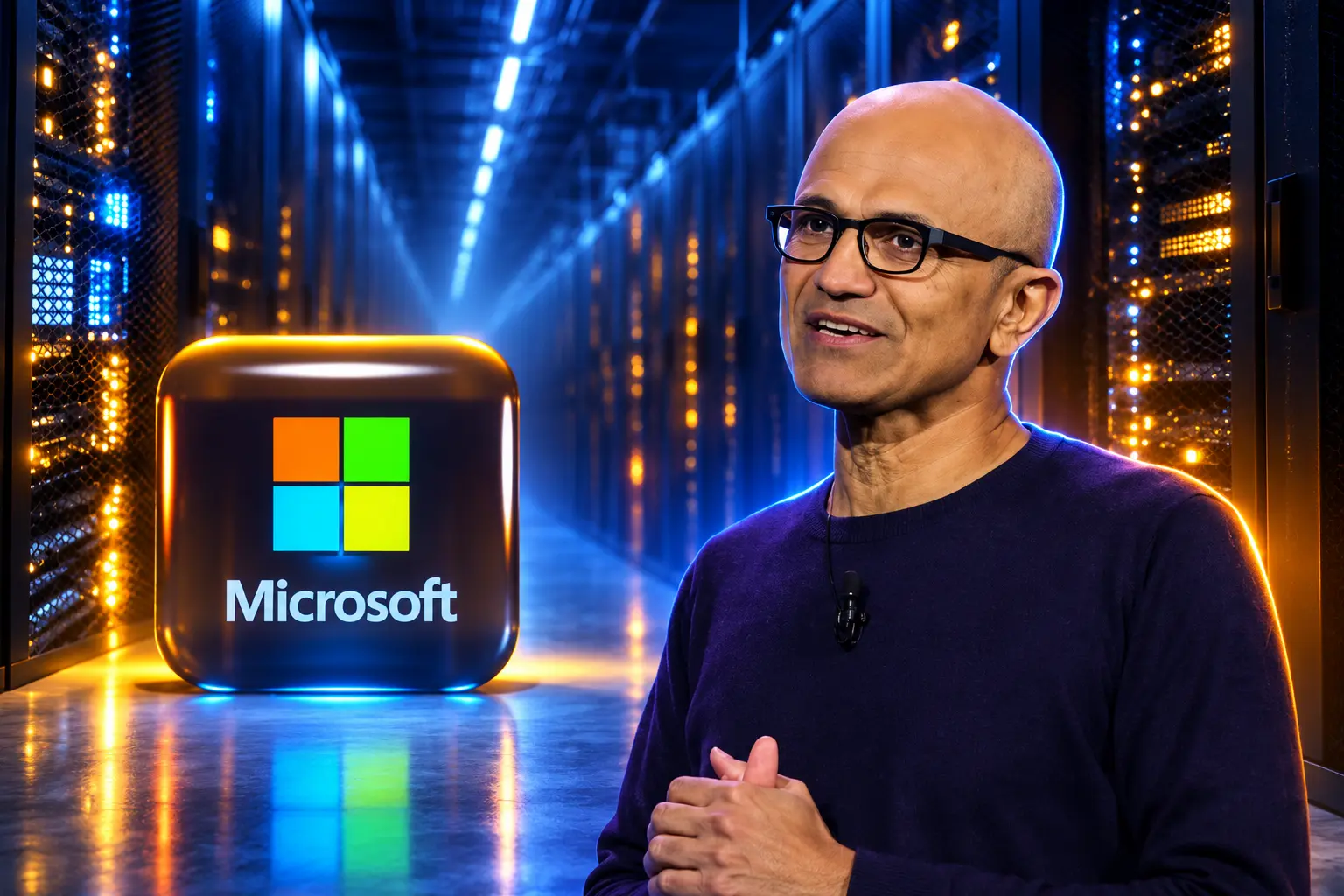
Azure Finally Shows Its Size in Dollars
For the first time Microsoft put a dollar figure on Azure, and earnings tables put the unit at $33.2 billion for the quarter, up 48%. Microsoft Cloud, the broader enterprise bundle, reached $63.9 billion, with growth accelerating to 30%, or 31% in constant currency.
CLOUD DEMAND ON THE BOOKS
- Azure dollars: $33.2 billion of revenue, the first time Microsoft has disclosed the unit in cash terms rather than as a growth rate only.
- Azure growth: 48% year over year, and Hood guided the next quarter to 49% to 50% in constant currency.
- Cloud bundle: Microsoft Cloud revenue of $63.9 billion, up 30%.
- Backlog: Commercial remaining performance obligation of $677 billion, up 73%.
That backlog is contracted work still to be recognized, and it is the number that lets Redmond keep ordering GPUs while it trims other costs. Hood guided next-quarter revenue to $96 billion to $97.1 billion, or 18% to 19% growth, which assumes the same cloud engine keeps paying.
The company now reports in two segments. Agents and Infra, which holds Azure and the rest of the enterprise stack, took in $76.8 billion, up 25%. That is where the profit and the capital bill both live, and it is also where the argument about people versus machines is being settled.
A Voluntary Exit Opened to 60,000 Staff
On October 26, two days before the print, chief people officer Amy Coleman told employees Microsoft was introducing a voluntary exit offer to eligible staff. The pool is about 60,000 people, more than a quarter of the 223,000 full-time employees in June, when the annual filing counted 121,000 in the United States and 102,000 abroad.
That 60,000 figure is the number who may take the package, not the number who will. Coleman’s note never promised a headcount target. It offered money and career-planning help to people already thinking about leaving, and it gave managers another tool for “changing needs.”
FROM JULY CUTS TO A DECEMBER DECISION
- July 6, 2026: Microsoft eliminates around 4,800 roles, about 2.1% of the global workforce, and says more than 30% of staff eligible for a voluntary retirement program took that earlier deal.
- October 26, 2026: Coleman opens the Voluntary Exit Offer to eligible employees at level 70 and below in Canada, India, the United Kingdom and the United States.
- October 28, 2026: The company reports $92.3 billion of revenue and $36.6 billion of GAAP net income for the quarter ended September 30, and shares rise 2.9% in after-hours trading.
- December 1, 2026: Eligible staff in India have a reported decision date, with a last working day of December 31 for those who accept.
The earlier retirement program was smaller and aimed at longer-serving people. Coleman said this new offer is untested: “The Voluntary Exit Offer is new for us. We’ll learn from it.” If take-up is light, the company still has a list of people it has already told they are optional. If take-up is heavy, the June payroll of 223,000 shrinks without a classic layoff round.
The bind for anyone who got the email is blunt. Take money and hunt in a tough tech market, or stay after the company has priced a life without you. That is a worse choice than the memo’s language of flexibility admits, and it is the choice that sits under a record quarter.
Who Can Take the Package and Who Cannot?
Eligible staff at level 70 and below on participating teams in Canada, India, the United Kingdom and the United States can take the package. Copilot, Xbox, Windows, finance and HR are among the groups in the pool. Data center and sales teams have been described as excluded, and how many people will accept is still unknown.
THE POOL AND THE EXCEPTIONS
- The countries: Canada, India, the United Kingdom and the United States, on participating teams only.
- The level cap: Internal level 70 and below, which reaches senior directors and general managers and stops short of corporate vice presidents.
- Teams described as in: Copilot, AI experiences, Xbox, Windows and Devices, finance and human resources.
- Teams described as out: Data centers, sales, marketing, security and quantum computing, plus some engineering groups.
The pattern matches the P&L. People who rack GPUs and sell the cloud are protected. People who build Copilot, ship Windows, make games, or run the corporate center are being asked if they would like to go. Capital spending cannot be paused for a missing GPU delivery. A product manager can.
This offer gives eligible employees who may be considering a future outside the company a new choice to make that transition now with support. It also gives participating organizations another way to adapt their workforce to changing needs.
Amy Coleman, chief people officer, company blog
Package math is local. Offer letters described to US staff at level 64 and below run at one week of base pay for every six months of service, with richer terms at higher levels and a common cap around 39 weeks. Indian staff have been told of about one month of base pay per completed year, plus health cover and career help. Microsoft’s public blog states only “financial support and career planning resources,” so the fine print lives in those emails, not in the memo.
July Already Cut 4,800 Roles
The October offer is the second act of a year in which Microsoft has been shrinking people while it grows machines. On July 6, Coleman told staff the company was eliminating around 4,800 roles, about 2.1% of the global workforce, mostly in commercial groups and Xbox, and that four gaming studios would move to new management.
She also said more than 30% of employees eligible for the then-recent voluntary retirement program had taken it, and that more than 4,000 people had been moved into new jobs over the prior year, including 500 that month. The July note tried to draw a line the October note no longer draws as cleanly.
“I also want to be direct that the roles eliminated today are not being replaced by AI,” Coleman wrote in July, while adding that AI is changing how work gets done and that some daily tasks can now be automated. Three and a half months later, the company is inviting a pool larger than a quarter of the June payroll to leave as it funds the same shift.
July was a classic cut with a number attached. October is a volunteer round with a much larger eligible list and no stated target. The through-line is that Redmond now treats headcount as a dial it can turn between earnings prints, even when the prints are strong.
Windows OEM and Devices Sales Fell 22%
The other reason Windows and Xbox sit inside the exit pool is that those businesses shrank in the quarter the cloud paid the bill. Devices and Consumer revenue was $15.5 billion, down 3%. Windows OEM and Devices revenue fell 22%. Xbox content and services revenue fell 2%.
Search and advertising revenue, excluding traffic acquisition costs, rose 12%, and Microsoft 365 commercial cloud revenue rose 17% as reported, or 18% on the company’s adjusted basis. Consumer Microsoft 365 cloud rose 17%. The old PC-and-games company is still inside the filing, and it is no longer carrying growth.
That split is why a profitable quarter can still produce an exit memo. Azure and Microsoft 365 are hiring in the form of GPUs, leases, and remaining performance obligation. Windows hardware and Xbox are the businesses whose people are being offered a door. The new two-segment layout makes the same point in cleaner math: $76.8 billion of Agents and Infra, up 25%, beside $15.5 billion of Devices and Consumer, down 3%.
Alphabet Grew Fast and Still Lost the Week
The same Wednesday, Google’s parent published a very large quarter that the market nevertheless punished. Alphabet’s published third-quarter earnings figures showed revenue of $127.6 billion, up 25%, and operating income of $40.6 billion, up 30%. Net income available to common stockholders fell 25% to $26.2 billion, and diluted earnings per share fell to $2.12 from $2.87. Shares dropped 9.75% in after-hours trading.
Google Cloud revenue, on Alphabet’s own slides, rose 103%. The miss sat in advertising and in a swing to $8.2 billion of net other expense, against $12.8 billion of other income a year earlier. Investors did not object to AI spend as an idea on October 28. They objected to spend that showed up without a profit beat attached.
TWO PRINTS, TWO VERDICTS
| Company | Revenue | Net income | After-hours shares |
|---|---|---|---|
| Microsoft | $92.3 billion, +19% | $36.6 billion, +32% | +2.9% |
| Alphabet | $127.6 billion, +25% | $26.2 billion, -25% | -9.75% |
Microsoft’s reward was the 48% Azure print, the $677 billion commercial backlog, and a GAAP profit that still grew after a $45.2 billion capital bill. Alphabet’s penalty was a profit drop and an ads miss on the same AI-spend week. The people inside Microsoft are being asked to fund the difference with a choice to leave.
Eligible staff in India have until December 1 to decide, with exits dated December 31 for those who take the money. Hood has already told analysts the next quarter’s capital bill will be larger still. The profit landed. The emails did too.
Disclaimer: This article is news reporting on Microsoft’s published results and workforce program and is for information only. It is not investment advice, a recommendation to buy or sell any security, or a forecast of Microsoft’s or Alphabet’s future share prices. Readers who are considering an investment decision should consult a licensed financial adviser who can review their own circumstances. Figures and program details are those in the company releases and filings named above and may change with later documents, uptake of the exit offer, and market moves.

Xiaomi 18 Pro Goes Global as Its Privacy Filter Falters

iFixit Finds HomeView Glued Shut After Repair Gains

Polymetallic Nodules Shelter 4,139 Animals Miners Want

One UI 9.5 Puts Now Brief Behind a System Agent

Framework’s $99 Keyboard Brings Laptop Repair to the Couch

Microsoft 365 Auth Fault Took Down Exchange and Teams

OpenClaw 2.0 Ships a Team Workplace With Host-Trust Defaults

Xbox Caps Game Pass Cloud Gaming at 15 Hours

OpenAI Unveils GPT-6 Astra With a Critical Cyber Label

Squishy Dumpling Toys Recalled After Hiding Illegal Water Beads
-
 NEWS3 months ago
Microsoft 365 Auth Fault Took Down Exchange and Teams
-
 GAMING3 months ago
Xbox Caps Game Pass Cloud Gaming at 15 Hours
-
 NEWS3 months ago
OpenClaw 2.0 Ships a Team Workplace With Host-Trust Defaults
-
 NEWS3 months ago
OpenAI Unveils GPT-6 Astra With a Critical Cyber Label
-
 LIFESTYLE3 months ago
Squishy Dumpling Toys Recalled After Hiding Illegal Water Beads
-

 BUSINESS3 months ago
Diesel Breaks Its Record as the White House Claims Credit
-

 NEWS3 months ago
IFA 2026’s Weird Gadgets Are Building a Sensor Home
-

 BUSINESS3 months ago
ChargePoint Stock Rally Prices Wilmer’s Three-Year Cash Plan