
NEWS
An Ancient Chimp Virus Silenced a Gene Humans Still Use
Chimpanzees carry viral DNA that shuts LINC00662, a brain RNA humans still use and cancer labs already flag as an oncogene.

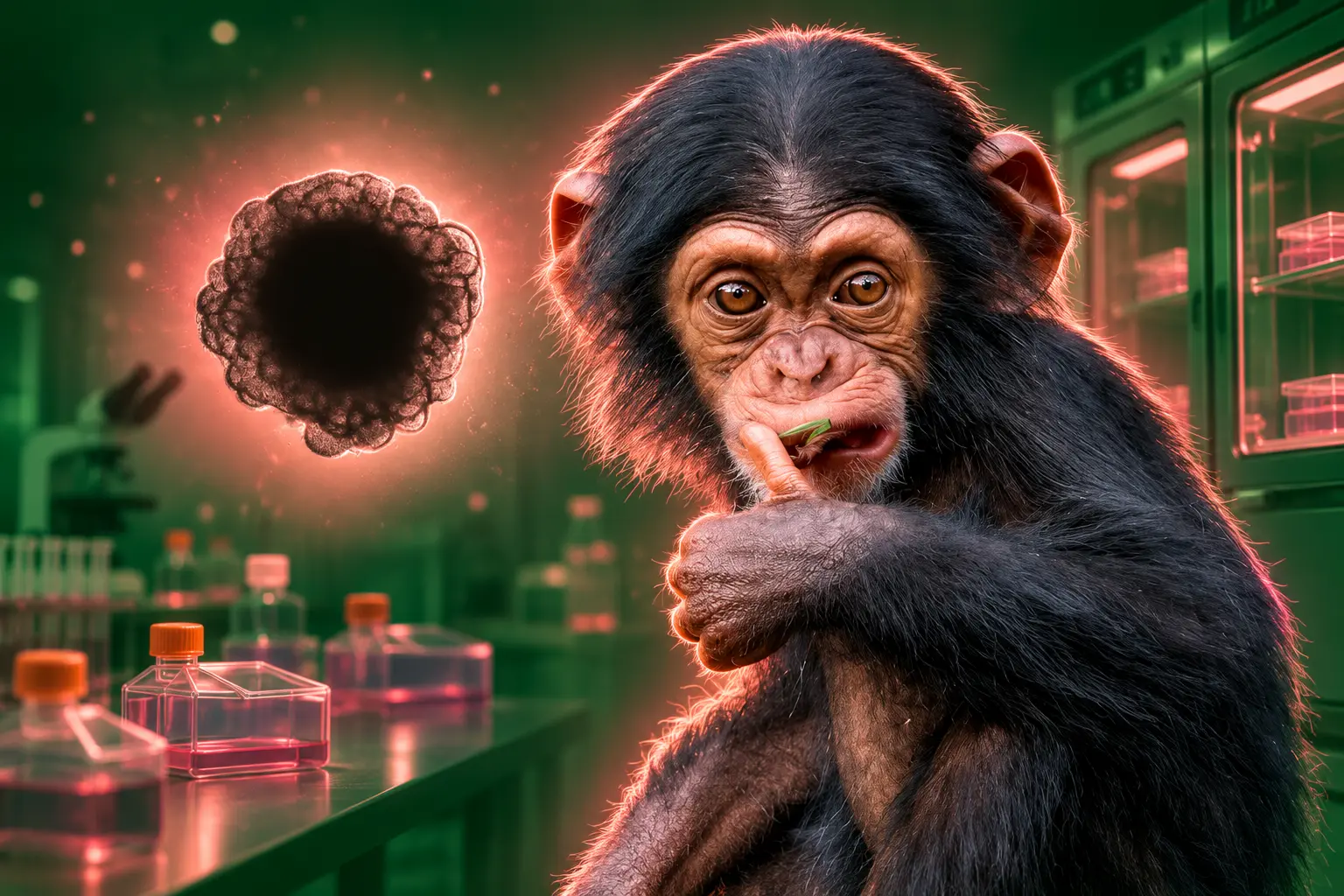
A 6,915-nucleotide remnant of an ancient retrovirus sits in a chimpanzee intron and keeps the brain RNA LINC00662 switched off. Humans still make that RNA during early brain growth because the viral insert is missing from our genome.
On October 23, 2026, Lund University scientists reported in Science Advances that cutting the viral DNA out of chimpanzee stem cells switches the RNA back on.
A 6,915-Base Insert Sits Inside a Chimpanzee Intron
LINC00662 is a long noncoding RNA on chromosome 19. It does not code for a protein. The human and chimpanzee versions of the locus look alike until you reach the first intron, where the ape genome carries a 6,915-nucleotide copy of PTERV1, Pan troglodytes endogenous retrovirus 1, on the negative strand.
Patricia Gerdes, a postdoc in molecular neurogenetics at Lund, and Johan Jakobsson, professor of molecular neurogenetics there, led the work with co-authors including genome scientist Evan Eichler. They grew unguided neural organoids from human and chimpanzee stem cells, then compared gene activity and DNA methylation, the chemical tags cells use to silence DNA.
LINC00662 was strongly on in the human organoids and off in the chimpanzee ones. Methylation on the viral insert had spread into neighboring DNA, including the LINC00662 region, which is not tagged that way in human brain cells. The paper reports that PTERV1 copies in chimpanzee neural tissue form over 150 methylated viral insertions with the potential to change how nearby genes are used.
Jakobsson put the gap in regulation, not in the gene list.
The virus we investigated specifically affected chimpanzees. Yet humans and chimpanzees have largely the same genetic makeup. That is why it is important to understand the differences in how genes are regulated. Our findings suggest that one gene, LINC00662, plays a significant role in early human brain development.
Johan Jakobsson, Professor of Molecular Neurogenetics, Lund University
African Apes Caught a Virus Humans Never Did
PTERV1 is not a human fossil. In 2005, Chris Yohn, Zhaoshi Jiang, Eichler and colleagues described a gammaretrovirus family that had bombarded chimpanzee and gorilla genomes independently and was also present in Old World monkeys, while humans and Asian apes showed no signal. Full-length copies they inspected were riddled with stop codons and could no longer replicate.
The 2026 paper places PTERV1 infections in African ape ancestors about 5 to 7 million years ago, the same window as the human-chimpanzee split, and finds only a single shared insertion between the chimpanzee and gorilla lineages. The LINC00662 insert is present in chimpanzees and bonobos and absent in humans, which puts it after that split and before chimpanzees and bonobos diverged, a window Gerdes estimated at about 1.5 to 5 million years ago.
Gorilla and macaque genomes are missing a stretch of about 300 kb that contains LINC00662 at all. Orangutans keep the locus but carry a LINE-1 insertion nearby rather than PTERV1. The viral family hit African apes. This particular brain-gene casualty is a chimpanzee-bonobo event.
THE PTERV1 FILE
- 25 to 35 million years ago: Last major wave of endogenous retrovirus activity on the human lineage, according to the 2005 comparative analysis.
- 5 to 7 million years ago: Human and chimpanzee lineages split; PTERV1 is active in African ape ancestors and absent from humans.
- 1.5 to 5 million years ago: The 6,915-nucleotide insert lands in LINC00662 in the chimpanzee-bonobo ancestor.
- 2005: Yohn, Jiang, Eichler and colleagues name PTERV1 and show it is missing from humans and Asian apes.
- June 22, 2007: Shari Kaiser, Harmit Malik and Michael Emerman report that human TRIM5α blocks a rebuilt PTERV1 core.
- October 23, 2026: Gerdes, Jakobsson, Eichler and colleagues publish the organoid and CRISPR results in Science Advances.
The 2026 paper notes that the original pandemic likely hurt fitness and population size in ancestral chimpanzees, and that the lack of PTERV1 in humans could mean different habitat, or resistance in germline cells, or both.
Cutting the Viral DNA Turns LINC00662 Back On
Correlation is cheap in genomes stuffed with old viruses. The Lund group deleted the PTERV1 sequence from chimpanzee induced pluripotent stem cells with CRISPR-Cas9. LINC00662 came back on. Gerdes spent about two years getting chimpanzee organoids stable enough for the comparison, which they ran at day 15, when the two species’ cultures still look broadly similar in cell type.
THREE TESTS IN THE DISH
| Experiment | Cells | Result |
|---|---|---|
| Compare organoid RNA | Human vs chimpanzee, day 15 | LINC00662 on in human, off in chimpanzee |
| Delete PTERV1 with CRISPR | Chimpanzee stem cells | LINC00662 expression returns |
| Silence LINC00662 with CRISPRi | Human organoids, day 30 | TUJ1 staining falls in the neurite-rich zone; organoid growth and cell-type mix stay similar |
Gerdes stated the causal point without dressing it up.
This shows that it is in fact the viral insertion that is responsible for the gene being switched off in chimpanzees.
Patricia Gerdes, Postdoc in Molecular Neurogenetics, Lund University
Restoring a transcript in cultured ape cells shows the insert can silence that transcript. It does not show that a Pleistocene infection steered the course of human intelligence, and a dish is a poor stand-in for a fetal brain inside a skull.
What LINC00662 Does in a Developing Human Brain
The team also asked what the RNA is doing where it is still on. Gerdes said LINC00662 is active in human fetal brain samples in early development, with expression highest at about 10 to 12 weeks after conception, and that it is on across several cell types in the human organoids. In human forebrain progenitor cells, the RNA binds proteins involved in axon extension and neuronal development.
When they turned LINC00662 down in human organoids and grew them to day 30, staining for TUJ1, a marker of young neurons and their fibers, fell in the neurite-rich intermediate zone. Organoid size and the mix of cell types did not shift in a matching way. Single-nucleus RNA sequencing picked up higher, not lower, activity in some genes tied to axon growth and dendrite development, which Gerdes described as a possible compensatory response to impaired neurite growth.
Jason Shepherd, professor of neurobiology at the University of Utah, who was not on the paper, said the result helps explain how humans can differ from chimpanzees while holding almost the same protein-coding gene set, because outside infections can change how those genes are used. Welkin Johnson, professor of biology at Boston College, also not involved, called endogenous retroviruses a real force in evolution and added that he was not sure he knew of another case this clean between humans and chimps. Neither of them claimed the RNA accounts for language, brain volume, or culture.
Cancer Papers Already Treat This RNA as an Oncogene
Keep LINC00662 on, and you keep a molecule that tumor biologists have been chasing for years. A 2022 review by Chenming Zhong and colleagues in the Journal of Cellular Physiology found LINC00662 expression raised in at least 14 tumors, tied to worse outlook and to resistance to radiation and chemotherapy. The RNA can act as a sponge for at least eight microRNAs and has been placed on ERK, Wnt/β-catenin, Hippo, and SMD pathways.
WHAT TUMOR STUDIES ALREADY SHOW
- Glioma: High LINC00662 tracks with poorer survival; knocking it down slows proliferation and invasion in cell assays, including via a miR-34a-5p path.
- Lung cancer: Early papers flagged the RNA as an oncogene that can support invasion and stem-like behavior.
- Adult tissues: NCBI’s expression summary is broad, not brain-restricted, with catalogued levels in testis and ovary among other organs.
The Lund project was funded in part by Cancerfonden, the Swedish Cancer Foundation, along with the Swedish Research Council, the Swedish Brain Foundation, Barncancerfonden, the MultiPark and StemTherapy programs, and Horizon Europe. Jakobsson has said that seeing how gene regulation can protect or damage the brain is part of why the comparison matters. An RNA that helps neurites grow in a fetal organoid can, in other tissues and later life, sit in a very different file.
Why Human Cells Still Reject This Extinct Virus
The 2026 paper states that each primate species encodes a TRIM5α protein with different antiviral specificity, and that the human version prevents infection of human cells with PTERV1. That claim sits on work published June 22, 2007, by Kaiser, Malik and Emerman, who rebuilt the core of the chimpanzee virus, about four million years old in their dating, and showed that human TRIM5α can actively prevent infection.
In their cell assays, human TRIM5α cut infectivity of an MLV/PTERV1 chimera by a factor of more than 100 compared with cells that did not make the protein. They found no primate TRIM5α that blocked both PTERV1 and HIV-1 well, and they suggested that changes along the human lineage while gaining resistance to this virus, and perhaps similar ones, may have left our species more open to HIV-1.
We suggest that selective changes that have occurred in the human lineage during the acquisition of resistance to this virus, and perhaps similar viruses, may have left our species more susceptible to infection by human immunodeficiency virus type 1 (HIV-1).
Shari M. Kaiser, Harmit S. Malik and Michael Emerman, Science, 2007
That is a suggestion from a restriction assay, not a verdict on why HIV spread in people. Emily Casanova, assistant professor of neurology at Saint Louis University, who was not on the Lund paper, has said humans may also have been geographically apart from the virus, or have limited its spread after contact. Habitat, immunity, and luck can stack. The genome only records that the insert never stuck in us.
Lab Models Leave the Big Brain Claims Open
Organoids are clusters of cells, not minds. Jonathan Stoye, an emeritus endogenous retrovirologist at the Francis Crick Institute, who was not involved, pointed to the value of studying long noncoding RNAs in these cultures because that part of the genome is still thinly mapped. Shepherd said a next step is to learn what LINC00662 does in developing human neural tissue, including in humanized mouse models, which is hard when the transcript is effectively human-specific in its activity.
WHAT WE KNOW
- The insert: A 6,915-nucleotide PTERV1 copy in chimpanzee intron 1 silences LINC00662 by methylation spread, and deleting it restores the RNA in chimpanzee stem cells.
- The human side: The RNA is on in fetal brain and human organoids, peaks at about 10 to 12 weeks after conception, and changing its level in day-30 organoids alters a neurite marker without rewriting the culture’s cell-type mix.
- The host defense: Human TRIM5α blocks PTERV1 in laboratory infection tests; chimpanzees, bonobos, and gorillas carry PTERV1 families that humans and orangutans do not.
WHAT IS UNCONFIRMED
- Cognition and size: No result in the paper measures intelligence, language, or the volume gap between human and chimpanzee brains.
- Disease in people: Links between this locus and human neurological disease remain a stated next project, not a finding.
- HIV tradeoff: The 2007 TRIM5α-HIV idea is still a hypothesis built on mutually exclusive restriction, not a clinical proof.
Gerdes, Jakobsson and colleagues said they plan to test whether other leftover viral sequences shifted brain evolution, and whether inherited viral DNA plays a role in brain disease. The CRISPR result will travel with them: an infection that never entered the human germline still explains why one chimpanzee brain RNA stays dark, while the matching human RNA stays lit, and stays complicated.
Frequently Asked Questions
What is LINC00662 in the human genome?
NCBI lists LINC00662 as Gene ID 148189, official name long intergenic non-protein coding RNA 662, an ncRNA at 19q11 with 3 exons on the complement strand of GRCh38 from 27790493 to 27793940. It makes RNA, not a protein, which is why headlines that treat it as a recipe for a brain protein are wrong.
Did the PTERV1 virus infect human ancestors?
No PTERV1 copies have been found in human or orangutan genomes, and Southern blots in 2005 were also blank for siamang and gibbon. The 2026 paper says human TRIM5α prevents infection of human cells with PTERV1, while a separate idea is that human ancestors were not in the same place as the circulating virus.
What is an endogenous retrovirus?
It is a retrovirus that inserted into a germline cell and is then inherited like any other DNA. About 8.3 percent of human genome sequence is long terminal repeat and endogenous retrovirus DNA, in more than 100 families, and PTERV1’s proteins resemble gammaretroviruses such as murine leukemia virus at 53 to 69 percent similarity in the 2005 analysis.
Do gorillas and orangutans carry the same LINC00662 insert?
They do not. Gorilla and macaque assemblies lack a stretch of about 300 kb that contains LINC00662. Bonobos share the chimpanzee PTERV1 insert at the locus. Orangutans keep the region but have a LINE-1 insertion nearby instead of PTERV1.
Is LINC00662 only a brain-development RNA?
No. NCBI’s adult tissue summary shows broad expression, including testis at RPKM 6.0 and ovary at RPKM 2.2 among 25 other tissues, and tumor studies have tied high LINC00662 to at least 14 cancers, including glioma, where knockdown slows cell invasion in culture.

Xiaomi 18 Pro Goes Global as Its Privacy Filter Falters

iFixit Finds HomeView Glued Shut After Repair Gains

Polymetallic Nodules Shelter 4,139 Animals Miners Want

One UI 9.5 Puts Now Brief Behind a System Agent

Framework’s $99 Keyboard Brings Laptop Repair to the Couch

Microsoft 365 Auth Fault Took Down Exchange and Teams

OpenClaw 2.0 Ships a Team Workplace With Host-Trust Defaults

Xbox Caps Game Pass Cloud Gaming at 15 Hours

OpenAI Unveils GPT-6 Astra With a Critical Cyber Label

Squishy Dumpling Toys Recalled After Hiding Illegal Water Beads
-
 NEWS3 months ago
Microsoft 365 Auth Fault Took Down Exchange and Teams
-
 GAMING3 months ago
Xbox Caps Game Pass Cloud Gaming at 15 Hours
-
 NEWS3 months ago
OpenClaw 2.0 Ships a Team Workplace With Host-Trust Defaults
-
 NEWS3 months ago
OpenAI Unveils GPT-6 Astra With a Critical Cyber Label
-
 LIFESTYLE3 months ago
Squishy Dumpling Toys Recalled After Hiding Illegal Water Beads
-

 BUSINESS3 months ago
Diesel Breaks Its Record as the White House Claims Credit
-

 NEWS3 months ago
IFA 2026’s Weird Gadgets Are Building a Sensor Home
-

 BUSINESS3 months ago
ChargePoint Stock Rally Prices Wilmer’s Three-Year Cash Plan