
NEWS
A Software Decoder Lets ALS Patients Speak and Sing
A UC Davis decoder cut ALS brain-to-voice errors eightfold on old recordings and let a second patient sing a scale, a pitch test text systems never pass.

Naive listeners misheard 5.24% of words from a new brain-to-voice decoder, down from 43.75% on the same ALS recordings. A second patient, a former singer, used a related implant to sing a major scale.
Maitreyee Wairagkar and colleagues at the University of California, Davis, will present both results at Neuroscience 2026 in Washington on Monday, November 16. The arrays were already in place. The decoder was new.
A Decoder, Not a New Implant, Cut the Errors Eightfold
Wairagkar’s group calls the model Brain2voice 2.0. It is a multimodal Transformer that, every 10 ms, writes acoustic features and time-aligned phonemes from intracortical spikes. Naive listeners who heard the output typed it back with a word error rate of 5.24%, an eightfold gain on the 43.75% the same lab reported as the prior state of the art.
The test used the lab’s 2025 brain-to-voice benchmark, not a fresh surgery. That matters. The 2025 system already turned attempted speech into sound in closed loop. Listeners still lost almost half the words. Residual dysarthric speech from the same man was worse: a 96.43% word error rate when people tried to transcribe what he could still voice on his own.
HOW THE TWO VOICE DECODERS COMPARE
| Measure | 2025 Nature voice system | Brain2voice 2.0 |
|---|---|---|
| Listener word error rate | 43.75% | 5.24% |
| Model step | 10 ms causal bins | 10 ms, plus phoneme tokens (7% raw error) |
| Recordings used | Participant T15, 256 electrodes | The same 2025 benchmark set |
Christian Herff, who leads the Neural Interfacing Lab at Maastricht University and did not work on the study, called the jump a clinically meaningful improvement rather than a machine-learning stunt. The preprint itself says the new voice, for the first time, crosses the intelligibility line needed for a brain-to-voice implant people might actually use.
That line is still a listening test on stored neural tapes. It is not a dinner-table conversation scored in the wild. The distinction is the whole argument.
Why Texting Forever Never Sounded Like Talking
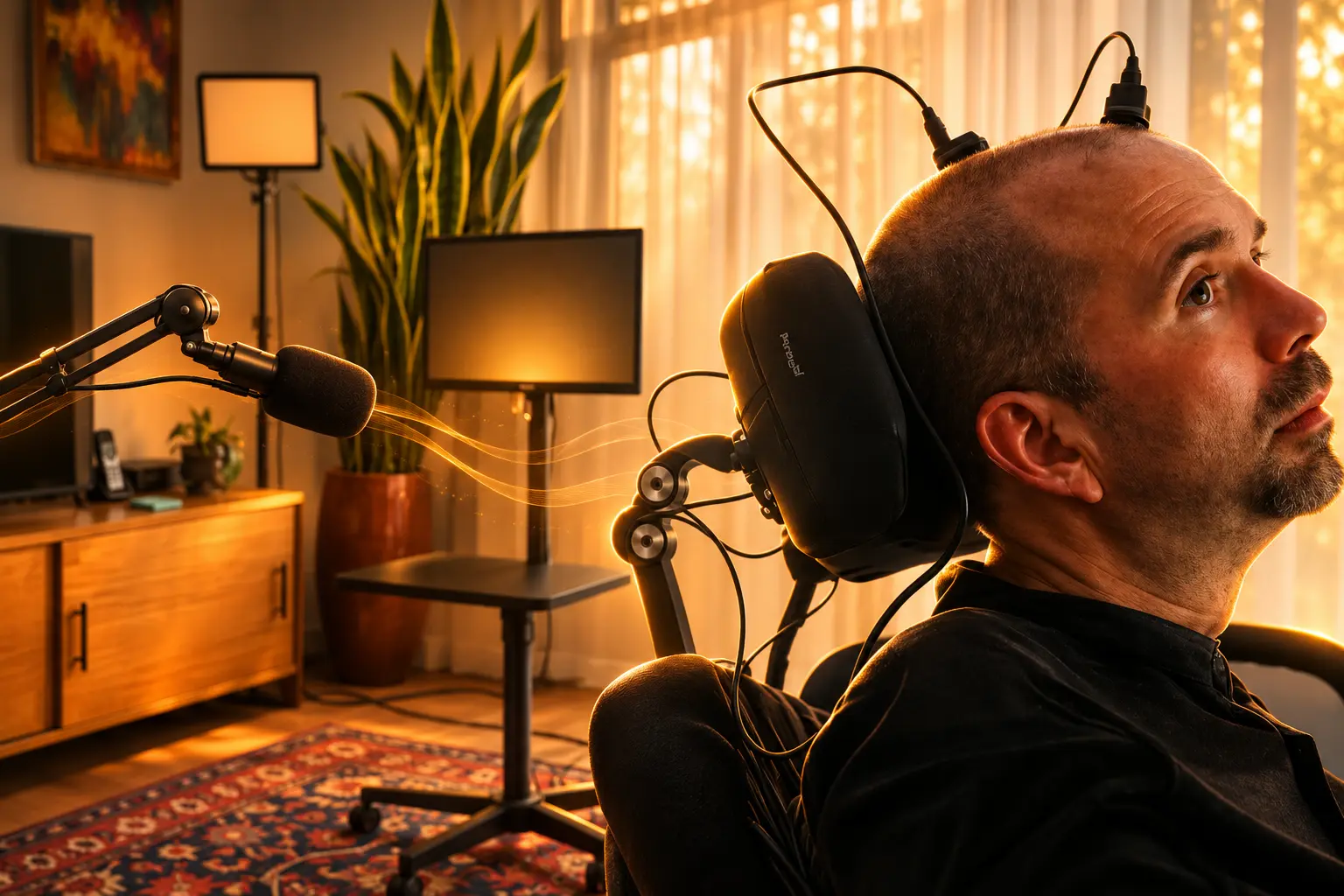
For several years the strongest speech implants have been brain-to-text machines. Electrodes catch the attempt to talk. Software maps that activity onto phonemes, then words, then a screen. The user watches a sentence assemble and, in effect, hits send. A cloned voice can read the line aloud after the fact.
Casey Harrell, a climate advocate with amyotrophic lateral sclerosis (ALS), has lived on that pipeline. Surgeons placed four 64-channel arrays, 256 microelectrodes in the speech cortex, in July 2023, when papers described him as 45. The text system is fast and, in the lab, almost exact. It still makes talk into composition.
Imagine you can only speak just by texting for the rest of your life, that’s not sufficient, right?
Maitreyee Wairagkar, neuroengineer, University of California, Davis
A brain-to-voice decoder tries to skip the screen. It synthesizes sound as the person attempts to speak, so they hear themselves with almost no wait. UC Davis Health has described that delay of one-fortieth of a second, about what a speaker hears of their own voice. The 10 ms figure in the papers is the model’s step, a shorter slice inside that delay.
The 2025 Nature paper already showed Harrell, listed there as T15, changing intonation, stressing a word, and singing short three-pitch melodies. Listeners still needed a transcript for half the words. Pitch without clarity is a party trick. Clarity without pitch is email.
Eight Pitches and a Major Scale
The singing that will be shown in Washington is a second experiment, still unpublished as a full paper. The participant is known as T21, a 58-year-old woman and trained singer who could not speak clearly when she enrolled. Researchers placed 384 electrodes in her brain, more channels than Harrell’s array set.
She attempted to sing and to change tone, the difference between a question and a statement, or between a glad line and an angry one. The conference abstract, as described in a technical write-up of the poster session, says the decoder told six set intonation patterns apart with more than 80% success in each of the two participants. For song, it told eight pitches apart and used them so T21 could produce a major scale while hearing the synthetic voice in the loop.
WHAT THE PITCH CHANNEL DID IN THE TRIAL
- Six tone patterns: The abstract reports more than 80% success on those set profiles in both participants.
- Eight pitches: The decoder used them as the ladder for a major scale.
- Closed-loop sound: T21 heard the note she had just made and could aim at the next one.
- Question and mood: The same channel carried a rise for a question and a brighter contour for a glad line.
- After the scale: Wairagkar said the former singer cried.
A scale is a poor concert and a fair instrument check. If the decoder cannot hold pitch while the person hears themselves, it will not carry the timing of a real exchange. Text systems never sat for that exam, because they do not sing at all.
Casey Harrell Already Logged 3,800 Hours at Home
Harrell is the reason this lab’s claims have weight beyond a poster. The voice-error cut uses his older recordings. The home-use record is a different mode: brain-to-text plus cursor, run by his family, with researchers gone.
THE DAVIS SPEECH IMPLANT, IN ORDER
- July 2023: David Brandman implants four microelectrode arrays in Harrell’s left precentral gyrus, in the BrainGate2 trial.
- August 2023: First decoder day, 25 days after surgery, hits 99.6% accuracy on a 50-word list after about 30 minutes of training.
- August 14, 2024: A New England Journal of Medicine paper reports high-accuracy brain-to-text, later holding near 97.5% on a 125,000-word vocabulary.
- June 12, 2025: Nature publishes the first instantaneous brain-to-voice result, with a 43.75% listener word error rate and short three-pitch melodies.
- June 15, 2026: Nature Medicine reports independent home use of the text-and-cursor system.
- June 30, 2026: The Brain2voice 2.0 preprint posts the 5.24% listener error on the 2025 voice set.
- November 16, 2026: The team presents the refined voice work and T21’s scale at Neuroscience 2026.
The June 2026 paper, when Harrell was 47, found he had used the system for more than 3,800 hours at home with no researchers present. He produced 183,060 sentences, 1,960,163 words, at 56 words per minute. He marked 92% of sentences as at least mostly correct. On prompted lab lists, accuracy stayed above 99% on that 125,000-word vocabulary. He went back to full-time work as an environmental advocate and used the cursor to run his own laptop.
Brandman, co-director of the UC Davis Neuroprosthetics Lab, has said the setup let Harrell talk with his wife and have a real conversation with his daughter. Sergey Stavisky, the other co-director, has said the earlier text decoder only ran when the research team was in the house; the later software kept up without them. That independence is the text system’s result. Brain2voice 2.0 has not yet published a matching home log.
What Listeners Still Cannot Hear in Ordinary Chat
The 5.24% figure counts substitutions, omissions, and extra words against the intended script. A single miss on a name or a “not” can still wreck a sentence. The measurement also comes from people transcribing cued speech, not from friends talking over each other.
Public argument around speech implants still ranks them by first-week word rate, as if the race were stenography. This week’s Davis result is a different exam: whether a stranger can type what they heard, and whether pitch is under the patient’s control. Those are the pieces that make a turn in conversation possible. They are also the pieces a words-per-minute chart does not show.
WHAT WE KNOW
- Offline voice test: 5.24% listener error is on reanalyzed T15 recordings, not a new implant.
- Pitch in two people: Six set intonation patterns cleared 80% in both, per the conference abstract.
- T21’s scale: Eight pitches, major scale, with live sound in the loop, unpublished as a journal article.
- Home use: Harrell’s 3,800 hours are the text-and-cursor system, which his family can start.
WHAT IS UNCONFIRMED
- Live 2.0 chat: No published word-error rate for Brain2voice 2.0 in spontaneous conversation.
- T21 paper: The singing study has not been peer-reviewed in full.
- Clinic calendar: The meeting materials give no date when a patient outside this trial could be offered the voice decoder.
- Other diseases: Stroke and locked-in work is on the same SfN program, from other groups, and is not this decoder.
Wairagkar has said the old barrier to real-time voice was not knowing when and how a person with speech loss was trying to talk. The 2025 paper solved timing well enough to sing three pitches. The 2026 decoder made the words clear enough that a stranger could write them down. Ordinary chat still has to be measured, because a friend who interrupts is not a listener with a transcript sheet.
Wires, Two People and a Living-Room Cart
The arrays still reach a computer through the skin. Care partners plug the system in. The home setup that ran for thousands of hours sat on a mobile cart, which is why Harrell’s independence is real inside a house and unproven on a bus. Infection risk from a wired pedestal is small and not zero, and the papers are case studies, not a device you order.
Two people, T15 and T21, carry this week’s voice and pitch claims. Harrell’s text system has the long home record. T21 has the scale. Brain2voice 2.0 has the 5.24% listening score on Harrell’s older neural files. Mixing those three sentences into one miracle implant is how the story goes wrong.
Several authors list patents on speech BCIs owned by the University of California and licensed to a neurotech startup. Stavisky and others also list advisory ties across the implant industry. That is disclosed on the preprint. It does not change the listening numbers. It is why the 5.24% needs to be repeated in a second lab, on a second dataset, in a conversation nobody scripted.
Washington Gets the First Public Look on Monday
The Society for Neuroscience, about 30,000 scientists and clinicians, is holding Neuroscience 2026 in Washington. Wairagkar’s poster is on the Monday, November 16 program. A press briefing is set for Tuesday, November 17, from 11:30 a.m. to 12:30 p.m. EST in Room 202B of the Walter E. Washington Convention Center, and online for registered media, per the Neuroscience 2026 meeting in Washington notice.
Cynthia Chestek, a biomedical engineer at the University of Michigan who was not on the Davis papers, is moderating. She has said the work brings brain-to-voice and brain-to-text closer to people outside trials. On the Davis system itself she was blunter.
This system, for the first time, is good enough. Good enough for real communication. It’s good enough to sing.
Cynthia Chestek, biomedical engineer, University of Michigan
Good enough, here, is a listener who can write the sentence and a patient who can hold a note. The arrays that produced those two facts have been in Harrell’s speech cortex since 2023. Monday’s session is the software catching up to the surgery, and the pitch test that a screen full of words never had to pass.
Disclaimer: This article is news reporting on published papers, a preprint, and a scientific meeting. It is informational only and is not medical advice, a treatment recommendation, or an assessment of any implant for a particular person. Readers who are considering a clinical trial or a communication device should speak with a neurologist or other qualified clinician who knows their diagnosis, and should not treat conference abstracts as care. Figures, trial statuses, and device designs reflect the cited papers and meeting notice as of the dates on those documents and can change with later data or regulatory review.

Xiaomi 18 Pro Goes Global as Its Privacy Filter Falters

iFixit Finds HomeView Glued Shut After Repair Gains

Polymetallic Nodules Shelter 4,139 Animals Miners Want

One UI 9.5 Puts Now Brief Behind a System Agent

Framework’s $99 Keyboard Brings Laptop Repair to the Couch

Microsoft 365 Auth Fault Took Down Exchange and Teams

OpenClaw 2.0 Ships a Team Workplace With Host-Trust Defaults

Xbox Caps Game Pass Cloud Gaming at 15 Hours

OpenAI Unveils GPT-6 Astra With a Critical Cyber Label

Squishy Dumpling Toys Recalled After Hiding Illegal Water Beads
-
 NEWS3 months ago
Microsoft 365 Auth Fault Took Down Exchange and Teams
-
 GAMING3 months ago
Xbox Caps Game Pass Cloud Gaming at 15 Hours
-
 NEWS3 months ago
OpenClaw 2.0 Ships a Team Workplace With Host-Trust Defaults
-
 NEWS3 months ago
OpenAI Unveils GPT-6 Astra With a Critical Cyber Label
-
 LIFESTYLE3 months ago
Squishy Dumpling Toys Recalled After Hiding Illegal Water Beads
-

 BUSINESS3 months ago
Diesel Breaks Its Record as the White House Claims Credit
-
 NEWS3 months ago
IFA 2026’s Weird Gadgets Are Building a Sensor Home
-
 BUSINESS3 months ago
ChargePoint Stock Rally Prices Wilmer’s Three-Year Cash Plan