
BUSINESS
Gas Falls Below $4, but Diesel Barely Budges
Regular gas fell to $3.9788 a gallon on Nov. 10, the first U.S. average under $4 since July, while diesel stayed near $6.16.

The national average for regular gasoline slipped to $3.9788 a gallon on Tuesday, Nov. 10, the first reading below $4 since July. AAA’s daily survey showed a 3-cent drop from Monday and a 17-cent drop from a week earlier, a round-number break that still left diesel at $6.1572.
The print is the winter-blend calendar and thinner traffic, not a full reset of the Gulf product market that pushed pump prices up this year.
Regular Gasoline Crosses Below $4
On its public fuel board, AAA showed a national average of $3.9788 a gallon for regular unleaded as of Nov. 10. That was 3 cents under Monday’s $4.0093, 17 cents under the prior week’s $4.1493, and 39 cents under the month-ago reading of $4.3669. A year earlier the same regular average was $3.0707, so Tuesday’s price was still 91 cents, or 29.6 percent, higher.
AAA NATIONAL AVERAGES
| Grade | Nov. 10 | Week Ago | Month Ago | Year Ago |
|---|---|---|---|---|
| Regular | $3.9788 | $4.1493 | $4.3669 | $3.0707 |
| Diesel | $6.1572 | $6.2875 | $6.2824 | $3.7389 |
The government’s weekly U.S. regular gasoline prices for the week of Nov. 9, released the same Tuesday, came in at $3.995 a gallon, down from $4.153 seven days earlier. Gulf Coast regular averaged $3.481 in that survey, while the West Coast averaged $5.110 and Los Angeles $5.559.
Patrick De Haan, head of petroleum analysis at GasBuddy, said stations in Indiana, Ohio, Georgia, North Carolina, Texas, Oklahoma, and Louisiana were already posting some prices below $3 a gallon. The national mean mixes those Gulf and Atlantic prints with California’s $5.71 regular, which is why a sub-$4 headline can land while a lot of drivers still pay well over $4.
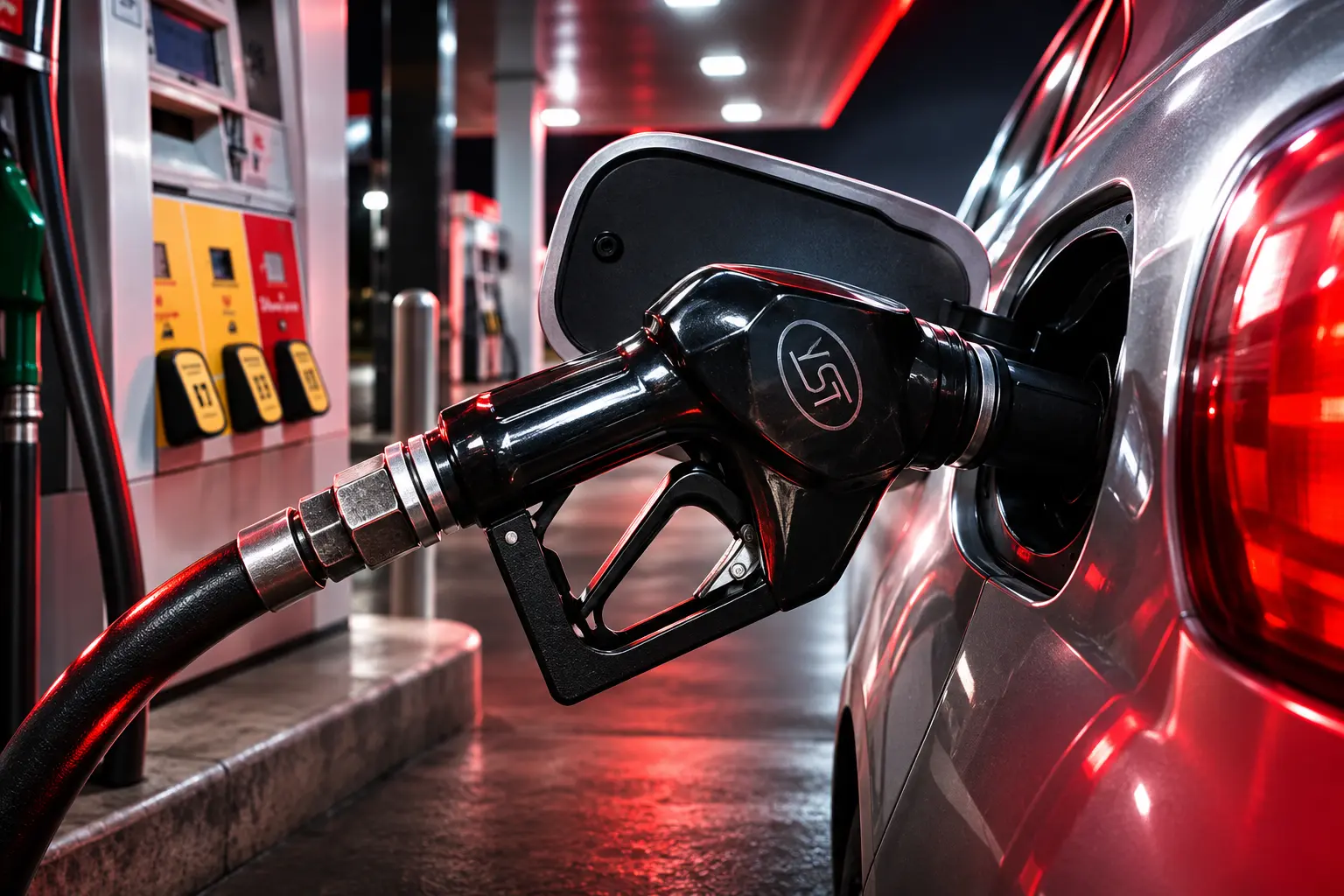
The Winter Blend Cut Arrives on Schedule
Refiners have switched to winter-blend gasoline, which costs slightly less to make than the summer formula. AAA has said stations can start selling that cheaper blend as early as mid-September, and that pump prices often fall 10 to 30 cents a gallon across the winter as road trips fade and fewer miles get driven in cold weather.
De Haan called the blend switch the biggest factor in the latest slide, with summer evaporation rules off the table and refiners finished with maintenance. He said that from Sept. 1 to Nov. 9, the national average fell in 13 of the 18 years from 2008 to 2025, and that the typical drop was about 25 to 55 cents. This year’s decline over that window was about 35 cents, in the middle of the historical pack even with the Gulf war still running.
The move started from a late-September peak, weeks before the Nov. 3 election, which matches the seasonal window De Haan tracks most years. Crude has also come off wartime highs, and that lower feedstock cost is now showing up in regular gasoline faster than in diesel.
THE 2026 PUMP-PRICE PATH
- May 11, 2026: EIA regular gasoline hits a recent peak of $4.50 a gallon.
- July 6, 2026: The same series bottoms at $3.77, the recent low.
- Sept. 21, 2026: The national average is back up to $4.47 as summer turns to fall.
- Sept. 22, 2026: AAA diesel sets a record average of $6.5276 a gallon.
- Nov. 10, 2026: AAA regular prints $3.9788, still 21 cents above the July 6 low.
Tuesday’s average is a break of the $4 line, not a new cheap season. It is 21 cents above the July 6 trough and 52 cents below the May 11 peak, and 49 cents below the Sept. 21 rebound high. AAA’s all-time regular record remains $5.0165, set on June 14, 2022.
Diesel Holds Near Its September Record
Regular’s 39-cent month-ago drop did not show up in the truck lane. Diesel’s month-ago average was $6.2824, so the fuel that moves freight and groceries is down 13 cents over that span, the same 13 cents it fell in the latest week. A year ago diesel averaged $3.7389, which means Tuesday’s $6.1572 is $2.42, or 64.7 percent, higher.
THE GASOLINE-DIESEL GAP
- Today’s spread: Diesel costs $2.18 more than regular, versus a $0.67 gap a year ago.
- Regular versus last year: The gasoline average is 29.6 percent higher than the year-ago $3.0707.
- Diesel versus last year: The diesel average is 64.7 percent higher than the year-ago $3.7389.
- Distance from the record: Diesel is 37 cents under AAA’s $6.5276 high from Sept. 22.
That leftover premium is the bill for anyone who buys on-highway diesel rather than a tank of regular. California diesel averaged $8.1150 on Nov. 10. Mid-grade national regular was $4.4990 and premium $4.8969, so even the gasoline grades above regular never reached the diesel mean.
WHO STILL PAYS THE DISTILLATE BILL
- Truck lanes: Long-haul freight still buys diesel near $6.16 nationally and above $8 in California.
- Grocery and parcel: Store shelves and last-mile vans run on the same distillate that barely moved in a month.
- Home heat in the Northeast: The CPI fuel-oil index rose 2.0 percent in October after a 15.3 percent jump in September.
A $4 regular headline does not cut those tickets. The spread itself is the tell: gasoline did the seasonal thing, and diesel did not.
Why the Pump Split Tracks Hormuz Products
Crude can leave the Gulf on bypass pipelines, Oman-coast convoys, and ship-to-ship transfers; diesel and other refined products cannot reroute as easily, so a winter-blend drop in regular can print while distillate stays expensive. The war that started on Feb. 28 still shapes that split, even as fewer barrels of crude are trapped at the strait than in the spring.
Kpler’s commodities desk has argued that a Strait of Hormuz left under Iranian control can see tanker transits recover only so far. Vessel counts rose from about 5 percent of pre-war transits in March to about 10 percent after an early ceasefire, then stalled. Under a long-term Iranian-control case, Kpler estimates transits could peak around 40 to 50 percent of Middle East Gulf export capacity, with crude partly absorbed by routes such as Yanbu.
Crude markets can partially absorb disruption due to alternative export routes such as Yanbu. However, other commodities lack this flexibility. As a result, partial reopening is sufficient to stabilize crude balances but will sustain inflationary pressure across refined products, LNG, and dry bulk markets.
Matt Wright, Kpler commodities analysis
That is the mechanism behind the pump split. Workarounds have put enough crude back into the system to let regular gasoline follow the winter calendar, and they have not rebuilt the product slate. Kpler’s note still leaves inflationary pressure across refined products, LNG, and dry bulk even when crude balances look less broken.
United Against Nuclear Iran counted 217 U.S.-facilitated transits through the strait in the first seven days of November, about 30.3 vessels a day, and said Iranian oil-laden tankers were still bottled along the coast. Those escorted crude movements help explain why regular could fall 39 cents in a month while diesel, a refined barrel, only fell 13 cents.
October’s CPI Already Booked the Spike
The Bureau of Labor Statistics, in its October consumer price index report released the same Tuesday, said gasoline (all types) rose 1.0 percent on a seasonally adjusted basis after 9.1 percent in September and 3.9 percent in August. Before seasonal adjustment, gasoline prices decreased 0.7 percent in October, which matches the pump slide that was already under way as winter blend hit stations.
The all-items index rose 0.4 percent in October after 0.6 percent in September. Energy rose 0.7 percent after a 5.2 percent jump the month before. Food rose 0.5 percent, and food at home rose 0.4 percent, a reminder that diesel’s freight cost still feeds the grocery ticket even when regular gasoline is easing.
Over 12 months the gasoline index was up 37.4 percent, a different series from AAA’s regular-gallon average, which was 29.6 percent above its year-ago print. Both measures say the same directional thing: Tuesday’s sub-$4 reading is cheaper than September, and it is not cheap against 2025.
California Still Pays $5.71 a Gallon
The $4 line is a national mean. AAA’s state board on Nov. 10 still had California regular at $5.71, or $1.73 above the U.S. print, with Hawaii at $5.6280 and Nevada at $5.0412. Washington averaged $4.98 and Oregon $4.6200. North Carolina was the cheap end at $3.24.
THE STATES THE $4 HEADLINE HIDES
- California: Regular $5.71 and diesel $8.1150, the highest pair on the AAA board.
- Hawaii: Regular $5.6280, a second state still more than $1.60 above the national average.
- Nevada and Washington: Regular $5.0412 and $4.98, either side of $5.
- North Carolina: Regular $3.24, where some stations have already dipped under $3.
West Coast drivers are still waiting on a meaningful California winter-blend cut at the pump, because CARB gasoline and local taxes keep that market in its own lane. EIA’s weekly California regular average was $5.562 for the week of Nov. 9, down from $6.227 on Oct. 5, so the state is easing, just not toward $4.
De Haan said the national regular average could fall to $3.70 a gallon by Thanksgiving if the geopolitical situation stays in balance, and that it may sink beyond that if the Gulf remains quiet. AAA’s own winter band is another 10 to 30 cents. Thanksgiving falls on Nov. 26, so that case still has two weeks of weather, blend, and tanker traffic to clear.
AAA will keep printing daily averages through those weeks, and De Haan’s $3.70 Thanksgiving case still depends on the Gulf staying quiet. Diesel at $6.1572, 37 cents under its Sept. 22 record, is the number that winter blend does not reset.

Xiaomi 18 Pro Goes Global as Its Privacy Filter Falters

iFixit Finds HomeView Glued Shut After Repair Gains

Polymetallic Nodules Shelter 4,139 Animals Miners Want

One UI 9.5 Puts Now Brief Behind a System Agent

Framework’s $99 Keyboard Brings Laptop Repair to the Couch

Microsoft 365 Auth Fault Took Down Exchange and Teams

OpenClaw 2.0 Ships a Team Workplace With Host-Trust Defaults

Xbox Caps Game Pass Cloud Gaming at 15 Hours

OpenAI Unveils GPT-6 Astra With a Critical Cyber Label

Squishy Dumpling Toys Recalled After Hiding Illegal Water Beads
-
 NEWS3 months ago
Microsoft 365 Auth Fault Took Down Exchange and Teams
-
 NEWS3 months ago
OpenClaw 2.0 Ships a Team Workplace With Host-Trust Defaults
-
 GAMING3 months ago
Xbox Caps Game Pass Cloud Gaming at 15 Hours
-
 NEWS3 months ago
OpenAI Unveils GPT-6 Astra With a Critical Cyber Label
-
 LIFESTYLE3 months ago
Squishy Dumpling Toys Recalled After Hiding Illegal Water Beads
-

 BUSINESS3 months ago
Diesel Breaks Its Record as the White House Claims Credit
-

 NEWS3 months ago
IFA 2026’s Weird Gadgets Are Building a Sensor Home
-

 BUSINESS3 months ago
ChargePoint Stock Rally Prices Wilmer’s Three-Year Cash Plan