
NEWS
Italian AI Finds the Art Thieves Were Willing to Ruin
Italy’s Swoads AI has recovered more than 165,000 stolen objects, including an overpainted church saint, while Caravaggio and Messina’s Antonellos stay missing.

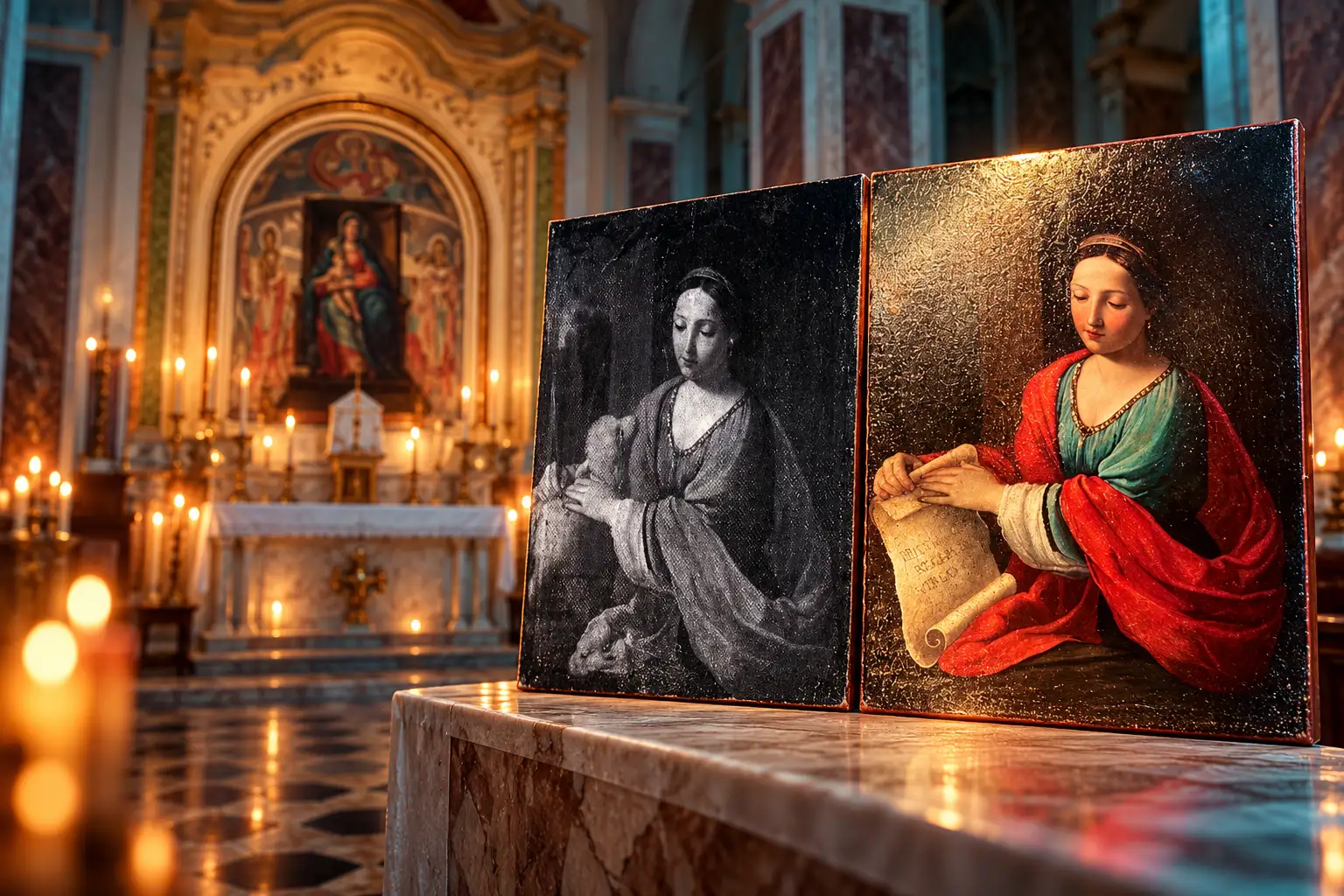
In October 2024, Italian art police seized an 18th-century canvas at a Parma fair after an AI match to a 2004 church theft. The woman in the picture held a parchment scroll; in the stolen-art file she had clutched a lamb.
Lieutenant Colonel Salvatore Rapicavoli, an IT engineer in the Carabinieri Command for the Protection of Cultural Heritage, says that matcher, Swoads, has since helped recover more than 300 large paintings and statues and more than 165,000 smaller coins, medals, letters, manuscripts, religious objects, stamps and cards, together worth more than €203 million ($226 million). He does not expect the same software to find Caravaggio’s Nativity, or the Antonello da Messina panels taken from a Messina museum on 15 August 2026.
Officers Photographed a Woman With a Scroll
Officers on a routine pass through Parma’s Mercante in Fiera antique fair were not browsing. They photographed stands packed with bronzes, globes and oil paintings, then pushed the pictures into an internal database. A couple of hours later the system flagged a fair-skinned young woman in aquamarine and red, a half-unravelled scroll in her hands. The next day they seized the canvas. “There was something off,” Rapicavoli said.
The Nucleo TPC in Naples later identified it as Sant’Agnese, oil on canvas by an unknown 18th-century painter, 102 by 78 centimetres, stolen on the night of 11 August 2004 from the Chiesa Madonna della Potenza in Sulmona, in Abruzzo, more than 500 kilometres (310 miles) from Parma. After the theft someone had replaced the lamb, the saint’s usual companion, with a parchment scroll and had stripped the halo and the palm of martyrdom so the figure read as a young pagan woman. Art historians at the Superintendency in L’Aquila confirmed the overpaint. Keyword search for a woman with a scroll would not have surfaced a file that still described a woman with a lamb.
THE SANT’AGNESE FILE
- 11 August 2004: Thieves take the canvas from the Chiesa Madonna della Potenza in Sulmona.
- 2020: Rapicavoli’s team conceives Swoads to compare fair and web photos with the stolen-art archive.
- November 2023: The unit puts the system into operational use.
- October 2024: A snapshot from the Parma fair flags the overpainted saint; officers seize it the next day.
- 20 May 2025: The unit returns the painting to the Diocese of Sulmona.
The TPC press notice says the canvas went back on the church wall for public view, pending a possible restoration by Culture Ministry experts to restore the original image. Italian law could not support a criminal case. The theft was more than two decades old, and the Naples antiquities dealer who had the picture had little provenance, likely inheriting it through a family business.
Swoads Treats an Altarpiece as a Fingerprint
Italy has kept a stolen-culture archive since 1969, the year the art unit itself was created. The Carabinieri TPC says that file is now the largest of its kind, with more than 1.3 million records of objects to find. Only some entries carry photographs, and many of those pictures are old, black and white, shot across a dining room with blown highlights and hard contrast. For decades officers walked fairs and shops, then queried the archive with phrases. Rapicavoli, who joined the stolen-art team in 2013, wanted a machine for the comparison grind. “The machine doesn’t get bored,” he said.
His group sketched the Stolen Works of Art Detection System in 2020 as a crawler that pulls images from the open web, social media, the deep web and photos officers take on the beat, then scores them against the archive. It pairs colour fields and rough silhouettes. It can treat a sliver of a chopped altarpiece as a piece of a stolen whole, and it can accept a picture that has been altered after the theft.
WHAT THE MATCHER ACTUALLY SEES
- Colour and outline: It scores shade and silhouette even when a theft photo is decades old and poorly lit.
- Cut panels: Large altarpieces sold in separate strips can still hit as parts of one stolen object.
- Overpaint: A lamb turned into a scroll does not need the right keywords if the rest of the composition still rhymes.
- Night crawls: Catalogue uploads, shop listings and social posts are compared while officers are off the floor.
“Regardless of whether it makes sense or not, it recognises it because it’s part of a whole that was stolen,” Rapicavoli said. The software does not need to know that the woman is a saint.
A Palizzi Shepherdess Reappeared in a Piedmont Sale
The same crawl caught a second kind of ghost in 2026. Filippo Palizzi (1818-1899) painted Riposo della pastorella, The Rest of the Shepherdess. In June 1972 thieves took it from the Galleria d’Arte Moderna Carlo Rizzarda in Feltre, in the Belluno hills, a blow heavy enough that the gallery closed. For decades the canvas moved through back rooms. Swoads then found a closely matching picture in the online catalogue of a Piedmont auction house. Carabinieri of the Turin TPC, working with prosecutors in Vercelli, seized it from a Piedmont seller the unit described as acting in good faith, reconstructed what they could of the ownership chain, and had the Feltre gallery confirm it was the stolen work. The painting went back to the Comune di Feltre in April 2026.
That is the market Swoads can see: a named 19th-century canvas that eventually needed a catalogue photograph, and a parish saint that eventually needed a fair booth. Both sellers, on the public account, were not the original thieves. Both recoveries closed a file without a splashy arrest.
What the System Will Not Recover
Rapicavoli has already drawn the line around the works people search for by name. He does not expect Swoads to return the Antonello da Messina paintings stolen in Messina in August 2026, and he does not expect it to return Caravaggio’s Nativity, which has been on Italy’s most-wanted list since 1969. Those thefts were not aimed at a fair stand. They were aimed at a wall, then at a hiding place that does not publish a jpeg.
I don’t expect the system is going to find me the Antonello Da Messina works that were stolen this summer, let’s be very clear. I don’t expect it to find me Caravaggio’s Nativity, one of our ‘Most Wanted’.
Lt. Col. Salvatore Rapicavoli, Carabinieri Command for the Protection of Cultural Heritage
On the evening of 15 August 2026, while some 100,000 people packed central Messina for the Procession of the Vara, thieves spent two to three minutes inside the Museo Regionale Maria Accascina. They pulled the five surviving panels of Antonello’s 1473 San Gregorio Polyptych, an altarpiece 170 by 203 centimetres, and smashed a sealed case for a small double-sided panel of the Madonna and Child with a Franciscan on one face and Christ on the other. They dumped two panels, identified as Saint Gregory and Saint Benedict, outside the museum. Four works left with them. Mayor Federico Basile called it almost certainly a commissioned theft. Art expert Alberto Fiz put the missing group at €70 million to €80 million. No recovery has been announced.
Caravaggio’s Nativity with Saint Francis and Saint Lawrence left the Oratorio di San Lorenzo in Palermo on the night of 17-18 October 1969. Fifty-seven years later it is still gone. A 2005 FBI valuation put it at $20 million, and later antimafia testimony has it passing through Cosa Nostra and possibly being cut for a quieter sale. A painting that never re-enters a catalogue cannot be matched to one.
THE OPEN MARKET VERSUS THE VAULT
| Work | Taken | Status | How it showed up |
|---|---|---|---|
| Sant’Agnese, unknown 18th-c. painter | 11 August 2004, Sulmona church | Returned 20 May 2025 | AI match at the Parma fair, October 2024 |
| Palizzi, Riposo della pastorella | June 1972, Feltre gallery | Returned April 2026 | AI match on a Piedmont auction site |
| Antonello da Messina, 3 San Gregorio panels plus biface | 15 August 2026, Messina museum | Still missing | Holiday museum raid, not a public listing |
| Caravaggio, Nativity | 17-18 October 1969, Palermo oratory | Still missing | No fair or catalogue image to scrape |
Carina Popovici, co-founder of the authentication firm Art Recognition, puts the limit in one sentence. These systems ask whether an image matches something already reported stolen. They do not catch the thief, and they cannot flag an object that was never entered. “The recovery still depends on investigators and legal cooperation,” she said. “I would call AI a force multiplier.”
About 300 Art Police, and 24 at the FBI’s Peak
A multiplier still needs people who can knock on a dealer’s door the morning after a hit. Timothy Carpenter, former head of the FBI’s dedicated Art Crime Team and now at Argus Cultural Property Consultants, says most forces cannot staff that chase. The Bureau created the team in 2004 and says it has recovered more than 20,000 items of cultural property valued at over $1 billion. Carpenter’s staffing comparison is bleaker than the recovery total.
THE FORCE THAT CAN CHASE A HIT
- Italy: Somewhere in the neighbourhood of 300 officers on the art-crime unit, per Carpenter.
- United States: At its largest, the FBI team had 24 people, he said.
- Italy’s archive: More than 1.3 million files of objects to find, per the TPC.
- Interpol’s public set: Almost 57,000 objects in the Stolen Works of Art database.
You have to have a large team dedicated to nothing but chasing leads generated by the AI. The Italians have somewhere in the neighbourhood of 300 personnel assigned to their art crime unit. At its largest, the FBI had 24.
Timothy Carpenter, former head of the FBI Art Crime Team, Argus Cultural Property Consultants
The matcher also fails in ways a large unit has to paper over. It still struggles with thin training photos. A vase shot from the front in a theft report will often miss a listing shot from the back. It cannot, on its own, tell a copy from a claimed original, and stolen-art files do not always require proof that the missing object was unique. Carpenter notes that Interpol’s database has listed Murillo’s The Melon Eaters as stolen even though an authenticated original hangs in Munich’s Alte Pinakothek; Interpol said those entries record other versions, including a copy reported stolen in Rome in 2009 and a disciple’s copy, falsely signed, reported stolen in Bucharest in 1998.
Interpol’s Public List Holds Almost 57,000 Objects
That copy problem sits inside a smaller public net. Interpol’s public stolen-art visual search, the ID-Art app, opens almost 57,000 objects to police, dealers and anyone with a phone. Users can type a title or take a photograph. Saved manual searches carry a timestamp that can show a due-diligence check was made. Italy’s TPC file is in another league by volume, and it is not the same list. A dealer who only searches Interpol will not see most of what Rapicavoli’s officers carry in their pockets at a fair.
Rapicavoli is already feeding the software watchlists for categories likely to hit the market, including rare Ukrainian manuscripts and icons, the sort of material flagged on the ICOM red lists of objects at risk. The unit wants an internationally connected identification network by 2027. Other countries have built their own matchers, from Turkey’s artefact tracker to France’s Arte-Fact and Germany’s Kiku. None of that wiring helps if the object never appears.
The other side of the same tools is already in the thieves’ kit. Image editors can change a frame, patch damage, and generate provenance paperwork or synthetic objects that do not exist. “So, AI is making things easier, while at the same time making them harder,” Carpenter said. High-value recent thefts, as Steven Frank, an intellectual-property lawyer who studies art authentication, has argued, are often commissioned straight into a vault or a freeport. The people who steal a Caravaggio do not then need a Parma booth.
The argument that travels is still Messina: a two-minute holiday raid, a van, the suspicion of a job done to order. An overpainted parish canvas with a fake scroll is not that story, which is why Swoads can post a fortune in recoveries while the empty frames everyone can name stay empty.
Sulmona Has Its Saint and No Defendant
On 20 May 2025 the TPC took Sant’Agnese home. Locals turned out, Rapicavoli recalled, elated. The church has a saint on the wall again, still wearing a forger’s scroll until restorers put the lamb back. No one is in the dock for the 2004 night. The Palizzi shepherdess is back in Feltre because an auction house needed a photograph. The Antonello panels have no such photograph to give.
Swoads will keep walking fairs and scraping catalogues, and it will keep finding the works thieves were willing to deface, chop, and sell in the open. The trophy list is a different job, and it always was.

Xiaomi 18 Pro Goes Global as Its Privacy Filter Falters

iFixit Finds HomeView Glued Shut After Repair Gains

Polymetallic Nodules Shelter 4,139 Animals Miners Want

One UI 9.5 Puts Now Brief Behind a System Agent

Framework’s $99 Keyboard Brings Laptop Repair to the Couch

Microsoft 365 Auth Fault Took Down Exchange and Teams

OpenClaw 2.0 Ships a Team Workplace With Host-Trust Defaults

Xbox Caps Game Pass Cloud Gaming at 15 Hours

OpenAI Unveils GPT-6 Astra With a Critical Cyber Label

Squishy Dumpling Toys Recalled After Hiding Illegal Water Beads
-
 NEWS3 months ago
Microsoft 365 Auth Fault Took Down Exchange and Teams
-
 GAMING3 months ago
Xbox Caps Game Pass Cloud Gaming at 15 Hours
-
 NEWS3 months ago
OpenClaw 2.0 Ships a Team Workplace With Host-Trust Defaults
-
 NEWS3 months ago
OpenAI Unveils GPT-6 Astra With a Critical Cyber Label
-
 LIFESTYLE3 months ago
Squishy Dumpling Toys Recalled After Hiding Illegal Water Beads
-

 BUSINESS3 months ago
Diesel Breaks Its Record as the White House Claims Credit
-

 NEWS3 months ago
IFA 2026’s Weird Gadgets Are Building a Sensor Home
-

 BUSINESS3 months ago
ChargePoint Stock Rally Prices Wilmer’s Three-Year Cash Plan