
BUSINESS
Retail Caught Nvidia’s Crash After Jensen Huang Resigned
Retail bought a record $111 million of Nvidia after Jensen Huang resigned, leaving Colette Kress to run Tuesday’s earnings without a permanent CEO.

Retail investors bought a net $111 million of Nvidia stock in Thursday’s first 30 minutes, the largest opening burst Vanda Research has on record. The shares fell as much as 14% to $148.80 after Jensen Huang resigned, then closed at $166.19, down 4.34%.
They were buying a company that no longer has its founder in the building. Colette Kress, Nvidia’s finance chief since 2013, is now interim CEO and still CFO, five days from earnings.
A Record $111 Million in the Opening Half Hour
Nvidia told the market on the morning of November 12 that Huang was out as president, chief executive, and director, effective immediately. The stock opened at $150.99, traded as low as $148.80, and still managed to finish at $166.19 on 740 million shares, more than double Wednesday’s already heavy session.
THE WEEK INTO THE RESIGNATION
| Date | Close | Low | Volume |
|---|---|---|---|
| November 9 | $178.67 | $170.24 | 463 million |
| November 10 | $168.89 | $165.89 | 429 million |
| November 11 | $173.73 | $170.77 | 339 million |
| November 12 | $166.19 | $148.80 | 740 million |
The close looks orderly next to that $148.80 print. The open did not. From Wednesday’s $173.73 finish, the low was a 14% air pocket, and the rebound back to $166.19 recouped nearly three-quarters of the hole by 4 p.m.
HOW RETAIL SHOWED UP
- The multiple: Vanda Research put the opening half hour at more than 40 times a normal Nvidia start, and called it the stock’s biggest opening on record.
- The week’s share: Nvidia took 61% of all retail buying in U.S. stocks and ETFs in the week through November 12, Vanda said.
- The leverage: Individual investors put $42.5 million into six 2x long Nvidia funds from Monday through Wednesday, one of the largest three-day inflows Vanda has logged, while funds built to bet against the stock drew nothing.
- The firm’s line: “This is very much a one-way flow story for retail,” Vanda wrote.
Mike Zaccardi, a CFA and CMT, called the session “one of the more epic ‘buy the news’ events in history.” The news was not a beat or a product launch. It was the founder leaving.
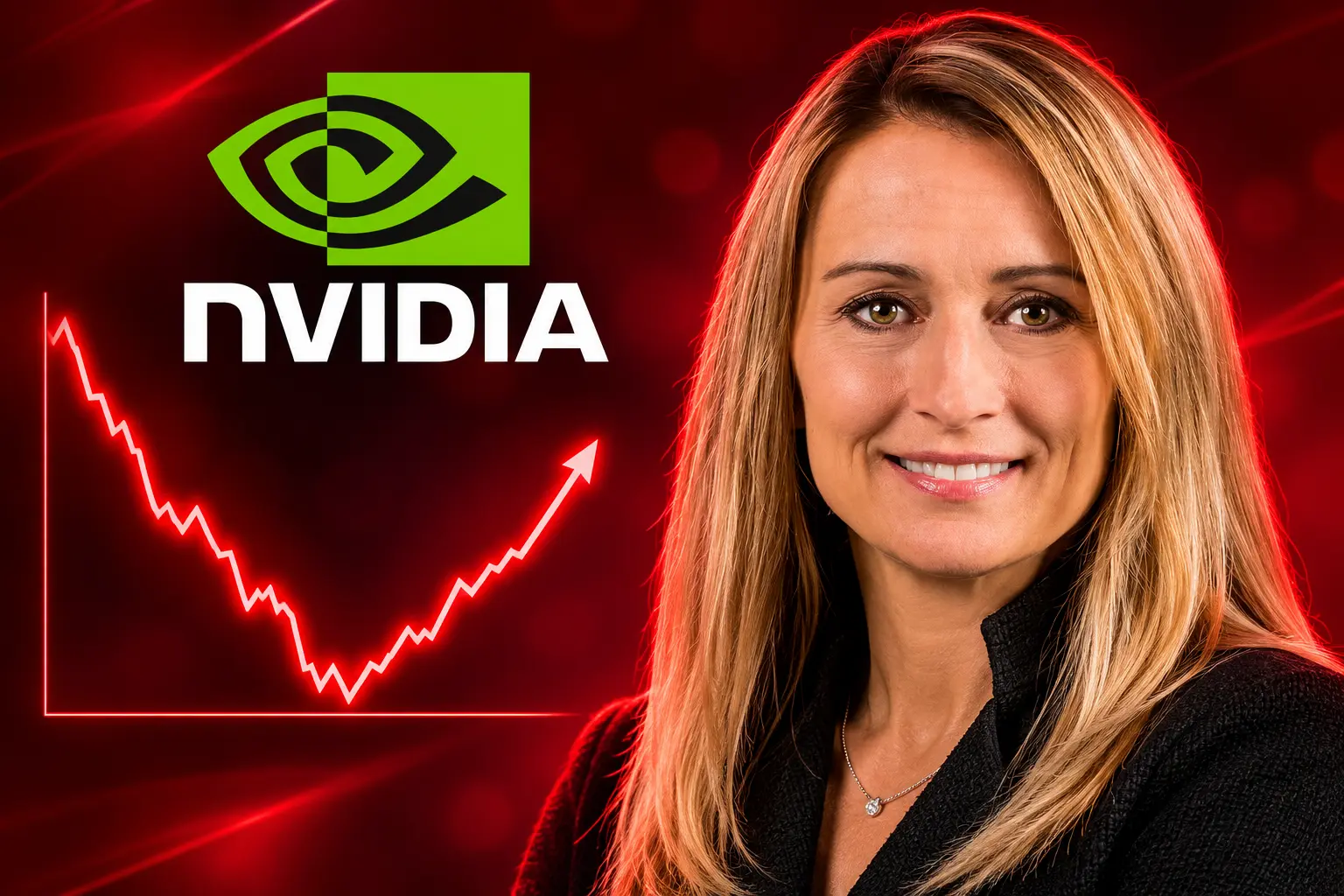
Who Is Running Nvidia After Jensen Huang Resigned?
Colette Kress, 59, is running Nvidia. The board appointed Colette Kress as interim CEO and left her in the finance job until a permanent successor is named, and it named Harvey C. Jones the first chair the company has ever had. Jones, a former Synopsys chief executive and executive chairman, said the board expects operations, customer commitments, and the product roadmap to continue without interruption.
The filing is colder than the press release. Nvidia’s 8-K says the board accepted Huang’s resignation on November 11 as president, chief executive officer, and a member of the board, then named Kress, age 59, interim chief executive while it searches. The public announcement hit on the morning of November 12.
THE WEEK THE ORG CHART CHANGED
- November 8: The board opens an independent investigation after reporting that Huang had been the target of a foreign intelligence effort, and Huang writes to staff that he owes his family and colleagues an apology.
- November 10: Outside counsel is named to run the probe.
- November 11: The board accepts the resignation, effective immediately.
- November 12: Nvidia announces the transition, Kress emails staff, and the stock makes its low at $148.80.
- November 17: Third-quarter results and the analyst call, with Kress in both chairs.
- November 18: Kress hosts a company meeting at 9 a.m. PT.
Kress joined in September 2013 after finance jobs at Texas Instruments, Microsoft, and Cisco. Nvidia’s sales were $4.13 billion in the fiscal year she arrived and $215.9 billion in fiscal 2026. Dan Ives, an analyst at Yorkville Ives & Co., said before the appointment was official, “She’s more than just a CFO. I’d almost view her as more of a COO.” He also said the permanent job is likely to go to an outsider, and that she may hold the interim seat for about a year.
The board is looking at internal and external candidates. It has not said whether Kress is in that pool, and it has not said whether the investigation is finished.
NVIDIA’s strength has always come from its people, and together with our leadership team, I am committed to building on the extraordinary foundation Jensen created over the last 33 years.
Colette Kress, interim CEO and CFO, Nvidia newsroom statement
To employees she was blunter about the week they had just lived through. “The Board, Estaff and I recognize that this has been an extraordinarily difficult period,” she wrote, and she thanked them for staying on the work. Huang had co-founded the company in 1993 and run it for 33 years. The person now answering for that machine is the executive who has spent those 13 years on the numbers.
Bounce History Was Written With Huang in the Chair
At Thursday’s low, Nvidia was down 38% from its October closing high of $239.24, nearly as deep as the Covid and tariff crashes. Those two recovered to new records within three months. The 2018 and 2022 slides ran deeper and took seven to 14 months to work off.
Days that look like Thursday have mostly paid off, with a caveat the tape is ignoring. Thursday was the seventh session since 2010 in which Nvidia fell at least 10% and then recouped at least half of the drop by the close. The stock was higher a year later after five of the first six. The exception was January 2022, the start of a much longer selloff.
Every one of those prior air pockets happened with Huang still in the job. He was the person on the earnings call, the person customers called about supply, and the person retail was underwriting when it bought the dip. A seven-session sample with the founder in the chair does not tell you what a sample of one looks like with the founder gone.
January 2022 is the ugly comparison for a reason. That was the time the story itself changed, and the first-day reclaim did not hold. Thursday’s reclaim to $166.19 is the same shape as those other first days. It is not the same company on the other side of the print.
Tuesday Puts Kress on the Earnings Call Alone
Nvidia has not moved the calendar. The company will hold its third-quarter call on November 17 at 2 p.m. PT, with results due around 1:20 p.m. PT. The quarter ended October 25. Ahead of the call, Kress will still post the written CFO commentary she has been posting for years. This time she is also the chief executive in the room.
The last official outlook, issued with the August results, called for about $108 billion of third-quarter revenue, plus or minus 2%, and gross margins of 74%, plus or minus 50 basis points. The prior quarter, which ended July 26, did $96.2 billion in sales, including $89 billion from data center. Those figures were booked while Huang was still CEO. Tuesday is the first report that has to be explained without him.
Kress has sat on these calls beside Huang since 2013. Analysts already know her voice on margins, supply, and the outlook. They have not heard her as the person who owns the roadmap questions, the China questions, and the succession questions in the same hour. The board’s search, which includes outsiders, will hang over that Q&A whether anyone asks or not.
The staff meeting is the next morning. Kress set it for November 18 at 9 a.m. PT, a day after she has to walk public investors through a quarter Huang spent, and a week after she told employees the period had been extraordinarily difficult.
Five Fidelity Buys for Every Sell by Noon
By noon Eastern on Thursday, Fidelity customers had placed 394,818 buy orders for Nvidia against 80,088 sell orders, about five buys for every sell. Buy orders for Nvidia were more than double the combined buy orders for the other nine most-traded names on the platform. Advanced Micro Devices, in second, had 24,790. Nebius had 24,519.
That is not a careful reading of a CEO search. It is the same reflex that has treated every Nvidia air pocket since 2023 as inventory. A bouquet of flowers was left outside the Santa Clara campus on Thursday. Jed Ellerbroek, a portfolio manager at Argent Capital Management, said the session felt like the calmest day in markets in a few weeks, “which is insane given the news since the last close.”
The unpriced piece is commercial. Huang personally sat on allocations. Large buyers who wanted chips early had to deal with the person who could move them up the list or threaten to cut them. That leverage does not transfer automatically to a finance chief in an interim seat, and it does not transfer to a permanent CEO the board has not named. Customers can slow orders, push on price, or test a rival, and they can do it while they wait to see who actually runs the company.
Brian Shannon, founder of Alphatrends, wrote that Nvidia was “getting close to capitulation.” His rule is to wait for a close back above the five-day moving average, around $175, before trusting a rebound. Thursday finished $8.81 short of that line.
The $148.80 Low Is Now the Line
The stock slipped under $153, the old ceiling that had capped it from late 2024 until June 2025, then closed back above it at $166.19. Traders treat a broken ceiling that turns into a floor as a sign buyers showed up. A break back under Thursday’s low would wipe that reading out.
LEVELS FROM THURSDAY’S SESSION
- Thursday’s low: $148.80 is the line a further breakdown would have to take out.
- Old ceiling: $153 broke in the morning and was recaptured by the close.
- Thursday’s close: $166.19, down 4.34% from $173.73, still below Shannon’s five-day average around $175.
- October close: $239.24, the high against which the $148.80 low was a 38% drawdown.
Wall Street did not dump the stock in print. Kevin Cassidy at Rosenblatt kept a Buy rating and wrote, “we expect employees, suppliers and customers to rally around the company.” James Schneider at Goldman Sachs also kept a Buy, calling Huang’s exit a “meaningful, but measured negative for the stock.”
WHERE ANALYSTS SPLIT
- Hold the rating: Cassidy and Schneider left their Buys in place and argued the business can keep running.
- Cut the target: RBC Capital Markets lowered its price target from $330 to $230. Ives had already marked a $225 target, down from $300, as the number he would use if Huang left.
- Wait for the tape: Shannon wants a close above about $175 before treating the bounce as real. Several analysts had warned before the announcement that a Huang exit could take 20% off the stock; the intraday low was 14%, and the close was 4.34%.
Retail already voted with the $111 million. The next vote is Tuesday, when Kress has to report a $108 billion quarter without the founder who booked it, and then walk into her own company meeting the following morning.
Disclaimer: This article is news reporting and analysis of Nvidia’s leadership change and the November 12 trading session, and it is for information only. It is not investment advice, a recommendation to buy or sell Nvidia or any related fund, or a forecast of Tuesday’s earnings. Readers should consult a licensed financial adviser or broker who can look at their own holdings, time horizon, and risk before acting on any of these prices or ratings. Share prices, flow figures, analyst targets, and the CEO search can all change after the sources used here, including after the November 17 report.

Xiaomi 18 Pro Goes Global as Its Privacy Filter Falters

iFixit Finds HomeView Glued Shut After Repair Gains

Polymetallic Nodules Shelter 4,139 Animals Miners Want

One UI 9.5 Puts Now Brief Behind a System Agent

Framework’s $99 Keyboard Brings Laptop Repair to the Couch

Microsoft 365 Auth Fault Took Down Exchange and Teams

OpenClaw 2.0 Ships a Team Workplace With Host-Trust Defaults

Xbox Caps Game Pass Cloud Gaming at 15 Hours

OpenAI Unveils GPT-6 Astra With a Critical Cyber Label

Squishy Dumpling Toys Recalled After Hiding Illegal Water Beads
-
 NEWS3 months ago
Microsoft 365 Auth Fault Took Down Exchange and Teams
-
 GAMING3 months ago
Xbox Caps Game Pass Cloud Gaming at 15 Hours
-
 NEWS3 months ago
OpenClaw 2.0 Ships a Team Workplace With Host-Trust Defaults
-
 NEWS3 months ago
OpenAI Unveils GPT-6 Astra With a Critical Cyber Label
-
 LIFESTYLE3 months ago
Squishy Dumpling Toys Recalled After Hiding Illegal Water Beads
-

 BUSINESS3 months ago
Diesel Breaks Its Record as the White House Claims Credit
-

 NEWS3 months ago
IFA 2026’s Weird Gadgets Are Building a Sensor Home
-

 BUSINESS3 months ago
ChargePoint Stock Rally Prices Wilmer’s Three-Year Cash Plan