
GAMING
The Ocarina of Time Remake Wants You to Hum
Nintendo’s Ocarina of Time Switch 2 remake, due November 5, sells humming into a microphone while rewriting jump, dash, and a $49.99 toy ocarina.

Nintendo’s last overview trailer for The Legend of Zelda: Ocarina of Time still leads with a simple trick: hum a song into the Switch 2 microphone, and Link’s ocarina answers. The Switch 2 exclusive launches November 5. Digital copies are listed at $59.99, boxed copies at $69.99.
The same remake also hands Link a jump button, a dash, a quest log, and a hall of monster statues. Button ocarina play still works. The new magic is the part Nintendo cannot stop showing.
Nintendo’s Last Trailer Still Asks You to Hum
On October 14, Nintendo posted an overview trailer for a game it calls a classic tale, built from the ground up for Switch 2. The US store lists an estimated 27 GB download, TV, tabletop and handheld play, HDR and VRR on a compatible set, and 16 languages. It is single player. The rating descriptors are Animated Blood and Fantasy Violence.
The pitch that keeps coming back is the instrument. Series producer Eiji Aonuma hummed Zelda’s Lullaby into a Switch 2 during the September 8 Zelda 40th Anniversary Direct, and the game treated it as input. Nintendo’s own copy is blunt about the rule: you hum a melody Link has already learned, or you play it on a real instrument.
Hum a melody Link has learned or even play one on an actual instrument, and the Nintendo Switch 2 microphone will hear your song and cause Link’s ocarina in the game to respond!
Nintendo of America, Overview Trailer announcement, October 14, 2026
That sentence is doing two jobs. It sells a childhood fantasy, standing in a room and making Hyrule listen. It also caps the trick. Unlearned songs do not count. Face-button ocarina play remains in the game, in one-handed and two-handed layouts, so nobody is forced to sing at a plastic slab. The microphone is the advertisement anyway.
Fully voiced cutscenes with expanded dialogue sit next to that gimmick, along with a full symphonic orchestral score. Link stays silent. Nintendo has not named the rest of the cast. Some players already hear Ganondorf as a younger register than the old text-box cackle, a complaint that will not be settled until the scenes actually run.
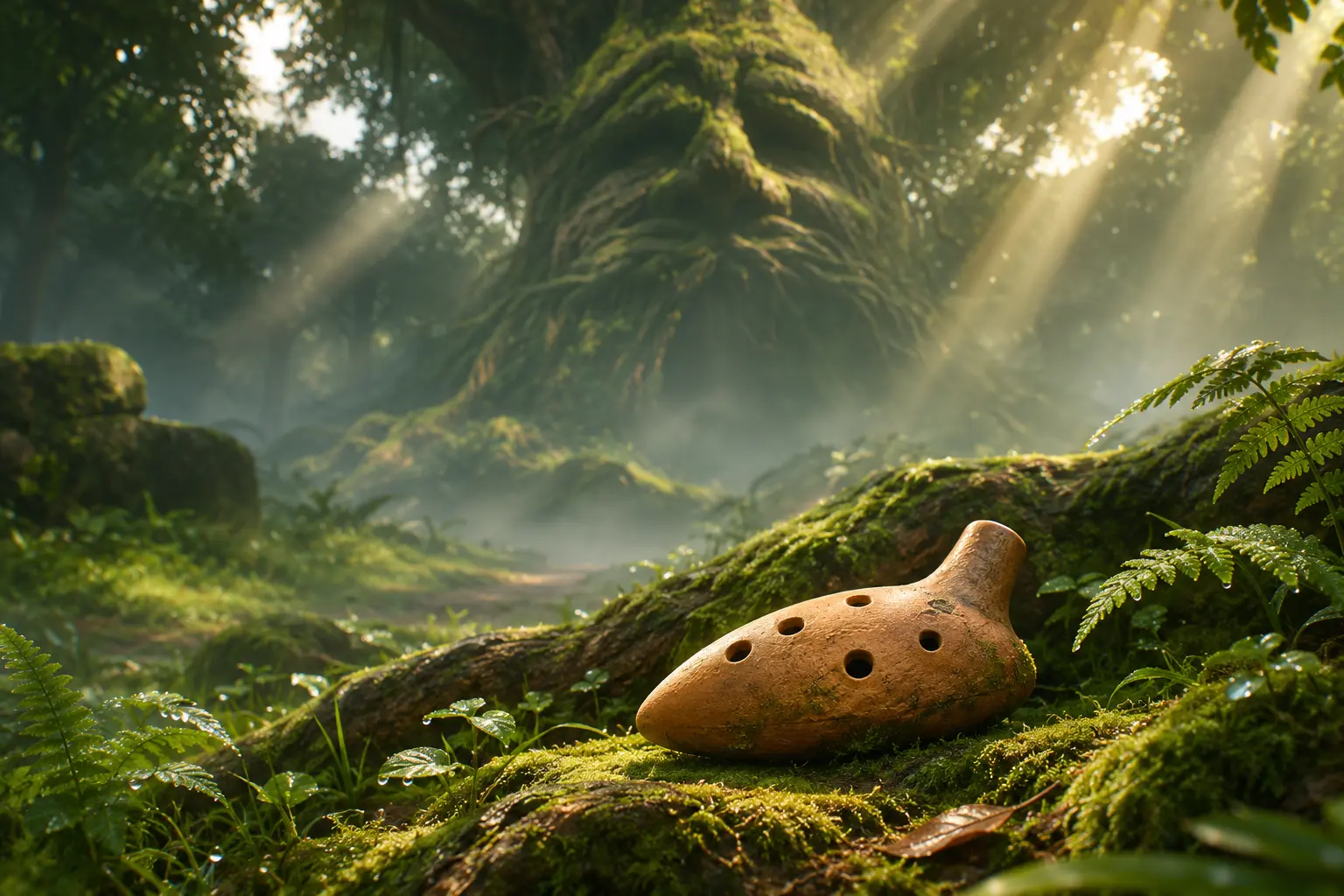
The $50 Ocarina You Do Not Blow Into
If the trailer makes you want an instrument in your hands, Nintendo’s US store has an answer that is almost a joke. The Electric OCARINA OF TIME for $49.99 ships November 5, the same day as the game. The listing is marked sold out. Nintendo’s product page is careful with the nouns.
THE TOY BESIDE THE MICROPHONE
- What it is: An electronic toy designed for the remake’s sound recognition, not a wind instrument and not a game controller.
- How you play: Press the mouthpiece button and touch the finger buttons. You do not blow into it.
- Two modes: Free Play for individual notes, and Auto-Play, which triggers 12 in-game songs with one button.
- In the box: Volume dial, headphone jack, and a stand. Three AA batteries and a screwdriver are not included.
So the accessory built for “bringing the ocarina magic into your real world” is a $49.99 sound box that can fire the songs for you. Aonuma also showed a playable ocarina during the Direct, a real mouthpiece this time, and Nintendo has still not posted a price or a firm US date for that one. HORI, which makes the electric model, already announced it on its US account in mid-September. The cheaper, louder object won the store page.
Why the Jump Button Changes Old Rooms
Humming is optional. Movement is not. Nintendo’s UK page tells you to cover long distances with a new dash and to “freely leap over gaps and obstacles with the push of a button.” On the N64, Link hopped when he hit a ledge. Here you decide. Hands-on previews put the ocarina and the Iron Boots on the D-pad, and they describe a sprint that starts when you hold the roll. People who already know Hyrule Field will keep backwalking anyway. The dash is a short burst, not a new gait.
Puzzles have been retuned around that jump. Early rooms that used auto-jump now ask for a button press, including a raised chest in the Kokiri Sword sequence. The Water Temple, long the series’ least loved bit of boot-swapping, lets you park the Iron Boots on a face button instead of opening the pause grid. Gyro aiming returns from the 3DS version. A right stick now moves the camera. Nintendo also left the old control scheme available for anyone who wants the 1998 habits back.
THREE VERSIONS OF THE SAME ADVENTURE
| System | N64 (1998) | 3DS (2011) | Switch 2 (2026) |
|---|---|---|---|
| Jump | Automatic at ledges | Automatic at ledges | Dedicated jump button |
| Fast movement | Roll chains | Roll chains | Dash after a roll |
| Camera | Z-centering | No free right stick | Free right-stick camera |
| Gyro aiming | No | Yes | Yes |
| Ocarina input | Face buttons | Buttons and touch | Buttons, humming, or an instrument |
| Quest log | None | Sheikah Stone hints | Threads of Time |
| Boss rematches | None | Boss Challenge | Hall of Fallen Heroes |
| Master Quest | No | Yes | Not listed |
| Voiced cutscenes | Text only | Text only | Fully voiced, silent Link |
Nintendo has not put Master Quest on the Switch 2 feature list. The 3DS cart still holds that inverted dungeon set, plus a Boss Challenge mode this remake replaces with something with a grander name. Hands-on reports have described the new build running at 60 frames per second, and three HUD profiles (Normal, Pro, Master) that strip the screen down in steps. Loading screens between major regions stay in on purpose. You still cannot climb a cliff and skip the next temple.
Threads of Time Does the Remembering
The original Ocarina of Time expected you to remember who wanted what. There was no quest log. Nintendo’s UK page now points lost players at a menu.
Not sure where to go next? Consult the Threads of Time to recap the story so far, see your current objectives and admire a grand tapestry that chronicles Link’s journey.
Nintendo UK, Ocarina of Time Switch 2 product page
The tapestry fills in as you go, a picture of the adventure instead of a trail of map pins. That is a gentler kind of help than Breath of the Wild’s waypoint arrows, and it is still a machine doing a job your memory used to do. Time of day is less gentle. “Time passes no matter where you are in this game,” the same page says, so indoor rooms and dungeons no longer freeze the clock. New faces, and new foes, can show up after dark in places the N64 kept still.
Navi is still in the party. Preview footage has her talking less out loud and putting more of the nagging into silent text bubbles, which is one way to keep the fairy without the old soundtrack of “Hey!” on a loop. She is no longer the only guide in the pause menu.
A Hall of Statues for Every Boss You Beat
The other new room Nintendo named in the October 14 post is the Hall of Fallen Heroes, “a place where statues of defeated monsters reside.” You go there to read about them, or to fight them again. Preview coverage has the hall tracking best times, which turns a one-shot temple boss into a scoreboard. The 3DS already had Boss Challenge. This version hangs the same idea in a museum and ties it to lore text.
That is extra game for people who already know every door in the Fire Temple. It is also a small admission that a 28-year-old dungeon crawl needs a reason to linger after the credits. The statues only appear for monsters you have actually beaten, so the hall is a trophy case first and a fighting pit second. Rematches will not help anyone who is still stuck on the first visit.
What Zelda Notes Adds on Day One
Zelda Notes, the companion layer inside the Nintendo Switch App, arrived with the Switch 2 editions of Breath of the Wild and Tears of the Kingdom. Ocarina of Time gets its own set. Producer Hidemaro Fujibayashi walked through it in the Direct. A Nintendo Switch Online membership is not required. You do need a Nintendo Account, a compatible phone, and an internet connection.
WHAT THE PHONE ACTUALLY HOLDS
- Today’s Record: A dated list of what you did, with automatic screenshots, plus counts for enemies, deaths, hearts lost, rupees, and distance.
- Gossip Quests: Photo clues that send you to spots in Hyrule. Points from those hunts buy ocarina sheet music.
- Play Ocarina: A virtual instrument on the phone, including original melodies you can share as QR codes.
- Ocarina of Time Quiz: A pool of over 2,000 questions, free once a day, with extra tries paid in rupees sent over from the game.
The app also surfaces the Hall of Fallen Heroes, Threads of Time, a map, a photo studio, and amiibo tracking. Nintendo is not charging extra for that layer, and it is still another screen between you and a 1998 dungeon. Two new amiibo, Young Link and Young Zelda, arrive in 2027 and unlock “in-game masks that evoke a retro graphical style.” Existing Legend of Zelda amiibo already give in-game extras if you tap them on launch day. The figures that actually paint the old polygons back onto Link are a year out.
The 1998 Game Is Already on the Same Screen
None of this replaces the copy a lot of Switch owners already have. The N64 original has been in Nintendo Switch Online’s Expansion Pack library since 2021, and it still runs on Switch 2. That is a different situation from the five N64 games that remain off Switch Online. You can play the auto-jump version on the same television the remake wants $59.99 to rewrite.
THE 40TH ANNIVERSARY CALENDAR
- September 8, 2026: Zelda 40th Anniversary Direct. Aonuma hums Zelda’s Lullaby. Release date set for November 5.
- October 14, 2026: Overview trailer. Nintendo names the Hall of Fallen Heroes and repeats the microphone pitch.
- October 29, 2026: The Legend of Zelda 40th Anniversary Edition Switch 2 goes on sale, game sold separately.
- November 5, 2026: The remake and the Electric OCARINA OF TIME share a launch date.
- November 23, 2026: Last day, 11:59 p.m. PT, to buy digital and still claim the 40th anniversary wallpaper.
- 2027: Young Link and Young Zelda amiibo, with the retro masks.
Buy the download before that November 23 cutoff and Nintendo emails a My Nintendo link for the wallpaper after the window closes. First-print boxed copies use textured foil cover art while supplies last. There is no collector’s edition bundled with the game itself. The $10 gap between $59.99 digital and $69.99 physical is the whole premium for a cartridge and a box.
Button controls still play every song. The microphone is a side door, and the $49.99 toy that auto-plays 12 of those songs is already marked sold out. The jump button stays in the room either way, and so does the 1998 original on the N64 app, for anyone who would rather hop at the ledge than hum into a mic.

Xiaomi 18 Pro Goes Global as Its Privacy Filter Falters

iFixit Finds HomeView Glued Shut After Repair Gains

Polymetallic Nodules Shelter 4,139 Animals Miners Want

One UI 9.5 Puts Now Brief Behind a System Agent

Framework’s $99 Keyboard Brings Laptop Repair to the Couch

Microsoft 365 Auth Fault Took Down Exchange and Teams

OpenClaw 2.0 Ships a Team Workplace With Host-Trust Defaults

Xbox Caps Game Pass Cloud Gaming at 15 Hours

OpenAI Unveils GPT-6 Astra With a Critical Cyber Label

Squishy Dumpling Toys Recalled After Hiding Illegal Water Beads
-
 NEWS3 months ago
Microsoft 365 Auth Fault Took Down Exchange and Teams
-
 GAMING3 months ago
Xbox Caps Game Pass Cloud Gaming at 15 Hours
-
 NEWS3 months ago
OpenClaw 2.0 Ships a Team Workplace With Host-Trust Defaults
-
 NEWS3 months ago
OpenAI Unveils GPT-6 Astra With a Critical Cyber Label
-
 LIFESTYLE3 months ago
Squishy Dumpling Toys Recalled After Hiding Illegal Water Beads
-

 BUSINESS3 months ago
Diesel Breaks Its Record as the White House Claims Credit
-
 NEWS3 months ago
IFA 2026’s Weird Gadgets Are Building a Sensor Home
-

 BUSINESS3 months ago
ChargePoint Stock Rally Prices Wilmer’s Three-Year Cash Plan