
NEWS
Starship Returns From Orbit and Hands Over Its Heat Shield
SpaceX caught Ship 42 after 14 orbits, giving engineers a flown heat shield on the pad, while the Version 3 booster still failed to return.

SpaceX caught Starship Ship 42 in the Starbase tower’s arms at about 3:21 p.m. CST on 14 November 2026, after 14 orbits and about 22 and a half hours away. It was the first time a Starship returning from orbit had been caught.
Booster 22, the first Version 3 Super Heavy aimed at a catch, diverted to the Gulf of Mexico minutes after Friday’s liftoff and never reached the tower.
Ship 42 in the Tower After 14 Orbits
The 407-foot (124-meter) stack left Pad 2 at Starbase, Texas, at about 4:47 p.m. CST on 13 November 2026. Ship 42 separated cleanly, reached about 275 km, and put 26 Starlink V3 satellites into orbit, three of them carrying cameras aimed at the heat shield. SpaceX commentator Dan Huot, watching the ship hang in the arms on Saturday, dragged out the line the webcast had been waiting for.
Can you believe it? Look at her! Baby, she’s back!
Dan Huot, SpaceX commentator, on the Flight 15 webcast
SpaceX posted the catch itself in one sentence, with the tower-cam video behind it.
Mechazilla catches Starship! Congratulations to the entire SpaceX team on this incredible achievement! pic.twitter.com/YJzmGUZb2B
— SpaceX (@SpaceX) November 14, 2026
FLIGHT 15 FROM TEXAS TO THE TOWER
- 13 November 2026, about 4:47 p.m. CST: Lifts off from Pad 2 with Booster 22 and Ship 42.
- Minutes after staging: Diverts Booster 22 to an offshore splashdown in the Gulf.
- 13 November 2026, evening: Reaches orbit at about 275 km and finishes deploying all 26 Starlink V3 satellites in about 42 minutes.
- 14 November 2026, about 2:25 p.m. CST: Relights a single Raptor for the deorbit burn, then hits reentry at about 2:58 p.m. CST.
- 14 November 2026, about 3:21 p.m. CST: Flips onto three Raptors and settles into the tower arms, the first ship catch.
This was the 15th full-scale Starship flight since 2023 and only the second trip to orbit. The planned catch time was T+22:32:34. SpaceX’s post landed within a minute of that mark.
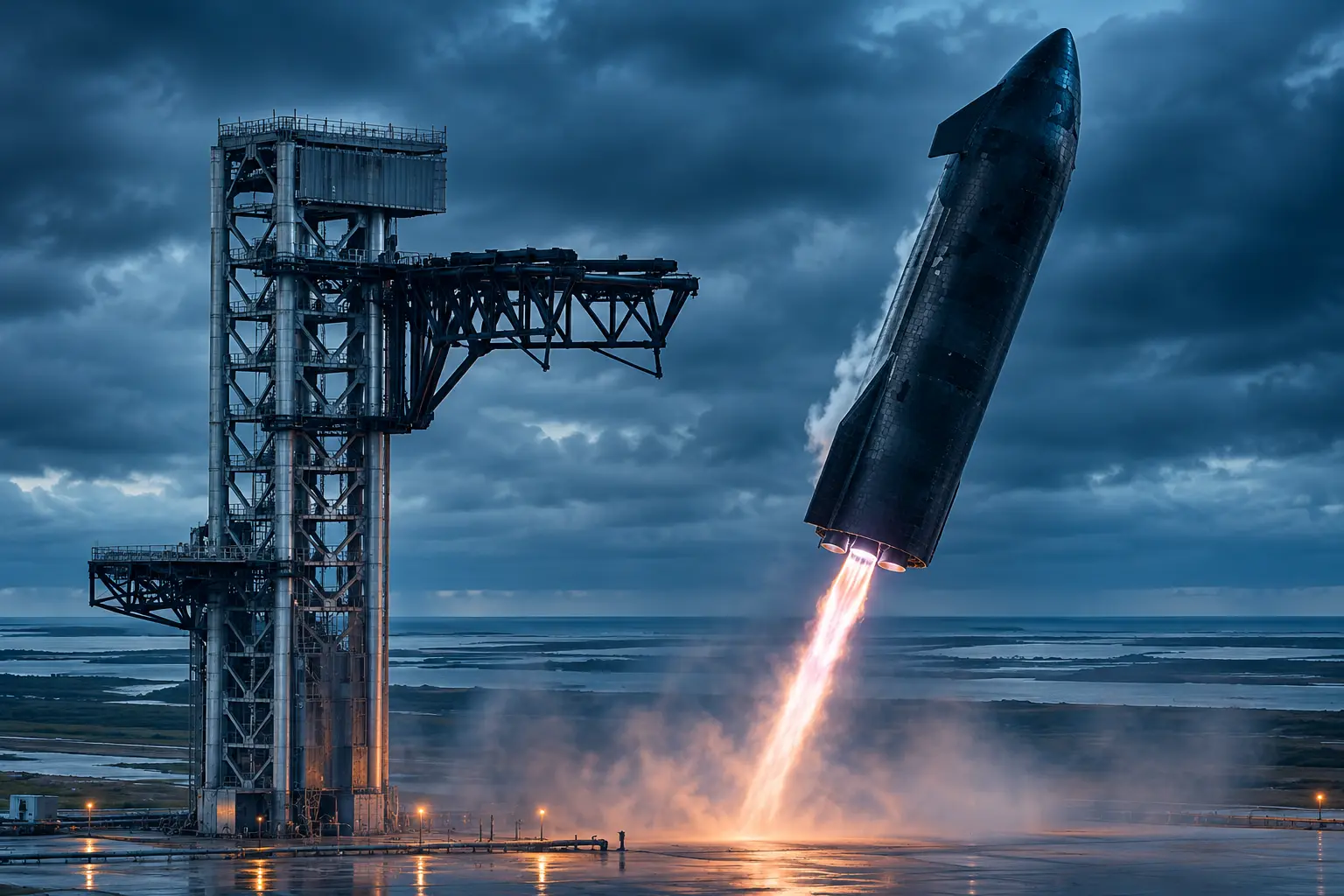
The Heat Shield Is What Engineers Get to Touch
The picture is a rocket hanging in a steel claw. The product is a heat shield that has been to orbital speed and is now sitting still, dry, and in reach. Earlier ships that survived came down in the ocean. Ship 40 even gave the company tiles to pull after a long soak in the Indian Ocean. A tower catch is a different kind of sample: the whole vehicle, the same afternoon, with no salt water in the gaps.
SpaceX would not send Ship 42 over land until that shield cleared a set of gates. Three of the newly deployed satellites photographed it from orbit. Ground cameras filled in the rest. Late on 13 November the company said the ship and its heat shield were healthy, and that the flight team still had to confirm reentry, the landing burn, and the tower approach before a catch was allowed. On 14 November it called the shield healthy again and committed to Starbase instead of a Pacific abort.
HEAT SHIELD GATES BEFORE THE ARMS CLOSED
- Camera satellites: Three of the 26 Starlink V3 spacecraft flew with cameras to scan the tiles from orbit before any overland return.
- Ground optics: Tracking cameras on the coast were used with those images to judge whether tiles had stayed put.
- Flight 14 hardware: Ship 42 flew extra tile-retention hardware, plasma-path fixes, and more curved tiles meant to cut heating in the gaps.
- Go for catch: SpaceX cleared the ship only after the reentry, landing-burn, and tower-approach systems all looked healthy.
A caught ship still has to fly again before reuse is a fact. What Saturday changed is the inspection loop. Engineers can now walk the flown tiles, mark what cracked or shifted, and feed that into the next stack without waiting on a recovery ship.
Why a Ship Catch Is Harder Than a Booster Catch
A Super Heavy booster turns around about two and a half minutes after liftoff and is back in about seven minutes, coming in over water. The ship stays up, circles Earth, then has to dump orbital energy as heat, cross Mexico and South Texas, belly-flop on four flaps, and light three engines for a flip that lasts about 18 seconds. The arms have to close on two catch fittings below the flaps in that window, and the last engine shuts down on contact.
The Shuttle already flew a winged orbiter back to a runway, so this is not the first time hardware that went to orbit has come home. It is the first time Starship’s upper stage has come home to the same tower that launched it, with no landing legs, after a night on orbit. That is a narrower feat, and a stranger one. The landing burn has less engine spare than a booster catch, which can open on as many as 13 Raptors. The ship has three.
Elon Musk has put a rapidly reusable heat shield on a par with the hardest remaining problems on the vehicle, because a tile-by-tile inspection cannot be the turnaround. Saturday does not end that argument. It does end the era in which every honest look at a flown Starship heat shield started with a splashdown.
A Low Fuel Mass Ended the Double Catch
The plan was to catch both stages. Booster 22 was the first Version 3 Super Heavy booked for that trick. After hot staging, SpaceX said the booster relit 32 of 33 planned Raptors for the boostback burn, then the burn stopped short. The company’s low fuel mass on boostback note is the working cause, with the root still under investigation. Guidance then ran an automated abort, sent the booster to an offshore landing burn, and the flight termination system fired at shutdown.
Wreckage stayed in the Gulf, marked off by buoys. Recovery teams were on the water the next morning, and SpaceX said its environmental team would pick up anything that washed ashore. The three booster catches already in the log were all earlier-generation vehicles on Flights 5, 7, and 8. Version 3 still has not been caught.
That gap is the cadence tax. Rapid reuse needs the cheap, heavy first stage back on the mount, not only the ship in the arms. Friday showed the new booster can still throw the catch away on the way home.
NASA’s 2028 Landing Runs Through This Pad
NASA is paying for a lander that can fly, come back, and fly again, not for a single catch video. The agency’s $2.89 billion firm-fixed-price contract, awarded on 16 April 2021, funds a Starship human landing system. Under the revised 2028 plan, SpaceX would loft tanker Starships in low Earth orbit to fill a depot, then fuel the lander. That lander would meet Orion in Earth orbit and push the stack toward the Moon. Two crew would go down; two would stay on Orion.
Artemis III, aimed at 2027, is now an Earth-orbit docking rehearsal with test versions of both Starship and Blue Origin’s Blue Moon. Neither company is assigned the first 2028 landing. NASA says it will pick on readiness. Administrator Jared Isaacman, writing after the catch, did not wait for that choice to cheer the hardware.
It was almost magic. Making more believers by the day.
Jared Isaacman, NASA Administrator, on X
A Moon lander still has to do work this flight did not try: cryogenic transfer in orbit, an uncrewed lunar demo, and a cabin NASA can certify. A heat shield you can inspect on the pad is one of the gates those later flights have to pass. A Version 3 booster you cannot catch is another.
Three Booster Catches, Then One Ship
The tower, nicknamed Mechazilla, had already proven it can grab a returning Super Heavy. It had never grabbed the ship. Flight 14, the first Starship flight to reach orbit, put 26 Starlink V3 satellites on the line on 28 September 2026 and ended with a Pacific splashdown after about 3 hours 10 minutes. Seven weeks later the same payload class flew again, stayed up through 14 orbits, and came back to Pad 2.
STARSHIP TOWER CATCHES AND ORBITAL RETURNS
| Flight | Date | Vehicle | Result |
|---|---|---|---|
| Flight 5 | 13 October 2024 | Super Heavy | First booster catch |
| Flight 7 | 16 January 2025 | Super Heavy | Second booster catch |
| Flight 8 | 6 March 2025 | Super Heavy | Third booster catch |
| Flight 14 | 28 September 2026 | Ship 41 | First orbit; Pacific splashdown |
| Flight 15 | 13-14 November 2026 | Ship 42 / Booster 22 | First ship catch; booster diverted |
SpaceX said after the catch that the flight showed full reusability. The log on the table is thinner than that sentence. Four tower catches exist, three of them boosters from an older generation, and one ship that has not been stacked for a second flight.
Starship Still Has Not Flown From Florida
NASA’s next crewed path starts at Kennedy Space Center, not at the Texas Gulf. SpaceX has been turning Launch Complex 39A into a Starship pad with its own catch tower, and on 5 November 2026 the pad ran a full water-deluge test. No Starship has left Florida. The company has said it expects to start launching from there in the coming months, which is also the neighborhood of the Artemis rehearsal work.
Until a Version 3 booster can come back as cleanly as Ship 42 just did, a second pad mostly adds a second place to lose hardware. Saturday still moved the thing NASA actually bought. A ship that has been around the Earth 14 times is hanging on the tower at Pad 2, and the people who have to make the tiles last through a Moon run can finally put their hands on it. Musk said he was inspecting Ship 42 after the catch. The booster’s wreckage stayed in the Gulf.
Frequently Asked Questions
Did SpaceX Catch the Super Heavy Booster on Flight 15?
No. Booster 22 was the first Version 3 Super Heavy planned for a catch, and all three earlier catches were older boosters on Flights 5, 7, and 8. After the abort it hovered through a landing burn over the Gulf, the flight termination system fired at shutdown, and SpaceX later posted it floating on its side while recovery crews worked the site.
Why Does Starship Land in Tower Arms Instead of on Legs?
Super Heavy has no landing legs, which saves mass for payload and lets the booster sit back on the same mount it left. The ship is 52 m tall and the booster is 72 m, both 9 m wide, and SpaceX ran squeeze tests on Ship 39 to mimic catch loads before any ship was flown into the arms. The fittings sit just below the forward flaps, not on the grid fins.
How Does NASA Plan to Use Starship for Artemis?
Both SpaceX and Blue Origin must fly an uncrewed lander demo before a crewed 2028 landing, and SpaceX is adding two Cabin 1 crew-cabin demonstrations. NASA is modifying Orion so Starship can push it from Earth orbit toward the Moon, and the first surface missions are scoped for two moonwalks of about two hours each in Axiom suits near the lunar South Pole.
What Payload Did Starship Flight 15 Deploy?
All 26 Starlink V3 satellites reached orbit, SpaceX made contact with every one, and they began raising their orbits to join the constellation. The company says each V3 satellite adds 1 terabit per second of capacity, which is the class of spacecraft Starship is meant to haul in volume once the ship and booster both come home.

Xiaomi 18 Pro Goes Global as Its Privacy Filter Falters

iFixit Finds HomeView Glued Shut After Repair Gains

Polymetallic Nodules Shelter 4,139 Animals Miners Want

One UI 9.5 Puts Now Brief Behind a System Agent

Framework’s $99 Keyboard Brings Laptop Repair to the Couch

Microsoft 365 Auth Fault Took Down Exchange and Teams

OpenClaw 2.0 Ships a Team Workplace With Host-Trust Defaults

Xbox Caps Game Pass Cloud Gaming at 15 Hours

OpenAI Unveils GPT-6 Astra With a Critical Cyber Label

Squishy Dumpling Toys Recalled After Hiding Illegal Water Beads
-
 NEWS3 months ago
Microsoft 365 Auth Fault Took Down Exchange and Teams
-
 GAMING3 months ago
Xbox Caps Game Pass Cloud Gaming at 15 Hours
-
 NEWS3 months ago
OpenClaw 2.0 Ships a Team Workplace With Host-Trust Defaults
-
 NEWS3 months ago
OpenAI Unveils GPT-6 Astra With a Critical Cyber Label
-
 LIFESTYLE3 months ago
Squishy Dumpling Toys Recalled After Hiding Illegal Water Beads
-

 BUSINESS3 months ago
Diesel Breaks Its Record as the White House Claims Credit
-

 NEWS3 months ago
IFA 2026’s Weird Gadgets Are Building a Sensor Home
-

 BUSINESS3 months ago
ChargePoint Stock Rally Prices Wilmer’s Three-Year Cash Plan