
BUSINESS
Target’s Strongest Sales in Years Still Skip Apparel
Target raised its 2026 sales forecast after 7.1 percent growth, but apparel still fell 3.8 percent and tariff refunds lifted earnings.

Target on November 18 posted a 7.1 percent jump in quarterly sales to $27.1 billion, its strongest growth in half a decade, and raised its full-year forecast. Comparable sales rose 5.6 percent. Apparel, the category that built the brand, still fell 3.8 percent.
Chief Executive Officer Michael Fiddelke called it progress built on style, design and value. The print says something narrower: more trips, cheaper baskets, a boom in trading cards, and a $301 million tariff refund sitting inside the profit line.
Traffic Came Back, but the Mix Did Not
The quarter ended October 31. Net sales of $27.1 billion compared with $25.3 billion a year earlier, a third straight period of growth after a 2.7 percent comparable-sales drop in the same stretch of 2025. Store comps rose 4.6 percent and digital comps rose 9.8 percent, with comparable sales growth of 5.6 percent beating a 3.5 percent LSEG compilation.
Almost all of that comparable gain was traffic, up 5.0 percent. Average tickets rose only 0.6 percent. Guests came more often. They did not spend much more once they were in the aisle.
GAAP and adjusted earnings were $2.65 a share, against $1.51 GAAP and $1.78 adjusted a year ago, topping a $2.07 estimate. Net earnings were $1.21 billion, up 75.8 percent from $689 million. Operating income was $1.67 billion, up 76.4 percent from $948 million. Shares rose about 4 percent on November 18.
Fiddelke, who took over on February 1, 2026, to succeed Brian Cornell as chief executive officer, said guests are choosing Target more often. Sales grew in all three months, strongest in back-to-school, then slower in October, then faster again in November, tracking in line with the company’s plan.
Collectibles, Grocery and Beauty Carried the Quarter
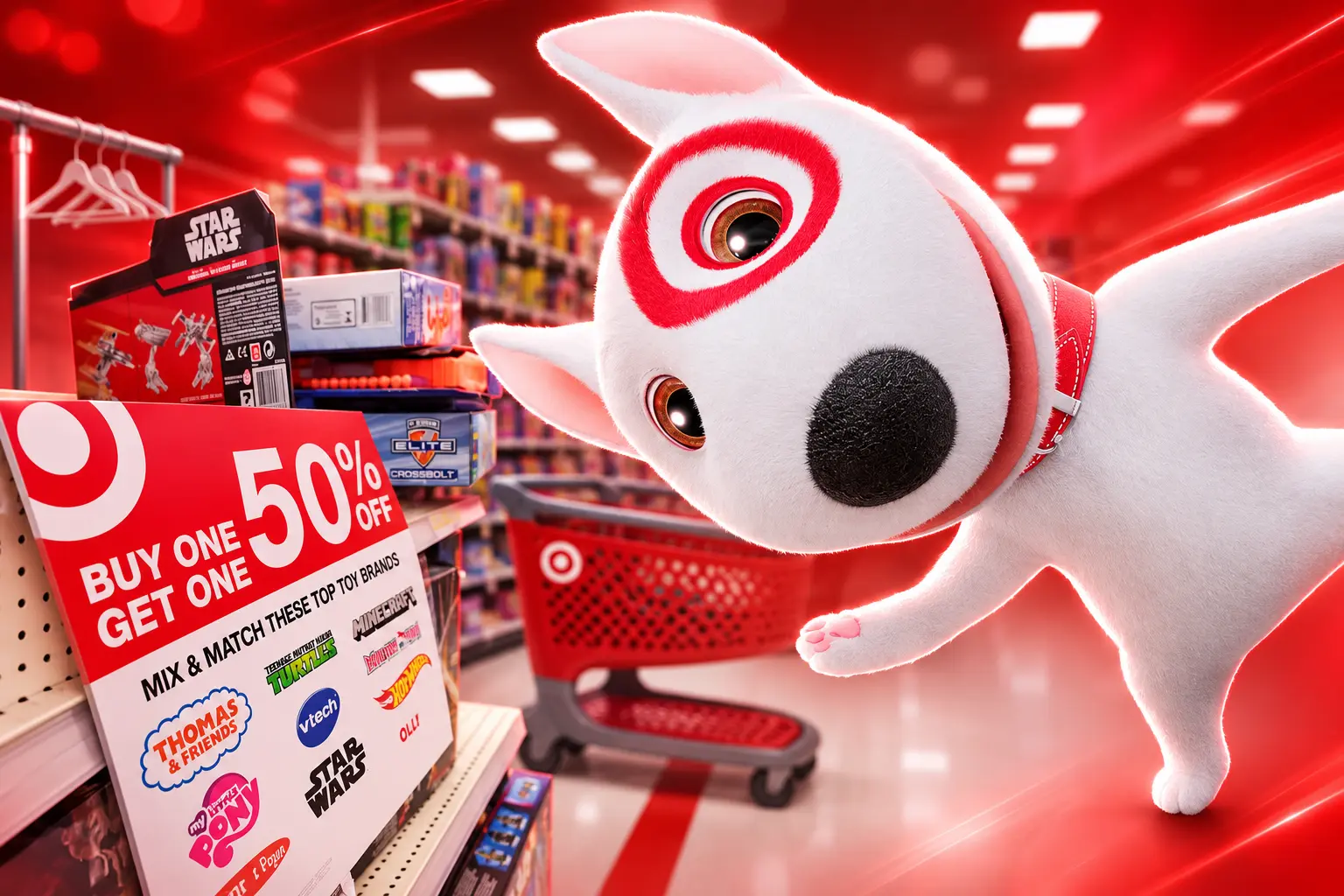
Fun 101, Target’s name for hardlines, jumped 26.8 percent and added more than $850 million in sales. Chief Financial Officer Jim Lee said trading cards made up about 40 percent of that category’s high-teens growth for the year to date, and that Fun 101 was still growing at a double-digit pace without the cards. Official highlights pointed to record Pokémon sales, the Heyday electronics brand, and Fan Shops rebuilt in more than 1,600 stores with nearly double the space.
Food and beverage rose 6.6 percent to $6.41 billion after a reset of about half the center-store grocery set, with more than 2,000 new food items in the quarter. Snacks, candy and drinks have grown nearly 10 percent since that reset. Beauty rose 9.1 percent to $3.53 billion, and Target Beauty Studio is now in more than 600 stores after the Ulta shop-in-shop deal ended.
WHERE THE $27.1 BILLION ACTUALLY CAME FROM
| Category | Q3 sales | Change vs 2025 |
|---|---|---|
| Food and beverage | $6.41 billion | +6.6% |
| Beauty | $3.53 billion | +9.1% |
| Fun 101 (hardlines) | added more than $850 million | +26.8% |
| Home furnishings and decor | $4.0 billion | +2.5% |
| Apparel and accessories | $3.69 billion | -3.8% |
Gross margin expanded 2.3 percentage points to 30.5 percent. The company said 1.1 points of that came from tariff refunds, and that the remaining 1.2 points, against a 28.2 percent year-ago rate, still had to absorb higher freight, the cost of cutting prices, and “modest pressure from category sales mix.” The mix that is growing is not the mix that used to pay the rent.
The Aisles That Made Target Famous Still Lag
Apparel and home together are about 30 percent of merchandise sales. Home furnishings and decor eked out a 2.5 percent gain, to about $4.0 billion, after Fiddelke called the rebuild a multiyear job. Apparel and accessories fell 3.8 percent to $3.69 billion from $3.84 billion, and apparel is about flat for the year to date.
Fiddelke told analysts those two businesses “have made us famous” and remain challenges. He said the company has made progress and is not satisfied, and on a media call he put it shorter: “We haven’t arrived.”
We lost focus on some of the foundational pieces our guests count on. That’s on us.
Cara Sylvester, Chief Merchandising Officer, Q3 2026 earnings call
Sylvester said the miss sits in women’s fashion and shoes, which she called significantly underperforming. Men’s, kids’, swim and some women’s categories are growing. In women’s fashion, she said the assortment and price map got too complex, and fit, fabric and quality were not consistent enough. Target plans to cut style counts by about 20 percent and lower prices on hundreds of items, with the first signs expected in spring 2027.
Where money has already been spent, the company likes the early reads. More than 75 percent of the bedding assortment is new and priced about 15 percent lower. Sylvester said bedding, bath and kids’ home are performing well. RBC Capital Markets analyst Steve Shemesh has said those two categories are the hardest to fix because they depend on taste and on shoppers choosing optional purchases. Morningstar analyst Brett Husslein said getting them right “will prove imperative to long-term profitability.”
How Much of the Profit Is a Tariff Refund?
Third-quarter results include $301 million of pretax refunds under the International Emergency Economic Powers Act, booked as a cut to cost of sales. Those refunds added $228 million to net earnings and $0.50 to both GAAP and adjusted EPS.
Pull that $0.50 out and EPS is $2.15. Adjusted earnings still rose 21 percent, and GAAP earnings rose 42 percent. That $2.15 also still cleared the $2.07 estimate. The sales beat does not need the refund. A large slice of the profit beat does.
THE EARNINGS WITH THE REFUND PULLED OUT
- Reported EPS: $2.65, of which $0.50 came from the $301 million pretax refund.
- Underlying EPS: $2.15, up 21 percent on an adjusted basis and 42 percent on a GAAP basis.
- Full-year guide: $10.65 to $11.40, including $2.14 already booked; without that, $8.51 to $9.26.
- Operating margin: 6.2 percent, including 1.1 percentage points from refunds, versus 3.8 percent GAAP and 4.4 percent adjusted a year ago.
The new full-year outlook is $10.65 to $11.40 a share, up from $9.90 to $10.90. The raised range includes $2.14 of refunds recognized through nine months, after $1.65 in the prior guide; the extra 49 cents is roughly the third-quarter refund. Target said the outlook excludes any further refunds. Full-year operating margin is now seen around 6.2 percent, including that 1.1-point benefit, after a prior view around 6 percent including 90 basis points.
Adjusted SG&A ran at 21.9 percent of sales, matching last year’s GAAP rate and up from a 21.3 percent adjusted rate, as incentive pay, extra store hours and new-store costs offset the leverage of a bigger top line. Inventory was $16.1 billion, up 8 percent, which the company tied to holiday stock and fuller shelves.
Price Cuts Bought More Trips, Not Bigger Baskets
The traffic recovery is the part of the quarter that does not need an asterisk. Target lowered prices on nearly 2,000 items in home, apparel and accessories during the quarter, on top of thousands of cuts over the past year. On-shelf availability improved by a full percentage point. Same-day services now make up two-thirds of digital volume, Same-Day Delivery reaches 80 percent of the U.S. population and is growing twice as fast as Order Pickup and Drive Up, and next-day shipping shows up twice as often at checkout as it did a year ago.
Non-merchandise sales, Roundel ads, Circle Card profit sharing, Circle 360 membership and the Target+ marketplace, rose 19.3 percent. Merchandise sales rose 6.9 percent. The company opened 32 stores in 2026, the most in a year since 2009, entered 11 new markets, reached nearly 2 million more guests and added more than 5,000 jobs. More than 130 stores got full remodels. Third-quarter capital spending was $1.4 billion, $0.4 billion higher than a year earlier. Trailing twelve-month return on invested capital was 16.5 percent, up from 13.4 percent.
That is a lot of payroll, concrete and markdowns to buy a 5.0 percent traffic gain and a 0.6 percent ticket gain. It worked on frequency. It has not yet rebuilt the fashion ticket.
Store Spending Rises Again for 2027
Target lifted its 2026 net sales growth outlook by one point, to around 6 percent, and said it will spend $5 billion to $6 billion of capital in 2027 after about $5 billion in 2026. The next dollar is going into stores, supply chain and tech before women’s fashion is scheduled to show even early progress.
The holiday floor is being set on the same value math that produced the traffic. More than 8,000 new gifts are in, over half exclusive to Target, most of them $20 or less, including thousands at $5 and under. Early Black Friday deals run through December 24. Ask Target, the company’s AI shopping tool, is part of the pitch. Seasonal space is slated to become a “Christmas Morning Magic Destination” in early December.
WHAT TARGET IS PUTTING ON THE HOLIDAY FLOOR
- New gifts: More than 8,000 items, over half exclusive, with most new holiday goods at $20 or less and thousands at $5 and under.
- Thanksgiving bundle: A $30 meal for six, the same $5-a-person tag as last year, with Good & Gather frozen turkey at 79 cents a pound.
- Deal window: The meal offer runs November 8 through November 29, before tax, and is not valid in Alaska or Hawaii.
- Store labor: Extra hours and training, plus a one-point gain in on-shelf availability, are meant to keep the traffic that price cuts already bought.
November net sales, as of the November 18 call, were in line with guidance and accelerating from October. The company also paid $527 million of dividends, $1.16 a share, and bought back $251 million of stock, 1.6 million shares at an average $155.49, with $8.0 billion left on the 2021 authorization.
The holiday quarter will test whether guests who came back for Pokémon packs, protein snacks and a $30 turkey bundle will walk over to the rack. Fiddelke has said the company needs more momentum in apparel and home. The first fashion fix he is willing to date is spring 2027, after the season this raise is betting on.
Frequently Asked Questions
When Did Michael Fiddelke Become CEO of Target?
Fiddelke became chief executive officer and a director on February 1, 2026, after a 20-year career at the company that included the chief operating officer job. Brian Cornell, CEO for the prior 11 years, moved to executive chair the same day. Fiddelke’s board-set package includes a $1.30 million base salary and a 200 percent short-term incentive target.
What Is Fun 101 in Target’s Sales Results?
Fun 101 is Target’s internal name for hardlines, the toys, electronics, entertainment, sporting goods, gaming, music and books business. It was the fastest-growing major category in the third quarter, and Lee said it was still growing at a double-digit pace even after stripping out trading cards, which supplied about 40 percent of the category’s high-teens year-to-date growth.
What Are the IEEPA Tariff Refunds in Target’s Earnings?
They are cash refunds tied to tariffs imposed under the International Emergency Economic Powers Act. Target recorded $301 million of them in the third quarter as a reduction of cost of sales, which flowed through gross margin and operating income and added $0.50 a share. Full-year guidance includes $2.14 of refunds already recognized and explicitly excludes any future refunds.
What Is in Target’s $30 Thanksgiving Meal for Six?
The bundle, announced October 22, is a Butterball Premium Whole Young Turkey up to 10 pounds plus russet potatoes, jellied cranberry sauce, two cans of French-style green beans, cream of mushroom soup, French fried onions, turkey stuffing mix, turkey gravy and two take-and-bake baguettes. Target is also selling Good & Gather frozen turkey at 79 cents a pound for the third straight year. Prices are pre-tax.
Disclaimer: This article is news reporting and analysis of Target’s published third-quarter results and outlook, and it is for information only. It is not investment advice, a recommendation to buy or sell Target stock, or a forecast of holiday or full-year results. Readers who are considering a trade or a change in holdings should consult a licensed financial adviser or other qualified professional who can review their own situation. Sales figures, earnings, refund amounts and guidance are taken from Target’s November 18, 2026, release and related remarks and may be revised in later filings.

The Strip Bojangles That Charged $100 for 10 Minutes

The Security Fixes Took Microsoft and the NSA Offline

iOS 27 Finally Shrinks the Giant iPhone Lock Screen Clock

AirPods Pro 3 Are $179 Again, Below Last Year’s Cut

Dragon Returns ISS Samples Only It Can Bring Home

Microsoft 365 Auth Fault Took Down Exchange and Teams

OpenClaw 2.0 Ships a Team Workplace With Host-Trust Defaults

Xbox Caps Game Pass Cloud Gaming at 15 Hours

OpenAI Unveils GPT-6 Astra With a Critical Cyber Label

Squishy Dumpling Toys Recalled After Hiding Illegal Water Beads
-
 NEWS3 months ago
Microsoft 365 Auth Fault Took Down Exchange and Teams
-
 NEWS3 months ago
OpenClaw 2.0 Ships a Team Workplace With Host-Trust Defaults
-
 GAMING3 months ago
Xbox Caps Game Pass Cloud Gaming at 15 Hours
-
 NEWS3 months ago
OpenAI Unveils GPT-6 Astra With a Critical Cyber Label
-
 LIFESTYLE3 months ago
Squishy Dumpling Toys Recalled After Hiding Illegal Water Beads
-

 BUSINESS3 months ago
Diesel Breaks Its Record as the White House Claims Credit
-

 NEWS3 months ago
IFA 2026’s Weird Gadgets Are Building a Sensor Home
-
 BUSINESS3 months ago
ChargePoint Stock Rally Prices Wilmer’s Three-Year Cash Plan