
NEWS
ULA’s Vulcan Starved Its Engines and Lost 40 Satellites
After two survived nozzle failures, Vulcan died of a fuel shortage to working engines, a ULA vehicle problem that now grounds Amazon’s cadence and Space Force.

United Launch Alliance said on Nov. 18 that its Vulcan Centaur failed because the booster could not feed enough fuel to its BE-4 engines. The Nov. 15 flight from Cape Canaveral Space Force Station lost all 40 Amazon Leo satellites, ULA’s first total mission failure since the company formed in 2006.
Preliminary data put the shortfall on the booster’s fuel feed, not on Blue Origin’s BE-4 engines, the solid rocket boosters, or the Centaur upper stage.
ULA Says the Vehicle Starved Its Own Engines
ULA posted the finding at 11 a.m. EST on Nov. 18, after an initial integrated review of flight data from the Leo 1 anomaly. Work remains to determine cause, the company said, but the low booster thrust came from inadequate fuel supply from the vehicle to the BE-4 engines, not from the performance of the engines.
Vulcan Leo 1 status update: https://t.co/gZb3gTjRxG
— ULA (@ulalaunch) November 18, 2026
That wording matters because ULA builds the first-stage tanks, lines, and pressurization at Decatur, Alabama, and buys the engines from Blue Origin in Huntsville. The booster burns liquefied natural gas with liquid oxygen. Each BE-4 is rated at 550,000 pounds of sea-level thrust. ULA has not named the fitting, valve, tank, or pressurization path that failed to keep those engines fed.
Mark Peller, ULA’s president and CEO, had already described the energy state the upper stage inherited. Speaking in Arlington, Virginia, on Nov. 17, he said the rocket finished its boost phase and that Centaur V ignited, but the first stage had left it too low and too slow.
We did complete the boost phase of flight. We separated the upper stage, our Centaur V, which ignited its RL10 engines, and it was continuing on downrange. We did separate the fairing, but the booster had left Centaur off in such a low-energy state in terms of altitude and velocity that Centaur wasn’t designed for and couldn’t make up for that performance deficit, and it was unable to reach orbit.
Mark Peller, president and CEO, United Launch Alliance, in Arlington, Virginia
On the afternoon of the launch, ULA had already conceded the point in plainer language. “ULA exists to provide assured access to space for our nation and for the customers who depend on us,” the company wrote after the Launch Director’s data came in. “Today, we did not meet that standard.”
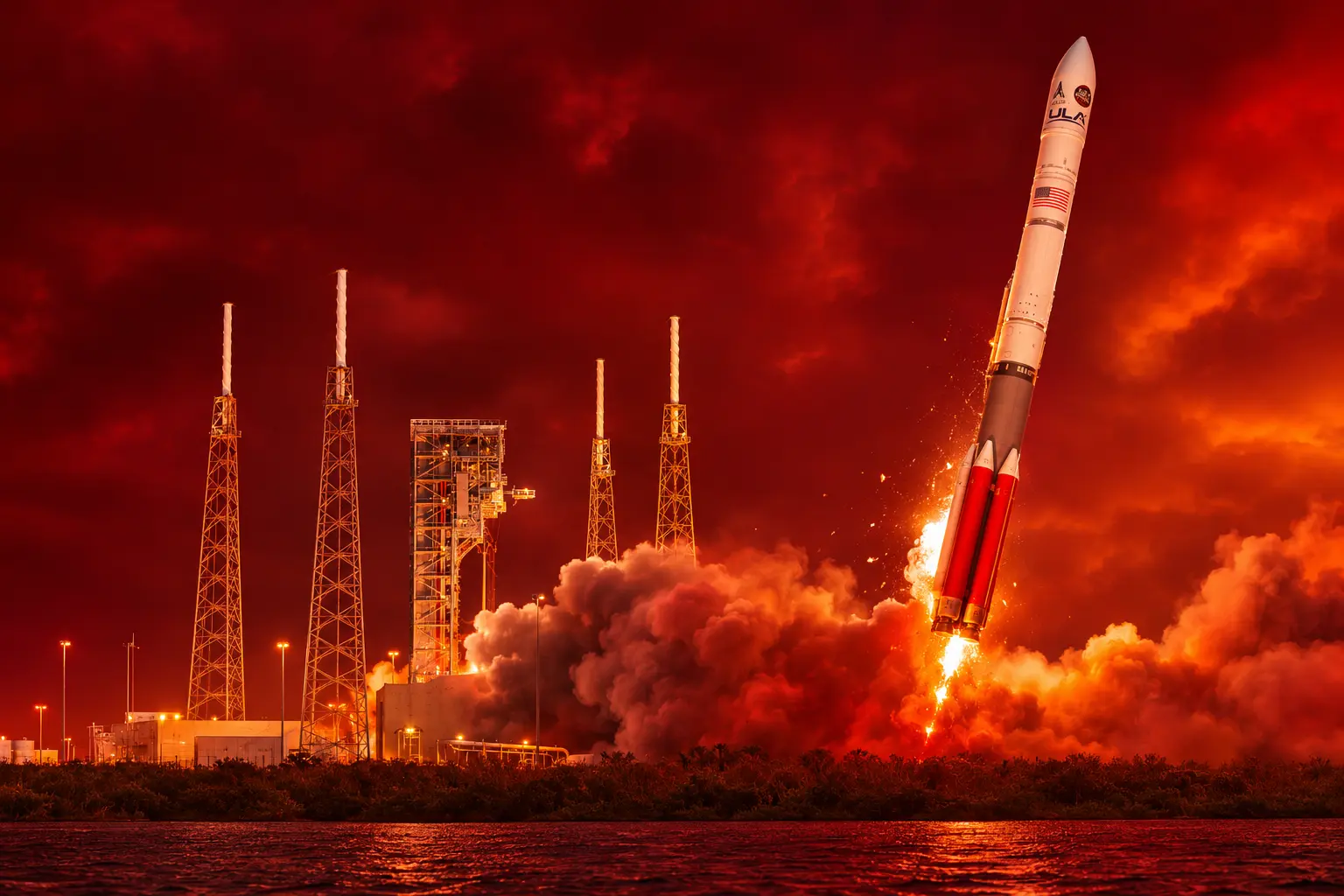
Six Clean Solids and a Centaur That Could Not Catch Up
Sunday’s stack was vehicle V-012, the first Vulcan flown as a VC6L: six Northrop Grumman GEM 63XL solids, a 70-foot fairing, and a shorter Centaur V built for low Earth orbit. The rocket stood 215 feet tall and was to weigh 1.99 million pounds once fueled. ULA said the two BE-4s and six solids would generate 3.9 million pounds of liftoff thrust, with the solids supplying three-quarters of that punch at the pad.
The solids were the live question going into the flight. They were not the thing that killed it.
WHAT HELD AND WHAT DID NOT
- The solids: All six GEM 63XL boosters burned out and were jettisoned about 1 minute 35 seconds after liftoff, and ULA said their performance was nominal after the nozzle changes flown for this mission.
- The upper stage: Centaur V started as planned, its two RL10C-1-1A engines ran as designed, and the payload fairing came off, but the stage could not make up the first-stage energy deficit.
- The BE-4s: ULA and Blue Origin both say the engines themselves performed, and that the thrust shortfall was a fuel-feed problem on the vehicle side.
- The mission clock: ULA lost telemetry and the mission at about 10 minutes, during the window when Centaur was supposed to be in a nearly 12-minute burn toward a 51.9-degree parking orbit about 285 miles up.
The planned sequence never reached the 16 separation events that were supposed to release the 40 satellites over about 25 minutes. A fuel-feed shortfall on the core is also the kind of vehicle problem a booster hot fire is built to catch on the ground, and ULA has not described a full-stack firing of this first six-booster core before Sunday.
How Many Amazon Leo Satellites Did Vulcan Lose?
All 40 satellites on Leo 1 were lost, the largest number ULA had ever flown for Amazon on a single launch, and the flight was the first of 38 heavy-lift missions Amazon booked on Vulcan after eight successful Atlas V deployments. Amazon has said it has already built more than 1,000 Leo satellites, and it still plans to start initial service before the end of 2026.
AMAZON’S VULCAN STAKE
- The lost batch: 40 broadband satellites, which ULA had billed as more than 50,000 pounds of payload on a LEO-optimized Centaur about 6 feet shorter than the high-energy version, with a third less propellant.
- The Vulcan contract: 38 flights, the biggest single block in Amazon’s launch plan, after eight Atlas V missions that ULA says all succeeded.
- The licence clock: The FCC still requires 3,232 first-generation satellites by July 30, 2029, after waiving the mid-2026 halfway mark in June.
- The next attempt: Arianespace still plans 36 Amazon Leo satellites on Ariane 6 no earlier than Nov. 23 from French Guiana, the fourth Ariane 6 Amazon flight of 2026, which would bring that provider’s Leo total to 136 if it succeeds.
Amazon said it is in close contact with ULA and will support the investigation so Vulcan can return to flight, while it looks at every option that keeps the deployment schedule intact. New Glenn, on which Amazon has booked 24 Leo launches, is itself still grounded after the May 28 pad explosion. The 40 lost spacecraft do not by themselves break a network of more than 3,000 satellites. They do knock out the rocket Amazon had called its heavy-lift workhorse, on the first try.
The Space Force Was Waiting on This Commercial Flight
Vulcan is one of two rockets certified to fly the most sensitive National Security Space Launch missions, alongside SpaceX’s Falcon family. After the Feb. 12 USSF-87 flight, the Space Force paused those Vulcan missions because a GEM 63XL nozzle failed again, the same class of fault seen on the October 2024 certification flight.
Brig. Gen. Eric Zarybnisky, the service’s acquisition executive for space access, said on Oct. 21 that the Space Force would lean on flight data from commercial Vulcan missions, including Leo 1, before restoring military launches. Sunday was supposed to be that data point. The six solids flew clean. The core did not.
While Vulcan sat out those nine months, the Space Force moved multiple national security missions onto Falcon 9 and Falcon Heavy so time-critical payloads would not wait on the nozzle review. New Glenn is not available as a third certified heavy either. A commercial failure that leaves the solids looking healthy and the core looking hungry does not automatically reopen the NSSL door. It opens a different investigation the FAA now has to close first.
Two Nozzle Failures, Then a Fuel Shortage
Vulcan debuted on Jan. 8, 2024, with the Peregrine lunar lander. It has now flown five times. Anomalies showed up on three of those five flights, and Sunday was the only one that failed to deliver a payload. Peller, before liftoff, had pointed to the first four missions as proof the rocket could fly through ugly SRB environments and still hit its aim point.
VULCAN’S THREE ANOMALY FLIGHTS
| Date | Flight | Anomaly | Outcome |
|---|---|---|---|
| Oct. 4, 2024 | Flight 2, NSSL certification | A GEM 63XL nozzle came off | Reached planned orbit |
| Feb. 12, 2026 | Flight 4, USSF-87 | A GEM 63XL nozzle failed again | Reached orbit; military Vulcan flights paused |
| Nov. 15, 2026 | Flight 5, Amazon Leo 1 | Inadequate fuel to the BE-4s | 40 satellites lost |
After February, ULA, Northrop Grumman, and the Space Force ran a joint review that included lab work, component tests, and a full-scale GEM 63XL hot fire in Utah. The team listed three credible causes and changed both the nozzle design and how it was built. Those changes flew on Sunday, and ULA said the six solids were clean. The nine-month grounding had been about a strap-on that had already failed twice. The loss was about the core that was supposed to be the stable half of the stack.
Blue Origin’s Engines Leave the Hot Seat
Blue Origin’s BE-4 is also the first-stage engine on New Glenn. The May 28 vehicle at Launch Complex 36 carried seven of them and was destroyed in a hot-fire explosion that Dave Limp, Blue Origin’s CEO, later traced to the main oxygen valve on one engine. Blue Origin said on Nov. 10 that a modified valve had finished qualification, was already in engines for upcoming flights, and was being rolled out across the rest of the fleet. The two BE-4s on Vulcan Leo 1 carried that retrofit.
ULA’s Nov. 18 review, which Blue Origin said it joined, puts that valve change outside the fault. Blue Origin said the companies together identified the low booster thrust as a fuel-supply problem from the vehicle to the engines, not engine performance, and that it looks forward to Vulcan’s return to flight. Limp struck the same note in his own statement.
Sunday’s outcome was disappointing for everyone involved. In these moments, it’s important to have strong industry partnerships. I’m proud of the BE-4 team for their rapid response and support of ULA’s investigation. We’re confident in the team at ULA and look forward to Vulcan’s return to flight.
Dave Limp, CEO, Blue Origin
New Glenn’s next flight is being aimed as soon as January. A BE-4 finding on Vulcan would have landed on that date. A vehicle-side fuel finding does not. It still leaves Amazon with two of its heavy-lift providers on the ground at once, and it still leaves ULA to prove a methane feed system that has now failed in flight.
What the FAA Investigation Still Has to Pin Down
The FAA opened a mishap review on Nov. 16, will oversee the ULA-led investigation at every step, and must approve the final report, including corrective actions, before Vulcan flies again. ULA has set no return-to-flight date. The agency also activated two Debris Response Areas after the failure and briefly slowed or held aircraft outside the affected zone.
FOUR DAYS OF THE INVESTIGATION
- Nov. 15, 2026: Vulcan lifts off at 12:40 p.m. EST from Space Launch Complex 41. ULA confirms at 1:30 p.m. EST that an anomaly about 10 minutes into flight kept the Amazon mission from orbit.
- Nov. 16, 2026: The FAA requires a mishap investigation, with ULA leading and the agency approving any fix.
- Nov. 17, 2026: ULA reports low booster performance just after liftoff, with stage separation too low and too slow, and Peller calls it a first-stage energy shortfall.
- Nov. 18, 2026: ULA says the thrust loss came from inadequate fuel supply from the vehicle to the BE-4 engines, not from the engines, while the solids and Centaur still look clean.
WHAT WE KNOW
- The payload: All 40 Amazon Leo satellites were lost and never reached orbit.
- The engines: ULA and Blue Origin both say the BE-4s performed and that the shortfall was fuel from the vehicle.
- The solids and Centaur: Six SRBs and the RL10 upper stage are described as nominal; Centaur could not recover the missing energy.
WHAT IS UNCONFIRMED
- The failed part: ULA has not identified which tank, line, valve, or pressurization element starved the engines.
- The grounding: No return-to-flight date is set, and the FAA still has to accept the corrective action.
- Military clearance: The Space Force has not restored NSSL flights on Vulcan, and Sunday’s core-stage fault is a different problem than the nozzle review that flight was meant to close.
Amazon’s next 36 satellites are manifested on Ariane 6 no earlier than Nov. 23. Vulcan stays on the pad until ULA can show the FAA which piece of its own fuel feed failed, and why a fifth flight still ran dry.

The Strip Bojangles That Charged $100 for 10 Minutes

The Security Fixes Took Microsoft and the NSA Offline

iOS 27 Finally Shrinks the Giant iPhone Lock Screen Clock

AirPods Pro 3 Are $179 Again, Below Last Year’s Cut

Dragon Returns ISS Samples Only It Can Bring Home

Microsoft 365 Auth Fault Took Down Exchange and Teams

OpenClaw 2.0 Ships a Team Workplace With Host-Trust Defaults

Xbox Caps Game Pass Cloud Gaming at 15 Hours

OpenAI Unveils GPT-6 Astra With a Critical Cyber Label

Squishy Dumpling Toys Recalled After Hiding Illegal Water Beads
-
 NEWS3 months ago
Microsoft 365 Auth Fault Took Down Exchange and Teams
-
 NEWS3 months ago
OpenClaw 2.0 Ships a Team Workplace With Host-Trust Defaults
-
 GAMING3 months ago
Xbox Caps Game Pass Cloud Gaming at 15 Hours
-
 NEWS3 months ago
OpenAI Unveils GPT-6 Astra With a Critical Cyber Label
-
 LIFESTYLE3 months ago
Squishy Dumpling Toys Recalled After Hiding Illegal Water Beads
-

 BUSINESS3 months ago
Diesel Breaks Its Record as the White House Claims Credit
-

 NEWS3 months ago
IFA 2026’s Weird Gadgets Are Building a Sensor Home
-

 BUSINESS3 months ago
ChargePoint Stock Rally Prices Wilmer’s Three-Year Cash Plan