
NEWS
Nabu Casa’s Aux-2 Is a $69 Proxy for Leftover Gear
Nabu Casa’s $69 Connect AUX-2 began as a PoE radio box, then added serial, audio, and Bluetooth to pull leftover devices into Home Assistant.

Nabu Casa put the Home Assistant Connect AUX-2 on sale worldwide on November 11, 2026, at $69 (€59). The white plastic box runs ESPHome on an ESP32-S3 and only talks to Home Assistant 2026.9 or later.
It is easy to read as a friendlier gadget. The board tells a colder story. Nabu Casa first wanted a Power over Ethernet shell for a USB radio. Serial jacks, a DAC, and a Bluetooth antenna went on because the costly part of the circuit was already there, and leftover TVs, inverters, and speakers still have ports Apple and Google will not touch.
They Started With a PoE Radio Box
Shay Redmond, product manager at Nabu Casa, wrote that the AUX-2 adding extra ports was surprisingly affordable once PoE sat on the bill of materials. The first sketch, after a portable Z-Wave demo in October 2025, was a compact box that would let a Connect ZWA-2 or ZBT-2 live on Ethernet instead of a USB port on a hub stuck in a closet.
Serial work was already underway. PoE was most of the hardware cost, so a second serial jack, a combo analog and optical audio socket, a Grove header, and a better Bluetooth antenna were cheap to add. Redmond said they had to stop stacking or the thing would never ship. The name is a pile of leftovers too: AUX is Audio, USB, and X for serial.
Since PoE accounted for most of the hardware cost of Connect AUX-2, adding extra ports turned out to be surprisingly affordable.
Shay Redmond, Product Manager, Nabu Casa, Home Assistant blog, November 11, 2026
Firmware 2026.11.1 landed on November 9, two days before sales opened. Nabu Casa still calls the result four products in one, which is also how it now counts PoE against four earlier boxes that skipped it.
HOW THE BOX CAME TOGETHER
- October 2025: Nabu Casa shows Z-Wave over Wi-Fi and PoE, which becomes the first AUX-2 brief.
- May 2026: Home Assistant exposes serial ports over the network through ESPHome, the path AUX-2 later uses.
- November 9, 2026: Signed AUX-2 firmware 2026.11.1 is posted for browser install.
- November 11, 2026: The box goes on sale worldwide at $69.
Each of those dates is a separate hardware gap that never earned its own SKU. The AUX-2 is the SKU that absorbed them.
What You Get for $69
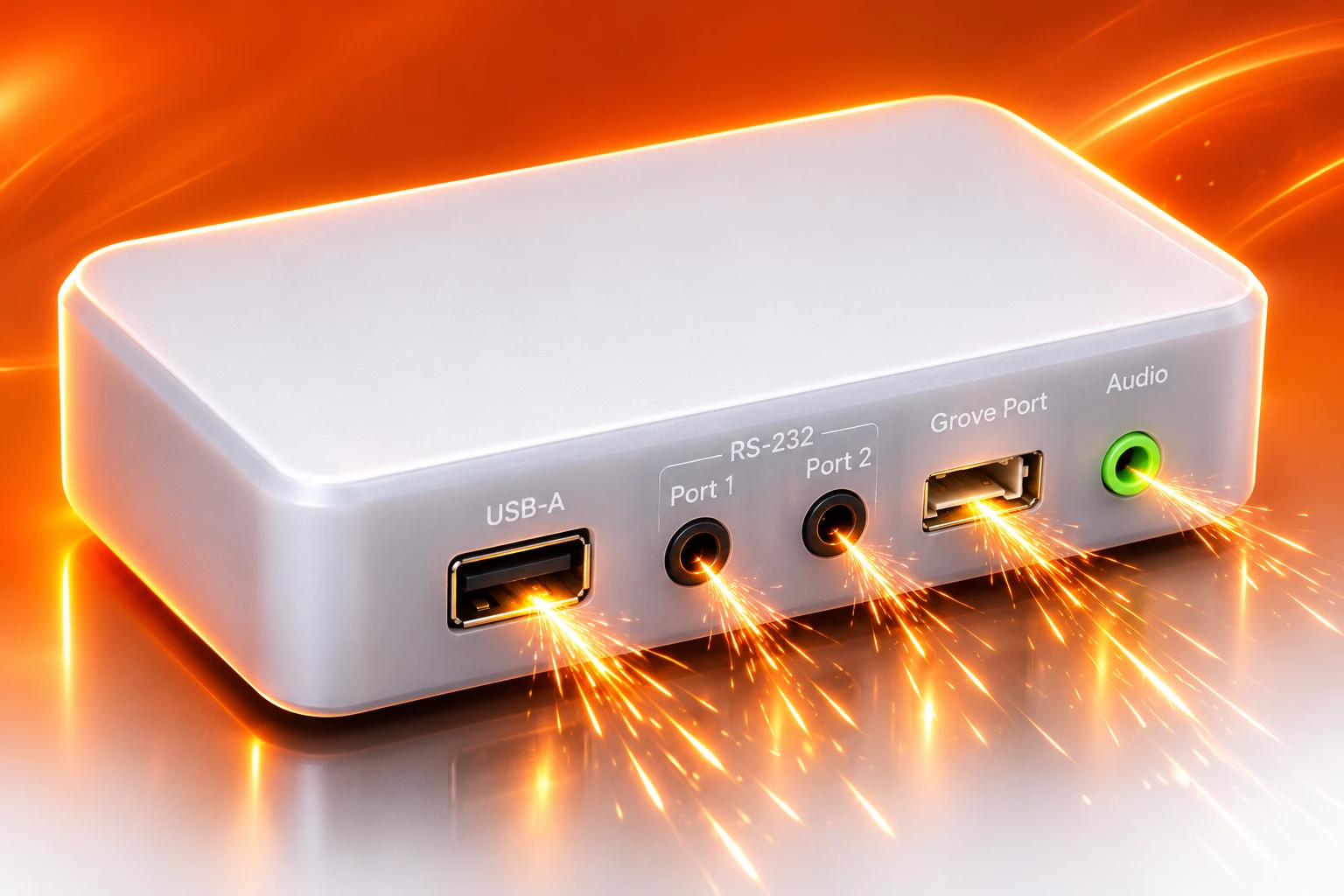
The Connect AUX-2 is available worldwide for $69, model NC-AUX-9758, in a polycarbonate shell Nabu Casa lists as white and semi-transparent. Home Assistant’s product page says stock may be limited while distributor listings catch up. The carton holds the box, a quick-start sheet, and warranty papers. It does not hold cables.
AUX-2 AT A GLANCE
| Item | Figure |
|---|---|
| Price | $69 (€59) |
| Size and weight | 106 × 63 × 25 mm, 104 g |
| Chip | ESP32-S3, 8 MB PSRAM, 8 MB flash |
| DAC | TI PCM5122, 112 dB SNR |
| Audio | 16-bit/48 kHz stereo, analog or optical, one at a time |
| Power | USB-C 5 V 2 A or PoE 802.3af, one source, under 1 W typical |
| Needs | Home Assistant 2026.9 or later |
Network is 2.4 GHz Wi-Fi or Ethernet (a W5500 chip), and Wi-Fi turns off the moment an Ethernet cable is in. Bluetooth 5 LE is on board with its own antenna when the box is wired. The USB-A port can host a Connect ZWA-2, a USB-to-serial dongle, or a cheap RS-485 adapter, one job at a time. A Grove header takes GPIO and I2C sensors. Four Phillips screws open the shell. The bootloader is unlocked, and Nabu Casa says PCB and 3D-print files will follow.
The Three Jacks Are Not Interchangeable
The friendliness pitch meets a row of 3.5 mm sockets that do not do the same job. Two of them carry RS-232 at ±5 V. The third is the only one that should ever see a speaker cable. Nabu Casa ships a sticker over the serial pair for a reason, and the setup guide is blunt about mixing them up.
The three 3.5 mm ports are not interchangeable. RS-232 Port 1 and Port 2 carry RS-232 signaling at ±5 V and can damage audio equipment.
Nabu Casa Support, Set up Home Assistant Connect AUX-2, November 11, 2026
TX/RX switches on the bottom exist because serial cables reverse those pins more often than anyone wants to admit. Converter leads for DB9, RJ11, mini-DIN, and the rest are a separate purchase. So is the audio cable. So is the amp, if the speakers have no power of their own.
THE PORTS THAT CAN BITE
- Wrong jack: The serial sockets can damage audio gear if you treat them as aux out.
- Pairing window: Setup has to finish within 15 minutes of power-on or the box leaves pairing mode.
- Empty carton: No audio, serial, or Ethernet cable ships in the box.
- No Thread: Nabu Casa says Thread is too latency-sensitive to run over this network path, and the rewrite has not started.
- Zigbee: A Connect ZBT-2 on the USB-A port is experimental, ZHA only, and needs Home Assistant 2026.11 or later.
There is no analog input, no Bluetooth audio, and no speaker amp. Indoor use only, 0-65 °C. Those limits sit next to a setup path that is, for Home Assistant hardware, unusually short: plug in USB-C, install the latest signed firmware from a desktop browser that speaks Web Serial, then adopt the box in the ESPHome integration. Wi-Fi onboarding uses Improv over Bluetooth from the Home Assistant app or another proxy. After that, the AUX-2 is just another ESPHome device with an encrypted link back to the hub.
Music Assistant Does the Heavy Lifting
Audio is the feature Nabu Casa put on the poster. The 3.5 mm jack auto-senses analog or optical S/PDIF and will not run both at once. Sendspin, the Open Home Foundation’s sync protocol, is on by default. Music Assistant, which is free, is the player that actually fills the pipe from Spotify, YouTube Music, local FLAC, and the rest. The box itself decodes FLAC, MP3, and WAV. It does not make a HomePod or a Sonos obsolete on day one. It hangs a line-out off the network so a receiver or powered speakers can join that group.
That is the hole Apple left when it killed the AirPort Express, a small Wi-Fi box whose whole job was a headphone jack in another room. The AUX-2 is already being read that way, and the read is fair, with the extra optical path and the serial jack for volume and standby on older amps. Redmond’s pitch is that you can also kill a receiver’s half-maintained “smart” mode, which burns power in connected standby, and still drive the kit from Home Assistant. Typical draw on the AUX-2 is under 1 W.
The Home Assistant Connect AUX-2 is available to buy now. No device left behind: https://t.co/AiJDhgYcY6@home_assistant pic.twitter.com/pdaoBA0MCv
— Nabu Casa (@NabuCasa) November 11, 2026
Grouping is the unfinished part. Music Assistant can cluster Sendspin players with AirPlay and some Sonos speakers on paper. Nathan Edwards, who lived with an AUX-2 for a couple of days, got music to unused in-wall speakers in under half an hour after he bought an amp and installed Music Assistant, and he had not got Sendspin groups working yet. He also wanted the box to show up as AirPlay or Spotify Connect, which is a Music Assistant plugin job, not a firmware switch. The DAC is a step up from the chip in Nabu Casa’s Voice Preview Edition, which is the right comparison if you care about the analog jack. The optical output is the one Redmond calls the star for a self-hosted FLAC library.
Cut the TV Off Your Network
Serial is the port that makes the stacking story more than a speaker dongle. Each RS-232 jack shows up in Home Assistant as a serial proxy. Traffic rides the encrypted ESPHome session. The protocol smarts live in Home Assistant, not in the box firmware, so a new TV or inverter integration can arrive as a software update without flashing the AUX-2. That is the Open Home Foundation’s proxy work in hardware form: keep the old connector, move the brains upstream.
Redmond’s example is an LG set. Turn off its internet access, use the LG TV serial integration, and keep local control without the vendor app. The same path is how Nabu Casa talks about AV receivers, projectors, UPS units, climate controllers, and solar inverters. Two native RS-232 ports cover two devices. A roughly $15 USB RS-485 dongle on the USB-A port adds Modbus, which is how a lot of plant and energy gear still speaks. Some devices need serial enabled in a hidden menu first. Some need a converter cable. That is not plug-and-play in the Apple sense. It is plug-and-play in the installer sense, at a price that used to mean a rack and a quote.
Edwards did not have time to try serial. That is the honest gap in early hands-on notes. The software side has been in Home Assistant since the May 2026 serial-over-ESPHome work. The AUX-2 is the first official Nabu Casa object that puts two of those jacks on a PoE drop next to the TV stand.
Grove sits in the same tinkerer lane. Redmond’s example is a $5 temperature probe on a rack UPS the serial ports already watch. GPIO and I2C only, no opening the case. If you want Squeezelite or Snapcast instead of Sendspin, the unlocked bootloader is the invitation. Factory firmware can be restored from the same support tree.
Z-Wave Goes Where the Hub Cannot
The original brief still lives on the USB-A port. Plug in a Connect ZWA-2 and Home Assistant finds the Z-Wave radio over the network, which is how you get the antenna out of a basement and onto a shelf with a single PoE cable. Nabu Casa has been testing that pairing for months and is willing to put it on the product page. Wi-Fi works in a pinch. Wired is the recommendation, and Zigbee on the same path is not a marketing claim yet because interference and testing time are still thin.
Thread is the leftover they could not stack. Redmond wrote that a ZBT-2 plus AUX-2 could theoretically become a standalone OpenThread border router, independent of Home Assistant, but it needs a serial rewrite that has not started. The FAQ is shorter: Thread is not planned. For a platform that has spent two years chasing Matter and Thread radios, that is a hard edge on a box sold as “no device left behind.”
Bluetooth is the quieter win, and the one Edwards actually used. AUX-2 is Nabu Casa’s first purpose-built Bluetooth proxy. On Ethernet the radio no longer shares an antenna with Wi-Fi. Govee hygrometers in a garage fridge held a link through three walls and the fridge itself in that test, which is the boring job a $69 multi-port board will do more often than it will drive a hi-fi. Several boxes can be scattered as extra ears. They will not take a phone pairing for music. The product page says that out loud.
A $35 Streamer Already Covers Half of This
None of this required a Nabu Casa badge. Apollo Automation already sells the CAST-1 audio casting device for $35, a 45 × 45 × 15 mm ESP32-S3 board with the same TI PCM5122 DAC, Sendspin, Music Assistant discovery, and a Bluetooth proxy. It has no RS-232, no Grove, no optical jack, no PoE, and Ethernet only if you add a W5500 hat. Power is USB-C at 5 V 1 A. If the job is “line-out plus BLE sensors,” the CAST-1 is the half of AUX-2 that already shipped, at $34 less.
AUX-2 VERSUS THE CAST-1
| Feature | Connect AUX-2 | Apollo CAST-1 |
|---|---|---|
| Price | $69 | $35 |
| Size | 106 × 63 × 25 mm | 45 × 45 × 15 mm |
| Audio jack | Analog and optical S/PDIF | Analog 3.5 mm |
| PoE | 802.3af | No |
| Serial | Two RS-232 jacks | None |
| Bluetooth proxy | Yes, dedicated antenna when wired | Yes |
| Power | USB-C 5 V 2 A or PoE | USB-C 5 V 1 A |
That gap is the product. You pay $34 more for PoE, optical, two serial ports, Grove, and a radio host. You also pay for a setup wizard that does not ask you to solder or open a YAML file. Edwards had a three-pack of ESP32 boards for $16 and never flashed a proxy. The AUX-2 is built for that person, who already installed Home Assistant, then went back to Google Home and Apple Home because the last ten percent of the house was analog and annoying.
Nabu Casa and Apollo Automation are the Open Home Foundation’s two commercial partners. Nabu Casa sends over a majority of net profits from licensed Home Assistant hardware and from Home Assistant Cloud. Apollo does the same from official ESPHome hardware. ESPHome, Music Assistant, Sendspin, and Home Assistant are the software the AUX-2 wraps. Buying the official box is how those projects get paid without a vendor cloud tax on every bulb.
Distributor pages are still going live, and Nabu Casa asked buyers to be patient if a shop is empty. PCB files are not posted yet. Zigbee over the USB port is still a test notes exercise. Sendspin groups are a software problem, not a hardware one. The ports on the front of the box are finished, sticker and all, and they point at the gear the big platforms already walked past.

Xiaomi 18 Pro Goes Global as Its Privacy Filter Falters

iFixit Finds HomeView Glued Shut After Repair Gains

Polymetallic Nodules Shelter 4,139 Animals Miners Want

One UI 9.5 Puts Now Brief Behind a System Agent

Framework’s $99 Keyboard Brings Laptop Repair to the Couch

Microsoft 365 Auth Fault Took Down Exchange and Teams

OpenClaw 2.0 Ships a Team Workplace With Host-Trust Defaults

Xbox Caps Game Pass Cloud Gaming at 15 Hours

OpenAI Unveils GPT-6 Astra With a Critical Cyber Label

Squishy Dumpling Toys Recalled After Hiding Illegal Water Beads
-
 NEWS3 months ago
Microsoft 365 Auth Fault Took Down Exchange and Teams
-
 NEWS3 months ago
OpenClaw 2.0 Ships a Team Workplace With Host-Trust Defaults
-
 GAMING3 months ago
Xbox Caps Game Pass Cloud Gaming at 15 Hours
-
 NEWS3 months ago
OpenAI Unveils GPT-6 Astra With a Critical Cyber Label
-
 LIFESTYLE3 months ago
Squishy Dumpling Toys Recalled After Hiding Illegal Water Beads
-

 BUSINESS3 months ago
Diesel Breaks Its Record as the White House Claims Credit
-
 NEWS3 months ago
IFA 2026’s Weird Gadgets Are Building a Sensor Home
-

 BUSINESS3 months ago
ChargePoint Stock Rally Prices Wilmer’s Three-Year Cash Plan