
BUSINESS
The AI Boom Now Runs on Borrowed Money
Alphabet, Amazon and Meta posted negative free cash flow while guiding as much as $740 billion of 2026 AI capex.

Alphabet, Amazon and Meta posted negative free cash flow in their latest reports, even as cloud and ads kept growing. Microsoft still had $18.6 billion left after capital spending.
On October 30 the Nasdaq fell 2.86%, chip stocks led the drop, and Blackstone told investors Anthropic may not get an investment-grade rating after its IPO. Demand for AI compute is not the part that broke. The cash surplus that used to pay for it is.
Alphabet, Amazon and Meta Are Now Cash-Flow Negative
Over two weeks of earnings, Alphabet, Amazon, Meta and Microsoft guided 2026 capital spending as high as $740 billion, using the top of each company’s own range. Amazon held its cash capex plan at about $220 billion. Alphabet kept $195 billion to $205 billion. Microsoft put the calendar year at about $170 billion. Meta narrowed its range to $135 billion to $145 billion, raising the floor.
Those plans used to read as confidence. In the September quarter they read as a cash problem. Alphabet reported a $9.1 billion free-cash-flow deficit, its second straight quarter in the red, after $51.4 billion of capital spending against $42.3 billion of operating cash. Meta said free cash flow was negative $2.12 billion after $34.91 billion of capex, including finance-lease principal. Amazon’s own release put trailing-twelve-month free cash flow at an outflow of $42.4 billion, against a $14.8 billion inflow a year earlier, after purchases of property and equipment, net of sales and incentives, jumped $94.8 billion. Microsoft was the exception, with $18.6 billion of free cash flow on $45.2 billion of capex.
THE 2026 BILL AGAINST THE CASH LEFT OVER
| Company | Free cash flow | 2026 capex plan | Growth that is supposed to fund it |
|---|---|---|---|
| Amazon | -$42.4B over 12 months | about $220B | AWS +39% to $46.0B |
| Alphabet | -$9.1B in Q3 | $195B to $205B | Google Cloud +103% to $30.7B |
| Microsoft | +$18.6B in Q3 | about $170B | Azure +48% |
| Meta | -$2.12B in Q3 | $135B to $145B | Revenue +26% to $64.60B |
Amazon’s cloud is not slowing. AWS net sales rose 39% to $46.0 billion, a $184 billion annualized run rate, the fastest AWS growth in nearly five years. Operating income hit $28.1 billion and a 13.9% operating margin, the company’s highest. Net income still slipped to $20.7 billion from $21.2 billion, mainly because the year-ago quarter included $9.5 billion of pre-tax gains on Amazon’s investment in Anthropic, the same lab now heading toward a public listing.
Our AWS investment in functionality and infrastructure is working, with over 39% year-over-year revenue growth in Q3 ($184 billion revenue run rate) and projected revenue growth rates of over 40% both in 2027 and in 2028.
Andy Jassy, President and CEO, Amazon third-quarter results
Jassy also said Amazon will spend “meaningfully more” in 2027 on top of about $220 billion this year. A 40% AWS path does not refill this year’s free cash flow. It extends the years of heavy spending before the cash comes back.
Search Ads Slowed on Alphabet’s Busiest Query Year
Alphabet’s October 28 release is the cleanest picture of a product that is working and a cash engine that is not. Consolidated revenue rose 25% to $127.577 billion. Google Cloud more than doubled, up 103% to $30.709 billion, on AI infrastructure, AI software and TPU system sales. Sundar Pichai, CEO of Google and Alphabet, said first-party model APIs now process nearly 32 billion tokens a minute, more than four times a year ago, and that the Gemini app has reached one billion users.
We had a strong quarter and are now on a half-trillion dollar revenue run rate. Our AI investments are driving overall Search query growth, including commercial queries. In fact, our year-over-year query growth rate is the highest it’s been in the last five years.
Sundar Pichai, CEO, Alphabet third-quarter results
The ads that pay for that stack did not keep up. Google Search & other revenue rose 12% growth in Google Search terms, to $63.350 billion. Total Google advertising was $82.012 billion. Advertising’s share of Alphabet revenue fell to 64.3% from 72.5% a year earlier, on the company’s own line items. On October 29 Alphabet shares fell 12%, about $500 billion of market value, the stock’s worst day on record.
Pichai said queries in AI Mode are, on average, three times longer than traditional searches, and that one in five AI Mode searches globally use voice, images or documents. Visual searches have crossed 50 billion a month. Philipp Schindler, Google’s chief business officer, told analysts the company is rolling ads in AI Mode into international markets and adding multi-turn ads in the United States. He also said most AI Mode queries are incremental, and that lower monetization in AI Mode weighed on Search growth in the quarter.
Alphabet is spending to scale the interface that converts a search into a longer chat, then asking advertisers to follow. CFO Anat Ashkenazi kept the $195 billion to $205 billion capex range unchanged and said spending will increase a lot in 2027. In the third quarter Alphabet issued senior unsecured notes for $28.7 billion of net proceeds and sold stock under its at-the-market program for another $12.4 billion. The search company is now a regular borrower.
Why Microsoft’s Capacity Delay Hit GPU Landlords
Microsoft still covers its chip bill with cash from operations, which is why its stock held up better on earnings day than Alphabet’s. Revenue was $92.3 billion, up 19%. Microsoft Cloud revenue was $63.9 billion, up 30%. Azure rose 48%. Commercial remaining performance obligation jumped 73% to $677 billion. The company returned $10.2 billion in dividends and buybacks.
The miss was on spending, not on demand. Amy Hood, Microsoft’s chief financial officer, said capital expenditures were $45.2 billion because third-party capacity deliveries were delayed. About three quarters of that capex went to short-lived assets, mainly CPUs and GPUs, including higher memory and storage costs. She put the next quarter’s capex above $50 billion and calendar-year 2026 spend at about $170 billion because of those third-party slips. Hood also said Microsoft will tap extra funding when it looks attractive, and that the company is still free-cash-flow positive.
Capital expenditures were $45.2 billion, as some third-party capacity deliveries we expected in Q1 were delayed.
Amy Hood, CFO, Microsoft FY27 Q1 earnings call
That delay is a problem for the firms whose business is renting the missing capacity. When a hyperscaler can wait, the GPU landlord that already borrowed to buy the same chips cannot. Bonds from those specialists have been trading below face value, and shares of the smaller AI compute landlords fell when Microsoft made clear that some of their deliveries had slipped. Azure still grew 48% with the delay in place. The customers are waiting. The project finance around the waiting is what cracked.
Meta is closer to the landlords than it looks. Mark Zuckerberg said the company launched Muse and Muse Wonder, its first frontier model, and that the core ads business is strong. Revenue rose 26% to $64.60 billion. Muse reached 10 million users in the United States and Canada within six weeks, with 25% using it daily, according to the earnings call. Zuckerberg has also said Muse is very compute-intensive to run. Meta is paying for that with capex that now exceeds operating cash, a new class of non-voting stock meant to finance growth, and $82.45 billion of cash, cash equivalents and marketable securities as of September 30.
Bond Buyers Are Funding the Next Wave of Chips
For a decade these companies funded data centers from the cash their old businesses threw off. That mix is over. FTSE Russell, using LSEG data as of early October, put investment-grade bond issuance by Amazon, Alphabet, Meta, Microsoft and Oracle at $218.1 billion, which had already more than doubled 2025’s full-year total of $107.3 billion. JPMorgan’s figure in the same note puts capex for those five at $697 billion by year-end 2026 on its own count, a different basket than the four-company $740 billion high end above.
By the end of August the same five names had $500 billion of index-eligible investment-grade debt outstanding across FTSE Russell’s main corporate-bond indices. Hyperscalers were 4.7% of the FTSE US Broad Investment-Grade Corporate index by market value, up from 2.7% two years earlier. Their option-adjusted spread sat at 119 basis points, against 86 for the broader index, a 33-point premium. Since December 2025 that cohort’s spread had widened about 31 basis points while the index had widened 1.
INDEX-ELIGIBLE DEBT OUTSTANDING, END OF AUGUST
| Issuer | Debt outstanding | Index credit quality |
|---|---|---|
| Amazon | $144.8B | AA |
| Alphabet | $120.4B | AA+ |
| Oracle | $117.2B | BBB- |
| Meta | $81.2B | AA- |
| Microsoft | $36.5B | AAA |
Oracle is the stress test already inside the index. S&P rates it BBB-, the lowest investment-grade notch, after cuts in 2021, 2022 and 2026. As of October 21 its five-year credit-default swaps sat at 331 basis points, against 80 for Amazon and 56 for Microsoft, which FTSE Russell translated into five-year default probabilities of 25%, 7% and 5%. Microsoft still funds more of its stack from operations, which is why it is the smallest of the five in that debt table and still AAA.
The issuance has also gone global. In 2026 the group has sold bonds in euros, sterling, Swiss francs, yen, and Australian and Canadian dollars, on top of $151.75 billion of dollar paper. Alphabet’s third-quarter notes and ATM stock sales sit inside that shift: even AA+ credits are raising outside cash because capex now outruns the old surplus.
Anthropic May Debut Without an Investment-Grade Rating
Anthropic filed to go public on October 26, with a planned Nasdaq listing under the ticker ANT. The lab’s growth still depends on buying enormous amounts of compute from the same hyperscalers that just told shareholders their own cash is spoken for. Amazon’s release listed new AWS deals with Anthropic models on Bedrock, and it remains an Anthropic investor. That loop only works if someone cheaper than equity will fund the chips.
Blackstone, an anchor on Anthropic’s $63 billion chip-financing deal known as Project North Star, has told investors in that deal the company is likely to receive a high junk rating after the IPO, in the double-B range. For months it had told the same partners it expected an investment-grade rating before year-end. KBRA already assigned Anthropic a BB+ issuer rating in June, one notch below investment grade. Blackstone funds have taken about $9 billion of the junior piece at yields above 10%.
THE CREDIT FILE AROUND THE LISTING
- The filing: Anthropic submitted its S-1 on October 26 and intends to list on Nasdaq as ANT, with bankers pointing to a possible November debut.
- The cash on hand: The company reported $112.4 billion of cash and cash equivalents as of June 30, against first-half 2026 revenue of $16.3 billion and a net loss of $80.7 billion.
- The compute bill: Anthropic has said it expects to spend more than $800 billion on computing infrastructure between now and 2045, a plan that only gets cheaper with an investment-grade rating.
- The rating gap: Pension funds and insurers often cannot hold junk debt in size, which is why a double-B outcome would push more of the build onto hyperscalers and private credit.
WHAT WE KNOW
- Blackstone’s message: Partners in Project North Star have been told a double-B rating after the IPO is now the base case, not investment grade.
- KBRA’s June call: BB+ is already on the file, with a positive outlook on some of the subordinated notes.
WHAT IS UNCONFIRMED
- Big-three ratings: Moody’s, S&P and Fitch have not published post-IPO ratings, so Blackstone’s warning is a forecast, not a decision.
- IPO terms: Share count, price and final valuation are not in the public filing’s usable form yet.
A junk-rated Anthropic does not stop training models. It pays more for the same GPUs, leans harder on Amazon, Google and Microsoft for capacity, and competes for that capacity with Azure customers already waiting on delayed third-party halls. The IPO was supposed to open the cheap-debt window. The window is the thing in doubt.
Chip Stocks Took the Hit the Spenders Passed Along
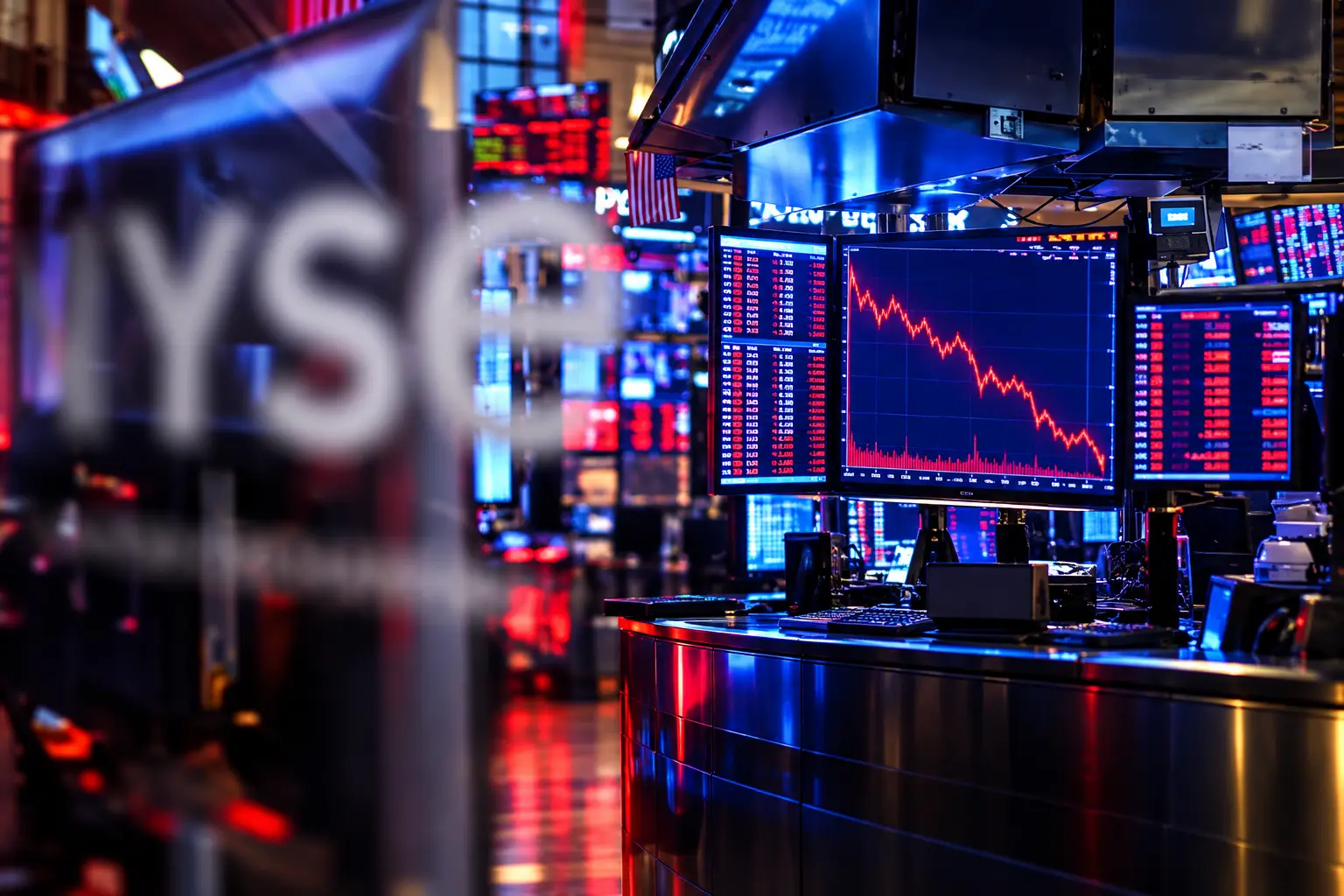
Friday’s tape priced the funding chain, not a collapse in AI use. The Nasdaq Composite closed at 25,437.00, down 747.73 points, or 2.86%, its largest one-day percentage drop since June 5 and 7.8% below its October 6 closing high. The S&P 500 fell 1.82% to 7,580.07. The Dow Jones Industrial Average fell 1.09% to 51,770.31.
THE OCTOBER EARNINGS CALENDAR THAT BROKE THE CASH STORY
- October 21, 2026: Meta reports negative free cash flow of $2.12 billion and raises the floor of its 2026 capex range to $135 billion.
- October 26, 2026: Anthropic files to list on Nasdaq under the ticker ANT.
- October 28, 2026: Microsoft and Alphabet report. Hood flags delayed third-party capacity. Alphabet posts a $9.1 billion cash outflow.
- October 29, 2026: Amazon reports a $42.4 billion trailing free-cash-flow outflow and holds the $220 billion capex plan. Alphabet shares fall 12%.
- October 30, 2026: The Nasdaq falls 2.86%. Blackstone’s junk-rating warning on Anthropic hits the tape. Apple takes back the world’s most valuable company title from Nvidia.
FRIDAY’S SELLING, IN THE CLOSE
- Nasdaq Composite: Closed at 25,437.00, down 2.86%, the worst session since June 5.
- Chip basket: Nvidia dropped 4.2%, AMD dropped 10.9%, and the PHLX Semiconductor Index dropped 7.2%.
- Intel: Fell 28.6% after a weak fourth-quarter outlook, its worst day since 1974, adding a PC and memory shock on top of the AI-spend scare.
Apple taking Nvidia’s most-valuable title is the tell. Investors did not rotate into a bigger AI spender. They rotated into a company that is not trying to fund this buildout from negative free cash flow. Nvidia still sells the chips. The buyers of those chips are now arguing with their own shareholders about debt, delays and ads that convert worse than the old search box.
Ashkenazi said Alphabet’s 2026 range stays $195 billion to $205 billion and that capex will rise a lot in 2027. Hood already put the next quarter above $50 billion. Jassy said Amazon will spend meaningfully more next year than about $220 billion this year. The backlog is still there: Azure at 48%, AWS at 39% with over 40% growth projected for 2027 and 2028, Google Cloud at 103%. The open question is no longer whether the racks fill. It is which balance sheet, and which rating, pays for the next ones.
Disclaimer: This article is news reporting and analysis of company earnings, bond-market data and public remarks, and it is for information only. It is not investment advice, a recommendation to buy or sell any stock, bond or IPO, or a credit opinion on Alphabet, Amazon, Meta, Microsoft, Oracle, Anthropic or any other issuer. Readers should consult a licensed financial adviser, broker or credit analyst who can consider their own objectives and risk limits before acting on any of these figures. The numbers and ratings here reflect company releases, FTSE Russell/LSEG index data and other sources as dated in the piece, and they can change with the next filing, sale or rating action.

Xiaomi 18 Pro Goes Global as Its Privacy Filter Falters

iFixit Finds HomeView Glued Shut After Repair Gains

Polymetallic Nodules Shelter 4,139 Animals Miners Want

One UI 9.5 Puts Now Brief Behind a System Agent

Framework’s $99 Keyboard Brings Laptop Repair to the Couch

Microsoft 365 Auth Fault Took Down Exchange and Teams

OpenClaw 2.0 Ships a Team Workplace With Host-Trust Defaults

Xbox Caps Game Pass Cloud Gaming at 15 Hours

OpenAI Unveils GPT-6 Astra With a Critical Cyber Label

Squishy Dumpling Toys Recalled After Hiding Illegal Water Beads
-
 NEWS3 months ago
Microsoft 365 Auth Fault Took Down Exchange and Teams
-
 NEWS3 months ago
OpenClaw 2.0 Ships a Team Workplace With Host-Trust Defaults
-
 GAMING3 months ago
Xbox Caps Game Pass Cloud Gaming at 15 Hours
-
 NEWS3 months ago
OpenAI Unveils GPT-6 Astra With a Critical Cyber Label
-
 LIFESTYLE3 months ago
Squishy Dumpling Toys Recalled After Hiding Illegal Water Beads
-

 BUSINESS3 months ago
Diesel Breaks Its Record as the White House Claims Credit
-

 NEWS3 months ago
IFA 2026’s Weird Gadgets Are Building a Sensor Home
-
 BUSINESS3 months ago
ChargePoint Stock Rally Prices Wilmer’s Three-Year Cash Plan