
BUSINESS
Exxon’s Refineries Out-Earned Its Wells as Diesel Hit $6.32
Exxon’s fuel-making arm beat its oil wells in the third quarter, as a $93 diesel crack and $6.32 pump prices, not just crude, paid the bill.

ExxonMobil’s fuel-making arm earned $9.05 billion in adjusted third-quarter profit, topping its oil and gas wells for the first time in at least six years. Chevron’s downstream profit reached $4.93 billion, more than four times the year-earlier total, while U.S. regular averaged $4.20 and diesel $6.32.
Crude still paid. The extra money, and the extra pain at the pump, came from turning barrels into fuel after wars knocked out plants abroad.
Exxon’s Refineries Out-Earned Its Oil Wells
On Oct. 30 ExxonMobil posted third-quarter earnings of $15.4 billion, or $3.72 a share, and $17.5 billion on an adjusted basis, or $4.23 a share. Its Energy Products segment, the refineries and fuel sales, earned $7.17 billion under U.S. GAAP. Upstream, the wells, earned $7.09 billion.
Adjusted figures make the split plainer, because timing charges hit the fuel side harder. Energy Products made $9.05 billion. Upstream made $7.31 billion. A quarter earlier the wells still led, $9.19 billion to $4.10 billion. For the first nine months, Energy Products adjusted profit was $15.95 billion, against $3.96 billion a year earlier.
Chevron did not flip its own mix. Wells still led. Downstream still set a six-year high.
HOW THE TWO MAJORS SPLIT Q3 PROFIT
| Item | ExxonMobil | Chevron |
|---|---|---|
| GAAP profit | $15.4 billion | $9.9 billion |
| Upstream | $7.09 billion | $5.70 billion |
| Fuel-making | $7.17 billion | $4.93 billion |
| U.S. crude run rate | 100% on the Gulf Coast | 1.09 million barrels a day (98%) |
Chevron reported $9.9 billion, or $5.06 a share, and $10.4 billion adjusted, or $5.28 a share. Downstream earned $4.93 billion, up from $1.14 billion a year earlier and just above the second quarter’s $4.87 billion. U.S. downstream alone made $3.59 billion, more than five times the year-earlier $638 million. Combined GAAP profit for the two firms was $25.3 billion.
U.S. refined-product sales at Chevron were 1,304 thousand barrels a day, against 1,303 a year earlier. The company said the jump in U.S. downstream profit came from higher margins on those sales, not from selling a lot more fuel.
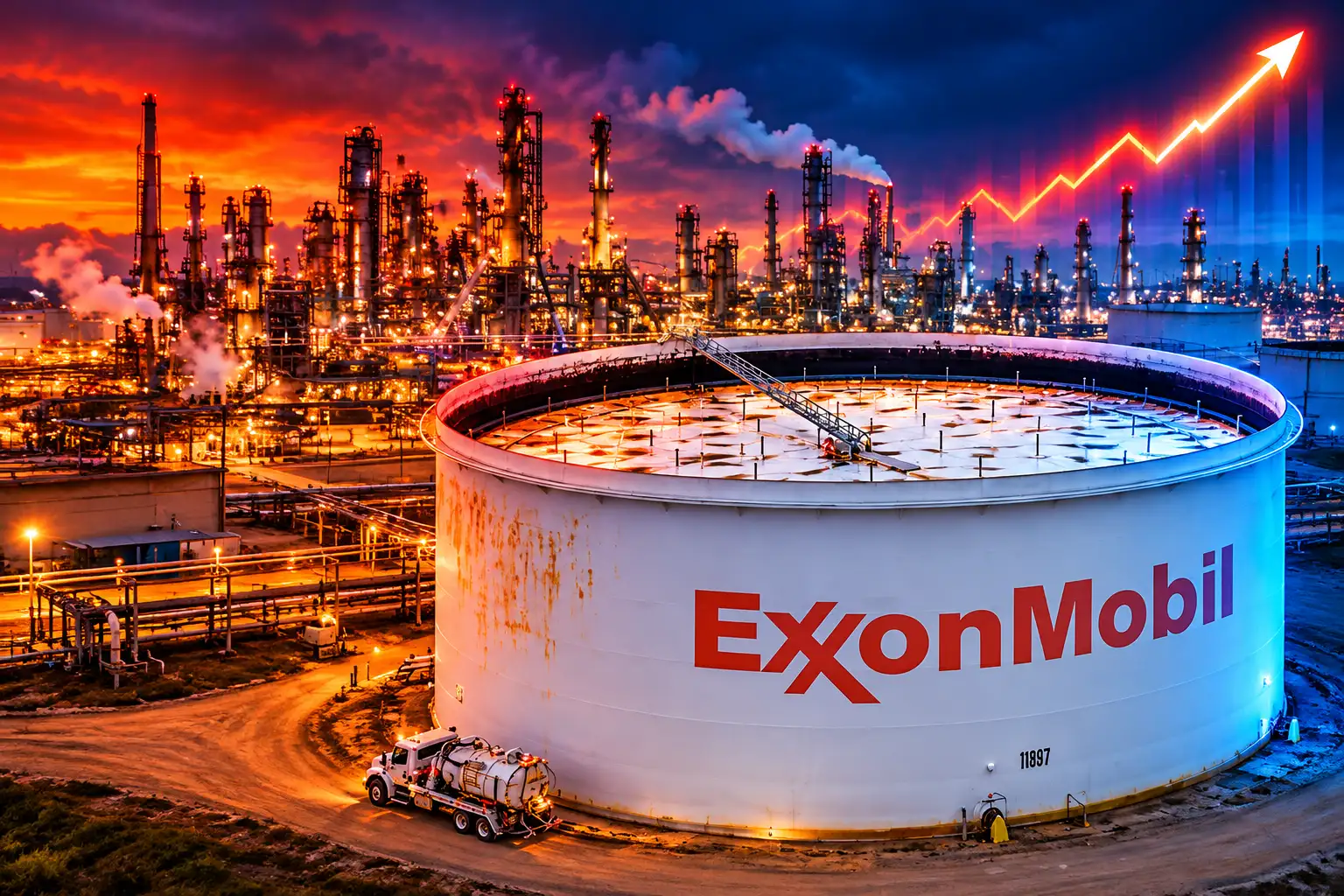
Diesel Paid $93 a Barrel Over Crude
West Texas Intermediate settled at $105.51 a barrel on Oct. 29, and Brent at $115.28, according to the U.S. Energy Information Administration’s daily snapshot. That same close put Gulf Coast diesel at $4.72 a gallon and Gulf Coast gasoline at $3.07. Multiply diesel by 42 gallons in a barrel, subtract WTI, and the gap is about $93 a barrel. Gasoline’s gap is about $23.
The EIA’s Gulf Coast 3-2-1 crack spread, a blended margin using Louisiana Light Sweet, was $43.33 a barrel. That blend still hides how far diesel has pulled away from gasoline. Heating oil in New York Harbor was $4.66 a gallon, almost in line with diesel, which is why truckers, railroads, farms and winter heating are bidding for the same slice of the barrel.
Crude can ease and fuel can stay expensive, because the profit sits in that product gap. Brent’s third-quarter average at Chevron was $97 a barrel, down from $104 in the second quarter and up from $69 a year earlier. Chevron’s upstream profit fell sequentially, from $8.18 billion to $5.70 billion, while downstream barely moved. Exxon’s wells also slipped as prices cooled. Its fuel arm more than doubled.
Gulf Coast Units Ran Full While Plants Abroad Went Dark
Exxon said U.S. Gulf Coast crude units ran at 100% in the quarter and posted the second-highest Gulf Coast diesel output on record. Chairman and CEO Darren Woods tied that to work that predates the war, including the Beaumont expansion.
On the U.S. Gulf Coast, investments such as our Beaumont refinery expansion have contributed to an increase in our distillate production by approximately 40% since 2019.
Darren Woods, chairman and CEO, ExxonMobil third-quarter 2026 earnings release
Chevron posted record crude throughput at U.S. refineries of 1.09 million barrels a day, with crude-unit use near 98%. Diesel and jet yields rose more than 10%, the company said. Woods told an interviewer that refining capacity is very tight and that diesel is the crunch point, because demand barely bends when the price rises.
About 10% of the world’s fuel-making capacity remains offline, Chevron Vice Chairman Mark Nelson said on the company’s call, after attacks on plants in the Middle East and Russia and after the effective shutdown of the Strait of Hormuz. ExxonMobil CFO Neil Hansen said finished-product flows out of the Middle East were running at less than a quarter of pre-conflict levels. Gulf barrels that cannot move, including Gulf crude trapped at both ends of damaged routes, leave U.S. plants as the units that can still run.
Nelson also said he would expect margins to ease as runs recover and export flows increase. That is a later story. In the quarter just closed, the plants that still ran captured the shortage.
A $6.32 Gallon Pushes Small Fleets Into Court
The American Automobile Association’s national average of $4.20 a gallon for regular on Oct. 30 was down 23 cents from a month earlier and up 38% from $3.04 a year earlier. Diesel was $6.32, up 71% from $3.69 a year earlier. AAA’s highest recorded national diesel average remains $6.53, set on Sept. 22, 2026. Regular’s record is still $5.02, from June 14, 2022.
WHAT THE PUMP DID TO FLEETS
- Court filings: Tallies of bankruptcy records put 221 U.S. trucking companies in court so far in 2026, a pace owners and lawyers say has not been this sustained in decades.
- Small-carrier survey: About two-thirds of fleets with 20 trucks or fewer, many of them one-truck shops, told Truckstop and Bloomberg Intelligence that revenue was flat or down from a year earlier, and almost 40% said they expected to leave within six months or were not sure they would stay.
- Who absorbs diesel: Christopher Ward, a bankruptcy partner at Lowenstein Sandler, said a large carrier such as J.B. Hunt can live with higher fuel in a way a $2.5 million five-truck shop doing local deliveries cannot.
- Who is still growing: Werner Enterprises said third-quarter revenue rose 23% to $950.5 million and that it swung to $6.6 million of net income, a reminder that the same diesel bill that closes a small fleet can hand pricing power to the firms that remain.
Diesel is paid in days. Freight is often paid in weeks. That timing gap, plus insurance and tighter credit, is what lands a one-truck shop in Chapter 7. Grocery shelves still get stocked. The bill shows up later in the landed cost of food and goods those trucks haul.
Gasoline’s 34.2% Climb Is Already in the CPI
The Bureau of Labor Statistics said gasoline increased 34.2 percent in the 12 months through September. Fuel oil, the heating cousin of diesel, was up 74.2%. All items rose 3.7%. On a seasonally adjusted basis, gasoline jumped 9.1% in September after a 3.9% rise in August and a 2.9% drop in July. The all-items index rose 0.6% in September.
Producer prices tell a harder diesel story than the pump. The producer index for No. 2 diesel fuel was up 115.2% in the year through September, which is the wholesale barrel before tax and the station markup.
GASOLINE IN THE CPI SINCE THE IRAN WAR
- March 2026: Gasoline index jumps 21.2% after the war begins in late February.
- April 2026: Prices rise another 5.4%.
- May 2026: A further 7.0% increase.
- June 2026: A 9.7% drop as fighting cools.
- July 2026: A 2.9% decline.
- August 2026: A 3.9% rebound as supply fears return.
- September 2026: A 9.1% surge, the largest monthly gain since March.
Those swings track the fighting more closely than U.S. wellhead output. Exxon produced 4.50 million barrels of oil equivalent a day in the third quarter, almost unchanged from 4.51 million in the second. Chevron produced 3.98 million barrels of oil equivalent a day, down 2% from the prior quarter. The barrels were there. The fuel was not always in the right place.
The Cash Went to Debt, Dividends and Buybacks
Both companies treated the quarter as a chance to shrink the balance sheet and keep the dividend machine on schedule, rather than to announce a new round of mega-projects aimed at the next 90 days of diesel.
WHERE THE QUARTER’S CASH WENT
- ExxonMobil holders: $9.4 billion went out, $4.3 billion as dividends and $5.1 billion as buybacks, on $25.7 billion of operating cash flow and $19.1 billion of free cash flow.
- The dividend streak: The company raised its annual dividend for the 44th straight year, declared $1.07 a share for the fourth quarter, and said it plans $20 billion of buybacks in 2027 if markets allow.
- ExxonMobil debt: Net debt was $22.1 billion at Sept. 30 after a cut of nearly $11 billion this year.
- Chevron holders: Distributions were $6.0 billion, including $3.5 billion of dividends and $2.5 billion of buybacks, with a $1.78 quarterly dividend payable Dec. 10. Adjusted free cash flow was $14.2 billion.
- Chevron debt: Net debt fell $7.8 billion in the quarter. Return on capital employed was 18%.
Woods also pointed to $16.9 billion of structural cost cuts since 2019. Those savings travel with the company when margins shrink. They do not change what a five-truck fleet paid for diesel in September.
Cheaper Crude Would Not Automatically Cut Diesel
Chevron CEO Mike Wirth said the company is putting capital back into a tight market, including a plan for Venezuelan joint ventures to invest $7 billion over five years. He also described a system that is still on edge.
We’re reinvesting to bring more energy to a supply-constrained market.
Mike Wirth, chairman and CEO, Chevron third-quarter 2026 earnings release
Wirth separately said the system is under stress and remains fairly fragile. CFO Eimear Bonner said product supply was tighter than in the prior quarter and that those conditions would last through the end of 2026 and into 2027. That is the tell for anyone waiting for WTI to do the work. If crude falls and diesel cracks stay wide, stations and truck stops will not follow the oil tape down on a one-for-one basis.
President Donald Trump had said in August that Chevron and Exxon were making too much money on a shortage, and his energy department later earmarked $150 million for refinery investments. The plants that can run are already at or near full rate. Extra capital shows up in diesel gallons months or years later, not in the week before an election. Regular was still $4.20 on Oct. 30, three days before the Nov. 3 midterms, with diesel at $6.32 and the national diesel record from Sept. 22 still on the books.
Frequently Asked Questions
What Is a Diesel Crack Spread?
It is the wholesale diesel price, converted to a barrel of 42 gallons, minus the crude price. On the EIA’s Oct. 29 close, Gulf Coast ultra-low-sulfur diesel at $4.72 a gallon was about $198 a barrel before subtracting $105.51 WTI. That gross gap is not the same as a refiner’s net profit, because it ignores energy, labor, chemicals and debt, and it is not the pump price, which still adds distribution, retailer margin and tax, including the 24-cent federal diesel excise tax.
Why Can Gasoline and Diesel Prices Move Differently From Crude?
A barrel yields a mix of products, and the mix is not fixed. When trucking, rail, farming, shipping and heating all bid for distillate, refiners raise diesel and jet yields and let gasoline lag, which is what Exxon’s record diesel yields and Chevron’s 10% yield lift describe. The EIA’s 3-2-1 crack, two barrels of gasoline and one of diesel against three barrels of crude, was $43.33 on the Gulf Coast on Oct. 29, a blended number that understates how far diesel has pulled away from gasoline’s $23 gap.
How Do Exxon and Chevron Label the Fuel Business?
ExxonMobil reports Energy Products for refining and fuel sales, then Chemical Products and Specialty Products as separate lines, with Upstream for the wells. Chevron reports Downstream for refining and marketing, and Upstream for production. In the third quarter Exxon’s Energy Products adjusted profit of $9.05 billion beat Upstream’s $7.31 billion, while Chevron’s $4.93 billion downstream result was still second to $5.70 billion from wells, so the “refining beat drilling” line applies to Exxon’s quarter, not to both firms’ mix.
When Did U.S. Diesel Hit Its Record National Average?
AAA’s highest recorded national average for diesel is $6.5276 a gallon on Sept. 22, 2026, which rounds to $6.53. Regular’s AAA record remains $5.0165 on June 14, 2022. The two fuels no longer share a peak. Gasoline is still below its 2022 high even after the 34.2% CPI climb; diesel is not, which is why the fleet bankruptcies and the $93 crack are a distillate story more than a gasoline story.
Disclaimer: This article is news reporting and analysis of company results, government price data and fuel markets, and it is for information only. It is not investment advice, a recommendation to buy or sell any stock, and not a forecast of retail gasoline or diesel prices. Readers who are making portfolio, business-fuel or household-budget decisions should consult a qualified financial adviser or accountant who can look at their own facts. The figures and operating rates here reflect company filings, AAA, the EIA and the BLS as of the dates named in the piece and will move as new prints, spots and pump surveys arrive.

Xiaomi 18 Pro Goes Global as Its Privacy Filter Falters

iFixit Finds HomeView Glued Shut After Repair Gains

Polymetallic Nodules Shelter 4,139 Animals Miners Want

One UI 9.5 Puts Now Brief Behind a System Agent

Framework’s $99 Keyboard Brings Laptop Repair to the Couch

Microsoft 365 Auth Fault Took Down Exchange and Teams

OpenClaw 2.0 Ships a Team Workplace With Host-Trust Defaults

Xbox Caps Game Pass Cloud Gaming at 15 Hours

OpenAI Unveils GPT-6 Astra With a Critical Cyber Label

Squishy Dumpling Toys Recalled After Hiding Illegal Water Beads
-
 NEWS3 months ago
Microsoft 365 Auth Fault Took Down Exchange and Teams
-
 NEWS3 months ago
OpenClaw 2.0 Ships a Team Workplace With Host-Trust Defaults
-
 GAMING3 months ago
Xbox Caps Game Pass Cloud Gaming at 15 Hours
-
 NEWS3 months ago
OpenAI Unveils GPT-6 Astra With a Critical Cyber Label
-
 LIFESTYLE3 months ago
Squishy Dumpling Toys Recalled After Hiding Illegal Water Beads
-

 BUSINESS3 months ago
Diesel Breaks Its Record as the White House Claims Credit
-

 NEWS3 months ago
IFA 2026’s Weird Gadgets Are Building a Sensor Home
-

 BUSINESS3 months ago
ChargePoint Stock Rally Prices Wilmer’s Three-Year Cash Plan